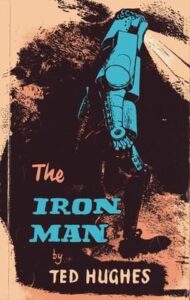
First published in 1968 Ted Hughes’s novella (for children?) was widely taught, referred to and recommended during most of the years I was teaching in mainstream secondary schools. Thus it has sat on my bookshelves for decades, crying out for reappraisal.
It’s a sci-fi, dystopian fantasy in which a huge (“head shaped like a dustbin but big as a bedroom”) Iron Man falls into the sea, breaks into pieces and reassembles himself to the terrified horror of the villagers, especially a boy named Hogarth. So they try to destroy him. Later, when a dragon as big as Australia lands on that continent from outer space (the geography is fun), humans realise that the Iron Man could be the answer to this dreadful threat. So they change tack and befriend him. Then there’s a contest of strength. No prizes for guessing who wins.
At one level it’s simply an exciting, rather whacky imaginative story with a nod to David and Goliath. But of course Hughes must have intended some kind of message – maybe something to do with the potential for technology to overpower nature? He must also have been thinking about space travel because this was the time of the Apollo missions and just a year before the 1969 moon landing. He probably had the nuclear threat in mind too because the Cold War was a hideous, frightening reality in 1968 – and his monstrous space dragon is casually saying that he will obliterate the world if his wishes aren’t met. Rereading it nearly 60 years later I can see climate change in the mix too. So perhaps it meets the criteria for a great work of fiction: it can be read and interpreted in any way which works for your own time and context. The reader has to respond. It’s very much a two-way process.
The writing is, as you’d expect, gloriously poetic but always accessible. Hughes, remember, wrote a lot of poetry specifically for children as well as his raw, searching stuff for adults. How about: “He picked up a greasy black stove and chewed it like toffee”, “the grey, empty moving tide” or “great grinding voice”?
However, the 2026 me has a problem with plausibility. I can, with an effort, accept iron giants and continent-sized dragons but what language is everyone speaking? Hogarth uses ordinary English to speak to the Iron Man who then addresses the “space-bat-angel-dragon” easily in the same language. Where and how did they learn it? Would this have bothered me less in 1968 or when I was a child? Don’t know.
My other issue is with illustration. There have been several illustrators for different editions of The Iron Man along with various TV and stage adaptations. My copy dates from the early 1980s and is illustrated by George Adamson and his work is true to the text. Contentiously, though, I don’t think there should be any illustrations at all. Hughes describes his two main creations with his usual graphic, accurate economy. They will be much more powerful if they are left to the reader’s imagination. Any attempt to capture them by drawing them feels belittlingly trivial. It comes back to my oft-made point that reading works in both directions as the writer’s mind becomes a hotline to the reader’s mind. Illustration can get in the way and certainly does in this case.
Next week on Susan’s Bookshelves: The Calamity Club by Kathryn Stockett