Press ESC or click the X to close this window

Shakespeare in Love (Susan Elkin reviews)

Shakespeare in Love – Tower Theatre, London

Reviewer: Susan Elkin

Adaptor: Lee Hall based on the screenplay by Marc Norman and Tom Stoppard

Director: David Taylor

The writing in Shakespeare in Love is so witty and literate that it glitters. This is Tom Stoppard, much of whose work for the 1998 film Lee Hall has ably translated to the stage, at his sparkling best. As in Travesties (1974), arguably Stoppard’s best play, the script is threaded through with quotes and references thus becoming an affectionate send-up of theatre itself.

“Give me to drink, mandagora,” says Shakespeare casually in the inn. “Anon, anon,” says Viola to her nurse. “I’ll be revenged on the whole pack of you” declares The Lord Chamberlain. Add to this effortless ingenuity Paddy Cunneen’s elegant period music, played live in this production, and you’re on to a winner almost before you start rehearsals.

Tower Theatre is very good indeed at attracting fine new talent and three leading actors in this show are appearing there for the first time. Christopher Edge excels as Will Shakespeare, variously nervous, passionate, exasperated and determined. This is an accomplished actor on top of his game giving a totally convincing performance.

Kizzy Parvin is warm, soft and delicate – but feisty – as Viola, who wants to be an actor but can’t be by law, which, of course, she defies. She gives a well-judged contrast between the “real” Viola and her character’s ability as an actor, combining sweetness and gutsiness. Then there’s James Collins, who commands the stage as Ned Alleyn, who is directing Shakespeare’s new play with forceful panache – another outstanding performance.

Also in this rich mix is Vahan Salorian who leads the music from a stage-right alcove. He is a multi-instrumentalist who really makes violin, pipe, trumpet, and guitar sound convincingly Elizabethan. As with previous shows at The Tower, there are occasional cohesion and intonation issues with the incidental ensemble choral numbers (all settings of Shakespeare songs), possibly because Salorian is not visible to most of them thanks to the fan shape of the playing area. James Collins, though, stands out again as a talented actor-muso with a very pleasing tenor voice.

This production needs, and uses a big cast, ably directed by David Taylor to make the best possible use of space and to allow every delicious line. Christopher Lloyd-Jones, for example, gives us a nervous Henslowe, Nvaron R Anderson a Christopher Marlowe who lords it over Shakespeare and Victoria Flint a suitably haughty Queen Elizabeth. Also rather delightful are the dances choreographed by Rachel Berg.

Runs until 29 March 2025

The Reviews Hub Score 4.5 stars

Warmly entertaining

This review first published by The Reviews Hub https://www.thereviewshub.com/shakespeare-in-love-tower-theatre-london/

Maidstone Symphony Orchestra 22 March 2025

Mote Hall, Maidstone

The third overture (of four)  which Beethoven wrote for Fidelio, his only opera – Leonora No 3 – is a pleasingly colourful concert opener because it tells the story so clearly. In this performance the trombones set the scene nicely in the opening dungeon scene, the off-stage trumpet nailed the triumphant drama and I admired the accuracy of the high speed string work which precedes the joyful ending.

Then came the centrepiece of the evening: Tchaikovsky’s flamboyant violin concerto and soloist Callum Smart whose modest demeanour belies his phenomenal technique. His first entry was breathtakingly mellifluous as he delivered every note with all the compelling warmth the piece demands. Wright meanwhile balanced the orchestra so that we heard a coherent conversation, including very incisive pizzicato, between soloist and players. Smart looks at the orchestra and listens attentively when he’s not playing himself and that’s very telling. The show-stopping cadenza was stunning too. How on earth does Smart find all those climactic harmonics and make then resonate so tunefully?

The tender shift into G minor for the Canzonetta movement was, as ever, a beautiful contrast: silky playing from Smart, some delightful flute work and plenty of tension in the link passage into the Finale. Smart and Wright emphasised the dynamic and rhythmic contrasts in the latter and packed the duet between soloist and orchestra with excitement. And if it wasn’t always quite together then it didn’t detract from the infectious joie-de-vivre. Smart’s impressive encore was his own arrangement of Amazing Grace – a mini masterclass in double stopping, split chords and imaginative harmonies.

Dvorak’s Symphony No 7 is always a melodic delight and MSO, now fully warmed up, more than did it justice on this occasion from the bravura brass work in the opening movement to the grandiloquence of the final page. Wright ensured there was gentle beauty in the string playing in the Poco adagio especially when  we reached the sublime cello melody and I have rarely heard this movement brought to such a sensitive conclusion. Also noteworthy was the elegantly negotiated counterpoint in the Scherzo which included strongly supportive timp work and delightful flute playing in the “trio” passage. Wright chose, rather refreshingly, to exaggerate the tempo changes in the Finale more than some conductors do and built plenty of mystery into that wonderful section which I always think sounds like theme music for a faux sinister comedy drama. Good old Dvorak.

Thanks, MSO, for yet another enjoyable concert.

Photograph credit: Patrick Allen & Roscoe Rutter 

Haydn Symphony 104

Barbara Hannigan

Academy Chamber Orchestra

Duke’s Hall, Royal Academy of Music

Transitioning from internationally renowned soprano to respected orchestral conductor is an unusual musical journey. Barbara Hannigan is on record as saying that as a singer she is also an actor. And, standing in for indisposed Rachel Podger, she certainly found plenty of drama in Haydn’s final London symphony at this performance which must have been a roller coaster experience for the participating students.

Second violins on the outside and cellos next to the firsts meant that we heard plenty of colourful detail directed with flamboyant fluidity. Hannigan  conducts by making expressive shape pictures with her beautiful hands rather than using a baton or doing anything as conventional as beating time, other than very occasionally. Her facial expressions are so eloquent that she is effectively acting the narrative of the music. This resulted in, for example, an exceptionally exciting development passage in the first movement. Hannigan loves Haydn and it came through in every bar.

There was plenty of tender insouciance in the adagio with a beautiful bassoon solo along with those alternating heavy statements. The decorated variation was lovely too because we really heard the second violins weaving round the texture and that can easily get lost.

The minuet and trio movement was enjoyably lively and Hannigan took the finale at a pretty nippy tempo. Her emphasis on the colourful swoops and quasi glissandi wouldn’t be to everyone’s taste but for a Friday lunchtime concert it felt pleasantly fresh. And the flute decoration was outstanding.


The Washing Line – Chickenshed, London

Reviewer: Susan Elkin

Devisers and creators: Michael Bossisse, Dave Carey and Bethany Hamlin

This powerful and disturbing show tells the horrifying story of the mass suicide of over 900 people in a 1970s religious cult, based in Guyana. And as cast members agree, talking over real-life footage at the end, it is extraordinary to be able to take events as grim as these and create art from them – but Michael Bossisse, Dave Carey and Bethany Hamlin and their huge, richly inclusive, young cast carry it off with thoughtful professionalism and enormous energy.

The Rayne Theatre, configured with a huge traverse playing area for this production, is strewn with dozens of dead bodies as the audience finds seats and music plays softly. Then the appalled first responders, handkerchiefs to their noses, arrive in temperatures of over 80 degrees F. Flies buzz on the soundtrack. Thereafter, with the aid of large screens the story is unfolded in a series of clear flashbacks and flashforwards as we gradually learn how the Jonestown cult began, the history of Rev Jimmy Jones, the members who spotted danger and fled, the assassination of US Congressman Leo Ryan who tried to investigate, and the response in the years since the events, now categorised as mass murder.

The main narrative medium is dance drama with compelling choreography (also by Bossisse and Hamlin) while MD Dave Carey provides evocative, pulsating music in late 1970s style. Cast members speak with their lithe bodies, engage in leaps and lifts and there’s one very beautiful sequence with a circus-style wheel.

And it’s all seamlessly hooked together with dialogue and song including a big choral number at the beginning of the second act. It is clearly heading towards mass death – bodies like washing on a line – from the moment the lights go down and yet this cast also conveys that there was peace, happiness and fulfilment at Jonestown which is why most of them stayed including young people, couples with families and mothers with new babies.

The cast is Chickenshed’s usual, gloriously diverse mix of young members (teenagers rather than children in this case) and adult staffers, most of whom have a long history with the organisation. Jonny Morton is charismatically sinister as Jimmy Jones and makes it perfectly plausible that so many people trust him unquestioningly. We also see him, in youth, killing a cat because it would be “happier dead than alive” and the number of women he keeps close as well as his wife (Sarah Driver – good) sets alarm bells ringing. Ashley Driver is strong as the detective in charge of the initial investigation and Alex Brennan is good as the commonsensible young man who wants to get out.

The Washing Line began life in 2017 as a Chickenshed Foundation Degree final year production entitled What’s Wrong With Jim? It was then developed into a full-blown show and staged in spring 2022. It has been adapted, deepened and expanded for this revival.

This is one of those rare shows at the end of which the audience is so shocked and moved that applause somehow seems trivial. There is no curtain call and it’s unusually quiet as people file out.

Runs until 5 April 2025

Star rating: 4.5

This review was first published by The Reviews Hub: https://www.thereviewshub.com/the-washing-line-chickenshed-london/


Zauberflöte

Wolfgang Amadeus Mozart

Royal Academy Opera

Susie Sainsbury Theatre, Royal Academy of Music

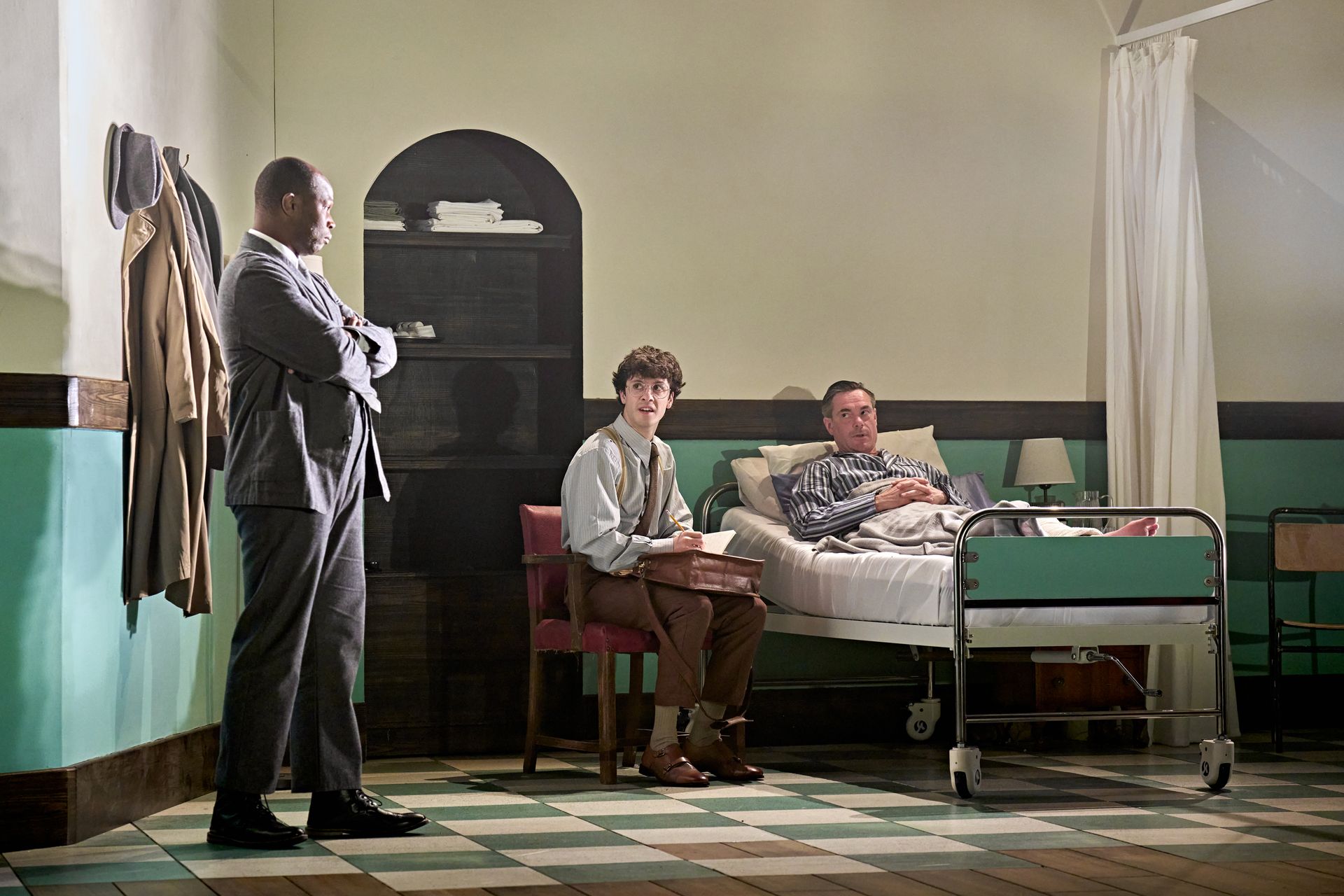
 Faced with such an incomprehensible narrative as Zauberflöte every director has to find a way of making some sort of sense of it. Jamie Morton and his design team set it in a hospital and why not? The whole thing is conceived as Tamino’s drugged dreams and nightmares as he lies in intensive care, ventilated and sedated. Thus, the three ladies become sinister nurses, Papageno and Papagena are cleaners, Pamina is his anxious bedside girlfriend and Sarastro a benign authoritarian consultant. It isn’t quite clear where The Queen of the Night and Monostatos fit into this conceit but never mind. Lots of ensemble tableaux (Royal Academy Opera Chorus), with drip stands, wheelchairs, crutches and the like, help to nail the ambience. I’m not sure that Mozart or his librettist,  Emmanuel Schikaneder, would have recognised it but  hey, this is 2025 so that’s fine.

All the principals role-share across the four performances. On 18th March, which was Press Night, I saw a strong cast amongst whom Conrad Chatterton is outstanding as Papageno – rueful, pragmatic and with a gift for making those familiar numbers sound as if you’ve never heard them before. He uses his physicality well too as he towers above almost everyone else on stage. Monostatos is probably the hardest role to bring off because it’s difficult to fathom who or what he’s actually meant to be. Clad in Wizard-like robes, an intriguing headdress and doing a lot of writhing, Owen Lucas makes him feel enjoyably sinister. Grace Hope-Gill finds all the puzzled wistfulness Pamina needs and as her mother, Binny Supin Yang, dressed in shiny PVC,  hits all those show-stopping top notes with menacing enthusiasm.

My biggest issue with this production is lighting, designed by Charlie Morgan-Jones. Of course, it’s meant to be hazy – we’re inside one man’s hallucinations but 2 hours and 35 minutes is a long time to watch something so relentlessly dark, with more stage smoke than I’ve seen in ages, that one was soon longing for a scene or two in which one could actually see what was going on. Second, the main lighting/stage design device is a quasi canopy of glowing tubes to connote institutional strip lights. These pointlessly change colour, re-angle and rise up and down continuously until it becomes a distracting irritant.

That’s a minor gripe, though. It’s a treat to see emerging singers delivering a generally pleasing production. I admire the decision to play this in the original German which must have been a challenge for some cast members but they rise to it with aplomb. Moreover, as always, Royal Academy Sinfonia, conducted this time by Olivia Clarke, are well balanced and supportive. Clarke is adept at allowing the audience to hear the musical detail – especially in the magical moment with flute (Sofia Patterson-Gutierrz) and timp (Anna Fyi).

I bought this book on autopilot because I’m an enthusiastic Elly Griffiths fan. I love her nonchalant present tense style, her wit and her engaging characters including cats. And I have fond memories of interviewing her in a Brighton café for Ink Pellet a few years ago. However, apart from noticing that this new book was the first in a new crime series, I had no idea what it was about.

And it was a shock. This is crime fiction spliced with sci-fi and hey, I don’t “do” fantasy of any sort so at 5% in (I was reading it on Kindle) I considered throwing it crossly aside. I didn’t want to read about time travel, thanks very much. But, because this is TGEG (The Great Elly Griffiths) and because I’d paid for it, I read on –  sceptically. And thank goodness I did. I should have trusted her. She can make anything compelling and by the time I’d got to 15% I was completely hooked.

Ali Dawson is a police officer in her fifties with a long history of failed marriages and an adult son, Finn, whom she adores. She now works for a special unit engaged on cold cases – very cold because the current one dates back to 1850. Think His Dark Materials, Alice in Wonderland, Narnia and even Enid Blyton’s The Magic Faraway Tree because Ali actually visits the period and place in question. And the reason it works fictionally is that she and her colleagues daren’t tell anyone what they’re doing because the reaction, obviously, would be cynical disbelief and suspicion of laughable irrationality. And a feet-on-the-ground reader like me identifies very much with that. Moreover Griffiths is very hot on the day-to-day details – food, clothing, sanitation and so on – at both ends which make it convincing. And there’s wry humour in that Ali has her 2023 brain and experience with her even in 1850 so there are some delicious anachronisms and characters she meets find her speech mode very strange. She explains by saying she comes from Hastings.

Finn is a special adviser to a Tory cabinet minister and the intricate, quasi gothic plot links his boss with the events in 1850 as we, like Dawson and Griffiths ponder metaphysical questions about how the past affects the present and vice-versa. If you move back in time can you change events? And could Ali have been murdered, or painted in 1850? Could someone from 1850 have come “through the gate” (an experience which causes terrible vertigo, by the way) to commit crimes in 2023?

When all is said and done, this novel is a whodunit. And I didn’t see the answer coming – yet another Griffiths strength. She’s very adept at keeping you guessing and springing surprises.

The Frozen People is great fun and very entertaining – as Griffiths always is. I’m now very intrigued to see where she takes this next because it is very clearly presented as the start of a series. I don’t think she’s likely to convert me to fantasy in general but she has certainly taught me a lesson about managing my prejudices and preferences.

Next week on Susan’s Bookshelves: Rule Britannia by Daphne du Maurier

REVIEW: HAVISHAM by Heather Alexander at Jack Studio Theatre 11 – 15 March 2025

Susan Elkin • 11 March 2025

‘Excellence marred by inappropriate music’ ★★★ ½

This one woman show is a fine piece of writing and Heather Alexander’s acting is sensitively nuanced.

We first meet Miss Havisham, familiar as the deranged, jilted bride in Great Expectations (1861) as a child of four, motherless, frightened and fragile. Alexander then depicts her being beaten for wetting herself in church, growing up (the onset of menstruation is a bit hammy) and spending too much time alone. And there are experiences in her life which Dickens probably never dreamed of. It’s imaginative work. Ultimately she’s a very vulnerable young woman whose father shows her no love but leaves her the Satis estate in Kent on the marshes of the Hoo Peninsula when he dies. She blossoms and becomes more confident in London living with her aunt but then she meets James Compeyson and we all know where it’s going. 

Alexander is a talented actor, as convincing as a young child as she is as a suave conman. She communicates expressively with her face and fingers. And Havisham is a compelling piece of theatre in two short acts. The set is neat too – lots of white lace, stage smoke and it’s amazing what you can do with two orange boxes and a piece of sheeting.

The sound effects are strong but adding other voices feels like a cop out in a one person drama. Moreover the music is very odd. The folk songs are anachronistic because most people didn’t know them until they were discovered and popularised by Cecil Sharp and co in the early 20th century. A brass band would not have performed Seventeen Come Sunday in the 1860s. And why the repeated use of a Baroque concerto? The piece – presumably Hot Gossip because that’s where Alexander’s background lies – which accompanies tragic Miss Havisham’s final descent into disaster doesn’t add much either. If these choices are meant to make the piece feel timeless then they fall sadly flat.

Havisham is worth seeing, though, for at least two additional reasons. First, any one woman show is a welcome antidote to the large number of one man shows on offer and deserves to be supported. Second, back stories to familiar characters from well known literature are a fertile and very interesting concept.

Photographer: Peter Mould

HAVISHAM by Heather Alexander at Jack Studio Theatre 11 – 15 March 2025, presented by Emul8 Theatre

BOX OFFICE https://brockleyjack.co.uk/

This review was first published by London Pub Theatres: https://www.londonpubtheatres.com/review-havisham-by-heather-alexander-at-jack-studio-theatre-11-15-march-2025

Vienna Tonkunstler Orchestra

Conductor: Yutaka Sado

Pianist: Yeol Eum Son

Cadogan Hall, Zurich International Orchestra Series 2024-5


There are several things to note about this enjoyable concert before we even get to the music. First, a splendid Austrian orchestra, conducted by a Japanese and working with a South Korean soloist is a fine demonstration of the inclusive internationalism of classical music. Second, it’s a joy to see an orchestra of this calibre led with energetic panache by someone so young. Jacob Meining is only 29. Third, even in 2025, it is still unusual to see, and hear, a female timpanist so bravo Margit Schoberleitner. You did a grand job.

Because Sibelius’s Symphony No 7 is “through-written” – that is without breaks between movements – and relatively short, it makes an satisfactory, if unusual, overture-like concert opener. Yutaka Sado leaned on Sibelius’s trademark big brass tunes and ensured we heard lots of crisp, incisive, distinctly Austrian string sound especially in the long slurred runs. An ascending scale is not, I have to say and always think, the most inspiring of recurrent motifs but this performance made it sound pretty fresh and arresting.

If you’re Austrian, as most members of this orchestra are, Mozart is in your blood and his Piano Concerto No 21 was accompanied here with charm and lightness. And Yeol Eum Son delights. She has an attractive feathery touch and blends her sound perfectly with the orchestra’s. She found plenty of elegant drama in the first movement’s cadenza and I really liked the flute and bassoon work in this movement. We then got an affectionately elegant account of Mozart’s most famous andante and a resounding allegro. She followed the concerto with a witty little encore, which I was unable to identify, in which her fingers moved so fast they disappeared.

After the interval the full orchestra returned for a warm and imaginative account of Brahms Symphony No 1. Sado rarely consults the score and often turns his baton into his sleeve in order to get deep and personal with his fingers. Sometimes he barely conducts at all. He simply sets them off and they play. He exaggerates tempi – especially in the opening of the concluding adagio which was very slow and played at the softest possible dynamic to allow for exciting crescendo and accelerando passages. Arguably, when he got to the big melody with trombones and muted violins it was a bit self-indulgent but it pleased the crowd by this point in the evening. Other highlights included nicely balanced horn interjections in the first movement and poignant string work in the andante with the leader’s solo at the end as moving as I’ve ever heard it.

Then there was an encore. Of course there was. Brahms’s Hungarian Rhapsody No 5 was a perfect choice with its almost absurd alternating swoops and fast string passages topped with lots of exciting wind parts. Fun to listen to and fun to play.