Press ESC or click the X to close this window

Prague Symphony Orchestra (Susan Elkin reviews)

Prague Symphony Orchestra

Tomas Brauner (conductor)

Gabriela Montero (piano)

Cadogan Hall, 12 February 2025

Zurich International Orchestra Series

Dvorak is to Prague what the Strauss family is to Vienna. It’s in the blood and you could hear that affinity in almost every note of this concert which began and ended with works by their most famous composer.

Tomas Brauner is Prague Symphony Orchestra’s Chief Conductor so there is a powerful rapport between him and the players, seated with violas to his right which made their contribution more prominent than sometimes. The Noonday Witch is one of four tone poems (1896) based on ballades by Karel Jaromir Erben. It tells a powerful story about a clamorous child who is killed by a witch and, even without programme notes, the narrative was very clear: lovely tuba work in the sinister witch sections. Bit strange, however for the leader to tune the orchestra to the piano for a work which doesn’t use it.

The piano was in place for Prokofiev’s Piano Concerto No 3 which is not a work for the faint hearted because it requires fearsome virtuosity – which, very happily, Gabriela Montero brought to it in abundance, with her iPad and Bluetooth pedal for notation support. Whether it was high speed cross rhythms or gentle lyricism, she played the first movement with verve, very ably supported by Brauner. The second movement opened with tantalising sensuousness before racing off so fast you could hardly see her hands moving, along with which was evocative work from bassoons and beautifully controlled muted strings, especially second violins and violas. It’s a pretty crazy piece of many moods and Montero has some of the most fluid hands I’ve ever seen on a keyboard – and I’ve watched a few. Towards the end of the final Allegro ma non troppo she and Brauner made the music feel almost filmic. A bravura performance by any standards.

It was, however, Montero’s encore which was arguably even more spectacular. Returning to the stage with a hand mic, she told the  audience that she had been improvising since childhood and would do so now if someone in the audience would sing her a few notes of a melody. After an embarrassed pause, someone in the balcony sang a bit of Greensleeves and Montero was off – initially in JS Bach mode and ending closer to Rachmaninoff or perhaps Prokofief  Quite a party piece but maybe it comes more naturally to a performer who is also an acclaimed composer, as Montero is.

Dvorak’s New World Symphony is always a crowd pleaser and frequently performed (I reviewed Philharmonia playing it only ten days ago) and for good reason: it’s such a perfectly integrated symphony. Brauner, now conducting without score, gave us lots of immediacy and intimacy. Highlights included the dialogue between the wind solos and the dramatic contrasts in the first movement, nippily elegant string work in the scherzo and delightful brass fanfares in the Allegro con fuoco. And of course the iconic largo – which includes one of the most pregnant pauses in the repertoire before the cor anglais entry – was played with oodles of respectful affection but still made to sound fresh. The bass pizzicato was particularly pleasing here.

We finished – of course – with an encore: an incisive romp through one of Dvorak’s delightful Slavonic dances complete with plenty of minor key excitement and Czeck panache.

Outlying Islands

David Greig

Directed by Jessica Lazar

Jermyn Street Theatre


Star rating: 4


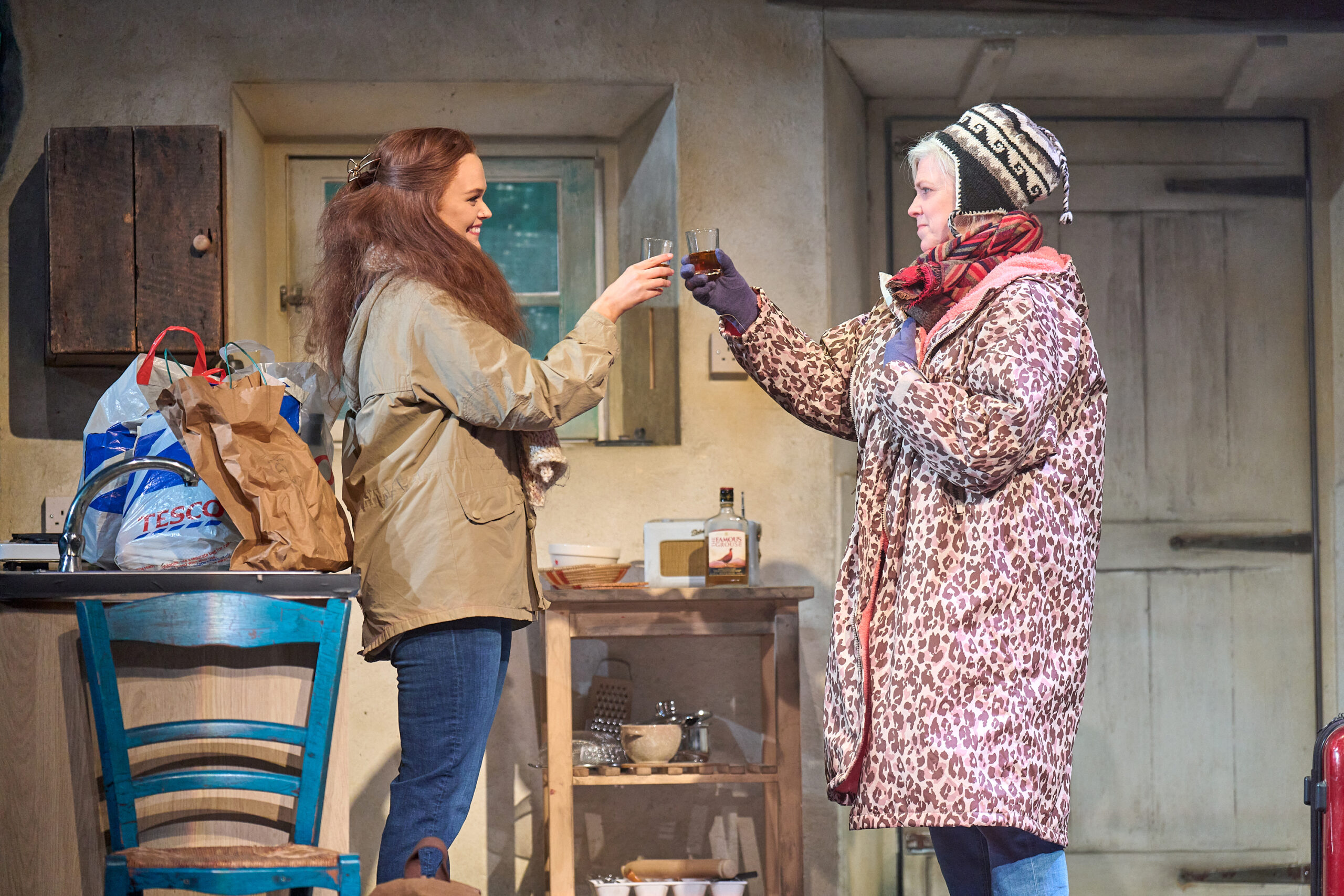
David Grieg’s intense 2002 play is about isolation, female sexuality, friendship, religion and wildlife – among many other things. It’s as thematically dense as a piece of Highland tartan and perhaps that’s appropriate as it takes us to a remote (fictional) Scottish Island. We’re forty miles from the mainland and in the late 1930s. War is imminent.

Two young men, both recent Cambridge graduates, arrive with their equipment to survey the island’s wildlife. They’ve been sent, rather wonderfully, by the “Ministry” (of what, we never learn) but they soon discover that, with the country on the brink of war, the Ministry’s agenda is about germ warfare rather than conservation. Yes, this play was inspired by the true story of Gruinard Island which was deliberately infected with anthrax, thus killing all wildlife, as part of a WW2 scientific experiment.

Initially there’s a lot of comedy in Outlying Islands. Roast puffin which tastes like chicken cooked in axle grease, anyone? The accommodation is hilariously primitive. Kevin McMonagle as the dour, blinkered owner of the island who’s hoping for lots of compensation money from the Ministry, is terrific, He talks with his face and times his lines with all the skill of a virtuoso violinist. He is also rather good at keeping extraordinarily still – no spoilers.

It all darkens (literally – fine lighting design by David Doyle) especially after the interval as things between the intense but ruthless Robert (Bruce Langley – strong) and the rather more naïve and gentle John (Fred Woodley-Evans – good) gradually complicate. And we know, poignantly, that all those fascinating birds they are so interested in will not be there much longer.

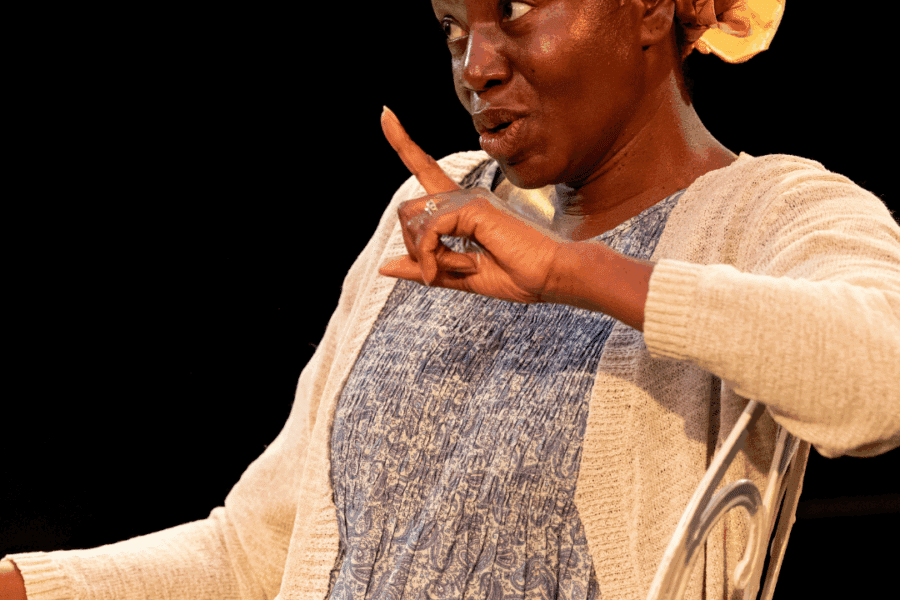
Then there’s Ellen, niece of the island owner. Whitney Kehinde brings chilly reserve to this young woman who is totally isolated from other women and young men although she’s a film buff which presumably dates from before her arrival on the island because her uncle regards cinemas as dens of iniquity. She too is an “outlying island” Then, once the restrictions are gone – “O brave new world that has such people in it” –  she starts uninhibitedly to find herself and we watch her discovering her own womanhood and feelings she has only before had for Stan Laurel. It’s a fine performance combining touching innocence and subservience with burgeoning strength and self-determination.

(c) Alex Brenner. 

Of course the play, which was new to me, is part of a tradition of island literature. There are elements of The Tempest – made even more overt by Christopher Preece’s evocative, often stormy, sound design. And at the end, when the army officer (nicely doubled by McMonagle) turns up to take them away from this island of dark secrets and doomed petrels, there’s a strong whiff of Lord of the Flies.

It’s a treat, for once, to see a fresh, well directed grown up play which both entertains and grips – as well as leaving you with a lot to think about.

Photographs by Alex Brenner

Each time I return to Jane Austen’s 1813 masterpiece, and I must have read it a dozen times, I notice and smile at things I haven’t noticed before. Take the pithy, one sentence account of the Bennet marriage: “Her father captivated by youth and beauty, and that appearance of good humour, which youth and beauty generally give, had married a woman whose weak understanding and illiberal mind had very early in their marriage put an end to all real affection for her”. Then, at the end of the novel, comes real poignancy when Mr Bennet says to his daughter of the proposed marriage he is doubtful about:  “My child, let me not have the grief of seeing you unable to respect your partner in life”. Austen’s italics are very telling here.

Just in case you’ve been holidaying on Mars for the last 200 years, Pride and Prejudice is the story of an ill-matched Hertfordshire couple who have five daughters whom Mrs Bennet (a pitiful, tiresome, comic character) is determined to marry off as soon possible. The novel runs along on on-off possibilities between Jane and Bingley, Elizabeth and Darcy and Lydia and Wickham. Mr Collins, the cousin who stands to inherit the Bennet estate – another genius comic creation – marries Charlotte Lucas from the next estate because Elizabeth, understandably, won’t have him.

Of course there’s a happy ending which traditionally means marriage – three in this case. We close the book confident that Jane and Elizabeth will both be very contented married women. Lydia’s position is far more interesting because hers is a forced marriage triggered by a wedding-free elopement and, one presumes, a lot of hormones and lust. Wickham, gamester in constant debt and probably a womaniser, is most unsuitable marriage material and Lydia is barely sixteen. It will not go well.

Austen prose always sparkles but it glitters more brightly in Pride and Prejudice than it does anywhere else, partly because the novel is full of unforgettable characters. The outrageous, entitled vulgarity of Lady Catherine de Bourgh, Mr Darcy’s aunt and Mr Collins’s patroness, for example, is perfectly done. So are some of the minor characters such as Sir William Lucas and Georgiana Darcy. No wonder this has always been the most popular of the six Jane Austen novels. And I’ve lost count of the number of different ways it has been dramatised.

I’ve come back to Pride and Prejudice now because it’s relevant to a new project I’m working on (you will probably hear more about this later in 2025) but, unsurprisingly, as soon as I read the first page, it became enjoyment rather than research and  I was entranced  – yet again. I’m sometimes asked to name a favourite book which would, for me, be absolutely impossible but this one would certainly have to be in my top ten.

Next week on Susan’s Bookshelves Of Mice and Men by John Steinbeck


Brighton Philharmonic Orchestra, guest-led by Igor Yuzefovich

Brighton Festival Chorus

Ben Gernon

Cody Quattlebaum

Brighton Dome

Ben Gernon conducted this all English, all 20th century concert without baton and a great deal of sensitive immediacy.

There’s really only one way to treat the Enigma Variations – with affectionate respect, and that’s exactly what Gernon gave it. Highlights included a pleasing contrast between variations one and two, some fine cello and bass work in the third and lots of sweetness in the eighth. The viola solo (Caroline Harrison) in the tenth and the cello one (Peter Adams) in the twelfth were beautifully poignant. And it’s good to hear Nimrod (Variation 9) allowed to flow. It’s much more moving this way than if you stagnate it as, for example Leonard Bernstein did.

The piece is famously a series of portraits of Elgar’s friends and, if you know a bit about this, you can hear their personalities in the music such as variation 12 which depicts an amateur cellist or the grandiose variation 13 which was for an organist friend. Actually it works perfectly well simply as a series of tuneful movements without worrying about “my friends pictured within”. And that, I presume, is how the pleasing number of children sitting near me were hearing it. Full marks to their parents for bringing them.

After the interval it was on to the wondrous drama of Belshazzar’s Feast and this was an outstanding performance. I think William Walton would have been very happy. Brighton Festival Chorus – all 140 of them – now illuminated in the choir seating behind the orchestra made an arrestingly rich sound from their very first entry. And, best of all, because this is a piece which tells a story, every single word was crisply articulated.

Belshazzar was the Old Testament king who disobeyed the rules by indulging in wine women and song,  admiring some glitzty gods and promoting himself above the “One True God.” Then, terrifyingly, the writing, literally, appears on the wall as a warning and he gets his come-uppance in one gloriously sung staccato chord.

Cody Quattlebaum (currently singing Count Almaviva in The Marriage of Figaro at ENO), who looks a bit like an old testament prophet with his spectacular hair, is superb as the baritone soloist who is effectively a narrator in this piece. He too has wonderfully incisive diction and a way of making his lower notes rattle with so much menace that you almost want to back away. He is every inch an actor as well as a singer.

The crisp syncopation in the chorus was especially delightful in the third section and I admired the trumpet work during the singing of “Blow the trumpet in Zion” as well as the way Gernon delivered the triumphant final bars.

Bravo BPO and BFC.  It was quite an afternoon.


Figaro: An Original Musical – London Palladium

Reviewer: Susan Elkin

Book: Ashley Jana & Will Nuziata

Music and Lyrics: Ashley Jana

Director: Will Nuziata

We’re in Italy although there’s nothing remotely Italian about the ambience. A lonely motherless girl Sienna (Cayleigh Capaldi) wants to be a singer, to the horror of her farmer father. So she runs away to join a circus owned by a dastardly Englishman named Figaro (Jon Robyns). From then on, this predictable, shallow narrative is effectively Carousel with a hint of Carmen and a lot of unresolved loose ends. The final, enigmatic line is “No more”, which comes as a relief, although it’s actually a lazy cop-out.

It’s a pity that the vehicle is so woefully superficial because there are some powerful performances here. Capaldi is very convincing as a star singer and, because it’s partly a show about a show (not exactly an original concept), there is plenty of opportunity for her to show off her impressive vocal range and colourful dynamics. And Robyns presents a highly attractive villain. With that fruity voice, he could (and does) seduce almost anyone. Ava Brennan, as the kind, down-to-earth company dresser/designer, is delightful too.

Also impressive are Sophia Goodman and Cian Eagle-Service as the two children Figaro has kidnapped/rescued to work in his company. Both are experienced in West End roles, have oodles of stage presence and they work beautifully together. Their harmony singing is impeccable.

Some of Ashley Jana’s music might be memorable if it was heard a few times. Occasionally an attractive melody comes along. And there’s a good moment when Sienna is arguing with her father and the music is pounding along in tense, urgent 6|8. Her lyrics, however, are pitifully banal.

Beneath all this is a fine seven-piece band (London Musical Theatre Orchestra) led by Caitlin Morgan. The string work – a full-string quartet sits at the centre of it – is especially fine although the volume is too loud when it’s lifted for what is presumably meant to be dramatic effect.

It was a mistake, incidentally, to call this show “Figaro”, a name which has irrelevant Mozart and Rossini connotations and is arguably misleading. The circus could, and should, have had any Italian name.

Runs until 4 February 2025

The Reviews Hub Score

2 stars

Toothless show pleasingly done

Review first published by The Reviews Hub https://www.thereviewshub.com/figaro-an-original-musical-london-palladium/

Shakespeare’s plays are full of leaders who are often Kings. Eliot A Cohen is a highly experienced and eminent US government adviser and academic. His 2023 book discusses the characters, words and actions of Shakespeare’s leaders and draws parallels – often uncannily close ones – with real-life examples. Power is the common factor, whether it is inherited, seized, acquired and/or lost.

Macbeth, for example, has deep-seated ambition beyond his proven competence on the battle field. Then ideas simmer, with input from the witches and his wife. Note that they can’t make him do what he does. They simply stir. The final decision to kill the king is his own although he still, at that point, has a few qualms of conscience. This however is the man who was capable of ruthlessly “unseaming” an enemy from “nave [groin?]  to chops” so he stabs King Duncan to death. And thereafter the killing quickly escalates until the perpetrator, or the one who gives the orders, is steadily dehumanised. Cohen compares him with Vladamir Putin.

It isn’t just kings and world leaders who have power. It could be the head of a business or club. Firing someone is a metaphorical murder, Cohen observes. When I was about half way through this fascinating book I was told a real life story by two friends. The organisation they both belong to as a way of pursuing a hobby (I’m deliberately fudging the details here) pays a professional to lead their activity. Last term their new chap proved unsatisfactory. So, awkward as it was, they fired him, to which he responded with steely but pitiful charm and bought them all farewell gifts. As I listened to this tale, Cohen’s book very much in my mind, I thought: “This is pure Julius Caesar, with a whiff of Richard II. The committee, which both my friends are on, are the conspirators, and the membership at large, who voted unanimously for his dismissal, are the mob baying for blood.” And it made me respect Shakespeare’s timeless perspicacity in a new light.

Then there’s the relinquishing of power. Is it possible to do it with grace?  Think of Margaret Thatcher grimly clinging on. Cohen observes that it’s very hard to watch someone else doing the leadership  job you painstakingly built up. Wise university deans (it would be vice-chancellors in the UK)  move right away and buy a house in the country when they retire. King Lear doesn’t understand this. Neither do many captains of industry, head teachers and the like. Prospero, on the other hand, deliberately destroys the magical tools which gave him the power which seems a strange decision. The whole question of magic, whatever we now mean by it, interests Cohen too. Obama, for example, had it in spades and it brought him many followers although, in Cohen’s view he didn’t achieve much as president.

Then there are leaders who have so much charisma and brilliant command of rhetoric that they can literally entrance their followers and persuade them of almost anything. Think of Mark Antony at Caesar’s funeral or Henry V before Agincourt – and of Adolf Hilter.

Cohen is pretty scathing about Henry V whom he regards as wily, manipulative, calculating and ruthless. I used to teach this play to A level students. If I were doing so now I would be insisting the my students read, and then discuss with me and each other, every word that Cohen has to say on Henry V because he comes up with things I’d never thought of.  Is there a pornographic element in the level of lurid detail in the threats to the Mayor and people of Harfleur? Does Henry actually enjoy the violence? Well, not in the 1989 Branagh film he doesn’t but you could think of half a dozen modern aggressors and play it that way. And why, given his fluency at every other point in the play is he so tongue-tied with Katharine to whom marriage is, anyway, a done deal? Surely it’s just an act? Note too, the sexual innuendoes he uses.

It’s a thought-provoking read to which my comments here probably don’t do justice. If you care about Shakespeare and or the dynamics of power in general The Hollow Crown is a must.

Next week on Susan’s Bookshelves: 

Scissorhandz: A Musical Reinvented – Southwark Playhouse Elephant, London

Reviewer: Susan Elkin

Writer and Director: Bradley Bredweg

Loosely inspired by Tim Burton’s 1990 film Edward Scissorhands, and to a lesser extent by Matthew Bourne’s 2005 dance version, this show enjoyed three sold-out runs in Los Angeles before trying its luck in London. Two cast members, Jordan Kai Burnett in the title role and Ryan O’Connor multi-roling, were in the original cast and both are strong stage commanders.

Scissorhandz is effectively a jukebox musical which cobbles together songs from recent decades, arranged and orchestrated by MD Bradley Bredweg who evidently has little love for volume control. As it winds through its plot for ninety minutes, it is relentlessly, bone-shakingly loud for most of its length. The occasional gentle number such as Snow Angel – which comes towards the end and is beautifully sung by Dionne Gipson as the Inventor, joined by others – is a great relief.

Of course, there are only a handful of stories in the world which simply get up-ended, expanded upon, reset or whatever to suit the context and this one is a take on Mary Shelley’s 1818 novel Frankenstein, which is itself a reversal of the traditional “overcoming the monster” narrative. As such, it was always about inclusion and empathy but Scissorhandz turns it into a glaringly obvious, unoriginal, woke statement.

The titular Scissorhandz is invented from spare parts by a thwarted mother in a lonely gothic house – the multi-level grey set and projection are one of the better things in this show. They are taken in by a family but the neighbours are prejudicially hostile in their various ways. Then there’s a bit of Romeo and Juliet stuff as Scissorshandz falls in love, but of course, it can’t possibly work out. They are a misfit and, as such, we are invited to welcome Scissorhandz into our hearts and society. The message is over-larded.

On press night, most of the audience seems to be drunk on decibels and there is rapturous enthusiasm for what is, if you can keep your head when all about you are losing theirs, actually a pretty ordinary show.

Runs until 29 March 2025

The Reviews Hub Score: 2 stars

Noisily woke

Philharmonia

Manfred Honeck

Pierre-Laurent Aimard (piano)

Royal Festival Hall, Southbank Centre


There is something richly incisive about Manfred Honeck’s conducting and in this concert, only his second with the orchestra, the platform cohesion – joy even – was palpable.

Carl Maria von Weber’s Der Frieschϋtz overture always makes a pleasing concert starter and Honeck’s very sensitive opening certainly grabbed attention. There was some delightful playing too in the section in which the horn plays over cross string work. Fun, moreover, to see traditional timpani played with hard sticks – lots of attentive leaning in and key twisting – by Antoine Siguré, who later switched to the pedal timps awaiting him at the back for the Dvorak.

Forces were then reduced for Beethoven’s third piano concerto which Pierre-Laurent delivered with measured passion and warm conviction. Familiar as this work is, it sounded fresh in this performance. Honeck, ensured, for example, that we noticed, really noticed, the beautiful wind and lower string work beneath the rippling filigree piano in the first movement and Aimard gave us a flamboyantly romantic take on the cadenza.  The largo was as slow as I’ve ever heard it but the concentrated delicacy allowed some carefully pointed musical beauty to shine through. And the third movement was resolutely heroic in tone with terrific cello sound, (born of their being positioned next to first violins) especially in the fugal passage. Then we got an exciting take on the final bars. Finale flourishes seem to be a Honeck trademark.

Dvorak’s “From the New World” symphony is, of course, like the preceding two works, highly popular and very well known. And there’s a reason for that. It’s like landscapes: the best bits tend to attract the most visitors. I have never, however, heard it quite like this. Honeck, conducting without score which makes for immediacy and a different sort of contact with players, exaggerated the tempo and dynamic shifts to such an extent that the performance was packed with much more breath-taking drama than usual. Pulling it about like this wouldn’t be to everyone’s taste but I rather liked it.

He showed again how good he is at delicate slow introductions and here there was less beating time and more gestural conducting. The poignancy of the cor anglais solo in the Largo never fails – it has survived familiarity and “that” TV ad –  and Henry Clay played it exquisitely in this performance with movingly expressive work from the rest of the orchestra. The Molto vivace was blissfully precise and very fast and the Allegro con fuoco was definitely fiery: lots of high octane playing, especially from the brass. And, yet again, the extreme dynamic contrasts worked a treat.

I’ve heard the Philharmonia in action many times but rarely in such spectacularly good form as this. I hope there are more concerts programmed with Manfred Honeck?