 Cargo
|
|
Tess Berry-Hart. Produced by Metal Rabbit Productions.
|
|
performance date: 08 Jul 2016
|
|
venue: Arcola Theatre, 24 Ashwin Street, Dalston, London E8 3DL.
We are in the hold of a big ferry with the cargo. The doors clang and it’s pitch black. The ship’s engines rumble and we are seated uncomfortably on pallets in the Arcola’s Studio 2 which lend itself very aptly to Max Dorey’s convincingly immersive design. The show runs 80 minutes like the crossing so we’re more or less in real time. Three people start to scrabble around in the dark and eventually we meet them properly when they turn on a torch. The titular cargo is, of course, human. Tess Berry-Hart – who helps to run the advocacy charitable fund, Calais action – has provided a taut script to force us to think, and think hard, about the real plight of refugees from war zones desperate for a better life in Europe. Eventually the three are joined by a smooth talking American (John Schwab) was has been asleep elsewhere in the hold. His gift of the gab doesn’t fool the others for long. This man is not what he pretends to be and Schwab makes him suitably manipulative and untrustworthy. All the acting in this show is outstanding and director David Mercatali makes skilled use of the talents of his four person cast who listen attentively and bounce off each other with real attention to detail. Milly Thomas as Joey is gritty, determined and still until she gets angry and eventually distraught. Hers is a beautifully controlled performance and she’s very compelling to watch. Debbie Korley is riveting as the dangerous, terrified Sarah, vomiting and shouting – when she isn’t dropping her defences and being relatively friendly. She has a way of using the whites of her eyes in the gloom to indicate that she’s much less than stable. The biggest accolade must, however go to Jack Gouldbourne as Iz, Joey’s younger brother. Fresh from youth theatre this is his first professional job. Gouldbourne’s character is initially naïvely and ebulliently excited about the promise of a new life. He jumps up and down with glee and makes silly jokes. Then he gets swept up in the fears and anxieties of the others and things which he doesn’t understand. Eventually when Schwab as Kayffe graphically spells out the terrible truth about the sort of work which really awaits him – as a virtually imprisoned, pimped rent boy – the horror on Gouldbourne’s face and his terrified weeping is something I shall not forget for a long time. Yes, it’s an acutely distressing piece but we all need to address these issues relating to human beings in the direst of straits so it’s good to have them spelled out. And it’s a fine piece of theatre, full of dramatic tension. Originally published by Sardines http://nesmagazine.co.uk/reviews/review.php?REVIEW-Arcola Theatre (professional)-Cargo&reviewsID=2473 |

This is verbatim theatre taken more literally than I’ve ever seen it. A series of short scenes – some no more than two or three sentences and others rather more sustained – are based entirely on words spoken by real people in real situations. We’ve all smiled at, or empathised with random eavesdroppings. Here, director, John Patterson and his cast of eight have turned a collection of them into 90 minutes of theatre which flows remarkably well considering how bitty a concept this actually is.
Thus we get a pharmacist advising a customer with a burn, banter in the hairdressers, two laughably self important men discussing designer shoes in a gym changing room, a pub scene where two older women are showing off to, and deliberately embarrassing a younger man, a pair of builders resolving a domestic problem as they work and much more. It’s the stuff of everyday life, sometimes wryly funny, occasionally hilarious and often poignant. Especially memorable is the concluding monologue in which Jack Cronin, who can cry real tears in role, presents a gay, apparently unloved suicidal man. It’s warmly powerful and deeply moving.
The basement playing space at Barons Court is very small which means that there’s much intimate immediacy in this show. The actors are never out of sight but simply retire to auditorium seats when they’re not on stage presumably because there is nowhere else for them to go. The cast of eight rise to the challenge off having to work quasi-televisually and all the acting is truthful and convincing. It isn’t easy to switch role and voice instantly and to do it many times in 90 minutes but these eight are very accomplished. I particularly liked the voice work by Anna Bonnett, for example, at one point the Eastern European daughter of a woman dying in hospital and at another a middleclass client having her hair done, among other roles. Stephanie Manton and Lara Bell are both admirably versatile too.
Angel Theatre Company exists to create opportunities for young actors to perform professionally during their first year out of drama school and it is clearly doing what is says on the tin. I just hope that lots of agents and casting directors see this show and that these actors are offered further work. They certainly deserve it.
Originally published by Sardines http:http://www.sardinesmagazine.co.uk/reviews/review.php?REVIEW-West%20End%20&%20Fringe-Eavesdropping&reviewsID=2475
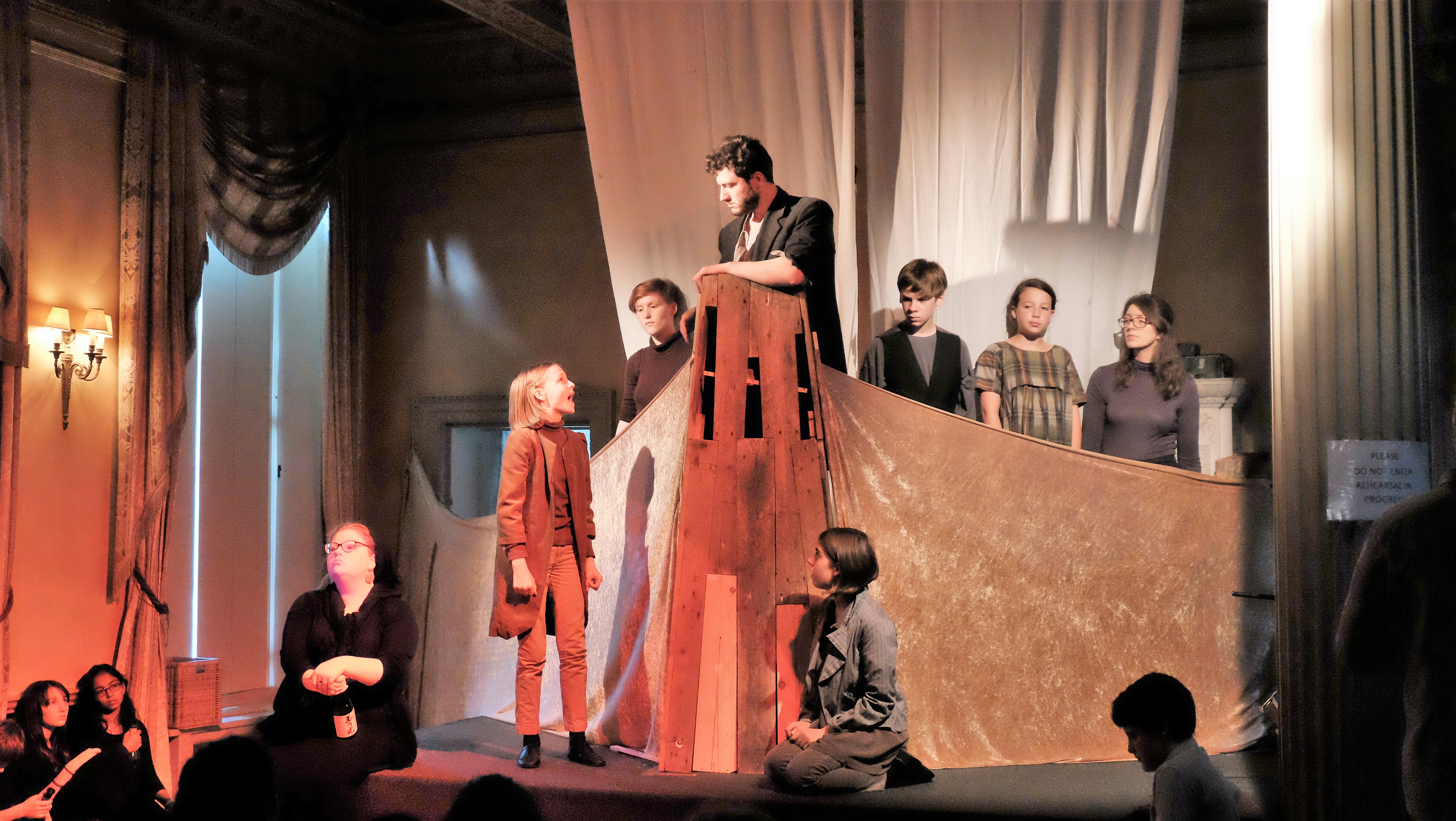
It’s the trumpet fanfare and the entry of the animals which gets me every single time. Last week, true to form, I wept at the sheer beauty of Benjamin Britten’s Noye’s Fludde which I had the pleasure of catching at Hampton Court House School.
Expertly conducted by the school’s music teacher Keiran Brunt this 58 year old ensemble piece can still work terrific theatrical magic with its tinkling percussive teacups for rain drops, feathery tongued recorder to represent the balletic dove and lyrical cello for the raven. Then there’s the quirky timpani accompaniment for the voice of God (headmaster Guy Holloway on this occasion – very apt) initially imperious and later benign.
It’s a magnificently well written piece and, intended for amateurs with professional support, it’s imaginatively inclusive. Based on one of the Chester miracle plays, it needs adults or senior students to play some of the parts alongside an elementary orchestra whose parts are beginner-level simple. You need competent singers – professionals Michael Mofidian and Harriet Hougham Slade at HCHS – to do Noye and Mrs Noye. Beyond that there are six small solo parts for children, Noye’s sons and their wives. An infinite number of animals can be played by very young chorus members because their unison marching songs are mostly on a single note. Mrs Noye’s soprano gossips have a slightly more complex choral role.
HCHS’s animals, incidentally, were sporting the best masks – papier maché and made in their art lessons – I’ve ever seen in Noye’s Fludde. And that’s saying something because this show and I go back a long way.
I first encountered it in 1964 when I was still a child and took part in a production at Sydenham High School. I was a gossip and I fell head over heels in love with the vibrant, moving 45 minute piece. Warmest thanks to Mrs Celia Yeo who directed it. Had I but known it the show was then only six years old, having premiered at Aldeburgh with Owen Brannigan as Noye (and Michael Crawford, no less, as Noye’s third son) in June 1958.
When I got to teacher training college a few years later I took part in another production directed by John Paynter. I played second violin in the string quartet which sits at the centre of the orchestration. Since then I’ve hardly missed an opportunity to see Noye’s Fludde – which is why I went to HCHS last week.
I bet some of those HCHS children, getting to know Noye’s Fludde for the first time now as I did all those years ago, will be besotted with it for ever. And that’s real performing arts education.

NOTE: I wrote this piece in 2001 a few weeks after my mother died. For various reasons – not least because I was feeling pretty low and it was all a bit raw – I didn’t publish it at the time. I’m sharing it now in the hope that it will help others currently in the same position.
Rummaging through someone else’s drawers – both the in-a-chest and the underwear sort – makes you feel like a cross between a burglar and a ghoul. But, of course, when a parent or anyone for whose belongings you find yourself suddenly responsible, dies, that’s what you have to do.
If you allow it to be, it’s a sad, grisly business. My widowed mother died in February, having lived independently and alone until she was admitted to hospital following a stroke five weeks before her death. So the house was as she left it – teacups still inverted on the draining board, full ashtrays in the sitting room and half-used jars of jam in the cupboards.
For me the most poignant things were a bedside book with her bookmark still in place, a half- done jigsaw on the dining table and her day-to-day engagement diary propped in its usual place on the side. Pause for a tearful smile – how splendid that she was well enough to read books, do jigsaws and have commitments almost until the end, I tell myself.
Walking into her home with a key felt simultaneously very familiar and extremely peculiar. And it was a while before I could bring myself to touch anything. But, of course you have to. This house must be emptied and then sold. Everything in it must be disbursed amongst my sister, my mother’s sister, me and our respective children, or sold or disposed of. So black bin bags, labels and notebook to the fore I decided to start in the bedroom.
I suppose you could cop out and get a dealer in with instructions to clear the lot – but it wouldn’t be very wise. Neither would it be sensible to bin the contents of whole drawers without going through each item. In my mother’s top dressing table drawer, lying amongst the sticky and dusty lipsticks, I found a lovely old gold chain which has been in the family for several generations. I suppose she had just taken it off one evening and thrown it in the drawer without putting it away properly. She knew where it was, after all. ‘But I knew you’d go through it all Dear so it didn’t matter did it?’ I can hear her muttering, as I mentally tell her off.
‘Just look at all these lighters, Mother.’ I find myself having more and more in-my-head conversations with her as I collect enough throw-away lighters to fill a supermarket carrier bag. I found them in every pocket, bag, drawer and corner, especially in the studio where, as a professional artist, my mother worked. There were even a couple in the greenhouse. ‘I bet you didn’t know you had so many!’ I visualise the cross defensive shrug I always got if she thought I was criticising her smoking.
And vases. Big ones small ones, round ones, tapered ones, squat ones, glass ones, pottery ones. She was keen on flowers which she used for both pressing and painting. Eventually I took a lot of these home and dotted them around my own house – fourteen at the last count. If only someone would give me some flowers to put in them. Unfortunately I haven’t inherited Mother’s artistic talents along with her vases.
Although my mother was, like me, very much a clothes person with a keen eye for colour and, in her prime, an indefatigable passion for shopping, I would have said that she had scaled her clothes down in recent years. But I’d have been wrong. I filled eighteen black plastic sacks with skirts, trousers, blouses, coats, suits and the like to take to the charity shop. (Rueful reflection – if someone had to this with my clothes as things stand, in comparison, I suppose they’d fill 100 bags)
Should I keep any of Mother’s clothes? ‘For goodness sake don’t send that to a charity shop you silly girl. I’ve never worn it and they’ll sell it for hardly anything,’ I can hear my mother’s voice in bossy-maternal mood addressing her 53 year old daughter. So I decide that perhaps I’d better hold on to the odd pair of gloves or a scarf that she was given for Christmas less than two months before her death.
How tactful she has clearly tried to be too. Revlon’s Charlie was ‘her’ perfume, so we’d all been routinely giving it to her for birthdays and at Christmas for years. ‘Thank you so much Dear, she’d say politely to the donor. ‘My favourite!’ In her house I found nine un-opened packets and several on-the-go bottles. The rate of receipt evidently outpaced the rate of use. Silly. Perhaps she would have liked something else for a change. More in-the-head conversations.
You go though life thinking you know your parents well. Then one day they’re gone and you realise just much you didn’t actually know about them. Things tell stories. There were love letters and air force wings because my parents met during the war when my father was a serviceman. Ribbons, buckles, corks and pressed flowers – evidently keepsakes but what events do they connote? We shall never know now and perhaps it isn’t our business anyway.
Photographs probably speak loudest. And finding a box of old pictures or an album is a sure fire distraction from the hard graft job of trying to get rooms clear. My father was a life long enthusiastic amateur photographer and, in Mother’s house, I found literally hundreds of family pictures, many of them taken before my birth and which I don’t remember ever seeing before, Treasure trove indeed. So I bring them home where they sit quietly in a large box, mothballed with good intentions that I will label as many of then as I can so that my children will know who and what they are.
Actually when you get going this isn’t really such a sad job. There was a lot of laughter too. I lost count of the times I found myself sharing a ‘Mother, how could you!’ joke across the barrier of death and separation. Perhaps saying good bye as you unravel a home and a life is the last stage in getting to know someone.
Susan Elkin’s advice to anyone who has to clear out the house of a deceased loved one:
- Take your time and pace yourself. Allow a number of days, probably over a period of several weeks.
- You will want to bring a lot of things home with you. Allow time to sort those out too in your own home. This can be quite time-consuming.
- Don’t work alone. You will get far less distressed by the clearing task, if there’s someone else there to share the smiles and tears with.
- Hold ‘on-site’ meetings with other members of the family to decide who is going to have what
- Be practical. Take bin bags in which to pack clothing, cardboard boxes for kitchen items, crockery etc, Bubble wrap is useful. So are stick-on or tie-on labels to attach to items which are going to other family members. Use a different colour sack for rubbish
- Many unwanted items – especially clothing – can usefully go to charity shops.
- Once you have removed everything personal or precious, and been carefully though all rooms, you can bring in a general dealer to clear. But bear in mind that if you have removed every item of value there won’t be much in it for him and you will probably have to pay him to take away the leftovers
- You will need to do some cleaning as the house empties.

Someone is bound to give you one for Christmas. It flowers once – usually a spectacular trumpeting of large-scale colour – and then what do you do with it? Do your ‘amaryllis’ bulbs – which should really be called hippeastrums because a true amaryllis is the outdoor-flowering belladonna lily – refuse ever to sing for you a second time? If so, it’s a shame because if you’re nice to them they will bloom year after year. I have several currently in bud for the fourth or fifth time. Here’s how.
Once the flower has withered, cut the stem off at the base with a sharp knife. Put the pot on a warm sunny window sill and feed it like mad with Baby Bio or some other all-purpose plant food from now until October. Remember school biology lessons and photosynthesis? What you want to encourage is a lot of nice healthy green leaves full of chlorophyll. Then the energetic sunlight can work with the carbon dioxide in the air and all that water you’re going to give the bulb several times per week to form the sugars which ‘feed’ the bulb.
In October slice all the foliage off cleanly and horizontally at the neck of the bulb. Then put bulb and pot away in a cool, dark dry place and forget about it for two months. The cellar of my Edwardian town house is ideal for this. A corner of the garage, shed or cupboard in an unheated spare bedroom would probably do just as well.
Exhume them just before Christmas, lifting the dry bulbs and their root systems carefully out of their pots. Shake off as much of the old soil as you can without disturbing the roots too much. Then put the bulbs in a shallow bowl of tepid water for an hour or two to soak the roots before re-potting.
Use roomy pots – 8 or 9 inch are best – and top quality bulb fibre. Put some pebbles or broken crocks in the bottom of each pot. This helps drainage and it makes the pots heavier and more stable as the plant grows. Fill the pots about two thirds with fibre. Ease the bulb into the centre of the pot and pack plenty more fibre around it, leaving about half an inch of the neck of the bulb exposed above soil level.
Keep the pots moist in a warm – not less than 60 degrees F – room and in the light.
Within a few weeks you should have a flower bud, or two or three if you’re lucky. This is the exciting will-it-or-won’t-it time which involves, if you’re like me, frequent close examination to see if I can see signs of life and much cheering come the happy day I spot the characteristic, slightly cloven, tip of an emerging bud. Amaryllis bulbs which have already flowered in previous years often show leaves before the buds appear. I rather like that because I think the flower stem actually looks more attractive surrounded by leaves than starkly solitary as it usually is in a first-year amaryllis.
Last year only one (out of seven) of my ‘old’ amaryllis bulbs has failed me. My usual practice then is to give the miscreant just one more chance. I treated it like the others during te summer – but if it doesn’t perform next spring I shall dump it. Sometimes they miss a single year but then go on to flower several more times.
A word about acquiring amaryllis bulbs in the first place. As with any other bulb the bigger the better, and the best hippestratums certainly come from specialist growers rather than from supermarkets and garden centres. Shop about for Rilona – a beautiful salmon pink variety and Mont Blanc which is an exquisite pure white. A good bulb weigh more than half a pound when you buy it and routinely puts up several flower stems. Both of these have flowered splendidly and serially for me.
The familiar supermarket amaryllis – usually Apple Blossom or Red Lion – tends to be a relatively slight bulb and is invariably packed with a very small pot and a diminutive bag of dusty, poor quality fibre. It is, I’m certain, presented like that only because it makes a handy easy-to-wrap gift. It is not because hippeastrums ‘like’ their roots to be constricted, contrary to what it might say on the box. Even if you can persuade it to thrive in a small pot, the grown amaryllis will be unstable and liable to tip – which it can’t do if you anchor it in a larger pot.
If you are given one of these ‘gift pack’ hippeastrums, the best thing to do with it is to jettison the provided pot and the growing medium. Instead plant the bulb in a decent sized pot with plenty of good bulb fibre. My Angelique amaryllis, for example, looked very sorry for itself when I took it out of the box in which it was given me a couple of Christmases ago. It was quite a small bulb, very shrivelled and had already dryly produced a sad, white, unpromising bent shoot. It reminded me of a neglected animal in need of a good home but I feared it might be beyond saving. Once , however, planted in a large pot, it soon sported two sturdy flower stems and an encouraging growth of green leaves. It has flowered annually since.
Ex Cathedra, Milton Court, 14 May 2016
One of a series of imaginative Ex Cathedra concerts to mark Shakespeare400, this event was an interesting and entertaining blend of words and music.
The first half consisted of an account of an ode written by David Garrick in 1769 for the first ever Shakespeare jubilee. Reconstructed with music by Henry Purcell and choruses by Sally Beamish, it’s a piece which is joyfully celebratory. Actor Samuel West, in Georgian costume, played Garrick with warmth and wit, his contributions seamlessly linking the musical items. Ex Cathedra makes a wonderfully rich sound because it’s a small group most of whose members are accomplished soloists so it’s in the same league as The Sixteen or the BBC Singers. And Jeffery Skidmore who founded the choir in 1969, and still directs it, also drew an elegantly supportive sound from a trio of original instruments including bass viol. Soloists emerged to sing certain numbers with Jeremy Budd being delightfully entertaining as Falstaff and there was some rivetingly good singing from Katie Trethewey.
After the interval came The Shakespeare Masque, a new work commissioned by Ex Cathedra from Sally Beamish and current Poet Laureate Carol Ann Duffy. It’s a community piece and Ex Cathedra has worked with local primary school children in each of the venues where it has performed this concert. At Milton Court the children came from Manorfield, Arnhem Wharf and John Scurr primary schools and were placed in the gallery above the stage. They’d clearly been well trained and contributed in a professional manner. Young people from the regular “academies” which Ex Cathedra runs to ensure that keen young singers get the opportunity to improve their skills were on the stage itself.
Also on stage was a larger six piece original instrument band and the score required plenty of colourful and deft solo work, especially for William Lyons leading on flute and recorder; for David Miller on lute and Emilia Benjamin on treble viol. Behind all this was the core Ex Cathedra choir providing ensemble with occasional solo spots. The whole thing was well stage managed with a lot of moving about and, yes it reminded me of Britten’s Noye’s Fludde which is, I gather, exactly what Skidmore intended – complete even to a bit of audience participation which we had to practise before the work began.
As for the sound, the music is often ebullient, even witty in places. Elsewhere it is often haunting and ethereal especially in the twelfth number “Under the Mulberry Tree”.
Originally published by Lark Reviews: http://www.larkreviews.co.uk/?p=2985
Canterbury Cathedral, 18 June 2016
Yes, it’s Verdi’s greatest opera. The passionate intensity, the astonishingly colourful orchestration (the piccolo cutting across the bass drum, for instance), the frequent use of unexpected minor keys and haunting rhythms, and the dramatic use of quartets and reprises all remind us that opera was Verdi’s day job.
And this powerful, popular work was in pretty good hands under Richard Cooke in a packed Cathedral. After a slightly shaky start – that sotto voce opening is notoriously difficult to do from cold especially in a venue with such a time lag – it settled into its stride as soon as it reached the firmer ground of Te decet hymnus.
Highlights included a Dies Irae perfomed as dramatically as I’ve ever heard it – enough to terrify even the staunchest unbeliever with every detail, especially in the woodwind, carefully allowed to push through the texture in the tenser passages. In Tuba mirum, the trumpets were temporarily placed prominently on either side of the choir – the effect being very persuasive. The choir was in fine collective voice and it was a delight to see the relatively new CCS Youth Choir, some of them very young, singing among the adults.
Sam Furness brought unusual sweetness as tenor soloist, especially in the Ingemiso tanquam and Offertorio and mezzo Katie Bray found plenty of claret-like richness especially in the lower notes of Lux Aeterna. Slightly (but only slightly) less successful was Michael Pearce as bass, although his Mors stupedit had real impact. Soprano Judith Howarth had her moments but occasionally seemed to be strained and her opening of Libera me was disappointingly lacking in tremulousness.
Of course the RPO is a fine orchestra and their presence raised the bar even above the standard which Canterbury Choral Society routinely achieves. Particularly impressive was the way Cooke ensured that their strength never overpowered the choir (who are assisted by very steep and high raking so that they were positioned well above the orchestra). Moreover he brought out many parts which usually go unnoticed. The Agnus dei moved me to tears, as it usually does, and that was heighted by hearing a string passage tucked into the texture which I’d never before heard stressed like that.
Cooke is very used to working in the Cathedral and to dealing with its poor acoustic. Magnificent building as it is, a concert hall it is not. Cooke waited longer than usual on every pause to let the sound die away completely, and there was a wonderful unrehearsed moment at the end when just as the final note was played the Cathedral clock struck nine as if it was joining in. Cooke kept his baton raised until that sound had died away too.
Originally published by Lark Reviews: http://www.larkreviews.co.uk/?p=3061
Youth theatre can, and does, change lives. Few people in the industry need reminding of the power of taking part in theatre and the effect it has on young people. But of course someone, usually the user and his or her family, has to pay for it. Nothing comes free.
Excellent news then that Marlowe Theatre, Canterbury, which runs a thriving youth theatre, has a bursary fund – the Marlowe Theatre Development Trust, a registered charity – with which to support youngsters who want to take part but cannot afford to pay the fees…
Read the rest of this blog at: https://www.thestage.co.uk/opinion/2016/susan-elkin/