Press ESC or click the X to close this window

Prom 42 (Lucas Elkin reviews)

Prom 42, Wednesday 21 August 2024
Beethoven’s Ninth by heart Jane Mitchell (Concept/Scriptwriter)
Ludwig van Beethoven Symphony no. 9 in D minor ‘Choral’ (performed from memory)
Rhiannon May, Tom Simper Actors
Masabane Cecilia Rangwanasha Soprano
Marta Fontanals-Simmons Mezzo-soprano
Brenden Gunnell Tenor
Christopher Purves Baritone
BBC Singers, National Youth Choir, Aurora Orchestra
Nicholas Collon Conductor

This is the third Aurora Prom I’ve had the privilege to attend, each progressively building upon
the success of the last. The first half was an exploration of the genesis and development of the
ninth symphony, set on a series of black boxes placed across the Albert Hall’s huge stage.
Using Beethoven’s notebooks as source material – a series of records of one-sided
conversations in the main, as the written word became the composer’s principal means of
communication as his deafness advanced – the dialogue, beautifully crafted into a coherent
narrative by scriptwriter Jane Mitchell, was expertly delivered by actors Tom Simper and
Rhiannon May (herself deaf) and both also using sign language. I particularly enjoyed the
juxtaposition of the composer’s craft with the daily mundane aspects of human life – Beethoven
struggling to find time for a much-needed haircut in the frantic days before the premiere for
example. This was interspersed by Nicholas Collon introducing sections of the orchestra playing
themes and melodies from the symphony in a way that was both detailed yet accessible –
perfectly pitched for a mixed audience.

After the interval came the symphony itself, entirely from memory, Aurora’s USP.
Unencumbered by stands or seats, the first movement zipped along with real vigour whilst the
second movement with its three- and four-bar phrases punctuated by timpani, here played with
very hard sticks, was delivered with such brio that at one point Collon was dancing on the podium.
The lyrical third movement with its decorated string passages building over a simple chorale-
type melody flowed and lilted as I’ve never heard it before, the players’ freedom of movement
translating into the playing.

I spent much of the first three movements wondering where the choir and soloists were: in the
fourth movement we were treated to music as theatre (distinctly different from musical theatre)
with the choir processing in seamlessly after the movement’s opening recapitulation of the
symphony’s earlier themes. Initially placed behind the orchestra the soloists later moved to
more traditional places at the front, whilst a particularly lovely touch was the entrance of
additional musicians for the military band section.

I cannot recall ever hearing Schiller’s words sung so clearly.  And the infectious enthusiasm of the
performers and obvious joy in their acheivement was shared by the rapturous ovations of a
delighted audience.

The evening concluded with Aurora’s rather special approach to an encore, something I won’t
share here – instead, book yourself a ticket to next year’s Aurora Prom, if you possibly can.

Prom 37, Saturday 17 August
Benjamin Britten War Requiem
Natalya Romaniw Soprano
Allan Clayton Tenor
Will Liverman Baritone
Tiffin Boys’ Choir, BBC Symphony Chorus, London Symphony Chorus, London
Symphony Orchestra
Sir Antonio Pappano Conductor

The War Requiem, one of the masterpieces in Britten’s long composing career, was
commissioned to mark the consecration of the new Coventry Cathedral in 1963 following the
destruction of the old in heavy wartime bombing.

A lifelong, committed pacifist Britten draws on both the traditional elements of a musical requiem
interleaved with Wilfred Owen’s war poetry. The enormous forces used to perform the work
(massed choir, chorus of boys, vast orchestra and separate chamber ensemble) works
particularly well in the Royal Albert Hall. I found the opening pianissimo Requiem statement – a
tri-tone bounced between male and female voices accompanied by haunting bells – particularly
effective, the antiphonal effect between voice parts being heightened by the vast separation of
the organ case.

Alan Clayton’s excellent, anguished interpretation of What passing-bells for these who die as
cattle, was accompanied by the chamber orchestra to conductor Antonio Pappano’s right which
led to the Dies Irae with its awkward rhythms symbolic of mechanised warfare. I could feel the
true torment of Will Livermore’s Bugles Sang whilst placing Natalya Romanov high at the back of
the orchestra allowed her voice to soar gorgeously over the textures below. A particular highlight
was the boys choir, positioned high and out of sight in a top level balcony whose sound floated
ethereally into the main auditorium.

The chilling fortissimo of the Angus Dei, underpinned by the sole appearance of the organ,
wound down through the Libera me and the final, telling statement Requiscant in pace
punctuated by the repeated tolling of a funereal bell – and a very long pause before the richly
deserved applause, the audience sensing perhaps not only the importance and symbolism of
the work but how its message of the futility of war holds true for our own, troubled times.

The friend who recommended this book didn’t tell me what it was about. She simply emailed “You might like this”. She was right. I did.

It’s an unusual, gentle, humane, affectionate exploration of grief, hope, reconciliation and love. I’m not in the least surprised that it’s done well in 21 territories. Imai Messina is an Italian who has lived in Japan, where her novel is set, for many years with her Japanese husband and children. She writes in Italian and the edition I read is translated into English by Lucy Rand.

Yui is a radio presenter whose mother and three year old daughter died in the 2011 tsunami. Seven hours’ drive from Tokyo is Bell Gardia a peaceful garden where bereaved people go to “talk” to their lost loved ones in an old phone box overlooking the sea. While there she meets, among others, a doctor named Takeshi whose wife has died leaving him with a very troubled three year old daughter. Very gradually they become friends and come to share the long, monthly drive to Bell Gardia. It’s the slowest imaginable burn but eventually, over several years, they begin to find comfort together and a way of facing the future. The tenderness is profoundly beautiful. Yes, this is a love story but also a great deal more.

Alongside the poignancy lies ordinary life. Imai Messina interleaves her chapters with shopping lists, menus and, for example “Objects Bought for her Daughter (and never used Found Around Yui’s House” which includes three diamante hair clips and a CD of Christmas Songs or “Two Things Yui Discovered from Googling ‘Hug’ the next day”. This insouciant quirkiness is the author’s way of sculpting her characters three dimensionally so that we see them from different angles.

Her characterisation is splendid. Beyond Yui and Takeshi are their families, the custodian of Bell Gardia, a distressed local boy who comes to the phone box to talk to his mother and many more. Each one is a plausibly drawn person that you care about.

One isn’t surprised to learn that, although this is a work of fiction, peopled, obviously, by fictional people, Bell Gardia is a real place. The author instructs the reader in an end note not to try to find it because “The Wind Phone is not a tourist destination”. You should go there only if you “intend to pick up that heavy receiver and talk to somebody you have lost” Instead she suggests that we should support the work of this “wonderful place” by donating via the official website.

https://bell-gardia.jp/en/about/

Next week on Susan’s Bookshelves: 


Naomi Jacob, who died in 1964, wrote seven books about the Gollantz family who were Jewish antique dealers in London and, at times elsewhere in Europe. I read them in my teens at my mother’s recommendation. The Founder of the House, the first book, was published in 1935 so I’m guessing that she discovered them her teens too. I remember borrowing them from the library and enjoying them a lot. Something reminded me of this the other day and I wondered how they’d strike me now. So I bought the Kindle edition of The Founder of the House and, to my faint surprise, was absorbed – all over again, 60 years after my first encounter.

The saga starts in Paris and then moves to Vienna in the first half of the nineteeth century where political turmoil and class distinction dominate everything. A fine arts man of great standing named Meldola has adopted his widowed niece whose late husband, Abraham Gollantz died nobly fighting for Austria or at least that’s the story which sustains her. Actually there was a seduction and a shot-gun marriage before he abandoned her for a chequered career in the military.  Their son, the highly principled Herman Gollantz, eventually  takes over grandfatherly  Meldola’s business and develops it. Then he  marries charming but sheltered Rachel, whose brother turns out to be bad news.

Herman’s son Emmanuel is the titular founder of the house. By the time we’re with him as an adult, the family has worked through numerous deaths, marriages and angst –  and these are people you find yourself caring about. Once there is no longer anything to keep Emmanuel in Vienna, he sells up and goes to London to start again, which he does pretty successfully.

It’s quite romantic. Emmanuel is tall, strikingly good looking, elegantly dressed and impeccably well mannered. He has a presence which turns heads when he walks into a room. He can also be cutting and decisive when he needs to be. I wonder who Jacobs based him on?  After years of bachelorhood when he eventually meets his future wife he takes one look at her and knows. It’s a bit implausible but it’s  narratively satisfying because he’s been through a false start or too so you’re cheering for him.

Naomi Jacobs was gay although she doesn’t write about gay love. She had strings of lovers and you only have to look at photographs to recognise that she was the sort of lesbian who likes to dress as a man. Maybe today she’d be “trans” – who knows? What fascinates me is that despite the distance it is from her own personal life she is very good at presenting the attraction between men and women. Emmanuel is so attractive and charismatic that, as a “straight” female reader, it’s hard not to fall in love with him.

She’s a fine creator of character too although, in general, I think she’s better at men than women. Simon Cohen, who works for Emmanuel in Vienna is a real flesh and blood, kind man – the dependable, loyal sort we all need in our lives. There’s a wonderful very wise, elderly English teacher  too.

Jacob, was obviously Jewish herself and for her nineteenth characters, anti-semitism is a given which they somehow have to rise above. There are people who disparagingly regard Emmanuel as just a “Jewish shop keeper” and, especially in Vienna, venues and events that he may not go to. She handles it skilfully.

I’m very glad I reread this because I think it has stood the test of time with its well informed background of Strauss waltzes, beautiful furniture, benign bank managers and overweight women who consume sweets incessantly.  I have the second book in the series ready downloaded to escape into soon.

Next week on Susan’s Bookshelves: The Phone Box at the Edge of the World by Laura Imai Messina

Bedroom Farce

Alan Ayckbourn

Directed by Robin Herford

The Mill at Sonning


Star rating: 4


This beautifully paced and structured play may be 50 years old but it never fails – largely, I think, because there’s a strand of tragic truth beneath the hilarity. “If s-e-x ever raises its ugly head, close your eyes before you see the rest of it” may be the funniest line in a very funny play but it also speaks sad volumes about the inhibitions and hang-ups of the past.

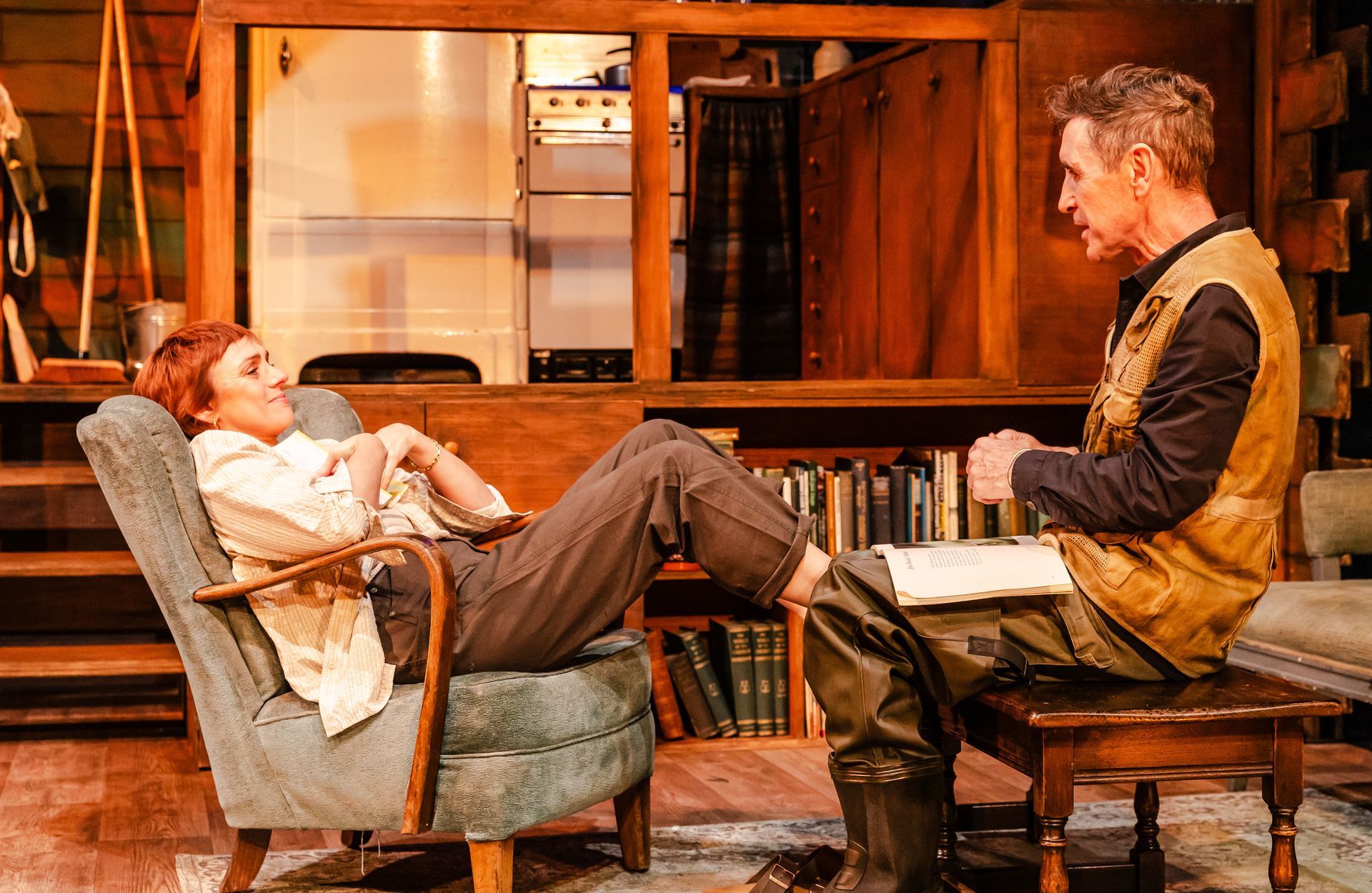
Traditionally, Bedroom Farce is staged behind a proscenium with three bedrooms side by side. Here, Michael Holt has placed one larger bedroom centre stage and inserted two more, obliquely into the downstage part of the Mill’s arc-shaped playing space. It’s a neat solution which works a treat.

Comic timing is, of course, the key to Bedroom Farce and Robin Herford, who has worked extensively with Alan Aykbourn ensures that all eight actors spin off each other with joyful aplomb. Every time-honoured line (”not often …”) is placed with precision. We relish every bit of miscommunication.

There is an exceptionally strong performance from Ben Porter as the troubled, earnest, humourless (autistic spectrum?) Trevor who has fallen out with his ditsy, nervy wife Susannah (Allie Croker – good), wrecked their friends’ party and always turns up when he’s not wanted. As his middle class parents trying (and failing) to help, Julia Hills and Stuart Fox get the mood perfectly.

Full marks too to Damien Matthews, whose character Nick is a fusspot with an exaggeratedly injured back which means he stays in bed throughout (except when he falls out) and has to assert himself mainly with voice. And my goodness, does one sympathise with his long suffering wife Jan (Georgia Burnell – nicely nuanced).

The whole premise of Bedroom Farce is characters turning up in other people’s bedrooms inappropriately, inspired apparently by an incident in which Aykbourn and his partner found themselves with an incongruous bedroom guest. It’s great fun in this production although we leave the theatre, knowing that none of these couples are ever going to be unequivocally happy – whatever that means –  because partnership is always a compromise and usually an uneven one at that.

Ayckbourn is always good on food. Those pilchard sandwiches eaten  in bed … and in this production Ben Porter manages solemnly to munch most of a Cornish pasty while insouciantly listening to other people’s tensions.

I take exception, however, to the duvets which adorn the beds of both younger couples. Surely in the mid-1970s it would have been candlewick over sheets and blankets? But, in the scheme of things, that’s a pretty minor worry. If you want a couple of hours’ gently thoughtful theatre complete with lots of laughter, this is one to catch.


BBC Philharmonic Orchestra

Anja Bihlmaier

Tobias Feldmann

Royal Albert Hall


Anja Bihlmaier is the BBC Philharmonic’s new principal guest conductor and she clearly has a warmly incisive rapport with the orchestra.

There was  powerful chemistry between her and violinist Tobias Feldmann, also from Germany, making his Proms debut with the Beethoven concerto: arguably the loveliest piece ever written for the instrument.  He found a mellifluous tone in the first movement, making this most familiar of pieces sound freshly full of light, shade and fluidity. The larghetto was languidly slow with oodles of sweetness which gave scope for Bihlmaier to bring out the gentle beauty of the wind parts and I loved the elegance of the bassoon with the soloist in the rondo.

Cadenzas go, it seems, in fashions. When I was growing up we heard a whole variety because it was said that the Kreisler ones – which we knew from recordings –  were too difficult to risk in performance. Then, suddenly, you heard Kreisler all the time. Now the fashion is Wolfgang Schneidehan (1915-2002) – as in this delightful performance. Basing his ideas on the version of the concerto which Beethoven wrote for piano and orchestra, Schneidehan turns the first movement cadenza into a timp and violin duet and it’s theatrical magic – personally, I can’t hear it too often.

Feldmann finished with Elgar’s Salut D’Amour, with orchestral accompaniment as his encore – charming, poised and affectionate.

The second half began with Sarah Gibson’s warp & weft and there was a sense of  great sadness in the hall. Gibson died, aged just 38, last month, suddenly, of cancer. Presumably, at the time the piece was programmed, she would have been looking forward to being present for the performance. So her textural collage, inspired by the art of Helen Shapiro, felt like a memorial. It features fragments of melody building to a coherent whole as in a piece of home-based weaving by women whose home-based art was traditionally regarded as second rate. There was spectacular work from the percussion section especially the mysterious xylophone runs and scaled gongs, one of which resonates dramatically at the end.

And finally to the glories of Brahms 4 which Bihlmaier took without baton – sometimes she does and sometimes not, according to the piece. She packed the first movement with mystery and colour and leaned lovingly (but never cloyingly) on the big Brahmsian melody in the Andante. The third movement was as “giocoso” as the composer could have wished and the string work in the final movement was deliciously powerful: plenty of the required passion and some delightful horn work.

PROM 23, Monday 05 August

Rachmaninov: Symphonic Dances (op. 45)
Busoni: Piano Concerto
London Philharmonic Orchestra
London Philharmonic Choir, Rudolfus Choir
Benjamin Grosvenor (Piano)
Edward Gardner (Conductor)

A pleasingly full Royal Albert Hall, for a Monday relatively close to the start of the season, greeted the London Philharmonic and its conductor Edward Gardner for tonight’s Prom.

First up was Rachmaninov’s last work, the Symphonic Dances: effectively a symphony in three movements. Opening with some wonderfully precise string work, particularly in the repeated down
bows, the movement then gives way to a lyrical wind section accompanying an unusual saxophone solo – a Russian theme played on an American instrument with great pathos by Martin Robertson.
The second movement, a waltz in G minor opens with, and is interspersed throughout by, cheeky brass fanfares, here given the proper fortepiano crescendo treatment by Edward Gardner and his players.
Gardner, quite rightly, never allows Rachmaninov’s waltz to get too comfortable – tempo changes and dynamic markings are particularly well observed.

The third movement, incorporating themes from the composer’s own All Night Vigil in juxtaposition with his much-favoured Dies Irae theme, in Gardner’s hands rattles along with continually forward-moving
tempi without ever falling into the trap of running away with itself – in all, a thoroughly enjoyable performance.

If the Symphonic Dances is a symphony lacking a movement, Ferruccio Busoni’s Piano Concerto, op. 39 is arguably a concerto with a couple of movements too many. An immense piece, running over and hour
and ten minutes, I would suggest Busoni would have benefited from the guidance of a firm editor: the piece never quite seems to make up its mind what it is.

For example, during the stately introduction (eclipsing in length many a concert overture) I forgot the piece was actually a concerto. However, Benjamin Grosvenor as soloist was first class: the technically
very difficult arpeggiated sections in the first movement danced, alternating the emphatic and playful passages beautifully. Later I particularly enjoyed the contrast he found in the third movement in a series of cadenzas in between passages of sombre lower strings.

Oh, and in the last movement, apropos of nothing, there’s a male-voice choir…. and a Rossini-esque gallop: both sung and played beautifully, but glaringly incongruous.

In this battle between soloist, orchestra, conductor and assembled forces versus the composer, in this evening’s contest, I think the musicians had it. But it’s not one I’d rush to again.

The Yeomen of the Guard

Arthur Sullivan and WS Gilbert

Charles Court Opera Company & Opera Holland Park

Directed by John Savournin

Musical director David Eaton


Photograph by Ellie Kurttz


This is the fourth year of collaboration between Opera Holland Park and Charles Court Opera and CCO’s first production of The Yeomen of the Guard. Dating from 1888, it’s a rather splendid piece which moves well beyond the usual G&S melodious comic romp, in many ways.

The Opera Holland Park setting with its huge width and annular playing space, surrounding the City of London Sinfonia, calls for something very different from CCO’s trademark, small cast, piano-accompanied, chamber versions of these operas. And on the whole it gets it in this production which casts all the soloists and has a chorus of twenty. John Savournin, and his choreographer, Merry Holden, create some visually attractive tableaux with, for example, the Yeomen Warders in solemn formation or the villagers in sepia pastels (design by Alyson Cummins) looking like a 16th century pastoral painting.

It felt a bit flat, however, for most of the first act. It was opening night and of course there were nerves, as well as some sound balance issues. Moreover Llio Evans who plays Elsie Maynard was unable to sing so she walked the part while Ellie Laugharne made a marvellous job, presumably on little or no rehearsal, of voicing the character from the pit. It was a very satisfactory solution but it probably worsened first night anxiety in the rest of the cast.

Sullivan actually wrote The Yeomen of the Guard overture himself, rather than, as he usually did,  tossing the job to an assistant, who would create a medley of the show’s best tunes. And it’s beautiful, so personally I’d rather listen to it without  distracting – and in this case pointless – stage action.  Then the opening is challenging because the opera starts with Phoebe (Samantha Price – good once warmed up) alone on stage with her spinning wheel and “When maiden loves”. In this case it was followed soon after by Savournin as the jailer, Wilfred Shadbolt, singing “When jealous torments reach my soul”. This number was cut very early by WS GIlbert and doesn’t  appear in the licence copy which was sent to the Lord Chancellor in 1888. In all my years of G&S enthusiasm I have never heard it sung before so it was an interesting curiosity but, sadly, pretty dull in theatrical terms.  It works much better dramatically to move on to the bustling chorus entry more quickly which is what usually happens.

Matthew Kellett, a CCO regular, is outstanding as the travelling jester, Jack Point. He gets all the character’s nervous energy right and, although I couldn’t always hear every pattered word from Row O, with OHP’s surtitles it doesn’t matter too much. He also gives us a very plausible tragic ending as the professional fool who’s really a vulnerable human being who doesn’t deserve the rejection he eventually suffers. Kellet makes it funny, of course, but there’s also a lot of depth. And – as a bonus – he looks wonderful in, for example, in “Hereupon we’re both agreed” because he’s a small man. The nimble duet with Savournin’s very tall, ungainly Wilfred, presents the pair looking enjoyably incongruous together.

The second act is much better than the first, or at least it was on the opening night.  It’s much pacier. The four part madrigal  “Strange Adventure” (Natasha Agarwal as Kate, Amy J Payne as Dame Caruthers,  William Morgan as Fairfax and Daniel Jeffery as Sergeant Meryll) was a musical show stopper with every note and harmony deliciously accurate, immaculately held together by conductor David Eaton. Another high spot was the sensitivity of “When a wooer goes a wooing”.

I was taught in childhood that The Yeomen of the Guard with its dark story of imprisonment (cf Fidelio) thwarted love and unhappy marriages was the nearest Sullivan got, with Gilbert, to the Verdi-esque grand opera he thought he wanted to write. This production certainly brings out that ambivalence with some strong characterisation and rich singing.

Full marks, moreover to the City of London Sinfonia who, as always, do grand work in the pit allowing us to hear clearly every note and nuance of Sullivan’s colourful orchestration and musical storytelling.