Press ESC or click the X to close this window

Frank’s Closet (Susan Elkin reviews)

Frank’s Closet continues at the Union Theatre until 30 March 2024.

Star rating: four stars ★ ★ ★ ★ ✩

Stuart Wood’s tenderly affectionate 2009 show fits the shabby chic of Union Theatre perfectly. It’s all layers of tulle, red lights and painter pillars thanks to the appropriately retro designs by Catherine Phelps (set) and Ben Bull (lighting).

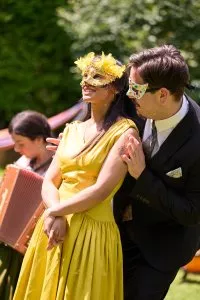
It’s a drag queen show in which five of seven performers are male and cheery campness is what makes it work so well. Sasha Regan, as ever, works wonders with her cast.

The eponymous Frank (Andy Moss) is about to marry his partner Alan (unseen until the final scene). The problem is that Frank has been collecting theatre costumes all his life and now they have to go – to the V&A.

So we are treated to an exposition of the costumes and the people who wore them while he explores his closet one last time. Gentle, witty nostalgia is what this is all about.

Not that there’s anything self-indulgent about this show which pounds along with zippy energy and some fine singing, often in harmony, and although there was a slight issue with sound balance (band louder than singers) at the start on press night, it soon settled.

Moss is rueful, engaging and appealing as Frank …

Read the rest of this review at Musical Theatre Review: https://musicaltheatrereview.com/franks-closet-union-theatre/

Philharmonia

Pablo Heras-Casado

Nicola Benedetti

Royal Festival Hall

14 March 2024

Louise Farrenc (1804-1875) is at last getting the recognition she deserves, I have,  for example, spent most of this term learning the second violin  part of her third symphony and her work is frequently aired on Radio 3.  And now comes a performance of this fine overture in E minor (Op 23) which starts with a solemn intro followed by appealing work with lots of semi-quavers and a colourful dynamic range – all brought out  by Pablo Heras-Casado who is business like and unshowy and doesn’t use a baton. The performance included some  attractive clarinet playing.

On this occasion the Philharmonia was ably led by Marika Faltskog who had to move at this point in the concert.  The harp was wheeled into place between first and second violin front desks for Bruch’s Scottish Fantasy  from which position harpist Heidi Krutzen could duet with violinist Nicola Benedetti,

Benedetti gave us a very sweet sound in the first movement and some resolutely incisive double stopping in the second which ended with a stunningly beautiful segue into the andante. The whole piece is folksong-inspired but this is the most folksy movement of the four. Benedetti and Heras-Casado made it sound both natural and affectionate without self-indulgence. Then in the fourth movement we got Benedetti almost dancing through all those demanding virtuosic passages interspersed with lyrical contrasting moods underpinned by the harp.

Now, visibly and comfortably pregnant, Benedetti radiates friendliness on stage –  and not only with her fellow players. A teenage boy presented her with flowers from the front row and I was moved to see her crouch to his level and engage him in a proper conversation. She’s a communicator in every sense.

And so to Beethoven’s Fifth. Like anyone else who has spent her whole life standing firmly on the classical music square, I’ve heard this symphony, literally, hundreds of times. Yet I never cease to marvel at the magic old Ludvig weaves with piccolo and timp in the final allegro. And Heras-Cabado (now without score) ensured that we heard and appreciated every beat of that joyous excitement.


He also treated us to a nippy, nicely modulated first movement, a silky grandiloquent andante and a dramatically robust scherzo with some splendid work from lower strings and woodwind. And my goodness, Heras-Cabado is good at coaxing contrasting dynamics. His pianissimos are magical.

Another enjoyable evening with the Philharmonia –  who must have been gratified to see the hall packed almost to capacity.

The Barber of Seville

Charles Court Opera Company

Wilton’s Music Hall

When Rossini (aged only 24) wrote the Barber of Seville in 1816 it was intended to entertain the masses and make him lots of money. It did both.  It was nothing to do with elitism, audience dress codes, handwringing, subsidies and wokeism.  And that’s exactly the spirit of Charles Court Opera Company’s two hour take on it. I smiled so much that I left the theatre with my face aching because this highly accomplished production is such enormous fun.

First – of course – the music. Musical Director, David Eaton has worked closely with director Joohn Savourin throughout the development of this show and that cohesion is palpable. He sits at an old fashioned upright piano below stage left and directs as much with his eyes as with what he plays. He and the cast of seven time time every note almost perfctly – and that’s quite an achievement, given the amount of recitative in the mix to drive the story telling.

That slightly tinny piano is a deliberate choice with Eaton in a Stetson and denim shirt because this Barber of Seville is set in the Wild West where Bartolo (Matthew Kellet – splendid) runs, or tries to, a saloon bar. Rosina (Samantha Price, mezzo, who role-shares with Meriel Cunningham) is his wealthy ward whom he makes work in the bar and plans to marry as soon as possible. Then a glamorous “bandit from Texas” ( tenor Joseph Doody, role-sharing with John Gyeantey) turns up although of course his real name is Count Almaviva. And so the daft plot, which transfers cheerfully to this context, wends its wacky way. And visually it sits almost integrally in the arty shabbiness of Wilton’s Music Hall.

The real star of this show is Jonathan Eyers as Figaro. He has enormous on-stage charisma. He uses his mellifluous bass voice with warmth and delivers beautiful chocolate-rich notes in the lower part of the register. He brings exceptional rapport – both musical and dramatic – to duets and other shared numbers. He’s also an immensely talented actor who grins, gestures, communicates with his fingers and commands the stage for every second that he’s on it.  Because of his willowy body shape and considerable height he looks wonderfully funny too especially when he’s gesturing or dancing.

This show is characterised by outstanding singing – whether it’s a full blown aria such as Price’s solo in which she laments her predicament and makes a puppet of her mop, or a sextet in which everyone is expressing a different point of view. And most other opera companies could learn a lesson or two about clarity of diction and precision from the way Savourin and Eaton have directed these performers.  Every syllable lands impeccably.

So what of the transferred plot? Well, Eaton is a lot more than a musician. He has written a hilarious libretto which gets a lot of humour from anachronism as well as weaving in lots of references to the Wild West including film and show titles. Because, however, Eaton is a musician, literally to his finger tips, every word fits the music because – presumably – he hears in his head the music that the words have to fit as he writes them. Bravo!

This is definitely a show not to be missed. I beamed all the way home.


I recently reviewed a  2024 children’s book for a magazine in which I said it was like Charlotte’s Web crossed with Harry Potter. In truth I was just trying to think of something which features anthropomorphic arachnids, insects and the like. But it reminded me that it was a very long time since I read EB White’s 1952 masterpiece, although I’ve reviewed at least two theatre adaptations.  So back I went to revisit it.

It is, of course, a rich celebration of friendship. Wilbur is a runt piglet in Maine, rescued from her farmer father and hand-reared by Fern. His ultimate destination, obviously, “should” be bacon and pork. That’s the whole point of keeping pigs on a farm. Wilbur who can talk and reason, feels lonely in his pen and needs a friend especially when he realises what his future is. Enter Charlotte, a big grey spider whose web is above him in the barn. Charlotte is a delightful creation. She has all the attributes of spiders: spins, propels herself on draglines and eats flies but she speaks very articulately and is literate.  She’s also very kind and wise.

Once they realise that it won’t be long before Wilbur is taken to market she hatches a rescue plan. She creates words in her web praising Wilbur which amazes the human beings and, in the end, turns “Some pig”  into an attraction who will probably never be slaughtered – with reluctant support from self-interested Templeton the rat whose personality most of us would recognise. He’s hard to dislike but not to be relied upon unless there’s plenty in it for him.

The details are beautiful. Everyone needs a friend like Charlotte – and considering how chary many people, including children, are of spiders that’s quite an achievement. Unfortunately, however, spiders live for only one season, while – if they’re allowed to live out their natural span – pigs live for decades. But there is a moving message about the rhythms and continuity of life at the end.

Fern and her brother Avery are nicely depicted. She loses most of her interest in Wilbur when he gets big, as most children would but White – himself a Maine man and a keeper of animals – knows how children love to play, spend money at the fair, get dirty and charge about.

The edition I re-read had Garth Williams’s original illustrations and they’re a delight too: charming, loving and witty. We used sometimes to use Charlotte’s Web as a Year 7 class reader with reluctant readers.  I’m so glad I’ve found it again.

The Lonely Londoners

Novel by Sam Sevlon, adapted by Roy Williams

Directed buy Ebenezer Bamgboye

Jermyn Street Theatre

Star rating 4

It’s 1956 and we’re in Bayswater where four West Indian men are trying to make the best of a new life which includes grey skies, cold, hostility, misunderstandings and disappointment. It’s a case of balancing the knowledge that they are British citizens against the way most Londoners regard them.  It calls for pragmatism which not all of them can manage. All the tensions, anxieties and fears are there. Getting work is difficult, as is finding accommodation, the white prostitutes in the park are tempting and what about the wives and girlfriends back home? Even when they’re “sent for” the adjustment required is too much for some.

All this is neatly but movingly packaged (with some rueful humour) in this fine, far reaching play for a cast of seven – on stage throughout and moving in and out of the action. Roy Williams’s script is punctuated by mime sequences  against Toby Gayle’s dramatic sound design and Elliot Griggs’s lighting, when there are things to be said which go beyond words. It’s powerful, heart-wrenching stuff.

Gamba Cole is splendid as Moses, the man in whose “flat” the action takes place as he offers advice and tries to be the voice of realism. When, eventually, we learn his backstory it’s devastating. Tobi Bakare plays the unemployed Lewis with great subtlety: he’s a very troubled, angry man and when his wife Agnes (Shannon Hayes – good) and mother (Carol Moses – outstanding observation) arrive it just complicates and worsens things. Romario Simpson is strong as the newly arrived Galahad full of cheery expectations which aren’t going to be fulfilled – or not for a long time, anyway. Gilbert Kyem Jnr as Big City is, literally as well as figuratively, a towering presence on stage although he’s working too hard at the Trinidadian accent which often obscures clarity. And Aimee Powell adds a lot of plaintive atmosphere with singing from the back, unaccountably, until we realise she’s Moses’s girlfriend and a voice from the past in every sense.

It’s quite a coup for Jermyn Street Theatre to stage the world premiere of a new Roy Williams play. It is, as ever, certainly a small theatre whose size belies its achievements.

Love from Carmen

Rayne Theatre, Chickenshed

Words by Paul Morrall, music arrangement and direction by Phil Haines

Directed by Cara McInanny

Star rating 4

Rarely have I seen a more energetic show anywhere – ever. Michael Bossisse’s fluid, slick choreography means that the stage, with its huge cast, is never still. This imaginative retake on Bizet’s Carmen is visually like a continuously shaken kaleidoscope and therefore theatrically very exciting.

This is a Carmen for 2024 (Chickenshed’s 50th anniversary year), set in a refugee camp where feelings of antagonism, love and jealousy are running high and the main metaphor for hope is a circus within the camp run by a feisty young woman named Carmen (Bethany Hamlin).

Did I say circus? That means we get, among many other delights, some stunning above-stage ribbon and hoop work, lots of make-you-gasp back flip and somersault sequences and Michael Bossisse (who plays Escamillo very warmly) dancing on jumping stilts. Oh yes, vibrance is the key word here.

Bizet’s music, full of very strong rhythms, lends itself to the drum and bass mix treatment and the words are mostly in rap form – a lot of words, apposite, witty and forthright, and the diction is always clear as principals and narrators drive the plot on at high speed. And that’s my only reservation about Love From Carmen. It’s so intense and complex in concept that the story telling gets blurred. I suspect that anyone who didn’t know  the plot of Carmen would have had only the haziest idea of what was going on.

Hamlin is superb. She sings acts and dances (a lot of ballet-inspired work in this production) with all the cocky passion that the role needs – and for good measure gives us a bit of impressive aerial hoop work. Cerys Lambert, who also directs the circus skills, is strong as the contrasting pale, anxious common-sensibe MIcaela and sings beautifully. And there’s lovely work from all the male principals too.

This show uses the usual massive Chickenshed ensemble many of whom sing short numbers – and, as always, you have to be quick to spot who’s actually singing. Occasionally there’s some pleasing harmony work as well.  Rarely still, the all singing, all dancing ensemble is impressively managed and includes some very nifty work with wheelchairs and props such as school desks.

I admire very much the way this gloriously inclusive production respects Bizet’s masterpiece but puts a completely fresh spin on it. All the famous earworm melodies are in – complete with all those mixed in additions. And the ending is terrific. We get Bizet’s wonderful, final dark climax music more or less straight and a series of five second blackouts as the story reaches its tragic conclusion. Very powerful indeed.

I was within a hairsbreadth of awarding this magnificent production a fifth star but felt, ultimately that I had to withhold it because of the storytelling flaw. Think of it as four and a half.

My attention was drawn to Valérie Perrin’s 2020, warm, moving novel about love and loss by a French friend who read it in her native language. I thought about that but it would have taken me at least a year so I plumped for an English (American) translation which reads pretty well with only very occasional infelicities, That indefinable but distinctive French-ness still shines through: the wistfulness, the realism, the food, the places and above all the cemetery where Violette works as resident manager. It’s like Debussy in words.

Brought up in orphanages and foster homes, Violette becomes pregnant and marries Philippe Toussaint very young. They manage – or rather she does – a railway level crossing. It’s a very dysfunctional marriage, somehow more plausible in a French novel than it might be in a British one. He’s an absentee father, a womaniser and lazy. And his parents really are the in-laws from hell. But nothing in this novel is simple or black and white and eventually we learn more about Toussaint and discover that he’s a complex, rounded character. He behaves badly but he’s a long way from a straightforward stereotypical useless husband.

When disaster strikes – and what happens is truly appalling – Violette gets a job managing a cemetery further south. Toussaint goes with her but disappears more and more often and eventually for nineteen years. At the cemetery she grows her own vegetables and sells plants to mourners and her garden becomes a symbol of regrowth and healing. Bound up with all this is another story. A man called Julien Seul turns up at the cemetery very puzzled because his mother has left unexpected instructions that her ashes are to be interred there with the body of a famous lawyer. Gradually this back story is unravelled and Violette begins to feel that at last she might be able to move on.

It’s a subtle take on “multiple narrators”. We shift back and forth through time sometimes in the first person and sometimes the third. There are letters and diaries. But it’s all made clear with dates and fonts as the narrative winds – it’s quite leisurely –  towards an unexpected twist and a strong hint of happy ending.

Perrin’s characters are very engaging. Sasha the elderly gay man,  whom Violette comes to love like a father and from whom she takes over the cemetery and the garden, is delightfully drawn. So is Celia the woman she invites into her home at the level crossing when a train is halted by a strike. Celia lives in the Midi and offers Violette the annual use of her chalet for a holiday – it’s a longterm friendship to celebrate. The grave diggers and undertakers are memorable too. There are many others but I’m not doing spoilers here.

This book got under my skin.. “Death is not an absence, It’s a presence” is a thought I shall long ponder along with the assertion that if you love someone then nothing, not even death, can take that away. Valérie Perrin was new to me but it won’t be long before I explore more of her oeuvre.

Next week on Susan’s Bookshelves: Charlotte’s Web by EB White


Show: Marry Me A Little

Society: London (professional shows)

Venue: The Stage Door Theatre. 150-151 Drury Lane, Covent Garden, London WC2E 9LB

Credits: By Stephen Sondheim, conceived by Craig Lucas and Norman Rene. Directed by Robert McWhir. Musical Director Aaron Clingham

Marry Me A Little

3 stars

Susan Elkin | 02 Mar 2024 10:17am

This compliation of nineteen Sondheim solos and duets into a loose investigation of marriage is an interesting idea but it becomes much more of a staged concert than a musical. It’s closer to a Schubert song cycle in concept and for that, the 60 minute run time is a long time for a contrived piece without coherent narrative.

Nonetheless Shelley Rivers and Markus Sodergren are both pleasing singers and hearing them work toether in a low ceilinged confined space without radio mics is more like opera than a musical but none the worse for that. Both are good at catching mood and conveying the joys, disappointments, yearning and regrets involved in any relationship. Rivers, whose intonation is almost always accurate, brings sweetness, along with a wide dynamic range and sustained full belt when she needs it. Sodergren, also catching many nuanced moods, brings a rather touching vulnerability to the role.  And I admired their rendering of Saturday Night which is effectively a fugue and pretty tricky.

All this is done, rather impressively, without visual cues. Aaron Clingham playing piano mellifluously is tucked away at the side where I suspect he can’t be seen by either singer.

We’re in the newly opened Stage Door Theatre above The Prince of Wales pub in Drury Lane which is an attractive, quite roomy space with the audience (who can also dine) sitting at tables. David Shields’s set occupies one end of the room and presents a domestic apartment with sofa, plants, fridge, shelves and the like. The intimacy of that audience proximity works quite well.

Director Robert McWhir makes sure that every inch of the small playing space is imaginatively used with plenty of movement and different moods evoked in corners and with props such as wine bottles.


First published by Sardines: https://www.sardinesmagazine.co.uk/review/marry-me-a-little-2/