Press ESC or click the X to close this window

Circle Dreams Around) The Terrible, Terrible past (Susan Elkin reviews)

Show: (Circle Dreams Around) The Terrible, Terrible Past

Society:  Ilkley Players Greenroom at National Theatre

Credits: By Simon Longman

(Circle Dreams Around) The Terrible, Terrible Past

3 stars


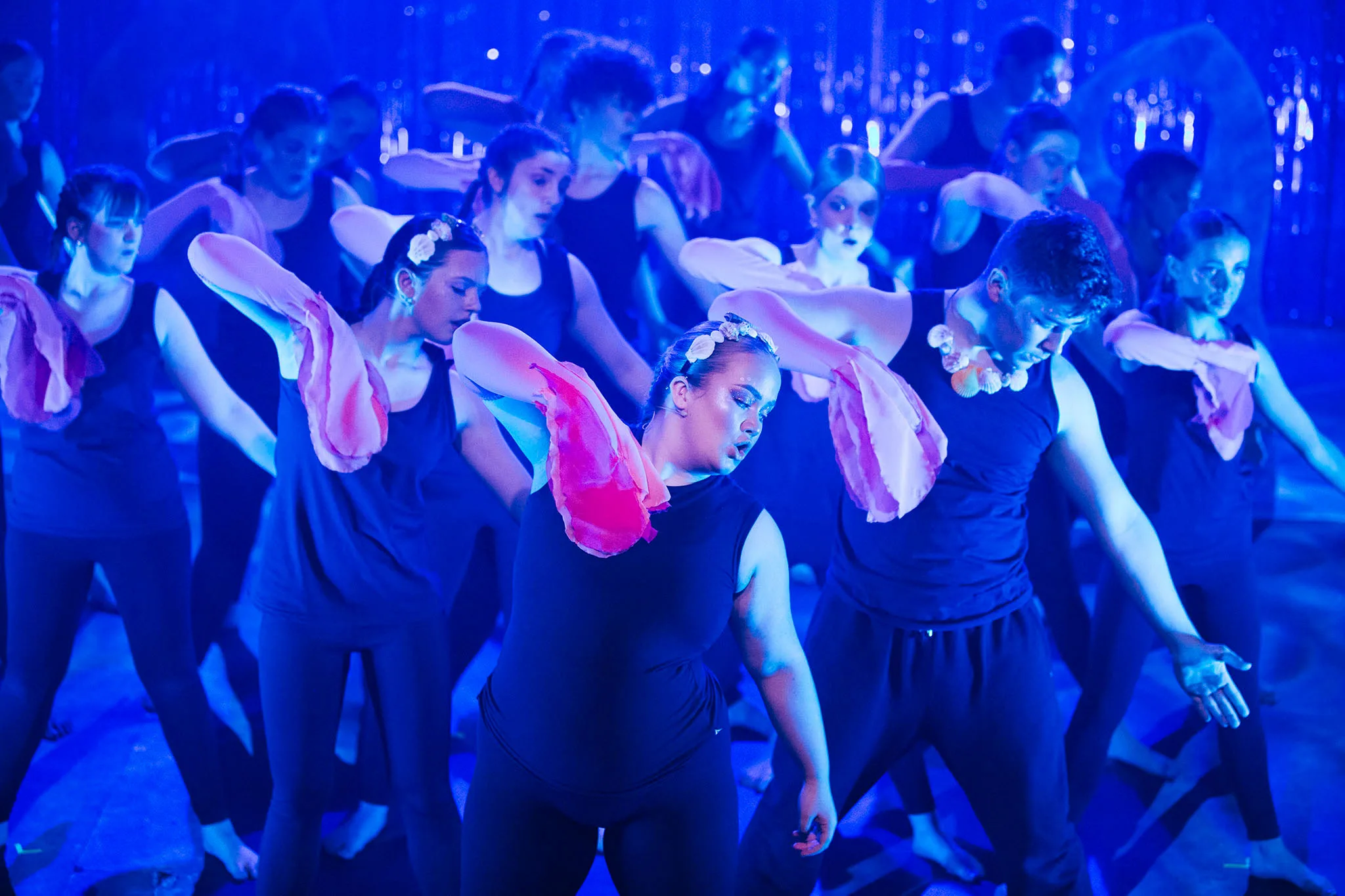
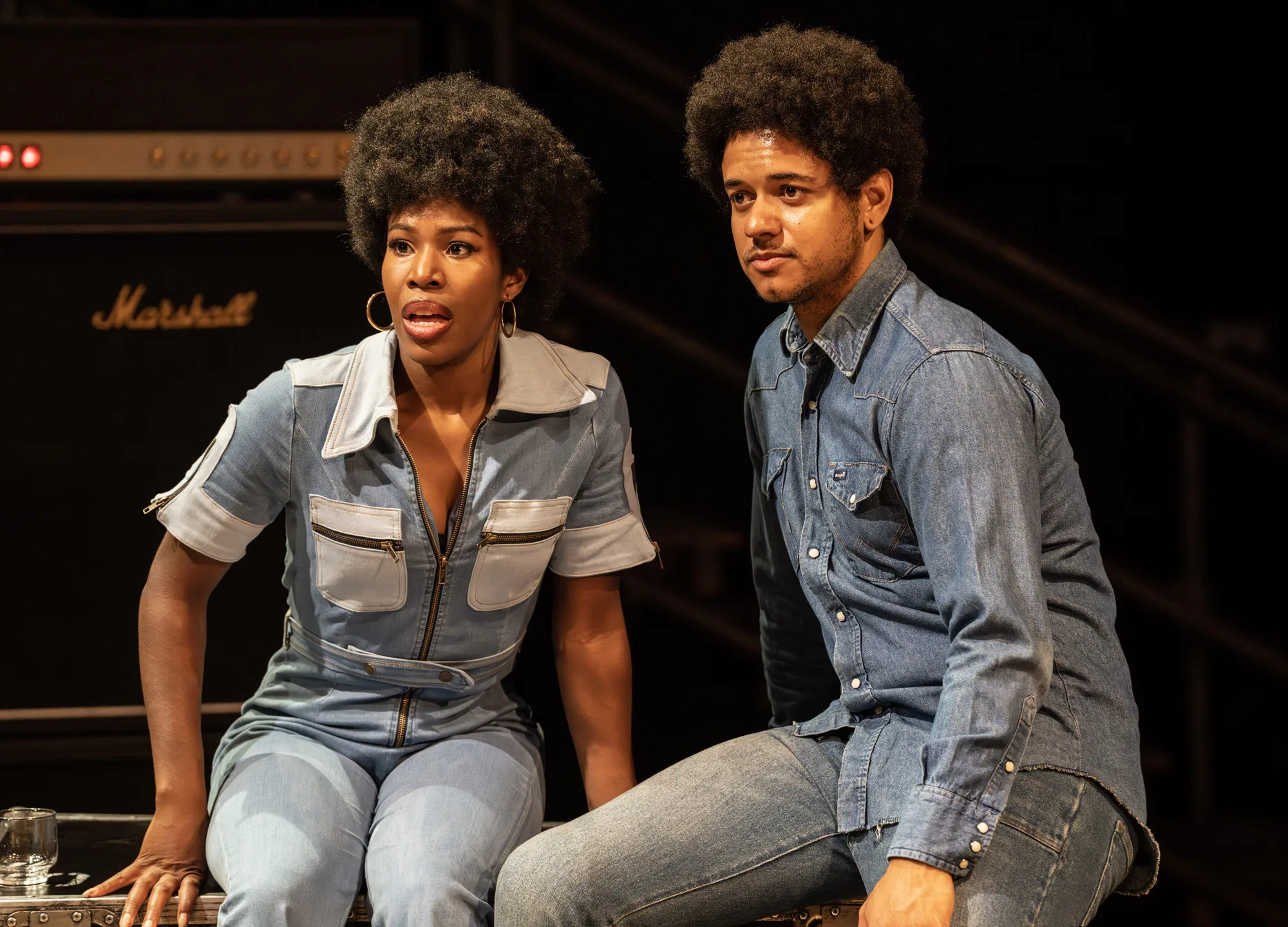
Photo: Jimmy Lee


The first of this year’s ten plays specially commissioned by the National Theatre for the Connections Festival, its annual youth drama festival, is a very experimental piece. Think Alice in Wonderland meets Samuel Beckett as we range across themes including nightmares, growing up, parental expectations and the circularity of life. It’s surreally funny in places with a lot of dark humour relating to undertakers, butchers, fishmongers and the symbolism of a lost shoe. Eventually the whole cast winds itself into a cat’s cradle of green luminous tape.

These young people –  most of them accomplished and conscientious – have clearly been directed (Andrew Leggott and Lisa Debney) to speak naturalistically and they do. The trouble is that for inexperienced actors in a space like the Dorfman it means that their projection is often weak. I was very glad of Stagetext’s captions at the side. The play itself is, moreover, too long and would have been better 15 minutes shorter.

First published by Sardines: https://www.sardinesmagazine.co.uk/review/circle-dreams-around-the-terrible-terrible-past/

Once Mr E and I had become an item in 1967 he took me to meet his maternal grandparents and it was lovely. His granny, Alice Hyne, was a very bright former grammar school girl whose promising career in the Civil Service was aborted by her marriage in 1917. She knocked off the Daily Telegraph cryptic crossword every day and had completed it, as usual, the day before she died (COPD with complications) in 1974. Of course she was an avid reader and liked and approved of me immediately because I was (am) too. She also liked my being a teacher because that’s what her mother had been before marriage. Granny Hyne willed me her well thumbed complete works of Shakespeare which not only had she read but used frequently to find crossword clue answers. I treasure it.

One day she asked me if I’d read Mazo de la Roche. I hadn’t so I did. Roche (1879-1961) was a Canadian whose most famous work is the Whiteoak Chronicles – a 16 book series about a British family who settled in Ontario in the mid-19th century. It spans a hundred years. Well I’ve always been a sucker for a family saga and I lapped it up – borrowing the books from the library. Gradually I became aware that some people are snooty about Roche possibly because she’s Canadian and maybe because she’s a story teller without literary pretensions. In the end I moved on to something else and didn’t mention her in “polite society”. In fact I suspect she’s far more highly regarded in Canada than she is in snobby Britain: her home in Toronto is now a “Heritage Property.” In Ontario there are schools and streets named after her and her characters. She’s been serialised on Canadian TV.

Coming back to Roche now in my mature years – with decades of serious academic study and teaching behind me – I opened The Building of Jalna on my Kindle, very curiously. It was published in 1944, by the way, and is the chronological first book but she didn’t write them in order. The first was published back in 1927 but actually falls in the middle of the sequence. The last title was Centenary at Jalna which was published in 1958, three years before Roche’s death. Did she have the whole thing mapped out in her head, I wonder, or did it simply evolve?

The Building of Jalna tells the story of Adeline Court and Captain Philip Whiteoak who meet in India, fall in love, marry and eventually decide to go to Canada to build a house on Lake Ontario. They’ve inherited the money to enable them to do this. The characterisation is strong. Adeline is a feisty, convention-defying impulsive redhead who doesn’t suffer fools and usually gets her own way. He is a competent, tolerant, attractive man also determined to make everything work well. The sexual attraction between them is vibrant but Roche (almost certainly gay herself) doesn’t do sex scenes and that’s rather refreshing. We get the message without them. There are other interesting characters too: the troubled Wilmott, whom they met at sea en route from Britain. Then there’s Robert, the son of the couple who put the Whiteoaks (and their two children) up while Jalna is built. Both are clearly entranced by Adeline but this is no soppy romance.

We get a vivid picture of the unspoilt mid-nineteeth century Ontario landscape and weather although Roche also makes sure we don’t miss the sadness of cutting down virgin forest for building. The other thing I really admired was Roche’s depiction of the voyage out – the storms, the damage to the boat, the seasickness and the death of their Indian ayah at sea. It is all pretty awful as many such voyages must have been.

In short, I enjoyed it and at my advanced age I am not remotely ashamed of that. I believe passionately in eclectic reading. If it grabs you, then go for it.  A good storyteller is worth celebrating and that’s what Mazo de la Roche is.  She sits somewhere between RF Delderfield and Daphne du Maurier in style. I have downloaded  Morning at Jalna which is the second title in the series. And, a little bonus, I’ve thought a lot about Granny Hyne in recent days and have been chatting to her in my head.

Next week on Susan’s Bookshelves: Death in Venice by Thomas Mann

Jane Eyre was performed by the Royal Academy of Music’s Musical Theatre Company at the Susie Sainsbury Theatre, London.

Star rating: four stars ★ ★ ★ ★ ✩

This version of Jane Eyre, further developed in the US in the late 1990s, was completely new to me. It’s a pacy adaptation which omits a few incidents and combines some. Most of Charlotte Brontë’s plot is, however, intact and some spoken lines are verbatim from her pages.

Paul Gordon’s score (accompanied by John Caird’s book and lyrics) is rich and melodic and provides an evocative subtext to the action. And it is beautifully played by an eight-piece band, deep in the forestage pit conducted by MD Ian Sutherland. I particularly admired Kumjung Lee’s wind work on flute, alto flute, piccolo and soprano recorder.

There are two casts for this show who do three performances each. I saw Cast A. Each cast comprises 13 performers. All are students on Royal Academy of Music’s one-year post graduate Musical Theatre course which operates as a company.

Of course this is the Royal Academy of Music so you expect a very high singing standard and you get it. Lucy Carter ….

Read the rest of this review at Musical Theatre Reviews: https://musicaltheatrereview.com/royal-academy-of-music-jane-eyre/

Gavin Maxwell’s thoughtful, tortured account of his childhood is forever associated in my mind with Laurie Lee’s Cider with Rosie because both books were enthusiastically promoted by my teacher training college for what they would teach us about child development. I reread the latter and featured it here recently and that prompted me to go back, for the first time since about 1966, to Gavin Maxwell’s The House of Elrig (1965) which I now realise must have been hot off the press at the time.

Actually the two books couldn’t be more different although both authors became professional writers. Lee grew up in a humble home full of siblings in rural Oxfordshire. Maxwell, on the other hand, came from an aristocratic, landowning family. His mother was a Percy (the family name of the Dukes of Northumberland – see Shakespeare’s Henry IV part one, for example or visit Petworth House in Sussex). Maxwell is entertaining about the eccentric Percy uncles and their wives.

The Maxwells owned Monreith in Scotland and had an illustrious history of public service. The titular house which the young Maxwell loves with passion is on the Monreith estate and was home to him and his three siblings. His father was killed within hours of arriving at the front in France in the autumn of 1914 when Gavin, his youngest son, was three months old.

ELRIG3 (1)

The adult Maxwell found fame as a naturalist and his Ring of Bright Water (1960) about his relationship with otters is unforgettable, not least because of the 1969 film starring Bill Travers. All the signs of what would occupy the adult Maxwell are clear in The House of Elrig although attitudes to natural history and animal welfare have changed a lot since the 1920s. It’s hard for the modern reader (this one, anyway) to accept that plundering birds’ nests, killing insects as collector’s items and shooting game birds were ever considered compatible with a love of nature.

The most striking thing in the this book, though, is the sheer misery Maxwell suffered in two out of three of his prep schools and, once he was thirteen in the two years he spent at Stowe. He was totally innocent of sex, for example, until he was in his mid teens, Teachers keep issuing wordy warnings which he doesn’t understand. If he is perceived to be getting friendly with another boy, because of a shared interest in oology for example,  then both are punished – often physically. For a long time he has no idea what this adult anxiety is about. Of course there’s a lot of bullying too. Maxwell is shy, awkward and bemused.

Most of his teachers are terrible communicators and he is bored by them and what they’re trying to teach him. It’s a dreadful indictment on private education for boys between the wars. He spends much of his time in class dreaming of Elrig, walking round the estate in his head, looking at trees, wildlife, chatting to the gamekeeper and walking the paths. At one level it’s a very moving account of acute homesickness.

It’s interesting – amusing almost –  how language and connotation has changed in 67 years.  Maxwell describes the matron at Stowe, where he suffered a near fatal illness which finally put paid to his schooling, as “always kind, paedophile”. The word, of course, literally means “child loving” from Greek and, it seems that in 1965, you could use it to mean something perfectly pleasant and decent.

The House of Elrig is a good, uncompromising honest read with some beautiful descriptions of the natural world.  And those lecturers at Bishop Otter College were right. It is also a compelling account of how it feels to be a child in a situation over which you have no control.  How sad that Maxwell died (lung cancer) so young in 1969 at only 55.

Next week on Susan’s Bookshelves: The Building of Jalna by Mazo de la Roche


The Mikado continues at Wilton’s Music Hall, London until 1 July 2023.

Star rating: three stars ★ ★ ★ ✩ ✩

It was, and is, probably Gilbert and Sullivan’s most popular show and it’s evergreen. Sasha Regan’s all-male version, set in a 1950s boys’ camp – all long shorts and knitted tank tops – is a refreshing way of reworking it.

Like her HMS Pinafore and The Pirates of Penzance, this production respects the core material while also taking huge, innovative liberties with it. And of course, with this talented, immaculately directed cast, it works – mostly.

We presume these boys are staging some sort of show in their camp. They wander about during the second half of the overture doing campsite things and all the props (sausages on long skewers, cricket bat, wildflower fronds and so on) are campsite improvised.

Nonetheless the premise is confusing and you’re left …

Read the rest of this review at Musical Theatre Review: https://musicaltheatrereview.com/the-mikado-wiltons-music-hall/

Show: One Last Waltz

Society: London (professional shows)

Venue: The Bridge House Theatre. 2 High Street, Penge, London SE20 8RZ

Credits: By Luke Adamson. Directed by Luke Adamson and Joseph Lindoe

One Last Waltz

4 stars

This revival of Luke Adamson’s tender, beautifully observed play about encroaching Alzheimer’s, and inspired by his grandmother, is very welcome at a time when this hideous disease is in almost every family but not discussed or understood enough.

Recently widowed Alice (Judy Tcherniak) comes across her old dancing shoes and eventually decides she wants to revisit Blackpool where she and her late husband danced in 1958. Her daughter Mandy (Janna Fox), pulled in all directions, agrees to take her. At the hotel they meet manager Georgette (Julia Faulkner) who works a little miracle for Alice despite Blackpool’s having changed out of all recognition. As the 70 minute play progresses, Alice’s condition worsens steadily and there’s a chilling scene on the beach when she wanders off and gets lost.

Tcherniak is fragile, forgetful and convincing as Alice, one minute sweetly compliant and the next irascible and distressed, frustrated by her own brain – and in denial.  Fox makes Mandy totally believable too, loving her mother but with her irritation never far below the surface. The scenes between the two of them are very well judged and directed.

The outstanding performance in this production, however, is Faulkner who has played this role before. At first she’s all bossy obsequiousness and Mrs Slocombe, her vowel sound tortuously distorted. Then as she forges a friendship (of sorts) with Mandy because her own mother had Alzheimer’s her voice naturalises – it’s an impressively nuanced piece of acting. Finally she confesses to Mandy why she is racked by guilt and it’s pretty powerful theatre.

This play is not heavy or gloomy, however, In places it’s wryly funny. I defy anyone not to smile at Georgette’s repeated “croysont” or “pan o chocolate” or to enjoy her hangover through which she struggles to itemise a cooked breakfast for Alice who then, because her tired brain can’t cope, makes her repeat it.

The set is a masterpiece of low budget imaginativeness too. It consists mostly of cardboard boxes some of which are arranged to suggest a small hotel check-in. Others suggest furniture in Alice’s home. Some are simply boxes which Alice should have unpacked but hasn’t. There is, however, a lovely visual surprise at the end.

Warmly nostalgic music takes us back to 1958 with Alice. It’s particularly good to hear Elvis Presley’s Are You Lonesome Tonight? with his impeccable diction, perfect intonation and  accurate timing. The slow waltz tempo is irresistibly appropriate so it really doesn’t matter that it wasn’t released until 1960, when we’re meant to be focused on 1958.

I first saw this play in 2018 when it was produced by Black Coffee Theatre at Greenwich. My late husband, who by then had quite advanced Alzheimers, came with me and the level of his engagement astonished me. I have very positive memories of that evening.  I was therefore  curious to see it again now because obviously I identify with every word of carer anxiety, fury, disbelief and guilt. Yes, I can confirm it still works very well as drama and I was glad I had a tissue in my hand at the end.

The play text was published in March by Renard Press and is available via Amazon or from bookshops: One Last Waltz by Luke Adamson IBSN 978-1-80447-027-5


Show: Romeo and Juliet

Society: OVO

Venue: Roman Theatre of Verulamium. Bluehouse Hill, St Albans, AL3 6AE

Credits: William Shakespeare

Romeo and Juliet

3 stars

Forget Verona. We’re in Belfast after the 1998 Good Friday Agreement and, of course, the narrative is a pretty good match. And I loved guitar-strumming Lyle Fulton’s quiet, measured prologue and epilogue.

Staged in the glorious Roman Theatre and set loosely at the docks in Belfast where people load sacks, climb grafitti-ed scaffolding and use funny little mobile phones, the production feels pretty truthful. And it’s all supported by popular Irish songs, many of them folksy, which punctuate the action. They don’t add much to the plot but they’re nicely played, ceilidh band style led by MD, Tom Cagnoni on guitar and they certainly underpin the period and atmosphere. We also get stylised balletic fights and choreographed group scenes (you can see the care with which they’ve been rehearsed )  which connote tension, joy, fear or death and the music works well with those.

Jenson Parker-Stone is outstanding as Mercutio – hopping about the stage, over-acting during the Queen Mab speech, doing cartwheels and singing beautifully. But of course, Shakespeare’s biggest show-off is also brittle and vulnerable and Parker-Stone gets that perfectly after the fatal stabbing.

Francesca Aldred’s Juliet is sweet but sensible. Yes, she falls head over heels in love with her rather unlikely Romeo (Ryan Downey), no conventional heart-throb but a convincing ordinary living, breathing young man, but she always seems in control. And she speaks the verse well. Arguably Juliet gets the best poetry in the play and Aldred knows how to make it work.

Kate Hamilton is wonderfully insolent and aggressive as Tybalt but it isn’t quite believable that a slender young woman would  be physically threatening to all those brawny dockers.

It’s a strong cast of twelve, including three musicians, playing a text which has been very neatly adapted so that lines are often re-assigned. Faith Turner, for example, plays Capulet who is actually a conflation of both Lord and Lady Capulet. She’s good and I suppose it makes sense for her character to have alcohol problems so that when she hurls her famous series of furious insults at Juliet she’s in a drunken rage. I’m a lot less sure about her late night pass at the nastily sinister County Paris (Matthew Rowan), though. It’s a good idea to have Benvolio (Lyle Fulton) also framing the play. Ben Whitehead doubles as a pretty rough Lord Montague and the Friar quite well although some sort of cross or collar to indicate his ecclesiastical status would make his second role clearer to anyone unfamiliar with the play.

Pronouns are changed along with place names and other things. I’m puzzled, though, about the choice of Dundalk in place of Mantua. Wouldn’t somewhere with three syllables to fit the rhythm of the verse have been better? Anna Franklin, as the Prince – the politician with authority – sweeps on stage twice and lays down the law in modern, unequivocal non Shakespearean language with an English accent and direct references to Northern Ireland. It takes you by surprise because it’s an abrupt swerve. On the other hand it drives home the message.

Of course the cast speak in Belfast accents (including Franklin when she’s doubling as an unusually lovable Nurse)  which are not native to most of them. So congratulations to accent coach, Josh Mathieson who has done a remarkably good job. I was almost fooled into thinking this was an all-Northern Irish cast.

First published by Sardines https://www.sardinesmagazine.co.uk/review/romeo-and-juliet-7/


Show: Yours Unfaithfully

Society: London (professional shows)

Venue: Jermyn Street Theatre. 16B Jermyn Street, St. James’s, London SW1Y 6ST

Credits: BY MILES MALLESON. DIRECTED BY JONATHAN BANK. Presented by Mint Theater Company

Yours Unfaithfully

3 stars

It’s fun to see a play which was written ninety years ago but never before staged in London. Mint Theater, which has co-produced Yours Unfaithfully with Jermyn Street Theatre, is a New York company whose mission is to dig up forgotten, neglected plays and to air them afresh. Mint’s artistic director, Jonathan Bank, staged this play in New York in 2016 but has now directed this new production with an all-English cast.

It’s the 1930s and we seem, initially, to be in a traditional drawing room drama except that this one is about free love, open marriage and sex. Anne (Laura Doddington) and Stephen (Guy Lewis) are a married couple with an understanding that flings on the side are fine – except, of course, that they love each other and whenever there’s an affair the other partner is jealous. It’s an exploration of the insidious habit feelings have of overpowering logic.  Also in the mix are Diana (Keisha Atwell), a young widow with whom Stephen starts an affair and Alan (Dominic Marsh) a doctor friend of them both and old flame of Anne’s. Tony Timberlake plays Stephen’s overbearing clergyman father who has inflexible, traditional views about sexual morality and a passion for cricket.

These five bounce off each other as they try, often unsuccessfully, to live their beliefs with truth and integrity. There is, however, a lot of discussion and although the occasional line is very funny it’s generally a rather wordy play despite the best efforts of Jonathan Bank to stage as much action and movement as possible in Jermyn Street’s limited playing space.

Doddington is superb. She finds warmth, suppressed emotion and a lot of brittleness in her character and her visible listening is very convincing. Lewis’s Stephen is openly emotional and he is very good at speaking silent volumes with his face. And Marsh gives us a character who is logical, wise, reasonable and kind. He’d be good to next to at a dinner party.

When you have no curtains or screens lighting becomes extra important. William Reynolds’s design makes imaginative use of  blackout for dramatic effect and is especially good when Anne finds Stephen asleep on the sofa in warming dawn light.

It’s a decent, enjoyable quite modest two hours of theatre but it doesn’t get under your skin or set fires alight.

First published by Sardines: https://www.sardinesmagazine.co.uk/review/yours-unfaithfully/