Press ESC or click the X to close this window

Unseen Unheard (Susan Elkin reviews)

Unseen Unheard: The untold breast cancer stories of Black women in the UK – Review

Theatre Peckham, London
****
Written by Naomi Denny
Directed by Simon Frederick & Suzann McLean
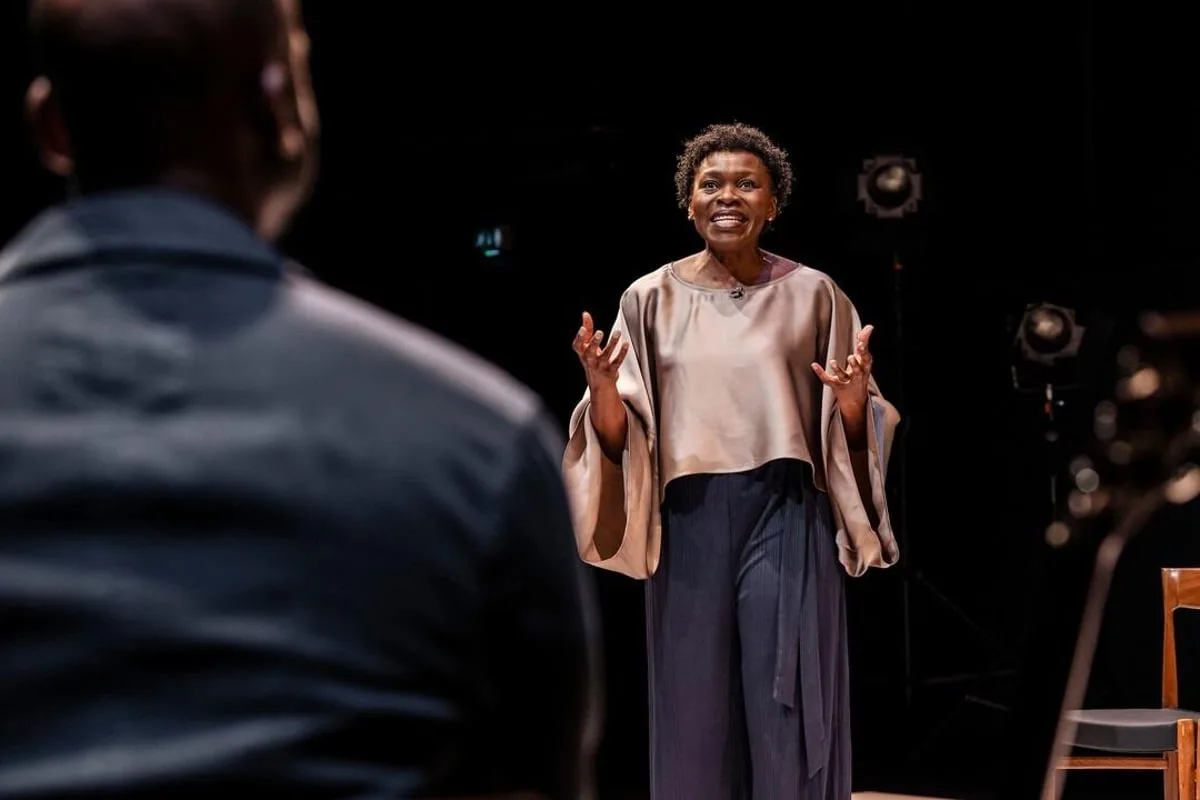
Six women attend a support group meeting for black women with breast cancer. It doesn’t sound like a promising premise for a lively play. It could easily have become a static, earnestly worthy documentary. In the accomplished hands of playwright Naomi Denny however, it’s anything but, with Denny delivering a pacey, dynamic, entertaining drama. Yes, of course, there’s anger, sadness and fear but there’s also a lot of wisdom and humour in this warm celebration of female friendship.
Denny has based her play on the testimony of five women, credited and named in the programme. From that she has moulded six characters, all very different but each a meaty role. And casting director Ali Anselmo has assembled an outstanding cast to bring these people convincingly and realistically to life.
Denise Pitter is very plausible as Pauline who chairs the meeting. She’s empathetic, respectful and carefully inclusive. Laya Lewis plays her passionate and funny friend Ruth. Both women are currently NED (no evidence of disease). Carol Moses’s Dorah, on the other hand, has Stage 4 cancer and is by turns forthright, bitter, outrageous, hilarious, kind and terrified. The nuancing is impressive.
As Sonia, Yvonne Gidden is tense, taciturn and apprehensive but gradually unbends and Genesis Lynea delights as her elegant, articulate doctor daughter although lack of age gap between them doesn’t work. Meanwhile Aliyah (Adaora Anwa) is the youngest attendee. Only 25 and still living at home she is struggling to come to terms with having been assailed by this disease so early in life.
The group dynamics are perceptively observed as they compare notes, concur, infuriate each other, argue, drink tea and share the food they’ve brought. Occasional freeze flashbacks (good lighting by Pablo Fernandez) provide insights into the experience of diagnosis or dealing with the horror of learning you have cancer as a single parent of two children.  It’s cracking drama as well as being informative. How many people know that a black woman with breast cancer is forty per cent more likely to die than a white one? This is a play with a powerful message.
First published by jonathanbaz.com http://www.jonathanbaz.com/2023/04/unseen-unheard-untold-breast-cancer.html

Musicals By Candlelight continues at St Paul’s Church, London until 10 June 2023.

Star rating: four stars ★ ★ ★ ★ ✩

This 60-minute concert was a happy meeting of several of my worlds. I review theatre and musical theatre. I have been attending classical music concerts all my life and these days review a fair number of them. I play amateur violin and am part of a quartet. So to hear an outstanding quartet playing theatrical music ticked a lot of boxes. It was definitely a concert with my name on it so thank you Musical Theatre Review for inviting to cover it.

Icon Strings consists of six  highly accomplished professional musicians of whom four played in this concert: Martyn Jackson first violin, Charis Jenson violin two, Sophie Lockett viola and Kirsten Jenson cello ….

Read the rest of this review at Musical Theatre Review https://musicaltheatrereview.com/musicals-by-candlelight-icon-strings-st-pauls-church/

Show: The Vortex

Society: Chichester Festival Theatre (professional)

Venue: Noël Coward

Credits: By Noël Coward.

The Vortex 4 stars

Photo: Helen Murray


The relationship between troubled sons and brittle, sexually active mothers is a rich source for drama. Shakespeare exploited it in Hamlet. So did Chekhov in The Seagull. And anyone who thinks Noel Coward was all about witty froth would do well to remember that his take on the mother/son theme, The Vortex (1924) was his first major success. It’s serious, quite dark stuff too, just spiced with the occasional whiff of Cowardian irony.

Moreover, if you can cast a talented real-life mother and son (Lia Williams and Joshua James) then there’s bound to be some pretty potent chemistry.  Yes, we’re in plush, stereotypical Coward drawing room (design by Joanna Scotcher) with tea tables, comfy sofas and a piano on which James’s character Nicky plays extracts from George Gershwin’s Rhapsody in Blue which dates from the same year as the play. Or at least that’s where we are until, along with some dramatic work with the revolve, it all disappears as we enter a bare-staged quasi nightmare with Lia Williams’s Florence.

It opens like a traditional drawing room drama with the cast of ten gradually assembling. Nicky, to everyone’s surprise, brings his new fiancée (Isabella Laughland)  home to meet his mother. There’s tension immediately and it later transpires that she and Florence’s lover know each other well. Also in the mix is an outrageously camp friend (Richard Cant having fun), a jazz singer, a family friend and Nicky’s very marginalised father.

It’s “a vortex of beastliness” in which jealousy is the norm and hardly anyone is reasonable with anyone else. There’s a lot of meaty subtext which would repay detailed study. The “closet scene” in which Nicky and Florence finally confront each other in a rawly empty, smoky  space is electric and we know that although promises are eventually extracted, the chances of their being kept are minimal. It’s a nuanced, ambiguous conclusion.

Williams, tall lithe and imposing glitters in this role and perfectly captures Florence’s shallow self-absorption along with her vulnerabilities. And James matches her beautifully. One isn’t surprised to read that he has, in the past, played both Konstantin and Hamlet. The support cast does a generally convincing job too.

The Vortex was originally a three act play. This production gives us a succinct version which runs for a continuous 90 minutes. Thus the pace never flags and it flows coherently towards its powerful final scene.


Show: Consent

Society: Tower Theatre Company

Venue: Tower Theatre. 16 Northwold Road, London N16 7HR

Credits: by Nina Raine. Directed by Ryan Williams.

Consent

3 stars

Photo: Robert Piwko


Nina Raine’s perceptive reflection on justice, morality, law and marriage feels as fresh now as it did when it debuted at National Theatre in 2017.

Four lawyers, bantering and often cynical, have interwoven lives. Jake (Nicholas Gill) and Rachel (Zella Rita Mazele) are husband and wife. Edward (Nick Edwards) and Time (Liam Brown) are their colleagues. Kitty (Ruth Kirby) is a publisher on maternity leave, married to Edward and Zara (Natalie Ava Nasr), who’s an actress, is friend of Kitty’s. Then there’s Gayle (Alexa Wall who doubles as Laura, a child custody lawyer) whose alleged rapist is prosecuted by Tim and defended by Edward. The relationships are not straightforward or fixed and there’s a lot of distress and reconciliation much of which relates to who has given sexual consent to whom. It’s certainly a thoughtful play with plenty to say to the me-too generation.

This pleasing production, niftily directed with a fine finale tableau, features seven competent actors who play off, and respond to each other pretty effectively. Liam Brown, in particular, is convincingly naturalistic as a lawyer conducting a difficult interview with a client. Then we see him with his friends sparring grittily while maintaining charismatic calm and quiet sex appeal – an all round impressive performance. Also excellent is Ruth Kelly, initially the exhausted mother of a new born, then as an anxious friend, later as a furious wronged wife and ultimately a in a (sort of) resigned resolution. Her range is striking.

Athena Maria’s set gives us a bar behind some sitting room furniture. It rather neatly serves as a kitchen, a pub and witness box. The sofas have symbolic function too. Moving them to different positions relates to the relationships of their owners in different spaces.

It’s an enjoyable account of a challenging play.


Show: 4000 Miles

Society: Chichester Festival Theatre (professional)

Venue: Minerva Theatre. Chichester Festival Theatre, Oaklands Park, Chichester, Hampshire PO19 6AP

Credits: By Amy Herzog

4000 Miles

5 stars

Sebastian Croft as Leo & Eileen Atkins as Vera in 4000 Miles at Chichester Festival Theatre Photo: Manuel Harlan


This refreshing play is not edgy. Neither does it pose big difficult questions, use abstruse theatrical devices or run for three increasingly puzzling hours. Instead it is a supremely beautiful, truthful, tender 90-minute look at the family dynamic between a New York grandmother and her hippy grandson. And it’s a delight.

Vera Joseph (Eileen Atkins), based pretty faithfully on the playwright’s still living grandmother, is ten years a widow. Then in the early hours of one morning her grandson Leo (Sebastian Croft) turns up with his bike, having cycled from Seattle. Gradually we learn that he’s estranged from his parents, has fallen out with his girlfriend (Nell Barlow) and that something awful has happened to his friend.

Atkins, as you’d expect is phenomenal. Her character is forthright, wise and more than a bit lonely. Atkins has an extraordinary gift for commicating with her eyes – quizzical, horrified, distressed and a lot more. In places this play is very funny and often the humour comes merely from her perfectly timing a look or a remark. When, for example, Leo finally tells Vera what happened to his friend it’s intense and poignant. When he stops talking there’s a pause before she says “I’m not wearing my hearing aids”. Yes, she and director Richard Eyre are both veterans. They know exactly how to get the most from every word and how to milk an anti-climax.

Also excellent is Sebastian Croft. Leo starts as an apparently brash quite “woke” young man but, irrespective of his bluster, Croft makes it subtly clear that Leo’s arrival at his grandmother’s apartment at 3 o’clock in the morning must be some sort of crie de coeur. And we see him all moods – trying to make out with a fluffy, frothy girl (Elizabeth Chu) he has picked up and brought back to the flat is very convincing but it’s pretty predictable that it will end in Vera’s stumbling into the sitting room in her nightie and discovering them. Croft captures every mood and shows us his character gradually maturing and deepening.

It’s all set in an attractively comfy, bookish sitting room (design by Peter McKintosh) which sits very well on the Minerva’s angled thrust. The doors off it – with the suggestion of two bedrooms, kitchen and the hallway outside the apartment – are neatly done too.

Atkins on stage is like watching a masterclass in acting and it must have been a fabulous and enviable experience for these three young actors to work with her and Richard Eyre. No wonder every move and every word in this production feels as natural as breathing – always the measure of a really fine production. In short: one of the best things I’ve seen this year.

First published by Sardines https://www.sardinesmagazine.co.uk/review/4000-miles/


Show: Legally Blonde

Society: Cambridge Operatic Society

Venue: Cambridge Arts Theatre. 6 St. Edward’s Passage, Cambridge, Cambridgeshire CB2 3PJ

Credits: Lyrics by Laurence O’Keefe and Nell Benjamin and a book by Heather Hach. Based on the novel (Legally Blonde) by Amanda Brown and the 2001 film of the same name.

Legally Blonde

4 stars

Rehearsal photo: Peter Buncombe Photography


This imaginative, very professional production is fine example of how to turn what is basically a pretty banal, uneven piece into vibrant entertainment.

The story of empty headed, fashion loving, sorority-obsessed Elle Woods (Kaitlin Berridge) and her journey through Harvard Law School is an obviously unlikely journey of discovery. Naturally she’s going to succeed as a lawyer against the odds and of course she will ultimately reject the man whom she chased to Harvard, once she recognises her own worth. Narrative surprises are thin on the ground.

Berridge is one of the best I’ve seen in this role. She starts in the expected frothy pink and appears shallow but develops real depth as the show proceeds. She is warm,  feisty and intelligent and effortlessly keeps the audience on side. Her singing is more than competent, is a strong naturalistic actor and no mean dancer. The opening scenes with her sorority (good to see so many accomplished young women in the cast) are arrestingly lively and her outrage, when the whole thing turns jarringly serious towards the end is powerful.

There is a lot of talent in the support cast too. Michael Broom delights as the very decent Emmett in contrast to the foul, authoritarian Professor Callahan. Andrew Ruddick makes the latter totally believable strutting about controlling everyone and then, revoltingly, making a pass at Elle. He is, in turn slick, funny and foul and it’s pretty compelling.

One of the better things about this show is the number of opportunities it provides for cameo roles. Rodger Lloyd, for instance, briefly steals the show as the absurdly sexy Kyle, a UPS man. Amelia Bass sings beautifully as Paulette, the hairdresser who befriends Elle.

Daisy Bates, moreover, is fabulous as Brooke, the fitness empire proprietor who is accused of murdering her husband. The astonishing skipping scene which she leads will stay with me for a long time – just one example of the splendid choreography built into this show by co-directors Helen Petrovna and David Barrett.

Much of the Legally Blonde music (by Laurence O’Keefe and Nell Benjamin) is instantly forgettable and their lyrics are tediously repetitive. How many times do we hear “Omigod You Guys”? Much of it is lifted too. “Gay or European” is funny but only because it’s straight out of G&S. Nonetheless the band under Jennifer Edmonds does a rousing job with some attractive solo work.


 First published by Sardines: https://www.sardinesmagazine.co.uk/review/legally-blonde-8/

Show: The Snow Queen

Society: Shakespeare 4 Kidz

Venue: Fairfield Halls, Park Lane, Croydon, Surrey CR9 1DG

Credits: CR9 1DG

The Snow Queen

3 stars

This decent, five-hander sixty-minute show is a real mixture. At its heart is Hans Christian Andersen’s The Snow Queen retold by Julian Chenery with lots of borrowing from elsewhere. The quest to the Snow Queen’s palace owes a lot (including the permitted eight bars of music) to The Wizard of Oz with Gerda (Isabella Kirkpatrick) setting off to rescue her friend Kai (Daniel Wallage – good). En route, she gathers companions including a very familiar scarecrow worrying about his lack of brains. Also in the mix are pantomime conventions including appeals to the audience and invitations to sing along and a series of quite clever crow puns for the appreciation of attentive grown ups.

Zoe Beardsall is well cast as the Snow Queen because her unusual height makes her seem imposing and powerful. She doubles as several other things including a rather jolly Finnish woman and has impressive full belt singing capacity. Kirkpatrick is strong as  the feisty Dorothy-like Gerda and looks good beside Beardsall because of the dramatic height difference. Jim Burrows has a lot of fun as the cheeky, pushy Snowman although I’m very glad I don’t have to do three shows a day under stage lights in that costume.

Hugo Joss Catton is a refreshing reindeer – the third companion who joins Gerda along the way. The front leg stilt idea has, of course, been done many times since we first saw it in The Lion King but Catton’s body work and the unlikely way he uses the front legs in dance is exceptionally good fun. He also brings comforting gravitas as Hans Christian Andersen occasionally contributing narration.

This show has been revived several times since it debuted in 2015. The 2023 version is directed by Olivia Chenery (Shakespeare 4 Kidz is a family business). It did three shows free for primary schools in Croydon before its tour of Dubai. What it lacks in originality it makes up for in energy and commitment. And most of the children I saw it with were clearly engaged and enjoying themselves.

First published by Sardines https://www.sardinesmagazine.co.uk/review/the-snow-queen-99/

Cranes Flying South was written in 1899 and its Russian author, Nikolay Nikolaevich Karazin was a military officer and painter (specialising in war and exotic places) as well as writer. At one point (1948) a translation of it was published by Puffin books and there was a pile of these in the English stock cupboard when I started my first teaching job in 1968. So I read it and “did” it with a couple of classes without, as far as I remember, resounding success. But it’s a novel I’ve thought about on and off over the years because it taught me a few things about bird migration. What would I think of it now?

You can still buy it via Amazon courtesy of  Kessinger’s Legacy Reprints which is presumably a series. The book I bought is actually a facsimile of a 1931 Junior Literary Guild New York edition translated from the Russian by M Pokroysky and illustrated by Vera Bock. It came from the US and took a while to arrive.

Cranes2

Two crane chicks, one male, one female, hatch in the Great Oshtashkovo Marshes in western Russia. The male narrates the story. As soon as they have fully functioning wings it’s time for their colony to migrate south to Africa so this account of their journey is actually yet another quest story.  Of course there are obstacles and difficulties to beset them en route. The storm over the eastern Mediterranean which leads to some of them landing on a passenger boat taking pilgrims to Jerusalem is quite nicely done, for example. Inevitably some birds fail to make it to the ultimate destination. It is a classic case of the survival of the fittest.

The bird’s eye descriptions of the places they pass over or through are some of the best things in the book: Ukraine, Kiev, Rivers Dnieper and Danube, Black Sea, Marmora Sea and Turkey. Cyprus is the plan but because of the storm instead they fly into Egypt from Beirut and then south into the Sudan, noting war in Khartoum as they go. If I were teaching this novel now I’d have the students construct an annotated map to show the route these birds take.

I’d also be asking them to think about anthropomorphism and make a chart in two columns listing things that cranes do in real life and what they don’t. Birds don’t, for example, blush, help each other out, have children, worship God or hold philosophical discussions. On the other hand cranes do organise themselves into flight triangles, have leaders and eat fruit and legumes from the farmed fields they land in – which is why human beings tend to be less than friendly.

CranesF

When the birds arrive in Africa the narrator casually refers to blacks, natives and savages which jars for a 21st century reader. I think it’s partly because this is a book of its time. A hundred and twenty five years ago such language was, regrettably, the norm especially in America. Second, it may be a translation issue. I have no way of telling which words Karazin actually used and how nuanced his language might have been compared with the options available to the translator.

So this book is a bit of an antique curiosity but worth reading for its colourful descriptions and sense of what an enormous feat that long annual migration to warmer climes is. Amazon and other sites which have copies have lots of comments from people who remember the book from school with affection.  I had long assumed that it was very niche. In fact such memories show that it must been quite a common English department acquisition in the 1950s and 60s.  I wonder how popular it was, or even is, in Russia?

Next week on Susan’s bookshelves: Cider with Rosie by Laurie Lee.