Press ESC or click the X to close this window

Woman in Mind (Susan Elkin reviews

Venue: Chichester Festival Theatre. Oaklands Way, Chichester PO19 6AP

Credits: Alan Ayckbourn

Type: Sardines

Woman in Mind 4 stars


We tend to associate Alan Ayckbourn with comedy but, as every reader of Sardines knows, his work is much more nuanced than that. Woman in Mind, which he wrote in 1985, as a young playwright, is actually a searing tragedy whose many comic moments only highlight the plight of the central character.

Susan (Jenna Russell) is a middle class, middle-aged vicar’s wife losing her mind. Perhaps it’s the result of a knock on the head. Or it may be a severe menopause or early onset Alzheimer’s. The reason doesn’t matter much. What we’re watching is a mind being taken over by dementia.


Her delusions take the form of re-enactions of the life she, at some level, wishes she’d had: a grand country home, maybe even an estate, a loving daughter (Flora Higgins) a dishy very caring husband (Marc Elliott), a dashing younger brother (Orlando James) and a glittering career in her own right.

What she actually has – and Mark Henderson’s lighting and Simon Barker’s video design complete with flying birds make us acutely aware of the difference – is an overbearing, boorish, boring, bossy sexless husband (Nigel Lindsay in excellent form) and a small garden. Their son Rick (Will Attenborough) has attached himself to a silent sect in Hemel Hempstead but comes home and upsets his mother still further during the course of the play.

Russell finds a lot of eloquent silence as Susan gazing into the distance, clearly desperately unhappy and barking cynical remarks at those around her – between her delusional episodes. It’s a challenging but very meaty role and Russell is good at switching mood as suddenly she sees her other life or aspects of it. Her final scenes when, soaked to the skin by rain, she falls apart completely – and, in a bizarre muddled-mind sequence – conjures up entwined, distorted versions of both her lives are almost unbearably moving. Anyone who has lived with loss of mind at close quarters, as I have, will identify with the horror of watching someone disappear into a world of their own while onlookers, rooted in their own version of reality, have no idea what is going on.

Matthew Cottle turns in a fine performance as Bill, the kindly but slightly dotty local doctor who tries to help Susan but is out of his depth. And there’s lovely work from Stephanie Jacob as the lumpy sister-in-law galumphing round the stage and producing inedible food and undrinkable beverages.

Yes, this is a production which will make you laugh. A lot. It is also likely to make you cry.


 First published by Sardines: https://www.sardinesmagazine.co.uk/review/woman-in-mind-2/

Anya Seyton. What a historical novelist she was. Born in 1904 in Manhattan, she died in 1990 in Connecticut.  My attention was first drawn to her by a friend at college who – as almost every reader does – had fallen in love with Katherine. So I read that in the late 1960s and then, gradually the rest of Seyton’s wonderful, varied oeuvre in the years that followed, including Smouldering Fires (1975) which was one of her last.

Unusually for me, and perhaps because I tend to associate novels with where I was when I read them, I can remember exactly when I read The Winthrop Woman (1958). The first time was on a school trip to France in my first teaching job in 1970 when a waggish older colleague, who hadn’t read it, inaccurately dubbed it a “hysterical novel”. Then I came back to it on a family camping trip also to France, when my children were young, in 1984. It’s a meaty brick of a book so maybe, in those busy days, I needed to be away to get a run at it.

Even now I was glad of a five hour rail journey (and back) to Cornwall last week because The Winthrop Woman was the perfect companion. Not that Seyton is remotely difficult to read. She is a compelling, very accessible story teller – through whom, I have learned, over time a great deal of 17th and 18th century American, and other, history.

The Winthrops were a leading family in the migration of settlers to the east coast of America in the early 1600s. They were prosperous in Suffolk but felt the pull of a new life where they could be true puritans – devout believers wishing to cleanse (purify) their lives from anything tainted with Catholicism,  newish conventional Anglicanism or even paganism which involved traditions such as dancing and maypoles.

Elizabeth “Bess” Winthrop, niece of the famous John Winthrop (whose son, Bess’s cousin, was eventually Governor of Connecticut) was a much freer thinker – not least, according to Seyton, because of a ruthless, public beating at her uncle’s hand, back in her Suffolk childhood. Not that John Winthrop is a villain. All Seyton’s characters are roundly multi-dimensional – often misguided and/or misunderstood but rarely evil.

The life which awaits them, once they’ve survived the perilous trip across the Atlantic, is primitive but gradually improves as they build substantial homes and cultivate land – and that’s a huge problem because, of course, native Americans (“Indians”) have been there for millennia and naturally resist invasion and attempts to wipe them out. It struck me more forcibly than ever before on this third reading of The Winthrop Woman that white settlers from England, Holland, France and elsewhere behaved appallingly and indigenous Americans – whose descendants  still protest today –  suffered terrible losses and treatment. Seyton presents it in a nuanced way, though, because Bess is not hostile to Indians, makes a friend of Telaka whom she rescues from slavery and helps Telaka’s brother which turns out to be a life saver.

Bess Winthrop – trying to put a distance between herself and her uncle although she is very fond of his third wife, Margaret – marries three times and bears lots of children, most of whom survive. First there’s the passionate and exciting cousin Harry who dies in a drowning accident. Then there’s the dull but usually harmless Robert Feake who is mentally ill and, in fits and starts, gradually gets worse. Finally she marries (not without untold complications) Will Hallett – a real love match. She first meets him on the trip out from England and he crops up occasionally in her life from there on. She loses everything several times for various reasons and, somehow, finds the strength to start again – repeatedly. In real life Will Hallett, incidentally, did eventually achieve stable prosperity and lived to be 94, an extraordinary age for those times.

If you have yet to discover the joy of Anya Seyton, you have a treat in store. Take The Winthrop Woman on a long flight and prepare to be engrossed, moved, informed and entertained.

Winthrop1

Next week on Susan’s Bookshelves: The Hologram and Other Sinister Stories by Stewart Ross.

Venue: The Old Red Lion Theatre. 418 St John Street, London EC1V 4NJ

Credits: By Eric Henry Sanders. Directed by Lydia Parker. Presented by Over Here Theatre Company.

Maybe, Probably

3 stars

Photo: Rah Petherbridge Photography


Structured episodically like a sharply written TV sit com, Eric Henry Sanders’  four-hander is a witty exploration of 30-something first pregnancy.

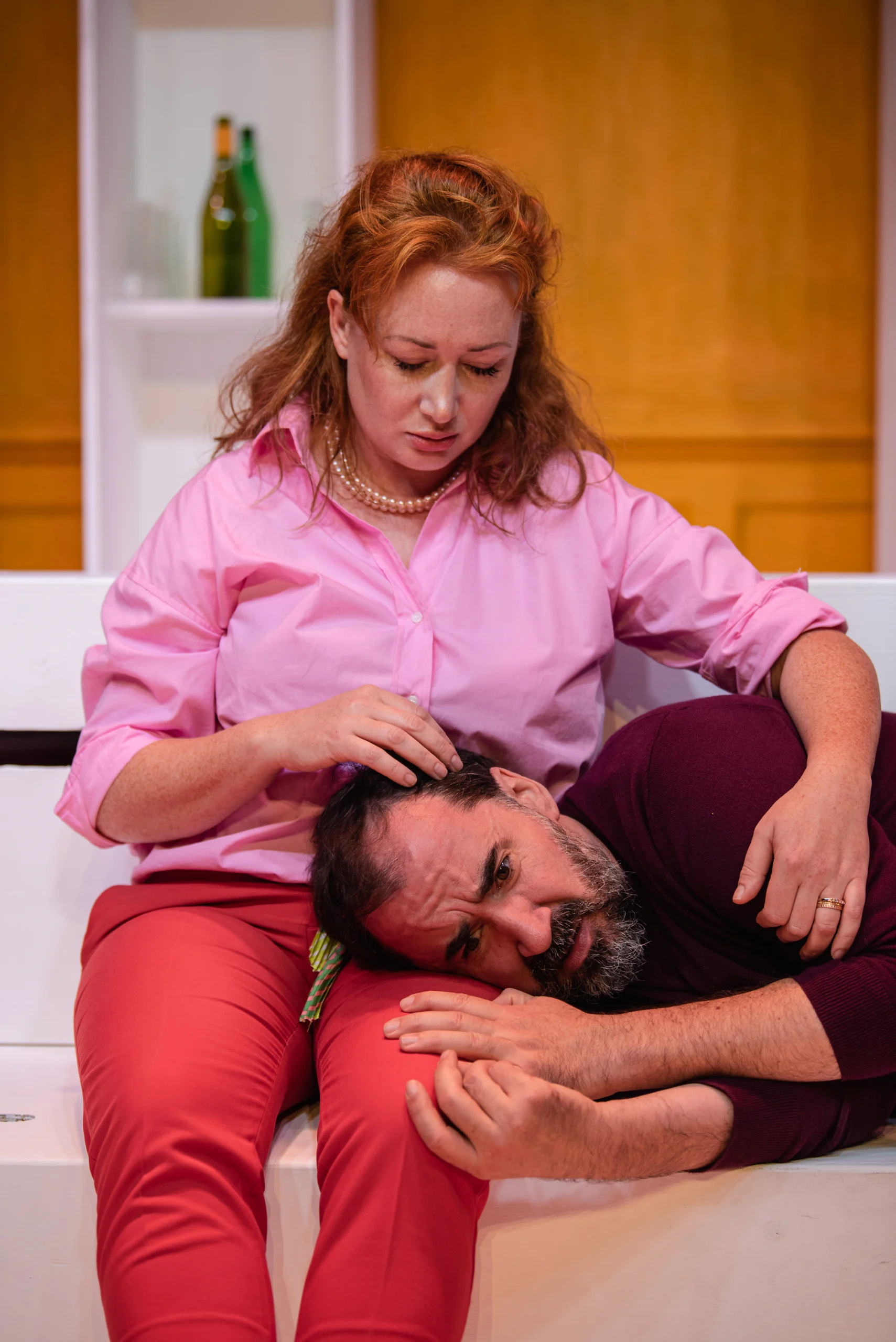
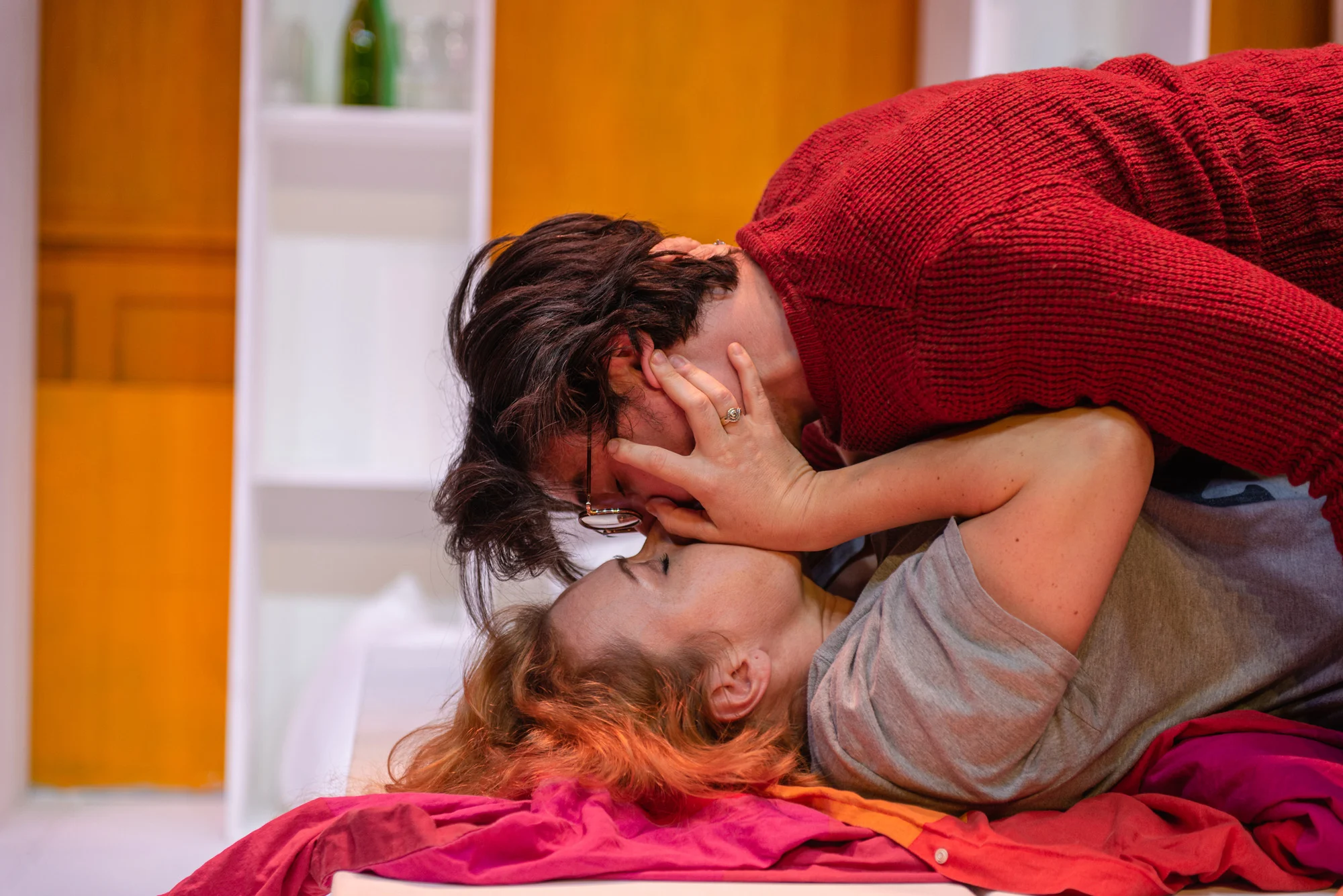
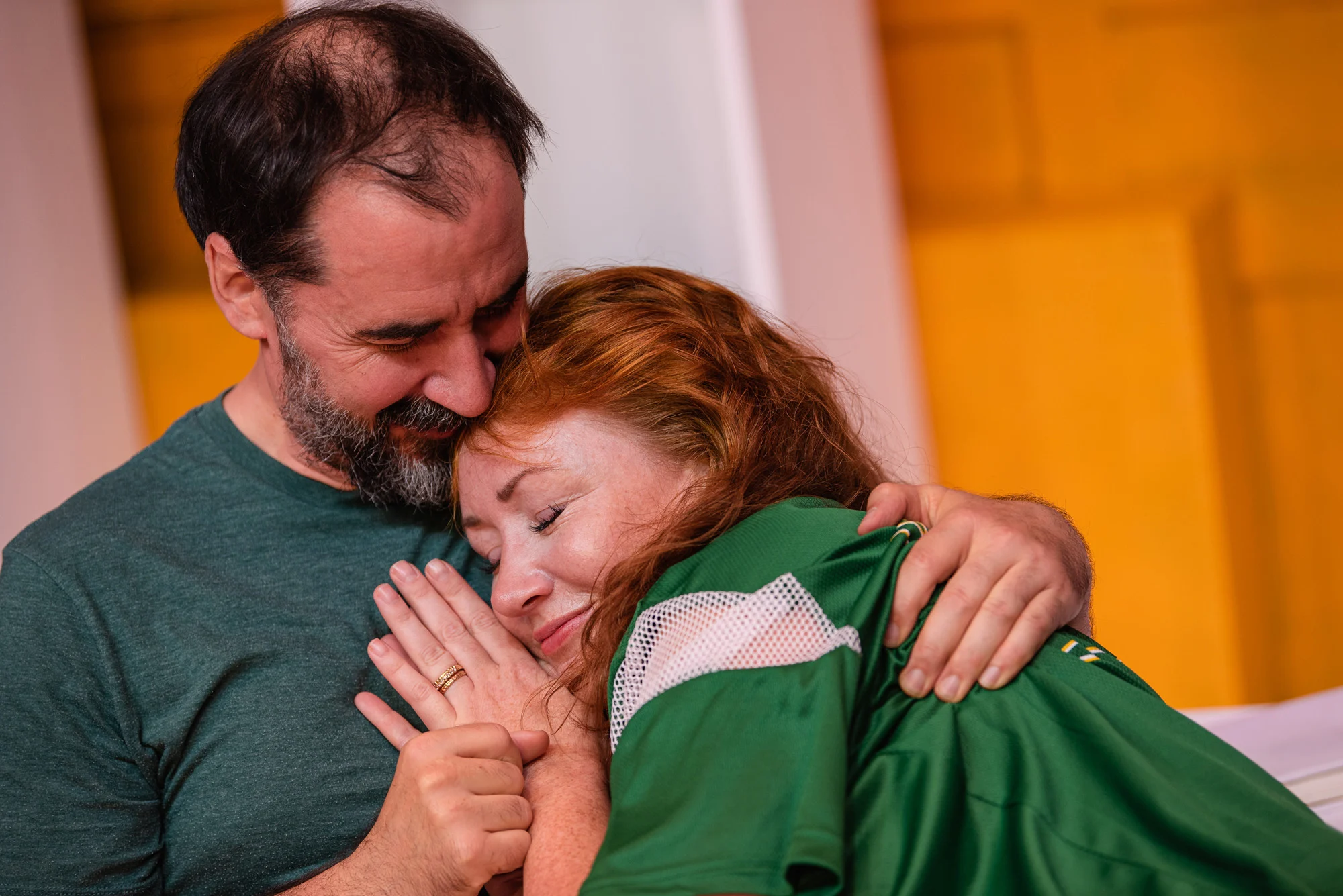
Kate (Christie Meyer) wins a horse race bet which brings her to the realisation that she would like a baby with her somewhat reluctant husband of twelve years, Guy (Cory English). Quite soon a pregnancy starts and brings with it a great deal of pretty plausible worry, angst and agonising. Meanwhile their friends Hugh (Lance C Fuller) and Zoe (Maria Teresa Creasey), who also happens to be Kate’s boss, have a two year old child, Lola, who horrifies, intrigues and fascinates Kate and Guy. Horse racing runs thematically through the play but doesn’t add much.


There are some good scenes, mostly duologues, all of them funny as well as occasionally poignant. Kate and Zoe assembling a to-do/to-buy list for Kate is a pleasing example of two actors working responsively together. Meyer has a way of communicating real depth of feeling with just a look or a dip of her head. The scene in which all four of them queue for the cinema in bitter cold is convincing. And I liked the contrast between the intense, truthful Guy and the rather more relaxed self accepting Hugh, who is currently a stay-at-home father.

Maybe, Probably has done well in the USA and is staged here with an American cast so it feels very natural. Although it is set in New York the issues it ranges over are both timeless and universal so we identify with each character and they’re all pretty well defined.  It sits happily in the bijoux intimacy of the Old Red Lion, with audience on two sides too.

The play could, however, be more streamlined. As it is we get a brief semi- black out and scurrying about with props at the end of each short scene which  feels oddly old fashioned and underdeveloped.  And, bizarrely, on press night a small but enthusiastically supportive audience applauded after each little episode. Thus the piece feels fragmented.

First published by Sardines: https://www.sardinesmagazine.co.uk/review/maybe-probably/


Venue: Jack Studio Theatre. 410 Brockley Road, London SE4 2DH

Credits: Conceptualised and directed by John Patterson. Produced by Angel Theatre Company.


Another Eavesdropping

3 stars

Well, if you want naturalism in a showcase for versatility this is probably the way to go. Based on eavesdroppings collected by the twelve cast members in public places this summer, Another Eavesdropping is verbatim theatre in its purest form – ranging in an hour and three quarters (including interval) from three young  men trying to get an Uber to the irritation of someone carelessly coughing over popcorn in a crowded cinema, an earnest discussion about cheese, and a lot more. Some of the conversation is so mundane that the humour lies in the banality. It’s very finely observed.

It’s effectively a series of vignettes of various lengths with, usually, one of the actors morphing into another character for the next scene so that there’s a casting overlap. Meanwhile the rest of the company sit – in their plain coloured teeshirts and jeans – absolutely still and neutral at the sides.  It is not a play as such. Rather it hops from one situation to another, randomly. Such structure feels reminiscent of a student showcase but that is certainly not a criticism of the standard of acting which is pleasingly high.

Ricky Zalman, for instance, is splendid as a sick, angry, man in a pharmacy ranting at great length about the way his prescription has been prepared. And Georgia Dawson plays against him perfectly as the patient, long suffering pharmacist. Both shine in other roles too – Dawson, for example, cries in a cubicle in the gents while Taylor Pope (excellent at all times) kindly tries to coax her out. Like every single scene in this show, it’s pretty convincing.

I liked Gordana Kostic’s preshow performance as a street busker, soprano soon casually moved on by a bossy official and she is strong as the doctor/social worker ruthlessly trying to manage a mental health patient. Ben Armitage’s opening scene in which he meets a girl he knows and camply talks at her for what feels to us, and to her, for a very long time is nicely done too.

There is a lot of talent in this show and most of it is entertaining but inevitably it feels bitty and that makes it hard work to watch because you have to keep readjusting.

First published by Sardines: https://www.sardinesmagazine.co.uk/review/another-eavesdropping/

Josephine Tey straddled two genres with her The Daughter of Time in 1951: crime fiction meets historical novel. Of course others have done this since in different styles: Ellis Peters and CJ Sansom to name but two. But when I first discovered it (I think someone mentioned it at school) in the 1960s, I was intrigued by the whole concept. I was used to Jean Plaidy and Agatha Christie – but not in the same book.

Time for a revisit. Tey’s detective, Inspector Alan Grant, who features in several novels is flat on his back in hospital with a broken leg. Given a photograph of Richard III by a friend he becomes fascinated by the mystery of the Princes in the Tower. They disappeared and although there was a confession from a man (fall guy?) named Tyrell, the truth has always been elusive. With the help of an outstandingly competent young researcher and several books, Grant  sets out to solve the 400 year old mystery. Were the boys actually killed and, if so, whodunit?

The novel is a good read but never let it be forgotten that this is fiction. Some of the source books Grant relies on are fictional too. And as soon as Thomas More’s writings about Richard were mentioned, alarm bells rang in my head because he was not a contemporary. Grant initially thinks he was but, eventually, realises that More was merely producing malicious hearsay between 1515 and 1518 (Richard died in 1460) for propaganda purposes, and comes to loath “the sainted More”.

Of course Tey manipulates the evidence to convince the reader (if s/he hasn’t got bogged down in Plantaganet family history and lost track) that Richard was a kindly man who couldn’t possibly have given the order to murder his nephews. It’s an interesting thesis. Grant, like all the best fictional detectives, is a pleasant man to spend time with and I love the character of Brent Carradine – a young American. He has persuaded his wealthy manufacturer father that he has to be in London to carry out research in the British Library. Actually he wants to be with his actress girlfriend. Grant’s all absorbing research is just what he needs. He will now write a book and avoid for ever the fate of having to go into the dreaded family business.

There’s now another slant on all this. Grant, Carradine and maybe their  creator Josephine Tey  are convinced that the posthumous presentation of Richard as a crippled monster was Tudor propaganda, well oiled by one William Shakespeare. Then, in 2012, astonishingly, Richard’s remains were found beneath a car park in Leicester. And guess what? The skeleton, of which we all saw photographs, showed clear evidence of scoliosis. So he really was a “hunchback”.  But that, of course, does not make him guilty of infanticide. So the mystery remains.

Tey’s novel is a gripping period piece but, like all historical novels,  needs to be read with cautious scepticism.

Next week on Susan’s Bookshelves: The Winthrop Woman by Anya Seyton

81H6lsmYavL._AC_UY218_

Venue: Nottingham Playhouse. Wellington Circus, Nottingham NG1 5AF

Credits: By Alan Bennett. Adapted by Adrian Scarborough

Type: Sardines

Author: Susan Elkin

Performance Date: 15/09/2022

The Clothes They Stood Up In

4 stars

All photos: The Other Richard


Alan Bennett is past master of insouciant incongruity – and trademark eloquent silences which are often hilarious and sometimes poignant. It’s slightly odd to see a Bennett story adapted by a different writer but I can confirm that Adrian Scarborough has more than nailed it. My only slight gripe is that Bennett’s novella of the same name dates from 1997. Scarborough has made some attempt to update it with references to Mary Berry, not being in the EU, digital TV and the like but it isn’t always consistent bcause we also get polaroid photographs and Kiri te Kanawa (now 78 and retired)  in live performance. Thus the play doesn’t always feel historically quite secure but it doesn’t matter much.

Maurice Ransome (Adrian Scarbrough) and his wife Rosemary (Sophie Thompson) have been to Covent Garden. Cue for several glorious Cos fan tutte sound bites. When they get home to their flat they discover that, in their absence it has been burgled: emptied, stripped bare so that they are left with just the titular clothes on their backs. Even the lavatory roll has gone which allows Bennett the opportunity for a few of his characterstic bodily funtions jokes. He has been accused, with some justification, of an obsession with excrement.

The unlikely plot which follows gives us – with Bennett’s unique blend of wistfulness and laughter – the chance to explore the Ransomes’ marriage, the significance of possessions, what friendship really means and a great deal more.

Scarborough and Thompson are magnificent together. He is, of course, insufferable with his bossy, pedantic, humourless, bigotry,  and self-absorption. Most of us would have put arsenic in his tea long ago. But his wife is loyal, dutiful and long suffering so she doesn’t do that. Thompson does a good line in brittle dappiness, deep underneath which is an independent woman who’d really quite like a life. She has a way of communicating – and getting laughs – by just looking. And everyone in the audience knows exactly what she’s thinking.

Also outstanding in this production are the three support actors: Ned Costello, Charlie de Melo and Natasha Magigi. Between them they play a whole raft of meaty cameo roles with oodles of versatility and impressive voice work. Magigi, for instance, delights as the overbearing, hands-on (literally) counsellor. De Melo’s Mr Anwar, local shopkeeper is warm and caring in stark contrast to Scarborough’s character. And Costello, who graduated from LAMDA, only last year is definitely one to watch. He pops up in so many convincing roles you keep blinking and checking that it’s the same actor.

A word of praise too for Robert Jones’s ingenious set which, using advancing and receding hydraulics, gives us the Ransomes’ sitting room in three different guises along with several smaller roll-on, roll-off scene evokers.

It’s well worth a trip to Nottingham.

First published by Sardines: https://www.sardinesmagazine.co.uk/review/the-clothes-they-stood-up-in/


Show: The Two Popes

Society: Rose Theatre Kingston (professional)

Venue: Rose Theatre. 24-26 High Street, Kingston upon Thames, Surrey KT1 1HL

Credits: By Anthony McCarten. Rose Theatre in association with Everyman Theatre, Cheltenham and Oxford Playhouse present a Royal & Derngate, Northampton and Anthology Theatre co-production in association with Tara Finney Productions.

The Two Popes

4 stars

In 2013 Pope Benedict shook the world – particularly theticularly the Catholic world with its 1.36 billion followers – by resigning. No pope had done this for six centuries. The reason is a mystery. There were rumours of ill health but he’s still alive today, aged 95. Or was it political? Benedict is an ultra, backward inclined traditionalist. Could he see that there had to be a change and that if he resigned his successor would almost certainly be the relaxed, liberal, commonsensible, approachable Cardinal Bergoglio of Argentina – today still very much in charge at the Vatican as Pope Francis?

Enter Anthony McCarten’s intelligent, neatly crafted play based on his 2019 book The Pope. First staged at Royal and Derngate, Northampton in 2019, this is its first London run.

Anton Lesser as Benedict is sardonic, authoritative and oozing white robed charisma. That’s why the informal scene when, more or less in mufti, he visits his friend Sister Brigitta (Lynsey Beauchamp)  for supper and TV drama works so well – the incongruous contrast  means that we meet a wholly rounded character. And she is the first person to whom he confides his thoughts about possible resignation.

Nicholas Woodeson gives us a powerful contrast in Bergoglio: “I’m an Argentinian. Tango and football are compulsory.” At 75, he too wants to retire and travels to Rome to discuss it with the Pope – thus allowing McCarten to make long scenes between the two men the backbone of his play. They disagree about almost everything: gay rights, abortion, birth control and, most serious of all, the condoning of abuse by Catholic priests. Equally, as two old men who worship the same god they have much in common too. And both are from backgrounds they would have done well to distance themselves from much earlier: the Pope from Nazi Germany and Bergoglio from the Junta in Argentina.

Dramatically, none of this is heavy or static and there are a surprising number of laughs in the play which manages to be moving, funny and thoughtful all at the same time.  McCarten’s dialogue is as sharp as a razor blade and Lesser and Woodeson – both actors at the top of their game – know exactly how to spin off each other to spellbinding effect.  And I liked Duncan McLean’s video projections which use images on a huge proscenium frame atmospherically to evoke various rooms in the Vatican – and at one point, noisy colourful Argentina.

There’s a nice performance from Leaphia Darko as the sister who assists Bergoglio and questions him in Argentina but Malcolm James and Angela Jones, billed as “ensemble” are oddly underused

 First published by Sardines: https://www.sardinesmagazine.co.uk/review/the-two-popes/

Show: Antigone

Society: Regent’s Park Open Air Theatre (professional productions)

Venue: Regent’s Park Open-air Theatre. The Regent’s Park, Inner Circle, London NW1 4NU

Credits: By Inua Ellams after Sophocles. Music composed by Michael ‘Mikey J’ Asante MBE. Co-directed by Max Webster and Jo Tyabji.

Antigone

4 stars


Antigone, written nearly two and a half millennia ago, is a political play about power. It’s also about family issues, tensions and conflicts of loyalty. You’d be hard put to find anything more searingly, timelessly topical especially in the hands of playwright/poet Inua Ellams. It took a few minutes to find its feet on press night but thereafter was pretty riveting.

Antigone (Zainab Hasan) is part of a 21 Century British Pakistani Muslim family whose uncle, Creon (Tony Jayawardena) becomes Prime Minister early in the play. A shootout leads to the death of Antigone’s police officer brother, Eteocles (Abe Jarman), a state of emergency declared and the body of the executed Polyneices (Nadeem Islam) detained indefinitely – a dreadful fate for a Muslim for whom burial rituals are crucial. Creon meanwhile, every inch a right wing Tory politician immaculately observed by Jayawardena, insists repeatedly that the law (which he has changed, of course) must come first. That means that no imam will bury Polyneices or be seen to sympathise with an extremist, however much Antigone pleads with her uncle. Of course neither Sophocles nor Ellams gives us a happy ending. As some wag behind me remarked at the end in rich Estuary “It’s Greek drama innit?”

Ellams’s language is richly poetic although most of the dialogue is in prose. I really liked Antigone’s opening speech – full of passionate rhetoric –  when she’s trying to prevent the closure of the youth centre she’s been helping to run and the moving poem Ellams gives her at the opening of Act 2 when she’s in prison. Hasan is splendid in this role. Her everyday London accent is very natural and she is totally convincing as a feisty young woman with passions, determination, love for her cousin, Haemon (Oliver Johnstone – good) and a powerful sense of right and wrong.

But the real star of this show is the chorus. What do you do with a Greek Chorus in a 21 Century play? Ellams repeatedly reworks them as young people in the youth centre, a posse of paparazzi, feminist groups, street demonstrators and much more. They rhythmically spit out angry, thoughtful or apposite words (often in iambic pentameter) and are spikily choreographed by Carrie-Anne Ingrouille to Michael ‘Mikey J’ Asante’s arrestingly dramatic music. It provides slick and very engrossing backbone to this interesting, gripping version of the play.

Welcome too is the casting of Islam as Polyneices. He is deaf and signs as he speaks as do some other cast members while he’s on stage. It’s a pleasing performance and adds yet another dimension to the drama – as well as making a fine production more accessible.


 First published by Sardines http://ardinesmagazine.co.uk/review/antigone-3/
 All photos: Helen Murray