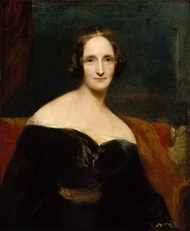
I recently saw and reviewed a stage adaptation of Frankenstein which re-invented Victor Frankenstein as Victoria and seemed to omit rather a lot of detail. I wasn’t sure though because, although I’ve seen at least six stage versions over the years, it was a long time since I’d read the book. Time then, to go back and remind myself what Mary Shelley actually wrote.
First published in 1818, the novel was revised by the author in 1831 and that’s the version most of us are familiar with today. It is, though, extraordinary to think that this one-off piece of sci-fi first appeared in the same decade as all six of Jane Austen’s Regency satires which are as full of bright light as Frankenstein is of brooding darkness. It probably isn’t completely facile to see this partly as a reflection of the two authors’ different circumstances. Austen lived in modest comfort all her life. Shelley, who eloped when she was 16, traipsed uncomfortably across Europe with Percy Bysshe Shelley, in exile and debt, giving birth to child after child, most of whom died. Aged 19, she wrote her novel in Switzerland in response to a challenge from Byron who was a neighbour. One adaptation I saw used that famous rainy day conversation as a framing device.
Mary Shelley’s own framing device gives us Captain Walton on a ship trying to reach the North Pole, surrounded by ice, mystery, danger and strange light. Then his men spot a peculiar creature heading away on a sledge. It is very large, otherworldly and frightening. Have they imagined it? Shortly afterwards they rescue Victor Frankenstein, imperilled on the ice. His huskies are exhausted and so is he. Eventually Frankenstein, who had been chasing the creature on the sledge, spends a week telling his story to Walton who confides it to his sister in letters. It’s a Russian Doll narrative – like Wuthering Heights, The Woman in White or many more recent novels by writers such as Victoria Hislop.
Victor Frankenstein is fascinated by what we now call science from childhood and, remember, this novel was written at a time of new revolutionary scientific thinking. Geologists were beginning to question conventional religious dogma about creation. Electro-magnetism was gradually being better understood. There were increasingly powerful microscopes and telescopes. And prodigiously bright Shelley was very well read. Eventually her protagonist builds a body and gives it “animation”. Of course it’s irresponsible. Once the creation (variously referred to in the novel as monster, fiend or daemon) is given life it is beyond Frankenstein’s control. He tells no one what he has done – until he confides in Walton on the ship in the Arctic.
Conveniently the Creation escapes and learns language – implausibly sophisticated language – by spying on a newly impoverished family living in an Alpine hut. When he finally confronts his creator – dramatically on a glacier – and they repair to a hut to talk , he states his terms. The “monster” wants a female companion because he has feelings and needs. If these are not met he will revert to savagery and he has already shown what he’s capable of. Well, I’ll spare you the spoilers just in case, unlikely as it is, you don’t already know this story which has been made into more films than you can shake a stick at, including Guillermo del Toro’s new 2025 version. It’s a creation (in every sense) which just goes on giving.
What struck me though, on rereading now, is that Shelley was not writing screenplay inspiration for horror movies a century and three quarters after her 1851 death. Yes, it’s a “gothic” novel and the Creation terrifies everyone who sees it. The best stage version I ever saw, by the way, presented him as a huge puppet made of thick ropes for muscles. However, Frankenstein also poses some pretty profound, ever topical questions.
Are we responsible for the actions of our own creations – our children, for example? If so, should believers in a conventional, omnipotent God blame him for all the evil in the world? What exactly do we mean by “humanity” and “humanness”? Is it morally right to destroy what you see as evil? Is company essential to human life? It’s even worth asking if Shelley’s Creation is actually real? Could he be Victor Frankenstein’s alter ego? It’s an interpretation which would make this novel an interesting precursor to Robert Louis Sevenson’s The Strange Case of Dr Jekyll and Mr Hyde (1886).
No wonder Frankenstein has been studied in universities all over the world, set for exams at every level and widely discussed in book clubs.
Next week on Susan’s Bookshelves: The Diver and the Lover by Jeremy Vine