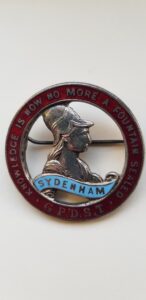
Tennyson and I go back a long way. He was my O Level poet and I remember loving the sensuous musicality of Oenone, The Lady of Shalott, Ulysess and more. So I asked for, and was given, a complete works of Tennyson for my 21st birthday, which I still have. Actually, had I but known it, I’d been carrying Tennyson around with me for a lot longer than that. “Knowledge is no more a fountain sealed” comes from Tennyson’s great plea for women’s education, The Princess (1847). It was, and is, the motto of the Girls Day School Trust (Girls Public Day School Trust in my day). So we had that unequivocal statement on the circumference of the hat badges we were obliged (dire penalties if we didn’t) to wear every day pinned to our velours and panamas at Sydenham High School, where I started on a London County Council-funded place in 1958.
Once I began teaching English in secondary schools, Tennyson appeared in all the anthologies through which we tried to instil a love of poetry in our students. And when I finally got round to doing a taught Masters with the Open University in my forties, the subject was nineteenth century poetry so there he was again. Yes, Alfred Tennyson and I are old friends.
No one has ever really pointed out to me however – and definitely not my very conventional Christian O level English teacher – that almost everything Tennyson wrote in the first half of his life was shot though with burgeoning new scientific ideas which challenged conventional views of “God” and his creations. Enter Richard Holmes with this hugely informative, astonishingly well researched account of Tennyson’s experience, influences and thinking in those, sometimes turbulent, years before 1850 – the year in which, aged 41 he published In Memoriam, married Emily Sellwood and became Poet Laureate. “At last …” was the feeling among his friends with regard to the first two of those events.
Holmes’s subtitle is “Young Tennyson, Science and the Crisis of Belief” and the book details, mostly, the first 40 years of his life before he morphed into the familiar heavily bearded establishment figure living in considerable comfort at Farringford House on the Isle of Wight with Queen Victoria and Prince Albert as neighbours. And the contrast is extraordinary. He even found ways of coming to terms with conventional religious belief.
Holmes uses Tennyson’s poem The Kraken, written while the poet was still at Trinity College, Cambridge, as a running metaphor for his inner demons, doubts and depressions: the terrifying sea monster “battening upon huge sea worms in his sleep”. And of course that almost unimaginably horrifying creature links with the burgeoning interest in palaeontology which surrounded him. Tennyson read, absorbed and was influenced by Charles Lyell’s geological discoveries and theories along with Vestiges of the Natural History of Creation by Robert Chambers (1844) and many other books which confronted the roots of nineteenth century thought. Creative agnosticism was becoming almost respectable. Atheism was still feared and loathed.
The young Tennyson could be excellent company. He was good looking with a beautiful voice and a gift for mimicry. A troubled childhood – one of eleven – with an abusive father in a Lincolnshire rectory probably contributed to some of his inner turmoil but he found a strong circle of friends at Trinity College, Cambridge including, famously, his beloved Arthur Hallam. Hallam died suddenly in his early twenties and the loss devasted Tennyson for the next 20 years. The many “grief” poems he wrote over two decades eventually came together to form In Memoriam which sold enormously well and made Tennyson rich. His elder son (born 1852) was named Hallam which, Holmes speculates, probably helped to bring closure for his father.
Another theme running though this biography is Tennyson’s close friendship with the sensible, jovial Edward “Fitz” Fitzgerald who later translated/wrote The Rubaiyat of Omar Khayyan (1859 ). We share Holmes’s sadness as the two men eventually drifted apart. At the same time, though, Tennyson was beginning to meet and associate with just about every nineteenth century writer, philosopher, scientist and economist you can think of. Holmes is very good at context.
It’s richly readable, entertaining, full of things I didn’t know and offers new takes on familiar poems. If like mine, your head often rattles with the rhymes and rhythms of Mariana, The Lotos Eaters and the rest – like favourite pieces of music – you will enjoy, and learn a lot from, The Boundless Deep.
Next week on Susan’s Bookshelves: The Most Wonderful Time of the Year by Beth Moran