I have probably read Great Expectations a dozen times. It featured on the English course at Bishop Otter College. I later studied it as part of my first degree and I used to teach it to GCSE students. I have also returned to it several times for the sheer joy of it. And each time I marvel because, miraculously, it seems to have got even better since I last opened it. It’s an invidious choice but I think it may be my favourite Dickens novel although ask me again next time I reread David Copperfield. This latest rereading actually related to a short story I’m working on – watch for the second set of Unheard Voices: Tales from the Margins of Literature which is, as they say, ‘in preparation’.
Set somewhere in the first forty years of the nineteenth century before the building of the “new” London Bridge in the 1830s and the arrival of railways, Great Expectations mostly presents action in two contrasting locations. It whizzes us repeatedly from the remote marshes of estuarine Kent (the Hoo peninsular) and its nearby town (Rochester) – and London. Dickens knew these locations like the back of his hand. He lived for many years at Gad’s Hill near Rochester and of course that shines through as one of the novel’s many strengths.
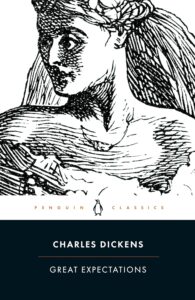
And it’s one of those novels which has characters and situations so well known that they have a life outside the narrative. People who’ve never read a Dickens novel in their lives often know about pitiful, jilted, spiteful Miss Haversham sitting in the shreds of her wedding dress among the insect-infested remnants of the wedding breakfast. The opening churchyard scene in which the seven year old Pip, narrating and remembering, is terrified by the escaped Magwitch is very famous too. And it isn’t just because of the many and various adaptations over the years. There’s something about these richly dramatic images which penetrated the public brain when the book was first published in serial form in 1860/1 and has remained there ever since.
I marvel at the plotting. Most Dickens novels abound with coincidences and Great Expectations is no exception. But it’s so tightly woven that they cease to be unlikely coincidences and become plausible connections. Gruff Mr Jaggers, who never speaks without biting the side of his finger, is the lynch pin. He is Miss Havisham’s London lawyer who originally arranged the adoption of Estella. And it is eventually revealed how that meant that Magwitch knew Mr Jaggers and put his business with him too. And the Pockets are related to Miss Havisham which is how Jaggers knows them and introduces Pip. I wonder whether Dickens worked it all out on a chart or made it up as he went along? He walked a lot – including from London to Gads Hill routinely – so probably developed his plots as he strode. He must have had a fine memory.
The themes of Great Expectations are timeless. It’s about loyalty or lack of it, guilt and regret. It also focuses on fathers, or quasi fathers, and sons. Joe is the nearest thing to a natural father Pip has and one of the nicest, kindest men in the whole of literature. Yet Pip treats him shamefully for a long time. Then there’s Magwitch who desperately wants a son and eventually Pip recognises that and softens in gratitude. And the theme is highlighted, kaleidoscope-like on the margins in the warm relationships between Wemmick and his “Aged P”, Matthew and Herbert Pocket and, eventually between Joe and his own son. I used to tell my students that a novel as fine as this is like an intricate piece of patterned tartan. You can pull out separate strands to examine them and then thread them back in.
I love the wit and sardonic humour too. When Pip first meets Wemmick he compares his mouth to a post office by which he means a horizontal slot for the posting of letters. He keeps this gag running for hundreds pages and it’s fun. Only Dickens could sum up a character (a cousin of Herbert’s) thus: “an indigestive single woman who called her rigidity religion and her liver love.” Or how about this for the tiresome, nosy Pumblechook? : “his fishy eyes and mouth open, his sandy hair inquisitively on end and his waistcoat heaving with windy arithmetic.
Of course Compeyson and Orlick are vicious criminals and Bently Drummle isn’t exactly man to warm to but nearly every other character Great Expectations has likeable features. Difficult people like Estella and Mrs Joe are more sinned against than sinning and people like Herbert, Wemmick and Joe are delightful. Even sparky Biddy is a lot more than just another of Dickens’s dull, virtuous women.
If you’ve never read it you have a treat in store.
Next week on Susan’s Bookshelves: London Falling by Patrick Radden Keefe