Press ESC or click the X to close this window

Susan’s Bookshelves: The Flames

Until my late husband and I went to Vienna to visit galleries, attend concerts and walk the Beethoven trail a few years ago I had never heard of Egon Schiele (1890-1918). He is, of course, huge in Vienna and everywhere we went we saw his work and learned more about him and we were, like many before us, stopped dead in our tracks by the visceral, raw sexuality and truth of his paintings and drawings. It was quite a learning curve.

So who were the women who inspired and modelled for him and enabled the creation of those extraordinary images? And “modelling” in this case almost always means highly explicit nudity. We’re a very long way from the modest robes of, say, the pre-Raphaelites.   Enter Sophie Haydock’s 2022 novel The Flames which explores the interwoven stories of Schiele’s mistress/muse, Vally, his sister Gertrude, and Adele and Edith Harms. The latter was Frau Schiele until the couple died of Spanish Flu within days of each other in 1918.

Haydock’s version of the Harms sisters is that Adele was passionately in love with Schiele and devastated by his marrying her sister. Anguish turned her spiteful and in the framing device we see her as an elderly woman at a 1960s Schiele exhibition trying to place her remorse. Haydock gives us an Edith who loves Egon dearly but is a reluctant model. He was, after all, often accused of pornography even as he got better known and more highly regarded.  Adele, on the other hand, is only too glad to do anything Egon wants – within the novel, at least.

Walburga Neuzil, whose name Haydock abbreviates to Vally, had also modelled for Klimt, whose protégé Schiele was. As a couple they lived together for several years and she saw him through arrest for indecency and brief imprisonment. Haydock imagines that she has humble origins and that Schiele sees the marriage with Edith Harms as advantageous. Vally certainly isn’t prepared to let him have his cake and eat it and enlists as a nurse in the war where she doesn’t, sadly, last long.

And as for Gertrude, history suggests that there may have been incest – or incestuous inclinations – between her and her older brother. It is well documented that their father once found them in a locked room and that he destroyed some of Egon’s art. We also know that they ran away and spent a night in a hotel room. Whatever the truth of all this Haydock shows a close relationship which resulted in some graphic art. She eventually married a friend of her brother’s and bore a child.

Of course, as you read this novel you want to see the paintings and drawings, an astonishing number of which have survived. Schiele was only 28 when he died – younger even than Mozart and Schubert. What on earth might he have achieved, had he lived into middle and old age? Haydock includes small illustrations here and there in the novel and you can get a glimpse of many of them simply by Googling. But the novel will probably prompt you to book a trip to the Leopold Museum in Vienna. Cardinal and Nun (Caress), painted in 1912 is one of the most arresting paintings I’ve ever seen, despite the artist’s having toned it down for commercial reasons. Vally was the female model. The male figure is a self portrait.

Next week on Susan’s Bookshelves: Stradivarius by Tony Faber

Show: Enchanted April

Society: Tower Theatre Company

Venue: Tower Theatre. 16 Northwold Road, London N16 7HR

Credits: by Matthew Barber, adapted from Elizabeth von Armin’s novel of the same name.

Enchanted April

4 stars

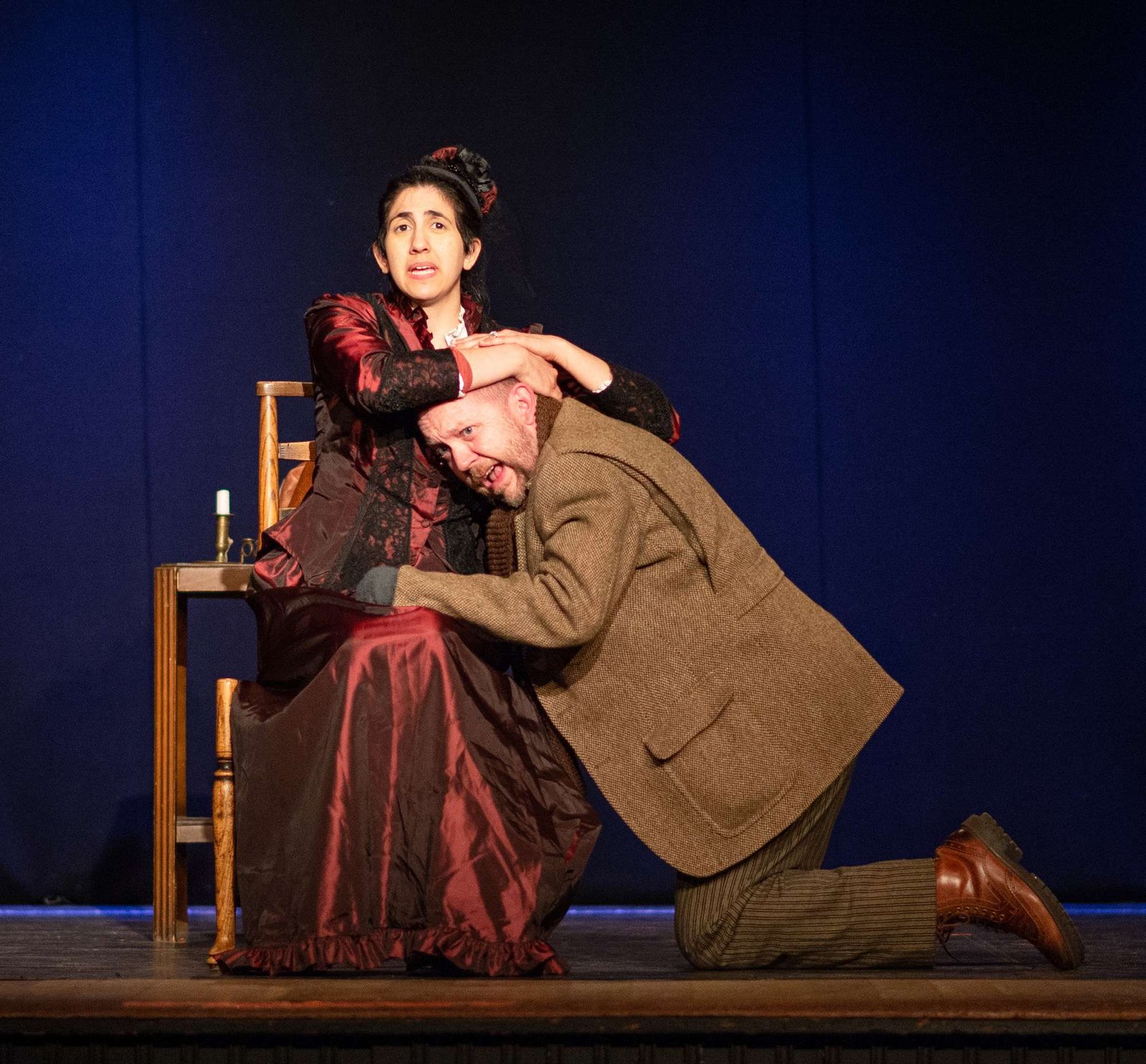
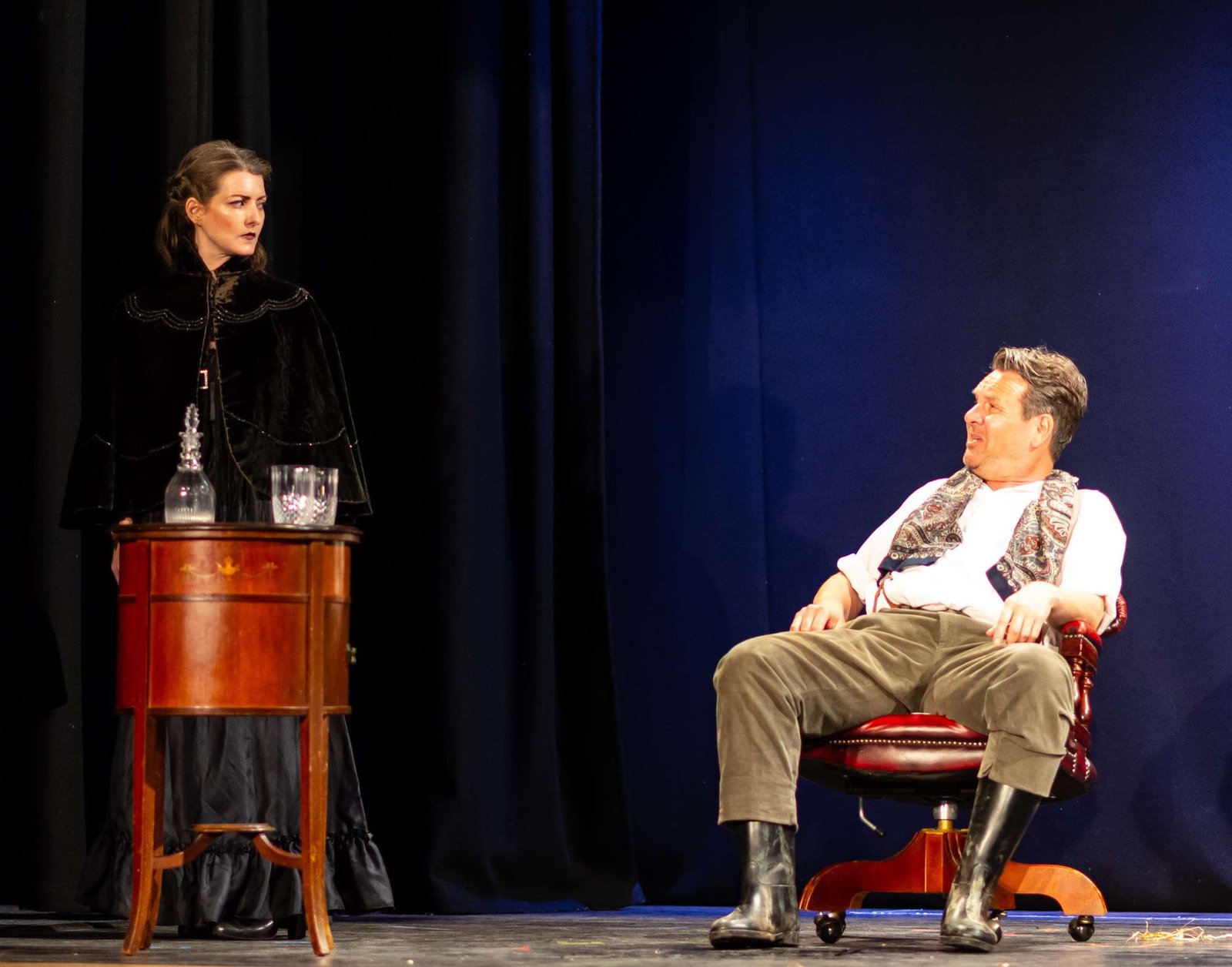
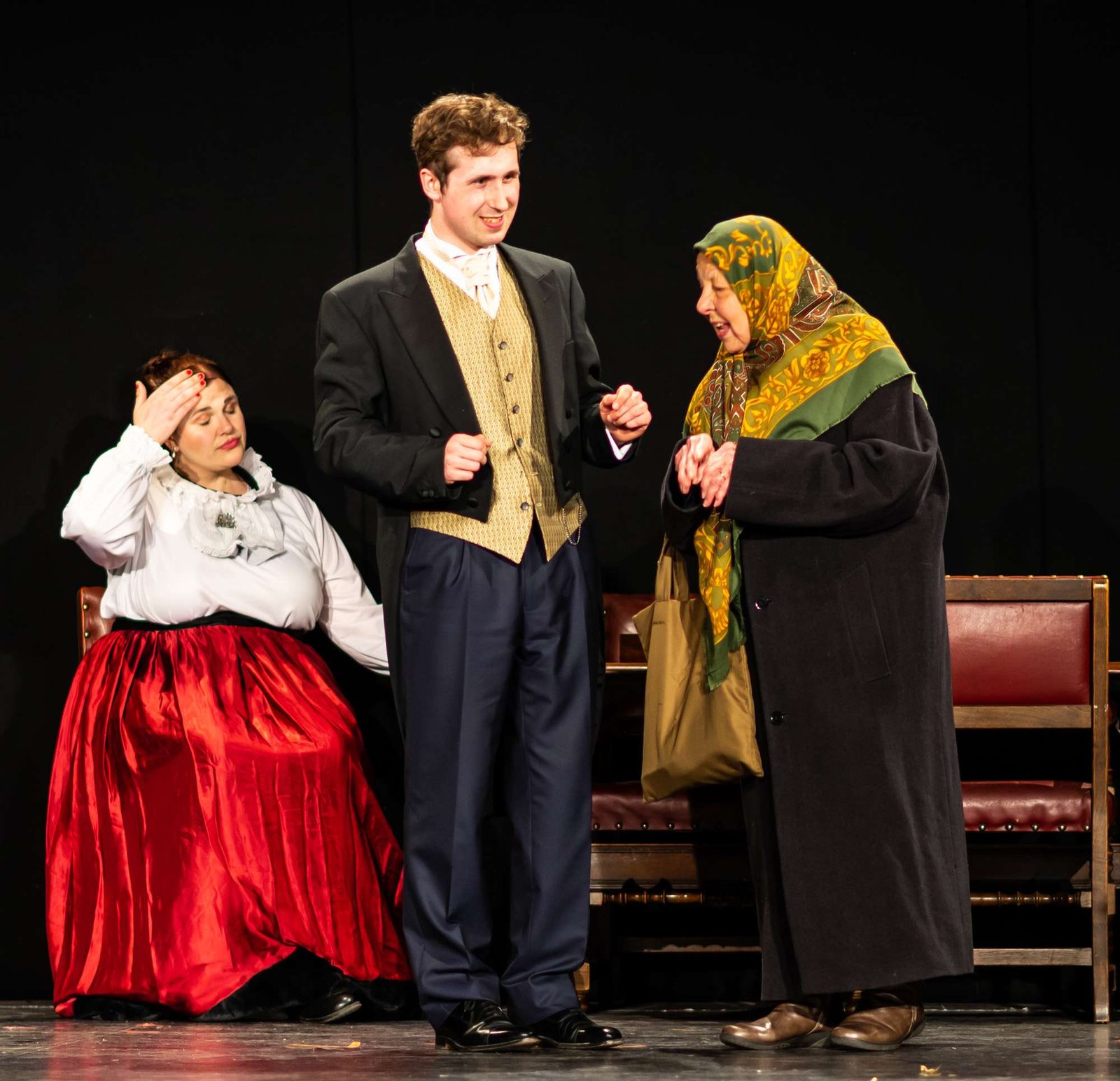
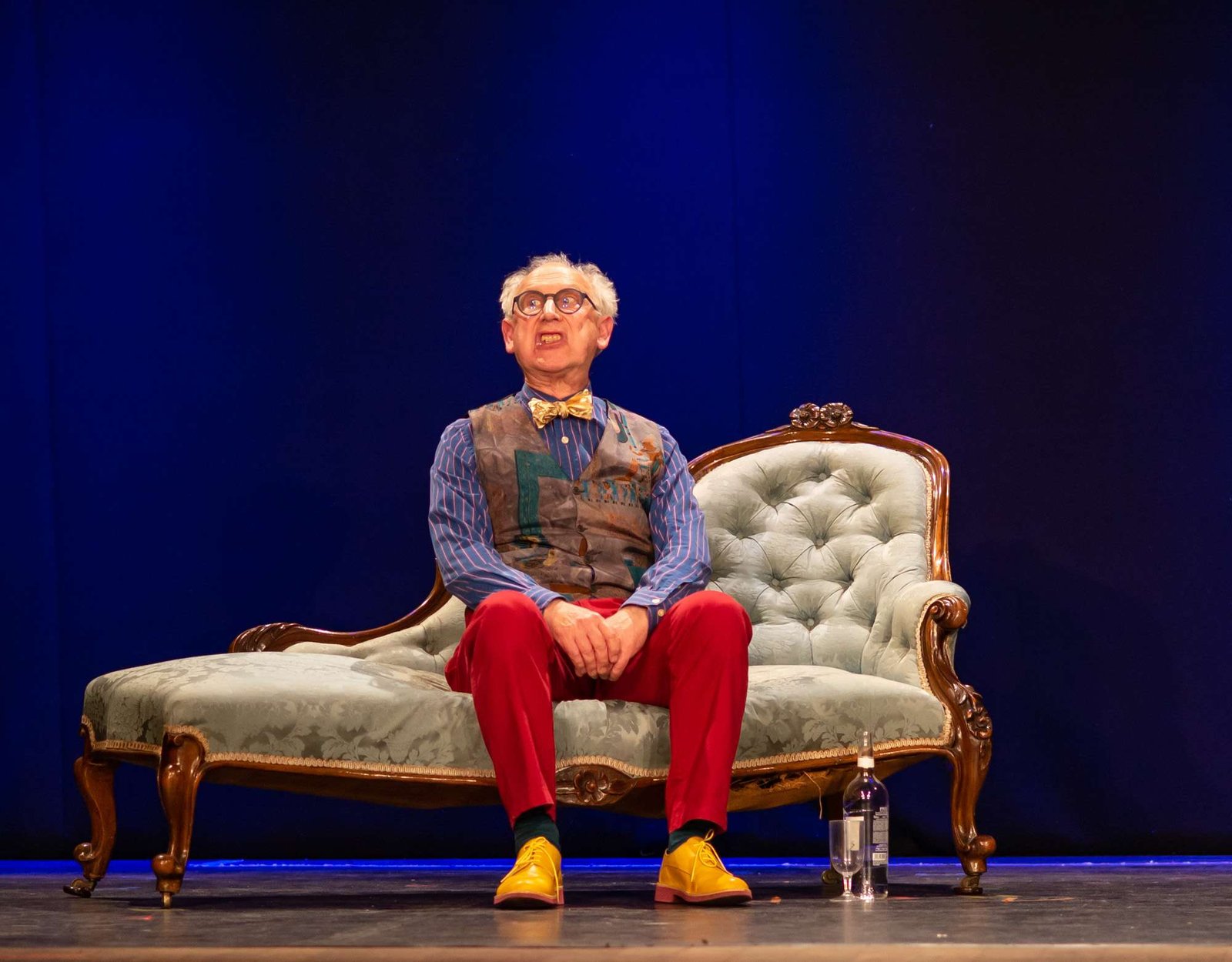
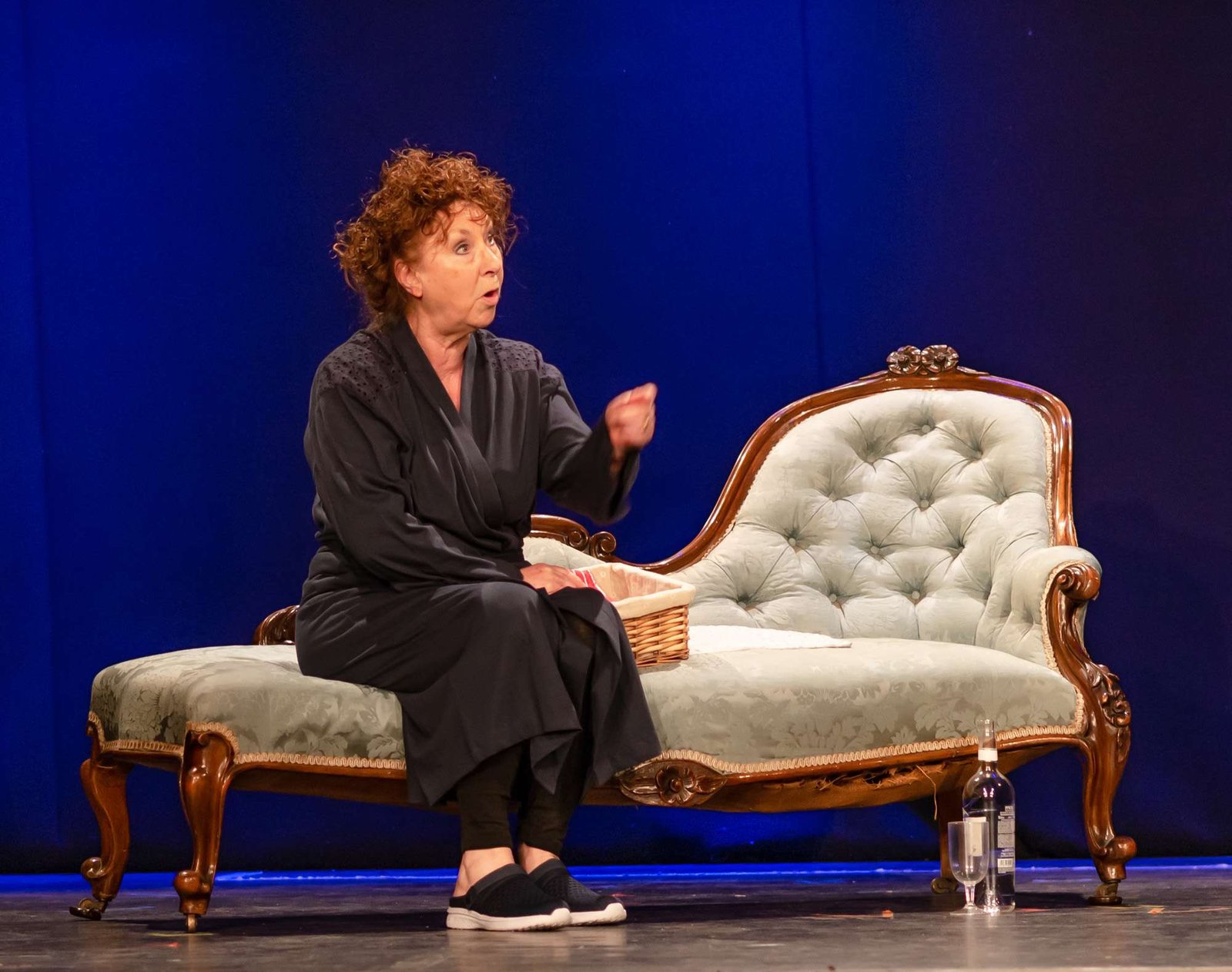
I had never heard of Enchanted April so I arrived at Tower Theatre completely free of expectation. And it turned out to be one of those  quite rare  occasions when I was charmed – enchanted, even – almost from the first word. How has it taken me so long to discover this play?

Based on Elizabeth Von Arnim’s 1922 novel, this adaptation by Matthew Barber presents two troubled women who decide to strike out independent of their husbands by taking a month’s holiday in an Italian “holiday let” castle. The first act shows their relationships with their husbands and the process of recruiting two other women to join them. The second act is set in Italy – all sun and Wisteria in contrast with the greyness and relentless rain they have left behind. Max Batty’s set really highlights the difference and the underlying metaphor.

So, in a sense, it’s a feminist piece with a whiff of, say, Cosi fan Tutte or Princess Ida once as they install themselves in feminine seclusion which, of course, doesn’t last long. These four women are all very different and this production (director John McSpadyen) has a lot of fun with exploiting the dynamic between them. Often taken for war widows, they are finding ways of being themselves against the grain of their social class prejudices a century ago. And if, you want to categorise, in Polonius mode, I suppose it’s a comedy. It’s certainly very funny but as in all the best comedy, it’s nuanced with real issues underneath.

Katherine Kennet hops up and down as Lotty Wilton shining with childlike enthusiasm but gradually grows up and sees that she can make something of her marriage. Ryan Williams gives a splendid performance as her hilariously overbearing husband, Mellersh Wilton. And his Brian Rix moment when the shower explodes and he fulminates on stage in a towel which keeps slipping is one of the funniest scenes I’ve seen on stage for quite a while.

Alisa Dann is excellent as Rose, the buttoned up restrained woman Lotty meets in her Ladies’ Club and eventually persuades to join her in her break for temporary freedom. Rose relaxes eventually and, literally, lets her hair down, agreeing to be painted by the landlord (Anthony Wilding – good). Paul Isaacs plays Frederick, Rose’s husband, who writes risqué books and, it transpires, also lives a risqué life although the coincidence of its detail is rather unsatisfying underplayed.

Also strong are Emily Carmichael as the hard drinking, brittly unhappy Lady Caroline and Rosanna Preston as the Katisha-like Mrs Graves with her outrageous intolerance and put downs. And Anna Didmore as the Italian housekeeper, Costanza, makes the most of, some wonderful sit com moments. As servants always did in pre-1950 plays, she sees everything that goes on and her reactions get lots of well deserved laughs. Her use of Italian is pretty convincing too.

It’s a play – and a production – with warmth and heart. It’s also uplifting to chuckle continuously for two and a half hours.

First published by Sardines: https://www.sardinesmagazine.co.uk/review/enchanted-april/

Show: Coming to England

Society: Birmingham Rep (professional)

Venue: Birmingham Repertory Theatre. Broad Street, Birmingham, West Midlands B1 2EP

Credits: By Floella Benjamin. Adapted by David Wood. Produced by Floella Benjamin, Keith Taylor and Nicoll Entertainment

Coming to England

4 stars

All photos: Geraint Lewis


Floella Benjamin’s truthful but generally update account of arriving in England from Trinidad is effectively Small Island from a child’s point of view and it’s interesting to have seen both shows within a month. David Wood has created a pacey stage piece by flipping the story on its head and adding some good songs.

Benjamin’s story is linear but Wood begins with her elevation to the House of Lords and then doubles back to the bullying and racism she encountered as a child newly arrived in grey London. Thereafter we’re in Trinidad until the last four children finally board ship and set sail for the Motherland.

Of course Benjamin’s memories of her Trinidadian childhood are romanticised with a huge contrast between the colours, smells, flora and fauna of the Caribbean compared with 1960s England. Director and choreographer, Omar F Okai and designer Bretta Gerecke focus very effectively on those contrasts with the giant flowers being an especial high spot along with Floella and her five siblings enjoying a lively carnival. Ian Oakley’s musical arrangements provide joyously evocative music.

Congratulations to casting director Annelie Powell for finding an actor – Paula Kay – who has Floella Benjamin (present on press night, of course) perfectly and looks very much like her.  Many people in the audience will have warm memories of her on Play School and other TV programmes and Kay has the same distinctive way of dancing and singing. Also neat and appropriate is her use of a Trinidadian accent for all the childhood scenes and RP as an adult looking back. It highlights the way the young Benjamin adapted and gets round the potential problem of adults playing children. It’s a fine performance.

The energetic ensemble is  fabulously strong and I loved Kojo Kamara’s jazz number as Floella’s father who so desperately wanted to come to England because he thought there would be more musical opportunities here §A. Bree Smith is a very versatile actor too – warm and loving as Mamie, the children’s mother, fierce as their teacher in Trinidad and hateful as their foster mother as they wait to be summoned to England.

All in all this is a warm, uplifting show which also addresses all the issues which haven’t gone away – witness George Floyd and Black Lives Matter. I loved it.

First published by Sardines: https://www.sardinesmagazine.co.uk/review/coming-to-england/

Show: To Kill a Mockingbird

Society: West End & Fringe

Venue: The Gielgud Theatre. Shaftesbury Avenue, London W1D 6AR

Credits: By Harper Lee, adapted by Aaron Sorkin

To Kill a Mockingbird

3 stars

All photos: Marc Brenner


When a novel is as well loved and known as Harper Lee’s 1960 groundbreaker, the dramatiser has a difficult job because he or she will never please everyone and the Lee estate sued over this version so it took several years to make it to the stage. You cannot follow any novel slavishly and we’re used to the Christopher Sergel adaptation, approved by Lee, which uses child actors and stresses the piece’s literary origins.

Aaron Sorkin does something quite different. He flips the plot so that we start at the trial of Tom Robinson for rape, uses it as the glue that the piece keeps coming back to and unravels most of the plot in flashbacks narrated by Scout (Gwyneth Keyworth). He also does his level best to update the piece. After all, the issues of racism and assumed white privilege are still very much with us. Most of the gratingly, shockingly anti-black lines Sorkin gives to Bob Newell (Patrick O’Kane) are, for example, actually quotes from things said recently in opposition to Black Lives Matter. As a way of pointing up the ongoing topicality of this profoundly shocking story it works reasonably well, although it’s difficult for anyone who knows Harper Lee’s novel well. You have to keep sternly reminding yourself that this play is an original work in its own right.

I’m generally doubtful about casting adults in child roles but, of course, it’s much cheaper because you don’t have to spend hours rehearsing three rotating teams. And I have to say that Keyworth is pretty convincing as Scout. She has a way with mutinous looks and body language through which smiles often break like the sun coming out. She also commands the stage whenever she’s downstage narrating – addressing the audience – and manages to blend childishness with maturing insights. Apart from anything else the piece is about Scout’s development. It might, less memorably but accurately, have been titled “What Scout Learns” and Keyworth makes that growth very clear.

Also strong, among others, are Jude Owusu whose Tom Robinson is quietly dignified and David Moorst as the vulnerable, wordy but funny Dil.

The beating heart of this show though is Rafe Spall as Atticus – the lawyer who defends a black man accused of rape – whose glittering performance is what most people will remember about this production. He finds all the warmth, passion and intelligence that the character needs. And there are some good scenes, way beyond anything Harper Lee wrote, with the family ‘maid’, Calpurnia (Pamela Nomvete). His closing speech at the trial is a master-class in acting. Spall also gives Atticus a sardonic ruefulness which is all his own. I’m sure he will be up for awards very soon.

There’s a large and business-like ensemble (with musical director Candida Caldicot on stage throughout as organist in frock and cloche hat) behind all this action and a lot of small roles which are understated so it isn’t always clear who they are or why they matter. Some of these tiny scenes could arguably be trimmed. As it is the show runs for three hours.

A tick, though, for Miriam Buether’s set. The show began life on Broadway (2018) and adapting to a smaller stage has not, I gather been easy. I like the way most of the Gielgud’s Victorian proscenium is encased in hot, atmospheric clapper board. Thereafter there’s nifty work with switches from court room to the porch of Atticus’s house. It’s neatly done.

First published by Sardines: https://www.sardinesmagazine.co.uk/review/to-kill-a-mockingbird/

Show: Hamlet

Society: National Theatre (professional)

Venue: Dorfman Theatre, National Theatre, London SE1 9PX

Credits: William Shakespeare. Reimagined for young audiences by Jude Christian and directed by Tinuke Craig

HAMLET

3 STARS

All photos: Ellie Kurttz


I’ve seen many of National Theatre’s Shakespeare for a young audiences over the years, sometimes on school premises and sometimes back at base on the South Bank. This pared down Hamlet (65 mins – who needs Horatio or Gravediggers?) has some of the clearest story telling I’ve ever seen. Sticking closely to Shakespeare’s play and using a fair bit of his language, this version ensures that every child in the audience is fully involved but none is patronised: quite an achievement for director Tinuke Craig and her cast.

This take on Hamlet is very much an intimate family drama rather than a big political play although it is witty to paraphrase one of Hamlet’s soliloquies with comments about lying leaders who party on while the rest of us cannot. Even the children chuckled knowingly. I liked the opening at the old king’s funeral – one big tribute spells KING and another reads DAD and there’s singing. Then Claudius (Vedi Roy) proposes to Gertrude (Claire Redcliffe) literally on top of his brother’s grave and we’re into a noisy party with dancing. We also get a splendid ghost scene with a scary§§§§ echoey voice. The  imposing tall ghost, like every character who dies, is covered in a gauzy veil so the status is obvious. And what a good idea to get the audience to provide sound effects for the play within a play which Hamlet directs getting his family to take parts.

The scene when Polonius (David Ahmad) gives his famous advice to Laertes (Chanel Waddock – deliciously sparky) is very funny with both Laertes and Ophelia (Jessica Olade) making it plain that they’ve heard every word of it many times before.

Karen Kebaily-Dwyer is warm and convincing as Hamlet although he is inclined to chop the lines into two or three-word sound bites – presumably in the interests of accessibility but to anyone used to feeling the rhythm it’s an irritant.

It’s a colourful production with Gertrude and Claudius in bright green and Rosencrantz (Efe Agwele) and Guildenstern in scarlet. The set (Frankie Bradshaw) is simple – mostly a single screen because it also has to work in primary school halls.

First published by Sardines.

To be honest I didn’t know much about Marian Keyes until I read a review of her new book Again, Rachel and realised that I’d missed out on her best selling 1998 book, Rachel’s Holiday.  Both sounded interesting so I bought downloads.

I thought Rachel’s Holiday, nearly a quarter of a century on, might feel dated but not a bit of it. The issues are timeless and apart from the absence of mobile phones (Rachel could really do with one) you hardly notice.

Rachel is an archetypal unreliable narrator. She is a drug addict but spends most of the novel trying to convince herself and the reader that she isn’t. She is now in a no-frills rehabilitation centre paid for by her long suffering family. The sad tale of how she got there is unwound in a series of flashbacks as she remembers her past.

Rachel and her friend Brigid have gone from their native Dublin to New York for work – and an exciting life. Looking past what Rachel tells us we can see that Brigid, while good for a laugh, is gradually building a career. But Rachel swallows and sniffs  every drug she can lay hands on, drinks very heavily, has sex with almost any man she meets and goes to work (low grade jobs in motels) only when she’s on her feet. She continuously undervalues herself and has no self-respect whatever.  Eventually she meets a man named Luke Costello – kind, tender, sexy and not a druggie which means she has mixed feelings about him. When he calls time she realises that she was in love with him. She is angry, confused and very difficult to live or deal with.

Keyes is good at characterisation. The people Rachel meets – and eventually bonds with – at the rehab centre are beautifully drawn from the extraordinarily perceptive (Sister) Josephine who leads the group sessions to the charismatic (or is he?) Chris to Rachel’s room mate who hides her problems behind clothes, perfume and make up.

Somehow when Luke and Brigid turn up to give “evidence” and make Rachel face the truth in a devastating group session, you know that if they’ve travelled 3,000 miles to do this then they evidently care very much about her and want to help her. So perhaps, you think – we’re heading for some sort of happy ending. No spoilers.

Many reviewers have dubbed this a comic novel but that’s far too simplistic. Yes, as in life, there are funny moments and Rachel is herself good company and funny. But there’s a lot of depth to this novel too. It explores the nature of  addiction and studies the psychology of people who overeat, become alcoholic, compulsive gamblers or whatever so often rooted in childhood experiences. And it stresses the concept of an addictive personality which once “cured” of one addiction often simply transfers it to another substance or habit.  It’s also a hopeful story. Life at the rehab centre seems grim … but it works and Rachel makes some real friends.

I shall wait a few weeks and then read the sequel which, apparently, shows us what Rachel is doing and where she is now.

Next week on Susan’s Bookshelves: The Flames by Sophie Haydock

The final concert in BPO’s 2021/22 season opened, appropriately enough, with a simple, short statement of solidarity with the people of Ukraine. Myroslav Skoryk’s Melody, currently being played by orchestras across Europe and Scandinavia, is a lyrically pretty piece, evocative at present given its connotations and context.

Elgar’s Introduction and Allegro which came next had a very well balanced sound. The last time I heard it live was at a Prom last summer in the Royal Albert Hall with the string quartet placed rather distantly on a higher tier behind the string orchestra. This time Sian Edwards and BPO made it work much more coherently by seating the four soloists at the front of their respective sections. It was an incisive and resolute account. Even the cello pizzicato, which often gets lost in the texture, sang through vibrantly.

A bit of chair shifting, arrival of wind, brass and timpanist on stage and we were then on to the colourful contrasts of Mozart’s last symphony (no 41, K551, Jupiter), its varying moods nicely pointed up. All the heavy chords and alternating busy passages in the opening Allegro, for example, were delivered with precision, panache and some very eloquent general pauses. Edwards then leaned on every elegant detail in the Andante cantabile (well done, Woodwind), gave us a warmly rich Allegretto and a Molto allegro which really danced all the way to its resolution.

The unusual lay out of this concert – symphony before the interval and concerto after – is an indication that Brahms’s first piano concerto is, like the second one written 20 years later, effectively a symphony. Joanna MacGregor, BPO’s very active, prominent and charismatic music director (she’d introduced the concert at the beginning and written some of the programme notes) is clearly very attuned to this orchestra. As we sailed into all the concerto’s glorious, angry D minor and the first mountainous movement she played the long solo opening statement, then picked up by the flute and later by horn, with such freshness that it caught and held your attention no matter how many times you’ve heard it before. MacGregor’s take on the work is measured as well as thunderously passionate as, ever businesslike she sits bespectacled with her just-in-case music resting flat on the open piano.

There was a lot of tenderess in the second movement as interwoven piano strings and wind soloists integrated with commendable control. Slow movements – and this one was played very slowly in this performance – are a minefield but Edwards held it together splendidly. Finally came the Rondo and resounding conclusion which included some arresting work on keyboard, particularly in the fervent mini cadenza.

All in all this was a delightful concert characterised by grace and passion. There was even a moment of comedy when Edwards and MacGreggor arrived on stage for the concerto to find no score on the podium so Edwards had to scuttle off and hunt for it – and in a lifetime of concert going that was a first for me.

First published by Lark Reviews

Well it’s always been controversial. Nabokov’s famous 1955 story about a middle aged man’s obsession with pubescent or pre-pubescent girls was turned down by several publishers who, presumably,  wouldn’t touch the subject matter. Amongst the ignorant, crass teenagers I mixed with in my youth it was bandied about gleefully as a “dirty” book so of course I read it eagerly but was disappointed. It’s a complex, highly literary work and, with hindsight, at 15 or whatever I wouldn’t have understood it on any level.

Humbert Humbert – his double name mirroring his duallty – is a self confessed paedophile. He refers openly to his pederosis.  His narrative is presented as a memoir to be presented in court so the reader knows almost from page 1 that he doesn’t escape his fate  although the crime isn’t actually the one the reader long assumes. He’s a scholar and linguist so his testimony is shot through with understated references and word play. Rereading it now, I ache to share it with an A level class so that we could unravel it together. No 21st century examining board is likely to set it, though.

Humbert courts and marries Charlotte Haze because he wants her daughter – the titular Lolita, whose real name is Dolores. After Charlotte’s death he takes Lolita on a year-long motel tour of America, requiring sex from her constantly and getting it  with various degrees of un/willingness. His “nymphet”, aged 12 at the start, ricochets from being a child who wants ice cream soda in every drugstore to a young woman experimenting with her own sexuality and power – and back again, many times.  There’s nothing straightforward about her.

The descriptions of his lust are utterly revolting – as the narrator knows they will be as he recounts in immense detail what he calls “my miserable story”. In some ways he’s the classic unreliable narrator but in other ways his account is searingly, disturbingly reliable – unless we are to suppose that he’s fantasising when he he tells us – in his wordy way – that, for example, he performed cunnilingus on his “pubescent concubine” before calling the medical services when she was taken ill. Within the confines of the novel I think he’s telling the truth because he is obsessed (and mentally diseased?). One half of him knows that what he is doing is both illegal and immoral – they’re on the run after all  – while the other half regards his life with Lolita as perfectly normal which is why he’s explaining it so earnestly.

And that’s the really remarkable thing about this novel – the way Nabokov has got into the mind of this complex character and made him arguably plausible and certainly fascinating.  He’s a verbose man too who can casually use words such as “adumbrated” and “viatic” and refer coyly to asking a pre-Lolita target to hold “in her awkward fist the sceptre of my passion” (a reference I would definitely have missed at 15). He often speaks in French too.

The real miracle to me is that Nabokov’s mother tongue was Russian, and English – as with Joseph Conrad – was his second language. His family left Russia when the Bolsheviks seized power and he studied at Trinity College, Cambridge before eventually setting in America. He wrote novels in Russian, published translations and taught Russian literature in universities. His first novel in English – The Real Life of Sebastian Knight – was published in 1941. It stuns me that anyone can have written this startlingly original novel, let alone someone working in a second language.

Next week on Susan’s Bookshelves: Rachel’s Holiday by Marian Keyes

Lolita 2