
Press ESC or click the X to close this window

The Long Song (Susan Elkin reviews)

Venue: CHICHESTER FESTIVAL THEATRE, Oaklands Park, Chichester

Credits: A new adaptation by Suhayla El-Bushra. Based on the novel by Andrea Levy (World Premiere)

Performance Date: 07/10/2021

The Long Song

3 stars

Suhayla El-Bushra’s  take on Andrea Levy’s (final) 2010 novel is an arresting account of slavery immediately before and after its abolition in Jamaica. It’s also a celebration of story telling and oral history in which so many narratives are laid one upon another that in the end we have to make up our own mind about truth and what we mean or understand by it.

A youngish black man, Thomas Kinsman (Syrus Lowe) has prospered and bought an estate in Jamaica – perhaps in mid-Nineteenth Century. He finds an elderly black woman named Miss July (Llewella Gideon). He has reason to believe she is the slave mother from whom he was separated in infancy. Eventually, with courtesy and respect (and a lot of food!), he persuades her to tell her story and her bent, dignified feisty figure dominates the stage from them on as she remembers her past.

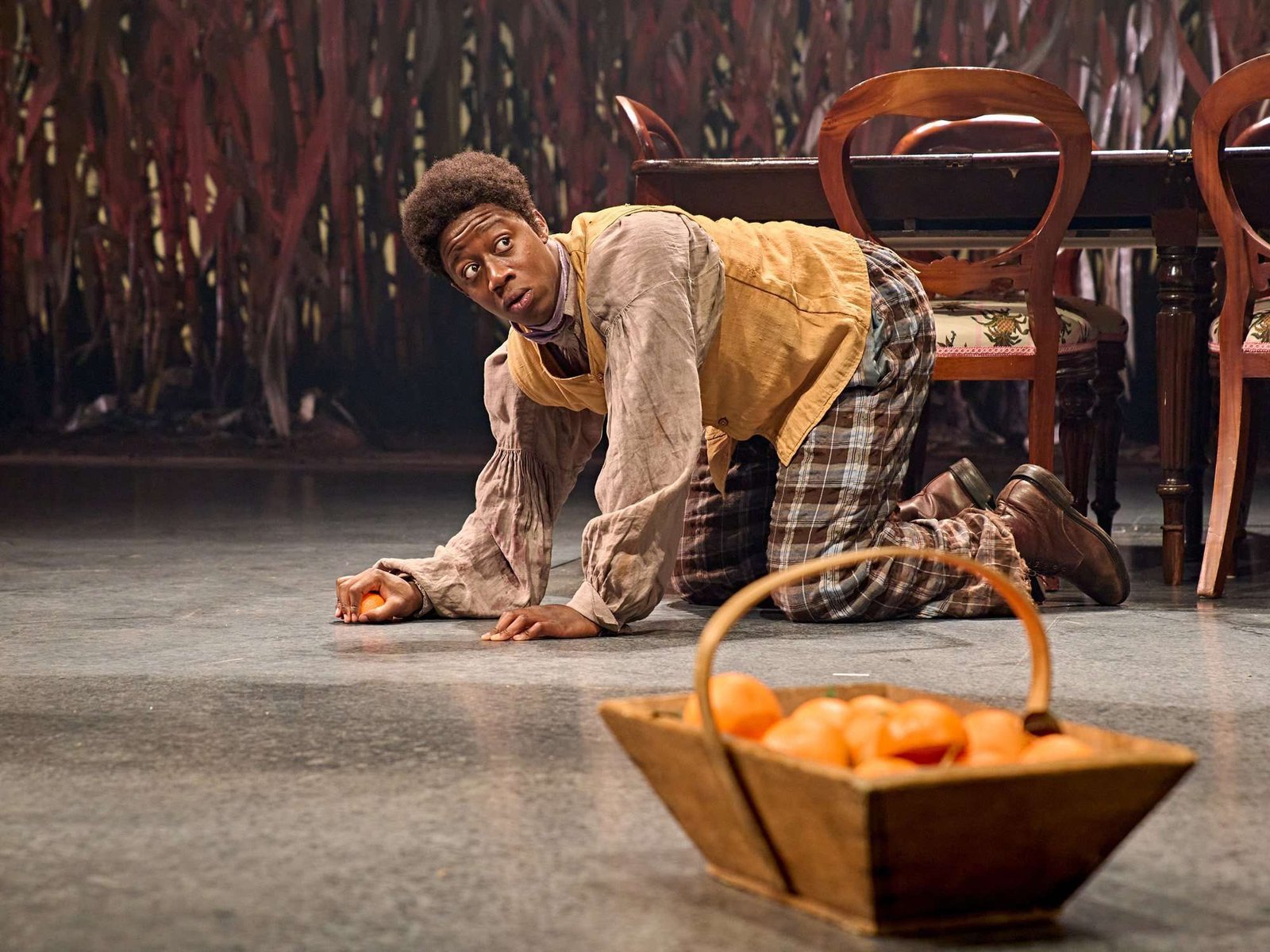
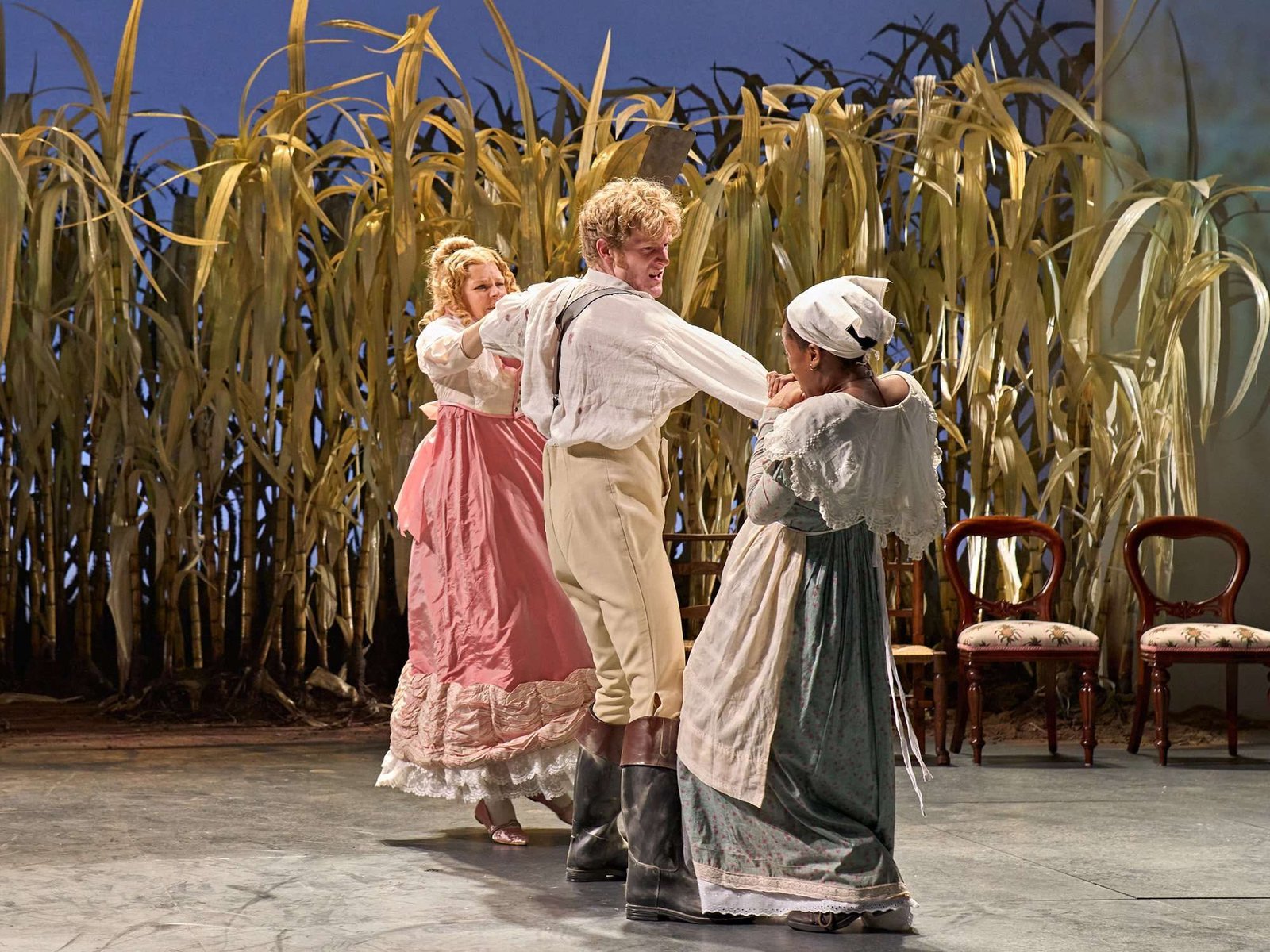
Enslaved black workers emerge from sugar cane upstage (designer Frankie Bradshaw) amidst atmospheric drum led music and you can feel the heat. Each person is characterised and of course each of them is ready to rebel when the time comes. It’s multifaceted as they, too remember, often recalling things quite different from Miss July’s account. Tara Tijani is strong as the younger Miss July, whose mistress even tries to take her name and insists on calling her “Marguerite” and I enjoyed Cecilia Appiah’s hoity-toity Miss Clara.

Scenes with the white overseer and the owning family are deeply shocking. There’s a fair bit of the sort of colonial language which would have been common currency at the time including the word which is probably now the most offensively emotive in the English speaking world but perhaps the line which stood out for me came from Olive Poulet as Caroline Mortimer: “Don’t kill him. He hasn’t finished my garden”. On press night the audience chuckled and then you could almost hear a collective appalled gasp as they had second thoughts.

It’s a sensitive and very timely contribution in the age of Black Lives Matter. You simply listen, believe and feel horrified shame as you marvel at the warm theatricality of the piece.

There is, however, an audibility issue. Hard as the cast have worked on their diaspora accents with voice coaches the end result is arguably over rich for UK audiences. I missed, for example, about half of what Llewlla Gideon said, powerful as she is in this role. And the thrust stage lay out at Chichester Festival Theatre means that sometimes characters are a long way from some of the audience and facing away from them. However fine the play you can’t respond adequately if you can’t hear much of what’s said – and, for the record, I don’t have a hearing problem.

First published by Sardines: https://www.sardinesmagazine.co.uk/review/the-long-song/

Maidstone Symphony Orchestra Mote Hall 9th October 2021

MSO Logo

Rarely have I watched a performer who exuded as much palpable pleasure in the music as Mayumi Kanagawa playing Bruch’s first violin concerto. She smiled several times at the leader during the piece and rocked appreciatively during the orchestral passages. Perhaps, since this was MSO’s first concert for 20 months, she was as delighted to be playing live as the audience was to be there.

Technically pretty impeccable, Kanagawa gave us some fine cross string work and double stopping and, later, dug out lots of romantic richness in the allegro moderato. The orchestra, meanwhile, accompanied her warmly. I occasionally hear in colours and perceive G minor as a navy blue key. Kanagawa’s simple dark blue outfit reflected that so perhaps she does too.

Her showstopper encore, Paganini’s The Hunt, was very welcome icing on the cake. Played with expert insouciance and lots of colour, her flamboyant double stopping and “impossible” leaps certainly impressed this indifferent amateur violinist.

The concerto was sandwiched between an incisively dramatic account of Beethoven’s Coriolan overture and, after the interval, Mendelssohn’s third symphony “Scottish”. I was pleased to note that Brian Wright took the whole symphony more or less attacca so that there was no space or temptation for audience applause between movements. It makes the work so much more cohesive than if it’s chopped up. Despite occasional fragments of raggedness, it resounded with melodious energy. The management of dynamics un the opening movement created a lot of lively interest and I liked the way Wright let the wind interjections, especially bassoon, shine through the texture. We were also treated to an elegantly understated second movement and as for the adagio … a conductor I was working under once commented: “This is one of the most sublime melodies ever written but you musn’t milk it”, MSO didn’t … but I still felt something in my eye at the end.

Yes, it’s utterly brilliant to see MSO in action again. They still sit at separate stands which makes page turning difficult for string players and the distancing changes the sound slightly but it’s hundreds of times better than the long, long silence we’ve all been through.

First published by Lark Reviews: https://www.larkreviews.co.uk/?p=6680

This is the best novel I’ve read about the Suffragettes who fought for votes for women before the First World War. It’s a compelling page turner which really nails their uncertainties, split loyalties, determination, sacrifices and suffering.

And Jeni Whittaker comes at it from an unusual position. Her great aunt, Gladys Mary Hazel, brought up the author’s father after his mother drowned. She was therefore, effectively, Whittaker’s paternal grandmother. It wasn’t, however, until she took her very ailing and elderly father to see the 2015 film Suffragette that he told her that his aunt had been very actively involved in the movement. Eventually that became her starting point for a “novelised biography” of the interesting Gladys some of whose papers she found in her father’s house.

It’s a first person narrative in which we learn about Gladys’s childhood in Ireland as one of seven, the move to England, teacher training and, eventually being drawn into “the cause” partly because of her social conscience but also because of her strong sense of injustice. Her activities inevitably alienate her parents as would her love affair with Michael if they’d known about it.

It’s carefully researched. The accounts of forcible feeding and its long term after-effects are graphic and shocking. But one of the many things I like about this novel is that every character and situation is presented in a balanced way. Some of the doctors with feeding tubes are distressed and traumatised by what they’re doing. Gladys has reservations about some suffragette activities. Her mother supports the cause but not the violence. Michael is attractive, loving and loveable but ultimately deceitful. Lots of decent, if sometimes misguided or misunderstood human beings, inhabit the pages. Nothing in this long, readable novel is black and white.

Many of the characters are real: Doctor Gertrude Austin, a wise woman and a mainstay to Gladys, for instance. The characterisation of complicated Emily Wilding Davison, who was probably mentally ill, is skilful and plausible.  And of course the Pankhursts are floating about – inspiring their followers but sometimes a bit self interested and lordly and not always behaving well.

Everything here is gloriously multi-dimensional. And I learned a lot. The title, by the way, comes from a game devised by Gladys’s older brother back in Ireland. They had to carry out unpleasant tasks and undergo little ordeals without sound or protest. It was good training for a future Suffragette.

Next week on Susan’s Bookshelves: The Man Who Died Twice by Richard Osman.

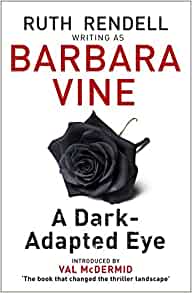
Ruth Rendell’s decision to write as Barbara Vine in parallel with her other titles gave her the scope to write a completely different sort of personality based thriller. Like her crime novels, each of her Barbara Vine titles was very compelling and wonderfully original  and I remember reading them in tense admiration as they were published – usually one a year. She was a very prolific writer.

So where to start re-reading? I looked at the list of titles and decided that I’d return to A Dark-Adapted Eye (1986) which was Barbara Vine’s debut. And of course I wasn’t disappointed. I was hooked from page one as if I’d never read it before although I remembered the end so I was acutely aware of some of the detail in a way I don’t think I was first time round. In that sense it reminds me faintly of Daphne du Maurier’s Rebecca, another novel which matures with each re-reading.

Vera Hillyard was hanged for murder. We know this from page one. The question is why? Whom did she murder? Her narrator niece, Faith, is looking back many years later and reflecting as she visits a man named Jamie in Italy. Gradually, tense drip by drip, but almost in passing, we learn who all the members of this family are and how they are related to each other. Some of them are quite conventional which provides an immaculately crafted contrast to Vine’s greatest strength. She is utterly brilliant (as is her alter-ago Ruth Rendell) at creating very strange but totally believable people. Vera, who is married to an absent military man is inscrutable, loves to sew and create beautiful things, has strange snobbish tics about, for example, eating habits, is humourless and puts others down constantly. She is also – we gradually realise, lonely and vulnerable – and given a terrible time by her very unpleasant son Frances whose character is another example of Vine’s gifts.  But it’s a very long time before we see how she could possibly have murdered anyone. Vine keeps you whipping the pages over to the very last.

Ruth Rendell died 22 years ago in 1999. She was a reliable best seller for decades and it’s odd that we don’t hear much about her now. A Dark-Adapted Eye is as fresh as the day it was written. If you’re a Rendell/Vine virgin you’re in for a treat.

I admired Rendell for another reason too. She married the same man (Don Rendell) twice. Divorced in 1975, after 25 years of marriage. they remarried in 1977 and remained together until her death. I think there’s something rather lovely about realising (presumably) that you’ve made a massive mistake and putting it right like that.  51u3FdgkKyL._SY291_BO1,204,203,200_QL40_ML2_

Next week on Susan’s Bookshelves: The Courage Game by Jeni Whitaker

Show: Ophelia Thinks Harder

Society: Sedos

Venue: Bridewell Theatre

Credits: By Jean Betts and William Shakespeare

Ophelia Thinks Harder

4 stars

Jean Betts is well known as an actor, director and playwright in New Zealand but less so in the UK. And that’s a pity because her Ophelia Thinks Harder is the most grown up, clever – and very thoughtful – play I’ve seen in a long time. Full marks to Sedos for staging it with such aplomb – and under such difficult circumstances. It was all set to go in March 2020 and we all know what happened then. Now it is reborn as the opening show in Sedos’s post-pandemic season.

We’re in Hamlet – obviously. Ophelia (Natalie Harding-Moore) is mourning her mother and thinking hard about a lot of things such as how women should be defined. The play is for her a journey of discovery as we work, more or less, through the plot of Hamlet with lots of spin, quirks and re-roling as the characters we thought we knew all morph into something else along with other characters such as the ghost of Joan of Arc (Freya Thomas – good), three old women who are actually Macbeth’s witches and various maids. There’s Horatio (Rhydian Harris), kind, reasonable and sympathetic to Ophelia in more ways than one. Polonius (David Pearson) is hideously self interested and repugnant. Danielle Capretti’s Queen, who operates the King as a glove puppet is slimy and as unmotherly as she could be.

And all this uses Shakespeare’s language woven in and out of modern English and asides. The Shakespeare goes way beyond Hamlet. There are witty borrowings from A Midsummer Night’s Dream. The Taming of the Shrew, King Lear, Romeo and Juliet. Macbeth, the sonnets and probably lots more I missed as the dialogue sailed past. The script is as good as anything by Stoppard.  It’s fiercely feminist with a lot of profoundly shocking things said by male characters. So much so that Sedos have placed a warning notice near the auditorium entrance.

It is, then, a challengingly ambitious play for a non-professional company but this is Sedos directed by Matt Bentley and it comes off very successfully. It makes, for example, excellent use of the Bridwell’s big performing space fading back into the shadows where clothes rails stand. Harding-Moore’s Ophelia begins as a rather wooden heroine. Two and a half hours later she’s bouncing with new-found confidence as, disguised as Osric, she joins the Players (who have, by the way, a lot of fun with sending up theatre. actors and the industry) and sets off for a new life. Harding-Moore is a fine actor in a huge role who really makes you think about the plight of women at all points in history.

And I’ve left Josh Beckman as Hamlet until last because he is outstanding – snarling, posturing, dominating. Even the curl of his fingers is expressive. His (sort of) closet scene with Capretti is a tour de force. He is an actor who changes the dynamic on stage the moment he appears.

Definitely one to catch if you can. Or if you can’t then at least read the play.

First published by Sardines: https://www.sardinesmagazine.co.uk/review/ophelia-thinks-harder/

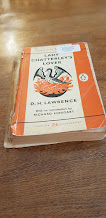
I remember the 1960 obscenity trial very clearly. My mother bought a copy of the book of the moment and carried it about in a brown paper bag so that we wouldn’t know she’d got it. Do parents still underestimate their children’s awareness so naively, I wonder? Of course I knew where she kept it and gleefully read it then – and understood very little of it except for gasping in amazement at seeing in print, words I’d hitherto heard only in the playground from boys showing off.

I’ve read it several times since but never before with the warm enjoyment and empathy I felt this time. When I reached the final page I actually sighed with regret. “Connie, I shall miss you” I thought. “You too, Oliver”. My old paperback copy, incidentally, fell apart when I took if off the shelf so I had to buy a new one for this re-read.

Lady Chatterley’s Lover was DH Lawrence’s last novel. He published it in privately in Florence in 1928 and it sold well so that for the last couple of years of his life he had a bit of the financial security he’d almost never known before. By then he was already sexually impotent owing to the tuberculosis which killed him in 1930, aged 46,  and his volatile, highly sexed wife, Freda had long sought her pleasures elsewhere. So although little seems to have been made of this, I reckon personal experience probably informed his depiction of Clifford Chatterley, paralysed by a war injury.

The plot is simple. Connie, Lady Chatterley, falls in love with her husband’s gamekeeper, becomes pregnant and eventually plans a future with him once they have both divorced. Lawrence – unlike rigidly moralistic Tolstoy whose Anna  (Anna Karenina, 1878)  has to die under the famous train because she is an adultress – allows his pair a hopeful ending.

The sex is as explicit as anything written since – and that, obviously, was the issue. When Penguin Books published it in paperback in 1960 they knew there would be a trial but they also knew that for someone as respected as Lawrence they could line up some big names for the defence: John Mortimer and Rebecca West, for instance, along with clergy, academics etc and win the case, thereby clearing the way for freedom of expression in other books. And that is exactly what happened.

It is actually a book of great lyrical beauty and truth. It’s worth reading for page 144 alone – the most accurate description of female orgasm I have ever read. Goodness knows how Lawrence knew. (Needless to say I didn’t notice this when I first toiled, in a very juvenile way, through the novel everyone was talking about.) Mellors falls in love with Connie and she with him because they’re equals and they’re honest with each other about sex and their feelings, both physical and emotional, and I really like that. Mellors eschews what he calls “false sugaries”. I’d remembered that he speaks to her, at intimate moments in broad Derby   “caressive dialect.” I had forgotten that he is actually a drop-out, a grammar school boy, who’d been commissioned during the war and normally uses received pronunciation. Connie’s sister, Hilda, who is very cross about the affair tells Mellors that his dialect use is “affected.”

It’s easy to scoff at Lawrence’s lexical tics. Once you’ve noticed his prediliction for “loins” and “thighs” it becomes a minor irritant but for the most part he writes beautifully: “But Clifford’s voice went on, clapping and gurgling with unusual sounds” we’re told as he reads Racine to his wife.  Or: “To Connie, everything in her world and life seemed worn out and her dissatisfaction was older than the hills”.

DH Lawrence is currently out of fashion. He shouldn’t be.

OldLadyChatt


Venue: Harold Pinter Theatre. Panton Street, London

Credits: By Noël Coward. Directed by Richard Eyre. Produced by Theatre Royal Bath Productions, Lee Dean and Jonathan Church Theatre Productions


Performance Date: 21/09/2021

Blithe Spirit

3 stars

Richard Eyre’s take on Noël Coward’s nice old 1941 warhorse is decently fresh. Of course the play is, effectively a traditional drawing room comedy and so far from the gritty realism of today that it only comes off with lots of verve. And that’s exactly what this production serves up.

We’re used to seeing Madame Arcati in eccentric flowing robes and often being almost a spirit herself. Jennifer Saunders does it differently. She arrives for dinner in a sensible “best” crimplene frock with frumpy shoes and witchy, straggly grey hair which she probably cuts herself. She is plausible, slightly coarse, patrician and forthright. When she returns later she wears a tweed shirt – and touch of genius – ankle socks. Only for her séances does she produce (from a capacious carpet bag) a relatively exotic cap and robe. Saunders is very funny, as you’d expect. She flits about incongruously and there’s a wonderful moment when she ends up on her back with sturdy legs pointing upwards and everyone on stage … reacts.

Geoffrey Streatfeild as the initially urbane, upper middle class Kent husband brings plenty of well judged hilarious distress to his character as life gets ever more complicated. Lisa Dillon is strong as Ruth the current wife, running her home and being revoltingly satisfied with the comfortable life she enjoys – until Elvira, the first wife appears.

It is always a challenge to make Elvira convincing as a ghost. In this production she first appears dramatically in silver light on platform 15 feet or so above the action. And that works well. Her costume (designed by Anthony Ward) is apt too – a sort of ethereal floaty, blue number – and she has chalk white hair. Once Ruth joins her as a spirit she is dressed identically. It makes the story telling crystal clear.

Rose Wardlaw gives a splendid performance as Edith the maid who charges about everywhere, speaks in a strange strangled voice and runs with her big moment in the second half.

I admired Ward’s set too. His version of the Condomine home is bookish with shelves behind the upstage piano and thickly lined along the upper landing.  It means there’s plenty for the poltergeists to have fun with.

Coward’s dialogue is masterly and this company makes it nip along wittily although the last 20 minutes or so seems a bit drawn out almost as though the joke has gone on long enough – despite the clever little theatrical coup at the very end.

First published by Sardines: https://www.sardinesmagazine.co.uk/review/blithe-spirit-10/

Bromley and Beckenham International Music Festival Concert 4

Credit: Andrej GrilcThe last of the four concerts which formed this weekend-long festival was a beautiful piece of synergistic programming. First we got Schumann’s Piano Quartet op 47 written in 1844 when the composer was 34. Then came Piano Quintet op 34 by Brahms first aired in 1865 when its composer was 32. Of course the two men knew each other well. Schumann championed the young Brahms and, famously, Brahms’s fondness for Clara Schumann lasted for the rest of his life.

And yet, separated by only 21 years these two works are very different and the group of top flight musicians led by Benjamin Grosvenor at Bromley Parish Church made sure that we noticed every nuance.

The Schumann was played by Grosvenor with Hyeyoon Park (violin). Timothy Ridout (viola) and Bartholomew LaFollete (cello). So attuned to each other are they that it felt like eavesdropping on a conversation – there is something very personal about chamber music played well. I admired the warm intensity they brought to the opening movement, the precise delivery of the scampering semiquavers in the scherzo and the majesty of the fugue in the finale. The highlight though, as usual with this work, was the sublime lilting 3|4 melody of the andante which these four played with gentle passion.

A different line up for the Brahms meant that Grosvenor and Park were joined by Raja Halder (who directed this delightful festival) playing second violin and Laura van de Heijden on cello. It was a fine rendering of this rather sombre work with lots of F minor melancholy delivered with plenty of dramatic tension in the first movement. In his introduction Grosvenor mentioned that the andante is clearly influenced by Schubert and yes, this quintet leaned on the rueful Schubertian insouciance before settling into Brahmsian richness. There was some especially lovely cello work from van der Heijden. And so to the portentous and then frenzied scherrzo played with all the right energy and stamina before the soulful finale opening. It was the contrasts they handled so well – taking this movement through its dance melody section to the well articulated anger at the end.

One of the remarkable things about this feisty festival is that, although these players clearly know each other very well they don’t work together regularly as a quartet or quintet – and yet the results were stunning. Lucky Bromley and Beckenham. I’m looking forward to next year already.

First published by Lark Reviews: https://www.larkreviews.co.uk/?p=6654