|
The Strange Case of Jekyll & Hyde
|
|
Adapted by Ross McGregor from the novel by Robert Lewis Stevenson. Produced by Arrows & Traps.
|
|
performance date: 04 Sep 2019
|
|
venue: Brockley Jack Theatre SE4 2DH
|
|
|
 Photos: Davor Tovarlaza @The Ocular Creative Photos: Davor Tovarlaza @The Ocular Creative
⭐⭐⭐⭐I’ve seen many adaptations of Robert Lewis Stevenson’s 1886 novel The Strange Case of Dr Jekyll and Mr Hyde over the years. It’s not usually a prospect which enthuses me because I’ve never warmed to the novel despite having taught it several times to secondary school English classes. But Ross McGregor’s riveting – and gloriously topical – reworking therefore took me by surprise. We are a year or two ahead in the USA. Trump has just been impeached for corruption and Henry Jekyll, a liberal young mayor from Indiana announces that he will run for president. But gradually we realise that there’s a man in his life. He’s called Hyde and they start as a gay couple but then strange, horrifying things begin to happen. It’s very clever and so far from Stevenson that it feels like a fresh new play full of very current issues including racism, homophobia and paedophilia. The content is uncompromising and you have to listen and pay attention but that actually adds to the quality of the experience The standard of the acting is very high too. Will Pinchin, who looks like the young Dick van Dyke, has exactly the right manner for a clean living, evangelical American politician. And he handles his character’s drug-fuelled breakdown beautifully, his hand settling into deformed stroke-like positions and his back arching. As Gabrielle Utterson, Jekyll’s press secretary who also has a huge issue in her own life, Lucy Ioannou is outstanding, She starts by being unsmiling and sardonic with very wry but telling facial expressions and then eventually succumbs to her own agony as the reality of what she is dealing with is finally, and very dramatically resolved. There’s excellent naturalistic acting form Gabrielle Nellis-Pain as the prostitute who’s (partly) a friend who supports Utterson. Charlie Ryall delights as Hayley who is dying very convincingly of radiation sickness (cue for neat work with ultra violet light) and Christopher Tester is good as Hyde especially in the early stages when he’s simply a teacher in a relationship with Jekyll. The inventive set (Charlotte Cooke) supports all this well too. There’s a semi-transparent screen behind which characters can appear to be on TV or be for some other reason blurred. And what a treat to see a serious play which relies on neither stage smoke nor strobe lighting. Arrows and Traps are at the beginning of a big tour with this production through to April 2020. It deserves to do well. |
 |
|
|
| First published by Sardines: http://www.sardinesmagazine.co.uk/reviews/review.php?REVIEW-Arrows%20&%20Traps-The%20Strange%20Case%20of%20Jekyll%20&%20Hyde&reviewsID=3688 |
|
|
|
Fight Like a Girl
|
|
Book, Lyrics & Direction by Nick Stimson. Music by James Atherton.
|
|
society/company: British Youth Music Theatre
|
|
performance date: 29 Aug 2019
|
|
venue: Mountview, 120 Peckham Hill St, London SE15 5JT
|
|
|
 Fight Like A Girl was written for British Youth Music Theatre three years ago by Nick Stimson and James Atherton. It has been substantially redeveloped since then and this is a brand-new production. Fight Like A Girl was written for British Youth Music Theatre three years ago by Nick Stimson and James Atherton. It has been substantially redeveloped since then and this is a brand-new production.
Stimson’s book and lyrics (he also directs) tell a powerful, topical story about Shannon, a deeply troubled teenaged girl (Jasmine Smith) who was separated at birth from her twin and adopted. She has grown up feeling a misunderstood outcast, does badly at school and, almost inevitably, gets into trouble with the law. She’s a fighter in every sense. Then, inspired by Olympic Champion Nicola Adams, she discovers the art of boxing. It’s a gritty piece about love and reconciliation among other things. Along the way we consider the plight of the homeless, life in a young offenders’ institution, parenting and adoption issues and a lot more. James Atherton, composer and musical director, provides tuneful, evocative music and I really liked the rhythmic work using the ensemble with simple but effective choreography (movement director: Kevin Johnson) and some well managed boxing scenes coached by Ian Perriss. It’s a fine work for a large ensemble (40 young people aged 12-21) because it provides lots of opportunities for small singing roles and makes imaginative use of every cast member. There are no also-rans in this production. Smith delights in the lead role. She has a real knack of hitting top notes with harsh anguish but staying in tune at the same time. Eden Glennie is strong as Lukey, a decent lad who excels at boxing, refuses to join in collective bullying and eventually becomes a sort of boy friend to Shannon. His is a very rounded character and Glennie conveys that well. Myla Newell is good to watch too, as Shannon’s easy going friend Zoe – nothing like as lightweight as her character initially seems. These young people met for a long weekend in May after which casting took place. Then they had an intensive fortnight to get this piece together – quite an achievement in a very short time. It’s an enjoyable show – my only caveat is that it’s a bit drawn out and might benefit from being 15 minutes shorter. Perhaps it tries to deal with too many issues. This is the first time I’ve seen BYMT in action since they relocated to the new Mountview HQ at Peckham last year. It’s quite a building and seems to be bringing out the best in the company which is celebrating its 15th birthday this year. Executive producer, Jon Bromwich, tells me that around 40% of the young people BYMT works with go on to conservatoire training. |
 |
|
|
| First published by Sardines: http://www.sardinesmagazine.co.uk/reviews/review.php?REVIEW-British%20Youth%20Music%20Theatre-Fight%20Like%20a%20Girl&reviewsID=3687 |
|
|
|
|
|
Evita
|
|
By Tim Rice and Andrew Lloyd Webber
|
|
society/company: Regent’s Park Open Air Theatre
|
|
performance date: 08 Aug 2019
|
|
venue: Regent’s Park Open Air Theatre
|
|
reviewer/s: Susan Elkin
|
|
|

⭐⭐⭐Samantha Pauly as Eva Perón and Company. Photo: Marc Brenner There is no doubt that the story of Eva Peron is a timelessly powerful tragic one. And it’s hard to watch Evita, which premiered in 1978, without thinking of Diana, Princess of Wales and reflecting on parallels and patterns. This revival opens dramatically with Samantha Pauly quietly appearing at the bottom of Soutra Gilmour’s tiered set. Once the audience has silenced she crawls up towards Trent Saunders as Che. Then there’s an explosion of noise, colour and sensation and, no, that’s not a metaphor. Pauly is a fine Eva, with a terrifically wide singing and acting range from full belt to intimate and from flamboyantly public to privately anguished or manipulative. It’s a performance of impressive depth delivered with fine intonation and lots of resonance. Her rendering of the last reprise of Don’t Cry for Me Argentina which she sings through tears with a catch in her voice is pretty riveting. Full marks to Trent Saunders too – the everyman commentator and narrator who is rarely off stage and develops into Eva’s inner voice. He gets the right balance between insouciance and sincerity and makes every single one of Tim Rice’s splendid words clear. The story telling here couldn’t be more direct and accessible. Ektor Rivera is convincing as Peron and there are some nice cameos by children. Best of all, though, is the choreography (Fabian Aloise) which pounds along arrestingly in the hands (and feet) of a very fine ensemble company who bring the sort of energy and vibrance which lifts a show like this off the ground, often literally. I also liked the positioning of the eighteen-piece orchestra visibly above the stage and making a first-class sound under the baton of musical director, Alan Williams. It is a pity about the pointless pyrotechics though. Director Jamie Lloyd, and presumably, Gilmour have allowed themselves to get carried away here. Of course it looks good to have fireworks, rockets, ash (bits of ribbon) repeatedly showered on to the audience and lots of smelly, coloured smoke but it distracts and irritates rather than adding anything useful to an otherwise enjoyable show. Trent Saunders as Che, Adam Pearce as Augustín Magaldi and Company. Photo: Marc Brenner |
 |
|
|
| First published by Sardines: http://www.sardinesmagazine.co.uk/reviews/review.php?REVIEW-Regent%27s%20Park%20Open%20Air%20Theatre%20(professional%20productions)-Evita&reviewsID=3658 |
|
|
|
|
|
|

When I was a child in the early 1980s, for several years in a row we would chuck a load of camping gear in the back of the estate car and our summer holidays were two or three weeks camping down through France and back again. Great fun!
In one of the early years the French dock workers in Calais decided to go on strike. The French family on the pitch next to us warned to us, and I remember my Dad tuning into obscure French radio stations to picking up news as we headed north: massive queues, no food, only one or two ferries sailing per day, disruption on an international news scale. Along with many, we diverted to Belgium and managed to get a Zebrugge to Ramsgate boat (which dates this story in its own right – Ramsgate hasn’t been used for passenger traffic in decades), finally limping back into Britain about 9:00pm at night, a day or two late.
So what did we do as a family, at this moment of stress? We found the first Indian Restaurant we could, had a curry, and soon felt much better.
This has always been this family’s automatic “what shall we do in a crisis?” reaction. It’s also been the standard go-to for happy events just as well. Birthdays, engagements, exam results (for better or worse) have all been marked by either by takeaway or dining in. And nothing much has changed in the last few weeks – if anything it’s got stronger.
The day Nick was admitted to hospital, I got a call from Susan mid-morning, immediately wrapped up work and headed for London. We spent all day in A&E, trying to alleviate Nick’s obvious worry and confusion in a strange place with various medics coming and going, probing, testing and discussing what to do. After about 10 hours, they finally decided to admit him “overnight, for further tests”.
There was no shadow of doubt, nor debate about what to do next. Susan and I jumped off the bus a stop early and went for a curry.
Seven weeks later, Nick died on Tuesday 20 August having never left the hospital or stood up again. On the Monday evening (19th) I got to the hospital about 8:00pm. No discussion was required: “Glad you’re here” said my brother. “We’ve been waiting for you – we’re going to the Indian over the way for a bite to eat”.
We went for another on Wednesday 21st, the day after he died. Although it had only been two days since the previous one, if felt like two weeks in terms of what we’d been though. Abdul, owner of the excellent Rukhsana on Randlesdown Road, Bellingham, has become an extended friend, asking each time: “How is your husband/father?”. We’ve all been very grateful for his kind, well-thought out words of encouragement and sympathy.
It’s been a hard few weeks, and the period of family adjustment will take some time – a process that will be eased, no doubt, by a curry or two.

Till death us do part. That’s what we vowed at St George’s Church, Forest Hill back in 1969 and we both kept that promise. Our marriage ended 50 years, five months later when Ms Alzheimer’s took her final, fatal bite last week.
Nick, as most readers will know by now, died at dusk on Tuesday 20 August in Lewisham hospital. His given names were Nicholas Donald George but almost everyone, including his children, called him Nick and I’ll drop all pretence of anonymity now that he’s no longer around to have a view about it.
These days, apparently, you can negotiate the cause of death with the doctor which seems odd to me. Who’s meant to be the expert? Anyway, they rang the following day and spoke to my elder son, Lucas, saying: “We’d like to put Alzheimer’s down for the death certificate. Would that be all right?” I heard him take the call. More patient than me, he politely agreed. I would probably have said: “Well of course it’s all right. What else were you thinking of putting? Yellow fever?”
It’s interesting, though. Received wisdom says that you die with Alzheimer’s not from it. But there was nothing else wrong with Nick at all. Medics earnestly tried to find other causes when he was first admitted to hospital – to no avail. He didn’t have Parkinson’s, heart problems, cancer or anything else. It was simply a disease which rapidly destroyed his brain thereby, eventually, jeopardising all other body functions. Never let it be said or implied that Alzheimer’s is just a bit of memory loss by sweet old folk who go a bit dotty. It’s an utterly hideous, degenerative, terminal disease which, in Nick’s case, galloped at obscene speed. He died only two years and four months after diagnosis. He was just 74.
So how am I doing now that I’m a widow? I seem to be OK-ish at the moment although it’s very early days. Both sons, who are just as bereft as I am of course, have been wonderfully supportive. I’m relieved that Nick finally managed to go the week after Felix’s family holiday in Devon and the week before Lucas’s in Wales so that neither of them had to cancel and one or other of them has been there for me throughout.
I struggle a bit with what I’m feeling, what I’m meant to be feeling and what I might soon be feeling because this is terra nova and the mind can play strange tricks. At the moment I am, it seems, getting back to normal life, doing what needs to be done – including, at last, some Work Work (as Nick and I used to call the stuff which pays the bills as opposed to doing the ironing or shopping) – and catching up with a few of the things I haven’t been able to do for months such as practising my violin and seeing friends. And, obviously, the three of us are funeral planning and sorting out post-death admin but not too frenetically. One of my coping mechanisms is to tell myself very firmly that Nick no longer exists (other than in our memories). What is, at the time writing, lying in the morgue at Lewisham Hospital is not Nick. It is just a few bits of left over skin, bone and other body parts. It helps.
I weep a bit over the many kind, thoughtful cards and letters which are still arriving every morning. And the Facebook and Twitter support has been utterly, movingly astonishing. Otherwise I’m not falling apart. I suspect I did much of the grieving process, including anger, months ago.
My sense of the ridiculous is returning too. Nick, I reflect, would have enjoyed the sit-com of his own death. Lucas, Felix and I were sitting with him, screens drawn. I’d been at his bedside for most of the previous 36 hours having popped home only once for a quick change of clothes. The boys had done shifts. So we were pretty peckish. An hour or two earlier Felix had nipped out and bought pizzas because we had no idea how long we were going to be there. At the moment that Nick took what became his last breath I was holding his right hand with my left. a pizza box on my lap, a mouthful of mushroom pizza and another piece in my right hand. Very romantic. Not quite how it is in the films. You’ll be relieved to know I never finished what was in the box. And it might be a while before I can look mushroom pizza in the face again.
For three weeks before his death one of Nick’s neighbours in the ward was Peter (not his real name). Suffering from frontal-lobe dementia and consequent disinhibition, he shouted all the time, constantly yelled inappropriate things, openly masturbated and tried to grope the unflappable nursing staff. It was sad and I was desperately sorry for Peter’s wife and family but it was also hilarious. As Felix said, it was like falling asleep and waking up in 1966 – in a Carry On film. On the afternoon of Nick’s death Peter disappeared. In his place arrived a very sick man who vomited noisily and frequently and whose lungs had to be audibly sucked out. All this was going on fortissimo, a few feet away, as we sat with Nick watching, and listening to those last tortured breaths, the intervals growing ever longer. “ Oh, I asked the nurse about Peter. They’ve moved him to another part of the ward” I whispered to the boys against the sound of yet another bout of retching. “Please, can we have him back?” said Felix laconically, reducing Lucas and me to fits of giggles.
Meanwhile the man in the bed immediately next to Nick, well enough to read the Daily Mail avidly every day, was chatting to his wife on his phone telling her cheerfully – and to our amused horror – that it was getting a bit dark in the ward because both the new arrivals opposite were black men. “No, we’re not outnumbered yet” he continued. “The chap next to me is still with us. His wife stayed all night last night and I think she’ll be here again tonight”.
She wasn’t. I was, as things turned out, home by 10pm.
This isn’t the last of these blogs. I think there will be a few more things I want to share as we approach and go through the funeral next month and there’s at least one guest blog in the pipeline. Moreover, I’ve been asked very often when I’m going to make them into a book. Soon, folks, I hope. Soon. I just have to get my head over the parapet and talk to the right people. I also have to find the emotional strength to do all that rereading and reliving. I’ve written over 100,000 words here.
We’re collecting for Ash Ward at Lewisham Hospital in lieu of funeral flowers. There are four ways of contributing if you wish to: 1. Go Fund Me https://www.gofundme.com/f/nicholas-elkin-memorial-fund?rcid=r01-156664178408-6f37fb2975e24e01&pc=tw_co_campmgmt_w 2. Cheque to my sister who’s coordinating the appeal (message me privately for her details) 3. BACS to my sister (ditto) 4. Cash at the funeral/memorial at which anyone who knows us and wants to come will be warmly welcome. Details will be announced very soon.

My Loved One has now been in palliative care for what feels like a very long time indeed. I’m writing this as the twelfth day dawns. And he’s been in hospital for nearly seven weeks. I’ve almost forgotten what normal life feels like and everyday marriage, when we talked to each other and shared things, seems about two centuries ago.
I go to Lewisham hospital every day, often twice. Sometimes I’m joined by other, ever supportive, close family members but usually it’s just me. It is now four days since MLO woke in my presence or showed any sign of consciousness. He just slumbers on. He hasn’t eaten anything for days and takes only tiny drops of water, usually from a little sponge. He is now thinner than I could ever have imagined anyone being. He looks like one of those profoundly shocking concentration camp photographs – literally skin stretched over bone. I suppose he’s starving to death and yet he breathes on.
The agony, however, is mine (ours) and not his. He is comfortable and warm in his bed and not in any pain. Hospital staff are making sure of that. I sit by the bedside with a book or a cup of tea (I think a constant state of feeling “tea-logged” goes with the territory) holding and stroking his bony wrist and sinewy hand under the bedclothes. It feels right and is, oddly, comforting for me. He is, I’m almost certain, not even aware I’m there or who I am.
You’re an absolute bastard, Ms Alzheimer’s. You have you robbed him (and me) – at such a speed that even doctors are surprised – of everything he enjoyed and was looking forward to in his early seventies. But even that wasn’t enough for you. Now that he’s dying and there’s nothing anyone can do about it, you’re gleefully prolonging it for as long as you possibly can, sod you.
On the other hand maybe it’s our own wholesome lifestyle coming back to hit us on the nose. One of the nurses, whom I feel I know quite well, returned to work on Thursday after seven days off duty. “Well I didn’t expect to see you still here!” she said with her usual warm twinkle. “We didn’t expect to be here” I replied, to which she said cheerfully. “It must be all those healthy veggie casseroles you’ve fed him for the last forty years”. It almost makes me wish I’d given him a lifelong diet of chips and deep-fried stuff. Perhaps then his heart would have given up by now.
People often ask how I’m doing in this horror story. Well, most of the time I manage to hold it together and have normal conversations with people but I’m extremely brittle if someone says the wrong thing. I also find it difficult to deal with ordinary tiresome trivia such as some jobsworth being officious, or Brexit or remembering what I’ve promised to do. And reminders can reduce me to a shuddering wreck: Wagner’s Prelude and Leibestod on radio 3 last week, for instance. It was one of MLO’s favourites and it is, of course, an utterly gut-wrenching farewell so it’s apt.
It is also very tiring and stressful to be constantly on the alert, waiting 24 hours a day for That Phone Call. Inevitably I’m sleeping badly.
And so it goes on. And on.
Image: South Africa 2009

This horrible, hideous, hair-raising story is nearly over.
Last Wednesday I was called into the hospital at 2.30am. I got there in 15 minutes from the moment I picked up the phone. Our two sons joined me an hour or two later. We listened at My Loved One’s bedside, tense and on tenterhooks, to ragged breathing with some longish pauses between breaths through the quiet of the night until, eventually, dawn broke over Ladywell. Various medical people came in to do checks during the long night. Once it was fully light MLO opened his eyes and then, after a while, drank a few sips of water and we realised that he was rallying – a little – and that he would probably linger for a bit longer.
Five days later and that’s still the case except that we’re now firmly and definitely in palliative care. The consultant came to see us on Wednesday and we all four of us agreed no more medical intervention (including medication, cannula and rehydration drip) or observation. Instead they will keep him comfortable and pain free and there’s an open prescription for three “comfort” medications, including morphine, should be need it. She offered us the services of a priest and asked if there were other family members we wanted to bring in.
There is, now, no question of discharging him home. He is simply to stay where he is, in a comfy pressure mattress bed with a view over the leafy Ladywell Fields, for as long as it takes. Given that MLO now refuses more than a few drops of water I don’t see how that can be long. I go to bed, desperately tired every night but unable to settle because I know as well as anyone that the most likely time for another phone call is 2.00 to 4.00 am when the body is at its lowest point in the twenty four hour cycle. Instead of sleeping I tend to lie there thinking and waiting.
Meanwhile MLO is sometimes awake during the day. Occasionally he murmurs at me but it’s not comprehensible and I’m not convinced he recognises me any more.
Strange though, how even when you’re trying the survive the most stressful thing which is ever likely to happen to you – death, or imminent death, of spouse – there are still things to chuckle at.
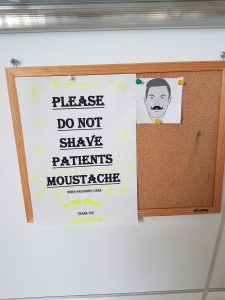
One day early last week an enthusiastic nurse radically pruned MLO’s moustache because she said it was in the way of spoon feeding him. The next one didn’t recognise the remnants as a moustache and shaved it off completely. Well, he’s had that moustache since 1970 and his children have never seen him without it but I decided that, in the scheme of things, it really doesn’t matter and said so.
“I am not upset. Don’t worry about it” I said to two (other) nurses whom I’ve got to know quite well. “Well we are!” they said and between them, created a notice to make sure it doesn’t happen again. They were afraid that some staff with limited English might not know what a moustache is so they found and printed off an illustration to pin behind his bed. And it makes me smile every time I look at it,
I can’t say too often how impressed I am by the quality of the faultlessly kind, genuine, friendly care MLO (and I) is/are getting from the staff of Ash Ward at Lewisham Hospital. The moustache saga is just a tiny example. On the morning that we made the palliative care decision one lovely woman, always warm and thoughtful, came to “our” bedside and said “Listen, we’re here for you guys as well as for the patient. Don’t forget that”. They deserve ten stars, never mind five.
As for me I’m locked in a curious limbo world. It feels as if a train is hurtling towards me relentlessly but in slow motion. Like Olive Oyl in all those old Popeye cartoons, I’m tied to the track. She was always rescued at the very last minute. I shan’t be.
Even now – and I’ve written over 100,000 words on this subject in these blogs – I sometimes struggle to get my head round the enormity of what’s happening to me.
Header photograph: Malta, 2010.

When you are struggling with the hardest job you ever do – trying to raise a child half-decently – and you’re heading for what feels like rock bottom, there’s always someone nearby who tells you “It’s only a phase”. Well of course, those phases don’t stop with toddlerhood. They become as clear towards the Very End as they were in the cradle. Shakespeare, famously and with his usual extraordinary power of observation, puts it like this:
And all the men and women merely players;
They have their exits and their entrances;
And one man in his time plays many parts,
His acts being seven ages. At first the infant,
Mewling and puking in the nurse’s arms;
And then the whining school-boy, with his satchel
And shining morning face, creeping like snail
Unwillingly to school. And then the lover,
Sighing like furnace, with a woeful ballad
Made to his mistress’ eyebrow. Then a soldier,
Full of strange oaths, and bearded like the pard,
Jealous in honour, sudden and quick in quarrel,
Seeking the bubble reputation
Even in the cannon’s mouth. And then the justice,
In fair round belly with good capon lin’d,
With eyes severe and beard of formal cut,
Full of wise saws and modern instances;
And so he plays his part. The sixth age shifts
Into the lean and slipper’d pantaloon,
With spectacles on nose and pouch on side;
His youthful hose, well sav’d, a world too wide
For his shrunk shank; and his big manly voice,
Turning again toward childish treble, pipes
And whistles in his sound. Last scene of all,
That ends this strange eventful history,
Is second childishness and mere oblivion;
Sans teeth, sans eyes, sans taste, sans everything.
I think a lot these days about the “last scene of all” because I am watching it unfold daily. My Loved One has lain in hospital for five weeks. Hospitals are for people who can be helped to get (at least a little) better. Despite the excellent efforts of the splendid staff at Lewisham Hospital MLO has continued to deteriorate. There is no more they can do. “We are approaching the end” the consultant told me plainly this week. The upshot is that he needs to go somewhere else where nature will simply take its course.
And unless, nature takes us by surprise in the next few days, he’s coming home to die. The bed is ready for him. All ideas of hoisting him in and out of it are now abandoned. We’re just waiting for funding to be agreed and the care package to be set up. I am due to meet the Palliative Care Team later this week. There may be hospice involvement.
Well Will, you really did get it right didn’t you? MLO now refuses even to try and eat almost everything he’s offered. He can hardly swallow and even getting medication in is difficult. Once home, without an IV drip, he will be dependent on the few drops of water we can spoon in. “Shrunk shank” is very much in evidence. Realisitically I suspect he’s on track to starve to death and given his frailty it’s unlikely to take long.
He hasn’t worn his denture since they had to remove it weeks back for an MRI scan and the process was no difficult that he’s been “sans teeth” ever since. He’s also more or less “sans taste” since he lost his sense of smell twenty years ago and I really don’t know how much his blank rheumy eyes are seeing. “second childishness and mere oblivion” apply as well since he can do less for himself that he could (presumably) as a six month baby but seems mercifully unaware of it.
He isn’t quite (yet) “sans everything” though. It is well known that hearing is the last thing to go. This week I have started taking my iPad and his old Bose headphones to the hospital. Yesterday I played him the whole of the Mozart Requiem. I sat at the bedside quietly doing a puzzle and listening to a comic drama staff were having with another patient while he lay unmoving with the headphones on. Suddenly I thought I saw MLO’s hand move but assumed I’d imagined it. Then it happened again. And suddenly his right forearm was vertical and twitching – and his mouth was moving. He was “conducting” along to the Sanctus. It was a marvellous, quite uplifting few moments and wonderful for me to think that, even at this darkening twilight stage, he’d briefly found a tiny shred of enjoyment and life quality. Thanks Wolfgang Amadeus.
“… with his satchel/And shining morning face” My Loved one around 1950.