Press ESC or click the X to close this window

Learning, learning, learning

It’s now 19 months since Ms Alzheimers’s official arrival in our household although of course, with hindsight, I now realise she’d been hovering on the horizon for quite a while before Diagnosis Day. And I marvel at what a lot I’ve learned – the practical stuff, the theory, the trivial and the serious. Above all there’s the acquisition of new and often quite surprising, self knowledge.

And I’ve been more aware of all this than ever in the last three weeks during which Ms A has suddenly tightened her grip and we’ve seen marked deterioration. At the time of writing it’s nine days since MLO has left the house.

I have, for example, learned that:

1.I can talk about death in a calm, matter-of-fact way which I would never until now have imagined that I could. Of course, I’ve thought quite a lot in the last year or two about widowhood and how I might/will cope with it. Several times recently MLO has raised the subject of his own death so I know that he is beginning to think about the inevitable too. Gently, but truthfully, I have astonished myself with how straightforwardly we can talk about it when he raises the subject. No tears. Just honesty.

2.I have morphed into the kind of person who can march into Sainsburys (where, I’ve discovered, they’re 25% cheaper than in Boots) pick up three huge packets of incontinence pants and saunter out via the checkout without batting an eyelid.

3.Yes, I can survive and still work reasonably efficiently in the daytime even if I’m woken and have to get out of bed to help MLO half a dozen times during the night. I seem to be adjusting to getting my sleep – up to 7 or 8 hours maybe –  in one hour bursts. Moreover I can now go back to sleep almost instantly (just I did when I had babies) which I haven’t been able to do for a very long time.

4.I (we) have some fabulous friends and an amazing family (nearly) all of whom are ready to drop everything and do everything they possibly can to help me when I need it. They astonish me continually. I’ve said this several times before but it can’t actually, in my view, be said too often.

5.If you’re catering for someone who needs as much fibre as you can cram in then you can make variations on an Elkin beans on toast theme. MLO doesn’t actually like Heinz beans but he does like hummus. I’ve discovered that you can mash any sort of tinned bean with any sort of nut butter seasoned with a few herbs and a dash of, say, basalmic or soy sauce and pile it onto toast. Infinite variety. Borlotti beans with almond butter anyone?

6.I now know how to turn the TV on. I’m with Cilla Black on this one. Remember when her beloved husband Bobbie died and she couldn’t get the news on because he’d always “driven” the TV set? Everyone derided her but it was the same with us. We’ve never been in the habit of much TV and I didn’t operate it often enough to remember. Well it took several texts to and from long-suffering sons but I have now got the hang of it. I’m trying to persuade MLO to watch gardening and antiques programmes which won’t disturb or distress him because he no longer reads much and I need entertainment for him which won’t fuel his Alzheimer’s-driven, frightened imaginings about crime and violence.

7.I’m much more patient than I often give myself credit for. I find I can usually repeat the same thing several times without getting cross. I do all this crawling out in the night, mostly without grumbling. I generally manage not to rush him – although he’s painfully slow at everything he does now. I probably blow about one time in twenty. Not bad really?

8.A trivial (but tiresome) health problem of my own worsens if I allow myself to get angry or stressed. I have only recently worked out the connection. It’s a good reason for taking a deep breath and smiling rather than flipping my lid.

9.I can now write features, reviews and articles despite being repeatedly interrupted and called away. I used to be quite precious about needing, say, two hours entirely to myself to get a piece of work finished. These days MLO appears frequently: hovering in my office looking troubled, anxious or vacant. “Can you help me please?” or “Is it nearly time for ‘them’ [usually an imaginary visitation] to arrive?” or “I just wondered what you were doing?”. So I have to stop, deal with him and recover my train of thought ten minutes later. And it’s OK. Usually I can.

10.It really doesn’t matter much if he forgets I’m his wife and thinks I’m a carer. I know exactly who I am, and who he is, so that will do for both of us. I just chuckle at him when he says things like “Do you help many people like me?” because I know – at present anyway – that I shall probably get him back at some point later. Today for example he pointed to the pendant I’m wearing and beamed. “I bought you that, didn’t I?” It was only a few weeks back too, in a jeweller’s in Chichester, so that was a good moment.

Stop learning stop living?
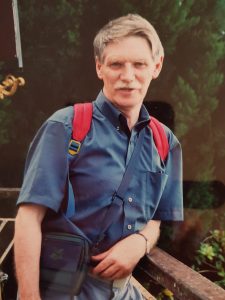
20181120_095311

A nice memory of how things used to be. I took this photograph in Penang in (I think) 2004. Doesn’t he look well!

It isn’t every day I stumble across a strong new vocational training opportunity which is almost free to the participants. I refer to the Lyric Ensemble which piloted in the 2017/18 academic year and has just started work with its second group.

Fifteen young actors, aged 18-25 are recruited to form an ensemble, Director of Young People at the Lyric, Nicholai La Barrie tells me he auditioned 80 earlier this term for the new 2018/19 cohort . “They include writers, actors, film makers, musicians, people who are interested in directing or producing” says Nicholai. “It’s a very rich mix of talent and our catchphrase is ‘training to perform’ ”

The idea is to find people with real potential who haven’t accessed training before and aren’t likely to. “It’s a way of opening up the industry to young people who are prevented from going to drama school by perceived or actual barriers” Nicholai explains. Some of the fifteen are supported by bursaries but even full fees are very low. “Right across the education and learning work we do here the average fee is £4.00 a session” observes Executive Director, Sian Alexander as the three of us sip tea in the Lyric’s rather nice café area.

The 15 ensemble members come to the Lyric two evenings per week for nine months at the end of which they create a studio show. Along the way they also take part in intensive weeks of training “And of course we keep an eye on production values, standards and rigour” Nicholai adds, explaining that last year there was a lot of focus on, for example, movement, improvisation, text and character. “What they do  has got to be good. We’re a professional theatre”. This year the emphasis is political so the end result show will be different. Next year (2019/20) it will be something else again, thematically, depending on who directs it.

Casting directors came to last summer’s shows. Nicholai assures me happily that each individual actor “shaped up” and that almost all got some sort of representation at the end of the course.  “They were snapped up” he says.  And that, obviously, is the acid test. Without an agent your chances of getting professional work are infinitesimal.

The groups are gloriously diverse and inclusive. They include people – often from youth theatres – of all ethnic and economic backgrounds as well as LBGT and people with disabilities.

Lyric Hammersmith will be enrolling its 2019/20 group in September next year. Some applicants will, predictably, already be Lyric Hammersmith members. But it’s open to all. Give it a whirl if you or any West London young person close to you is looking for a way of training without either leaving home or incurring debt

Vivid dreams – effectively nightmares – are one of Ms Alzheimer’s less welcome bestowals. And I hope the people who think this dreadful disease is just memory loss and cognitive decline are listening.

Whenever My Loved One falls asleep he disappears into a weird, disconcerting alternative world. And he sleeps a lot: most of the night and increasingly often for a couple of hours in the morning, afternoon or sometimes both. He’s perpetually tired and, now often also complains of feeling dizzy or says he has “the shakes”. When he surfaces he’s lost to me, sometimes for several hours, and the last ten days or so have shown a sharp decline.

Take the night last week when I drove to Canterbury to review Glyndebourne’s touring production of La Traviata. MLO should have been with me but decided on the day (like the Duke of Edinburgh except that HRH is 97 not 73) that he didn’t feel up to it. I rang him on the hands free as I left the Canterbury car park after the show. “I’ve had a terrible evening” he said agitatedly and in considerable distress. “People are coming and I’m really worried. I’ve phoned the NHS mental health people and they’ll be here soon to take me away” I knew immediately he’d been dreaming and that he couldn’t possibly have phoned anyone – he’s no longer capable of looking up a number and dialling it independently. So I went into teacher/professional mode and simply kept him talking, reassuring him until he seemed calmer. It took to the Medway Bridge to achieve that by which time I was only 40 minutes from home.

Since that night I’ve been repeatedly told that a crime has been committed and that we shall both end up in prison and that he can hear voices in the house and once he has to get to the bank for George (referring to his father who died four years ago). Sometimes it can be quite funny. When I pressed him about the aforementioned crime, at a less confused time when he’d been awake for a while and wasn’t quite so distant and distrait, he told me it was bigamy. “Gosh! How exciting” I said. “Perhaps we should write a novel because it’s all fiction. Neither of us is a bigamist. Trust me!”

One morning, also last week, he woke up very puzzled – he often thinks we’re in a hotel or holiday let and that he can hear other guests. I said firmly “No. There’s nothing to worry about. Nobody lives here except you, me and a big tabby and white cat”. Pause while he processed the information and then: “Well, it would have been frowned upon even 30 years ago.” My turn to be bemused: “What would?” Him: “Living together like this” Well that did make me laugh. I held up my left hand and said as cheerfully as I could: “Darling, we’ve been MARRIED for nearly FIFTY YEARS. Wedding rings and all that. We’re having a family celebration in the spring”. It was his reaction that chilled me. “Oh really?” he said clearly surprised and unconvinced.

It’s both hilarious and utterly tragic because in his more lucid moments (and even that is relative) he knows that sometimes (often) he talks nonsense. “I have a different narrative running in my head for much of the time” he said recently and, on another occasion “It’s as if I’m two people isn’t it?” Yes, dead right it is but I’m seeing the “normal” one less and less often. My least favourite thing is when he wakes me in the small hours stumbling round the bedroom in a panic because he can’t remember where the bathroom is or anxious and alarmed by something in his alternative world he can’t explain to me so I have to talk him back to calmness. A couple of nights ago I was out of bed with him half a dozen times between midnight and 3.30 am – it reminds me of having a fractious baby again but I was 24 and 28 when I dealt with that I knew it would only be for a few weeks. It’s not quite like that now.

So, we have to do things differently from here on. I shall obviously have to rethink some of my work habits. I am frequently out all day and all evening and that’s too long to leave a man with worsening dementia alone in the house. It was all right for a while but it isn’t now.

I am also looking into what is euphemistically called “help”. I need to hire a very reliable person who will “mansit” while I’m out in the evenings. Various avenues to explore. I certainly don’t want the standard “carer” who drops in for ten minutes, mutters some hearty platitudes and races off to the next client.

Sometimes I dream too – of how things once were – as an escape from the nightmarish reality. The other day I was just walking out of the door and realised I hadn’t made sure MLO was wearing one of the just-in-case pads I prefer him to wear when I’m out.  “Have you got a pad on?” I asked. “I think so” he said uncertainly. Hmm. Without thinking, I undid his fly to check. It felt vaguely familiar. What did it remind me of?  Oh yes (blushing, but not much) I remember … a very long time ago (or so it seems) … and in a completely different life …

Who was it who said that a young man needs a lover and an old man a nurse?. Been there. Done that. All of it. From romantic frisson to incontinence pads.

Three new  practical how-to books have landed on my desk along with one rather more academic title.

Whether you’re auditioning for a part in a show, for drama school or for entry to an organisation like National Youth Theatre it can be very difficult – given inexperience and, maybe, lack of informed up-to-date advice – to find exactly the right piece. You need something well written, probably gender and age appropriate which enables you to show the very best that you can do.

In National Youth Theatre Monologues (Nick Hern Books) experienced director Michael Bryher, himself a former NYT member who went on to train at LAMDA, has identified seventy five interesting possibilities some of which audition panels won’t have heard hundreds of times before. One powerful speech by Freddie and one by Diane, for example,  from Evan Placey’s Consensual the current  NYT revival and I’m pleased to see the inclusion of a piece from Dan Reballato’s 2005 play Outright Terror Bold and Brilliant about the London bombings too. It’s a pretty eclectic selection and a useful book for anyone at the start of his or her journey towards an acting career

As always the advice is that the auditionee should always have read the rest of the play and that’s partly why each monologue is preceded by three pages of support information including where you can find the full text,  a section about the playwright and the production history of the piece. The “Things to Think About” box will help some auditionees to marshal their thoughts and the basic facts about the sex, age, accent and so on of the character along with a scene summary are all a good starting point.

Victoria Deiorio’s The Art of Theatrical Sound Design (Methuen Drama) is strong on the science of sound and how the ear receives it as well as providing advice and lessons in how to apply artistic ideas to the stage through the medium of sound. Deirorio is a respected sound designer for theatre and film as well as Head of Sound Design for the Theatre School at DePaul University, Chicago.

Nearer home,  practising lighting designer Nick Moran leads the lighting courses at Royal Central School of Speech and Drama and it’s good to see a new edition of his Performance Lighting Design (Methuen Drama). It takes the reader from first principles – how light works and the tools at the designer’s disposal all the way to tips on how to build a career in lighting once you’ve grasped techniques such as using a lighting score or a ground plan. And it’s all supported with very practical diagrams and examples from productions.

And finally to  Ecologies of Precarity in Twenty First Century Theatre  (Methuen Drama) by Marissia Fragkou who teaches performing arts at Canterbury Christ Church University. Her interest is in ways in  which political issues are addressed in contemporary theatre and she mostly uses a feminist template as she considers the work of playwrights such as Simon Stephens, Carol Churchill, Mike Bartlett and debbie tucker green.

The Marlowe Theatre Canterbury is a rare venue in that it seems to work acoustically and visually for every genre: “straight” drama, musical theatre, orchestral concerts – and opera. This elegant, intelligent production of La Traviata sits as well in this space as if it were designed for it. In fact, this is but one stop on a big tour in Glyndebourne’s fiftieth year of touring.

In the pit are 56 musicians – just visible from the circle –  supporting, accompanying and intensifying the action but never overwhelming it. From those opening mysterious pianissimo tremolo chromatics, repeated at the beginning of Act 3, Christoph Alstaedt  uses colourful dynamics and exquisite control to highlight the drama. There’s a gauze screen, behind which we can see Violetta’s bed as the lights gradually come up during the overture. It’s a strong directorial (Tom Cairns) idea.

Mane Galoyan gives us a restrained but charismatic Violetta in Act One. She is, after all, terminally ill, as well as the life and soul of her big party. She and Luis Gomes as Alfredo stroke the perfect harmonies in their first duet so that we feel and engage with every note. Later she brings all the passion and warmth the role needs and I loved the symbolism of everyone leaving silently from the stage a few bars before the end so that Violetta dies alone – as we all must.

Luis Gomes matches her well and is convincing in his love and there’s a stonkingly good performance from Noel Bouley as Alfredo’s interfering, later remorseful father. The work in Act 2 Scene 1 when he confronts Violetta is as chillingly touching as I’ve ever seen it.

There’s nicely directed chorus work and some fine choral singing (chorus master: Nicholas Jenkins) although it’s a strangely misguided decision not to have them back for a curtain call at the end. It was as if they’d been sent home for an early night. They deserve the credit they’re not granted.

Hildegard Bechtler’s sets consist mainly of three big screens which move a little to suggest two different party rooms, Alfredo’s country place and finally Violetta’s bedroom. It’s simple but makes effective use of the space on the Marlowe’s big stage with Peter Mumford’s dark lighting adding a lot of atmosphere especially in Act 3.

But the real hero of the evening is, of course, Verdi with his dancing melodies and gut-wrenching constructions such as the near perfect quintet in Act 3 which, in this production, is deeply moving. And what wonders he weaves with his much favoured triple time. Of course he uses it for lilting dances, drinking songs and set pieces but he also makes it work for some very solemn moments of high emotion and Altstaed’s attention to detail made me notice it more attentively than ever in this production. No wonder old Guiseppe’s work has been so popular for so long.

This review was first published by Lark Reviews: http://www.larkreviews.co.uk/?cat=3

Billy Bishop Goes to War continues at the Jermyn Street Theatre, London until 24 November 2018.

Star rating: four stars ★ ★ ★ ★ ✩

It’s a pleasure to see two actors working together as sensitively as Oliver Beamish, who also plays piano, and Charles Aitken.

Between them they tell a graphic, poignant, horrifying, wryly funny story of a young Canadian who comes to Britain to “fight the Hun” in 1914, eventually becoming a Royal Flying Corps pilot with the highest ever “score” for shooting down enemy planes and therefore a celebrity …

Read the rest of this review at Musical Theatre Review: http://musicaltheatrereview.com/billy-bishop-goes-to-war-jermyn-street-theatre/

Follies
Book by James Goldman. Music & lyrics by Stephen Sondheim.
society/company: WWOS (West Wickham Operatic Society)
performance date: 02 Nov 2018
venue: Churchill Theatre, Bromley
 
 
Only a few years ago it would have been almost unthinkable for an amateur company to have tackled Sondheim with all those difficult key changes and shifting time signatures not to mention numbers which are often a unique cross between classical recitative and lyrical rock music. Now, standards are soaring so high that West Wickham Operatic Society’s Follies is the second very creditable non-pro Sondheim show I’ve seen in a month.

And of course – Follies, that famous 1970s reunion of a pre-war group of dancers – is, in many ways, a perfect choice for a company such as WWOS because beyond the four huge, challenging principal roles there are lots of cameos, solo songs by all sorts of people and plenty for everyone to do as well as masses of ensemble work. Rehearsal schedules must have been a nightmare to organise but convenient for the many performers who wouldn’t have been needed to attend as often as some shows and roles would require.

Scenery hired from Scenic Projects created a splendidly louche, passé atmosphere with three blocks each created from metallic filigree and providing balconies to gesture from and steps to sweep down. And there’s a deal of grandiose sweeping in this show as each middle aged character is, famously, represented by a younger on-stage incarnation of her (and in two cases him) self 30 years or more earlier.

Tracy Prizeman as Sally Durant Plummer really plumbs (no pun intended) the depths of her troubled, needy character who thinks she wants something better than her long term marriage. Her account of Losing My Mind in Act two is beautifully sung and underpinned with some poignant acting.

There was an extraordinarily accomplished job from Danielle Dowsett, the show’s co-director and choreographer, who sang the role of Phyllis – a programme change announced at the beginning.

Both lead men – Kevin Gauntlett (who also co-directs) as Buddy and Gary Glaysher as Ben Stone adeptly bring out the complexities of their unhappy characters and both sing well.

Amongst the cameos Josie LaFitte is a spikey, convincing Solange and Emma Brack has tremendous fun with Broadway Baby and brings it off to perfection with a bespectacled twinkle and jerk of the hips.

One of the best things of all in this enjoyable show is the 17-piece orchestra under MD, Anne Greenidge. They are seated upstage and you can see the glinting of trombone slides and the movement of bows through the gaps in the set which adds a quasi magical effect. They make a pretty good job of Sondheim’s complex score too.

 This review was first published by Sardines: http://www.sardinesmagazine.co.uk/reviews/review.php?REVIEW-WWOS%20(West%20Wickham%20Operatic%20Society)-Follies&reviewsID=3372


Over the Moon – ★★★★★
Presented by Hurly Burly Co.
performance date: 03 Nov 2018
venue: Half Moon Theatre, 43 White Horse Road, London E1 0ND
 

★★★★★

It isn’t often that I turn up to a Saturday morning show for under-3s – all buggy parking and parents meeting up congenially – to be moved to tears by sheer beauty of the piece within five minutes of its starting. But that’s what happened at Over the Moon. Staged at Half Moon Theatre and subtitled “an opera for little people” it is utterly exquisite.

Three performers Sarah Forbes (soprano), Catherine Carter (Mezzo) and Jenny Gould (piano) explore a day from getting up in the morning to finally going to sleep again at night – with a lot of sleeps in between because that’s what very young children recognise.

It was the Monteverdi duet – immaculately sung even though Forbes and Carter were flat on the floor when they started it – which got me first, coming as soon as it did after Hey Diddle Diddle. Yes, the music in this little (40 minute) show is as colourful and eclectic as the feathers, sheets and pieces of gauze which litter the stage and act as props during the singing. By the time we reached the gorgeous duet from Humperdinck’s Hansel and Gretel whatever it was that was in my eye had grown rather large.

Part of the reason it’s so moving is that it’s interactive and tiny audience members are encouraged to join in – and they did so very enthusiastically at the performance I saw. And to see a child of, say eight months, sitting up listening acutely to a bit of Ravel or Debussy is quite something.

Of course it only works as well as it does because of the quality of performance. Both Carter and Forbes sing beautifully but gently so there’s nothing remotely abrasive or “operatic” in their voices. They also – Forbes in particular – have developed a knack of smiling warmly at the end of each phrase which must take a lot of practice. Gould who sometimes sings as well as plays and chips into the action, is a very relaxed pianist who makes all the music feel approachable.

First published by Sardines: http://www.sardinesmagazine.co.uk/reviews/review.php?REVIEW-West%20End%20&%20Fringe-Over%20the%20Moon%20-%20%E2%98%85%E2%98%85%E2%98%85%E2%98%85%E2%98%85&reviewsID=3371