Press ESC or click the X to close this window

Susan’s Bookshelves: The Amazing Story of Adolphus Tips by Michael Morpurgo

It was a heart-warming pleasure to come back to The Amazing Story of Adolphus Tips (2006) There is nothing pretentiously “literary” about Morpurgo’s writing but he knows how to tell a gripping story and he hooks, really hooks, child readers so he gets my vote.

It was a recent conversation with a nine year old which led to my rereading of this title. She told me she likes Morpugo’s stories and had started this one only to have it removed from her by a teacher as “unsuitable”. Her school had apparently badged it as an 11+ title and her parents took the same view. Well, I disapprove with passion of age-labelling. I’d allow (and always did when I had control over such things) any child to read any book on the school library shelves which she or he fancied.

However, just in case I’d missed, or misremembered, something, I wanted to make absolutely sure there is nothing in The Amazing Story of Adolphus Tips which could cause distress or offence. And  of course there isn’t.

Shot through with Morpurgo’s trademark love of animals and hatred of war, the story opens with a recently widowed grandmother  disappearing on a mysterious jaunt. By way of explanation she then sends extracts from her 1943/4 diaries to her grandson who has often stayed with her in Devon. And, obviously, the framing device finally brings us back to the grandson and a Big Reveal about the real reason for Grandma’s trip.

We’re near Slapton Sands, Devon where Lily lives on a farm with her family and cat, Tips, who is purringly, furrily depicted. Her father is away fighting and her mother and grandfather are under pressure. The area is being used as preparation for the D-Day Landings which Morpurgo has researched carefully. This has brought many Americans to the area including Adie and his friend Harry who befriend Lily. Both men, just young conscripts, are black so they widen her horizons simply by being themselves.

Then the area has to be cleared for military use and Lily’s family is temporarily evicted which causes the disappearance of her beloved cat. Yes, there’s sadness and loss in all this: there are U boats out there torpedoing ships after all and, at a different level, how does a farmer deal with continual litters of kittens? There is also warmth as Lily becomes friends with Barry, the evacuee from London, and gradually comes to appreciate her teacher, Mrs Blumfeld, Jewish and from the Netherlands.  She is learning about people and situations all the time and the reader learns with her.

War is ugly. It denies happy endings to many people and several characters in this story have to deal with the deaths of people they love. Lily, however, in her old age, having nursed her very sick husband for a long time, finds a new beginning and it’s lump in the throat stuff. So yes, share this with any child you know who wants to read it. Even the publisher suggests age 8-12. If I knew my nine year old acquaintance a little better, I’d buy her a copy and tell her to enjoy it quietly at home without telling anyone at school.

Next week on Susan’s Bookshelves:


The Government Inspector

Nikolai Gogol, adapted by Phil Porter

Directed by Gregory Doran

Chichester Festival Theatre


Star rating: 4


Gogol’s groundbreaking 1836 play is very famous but this was the first time I’d seen it – and an interestingly entertaining experience it turned out to be. I haven’t laughed so much in the theatre for quite a while.

It’s a satire – and, in Phil Porter’s new version very much a farce – which sends up the imperialist Russian regime from the point of view of an insular little town in Ukraine thereby adding more than a whiff of topicality. The simple plot presents the lazy, incompetent corrupt men who cosily run the town suddenly being informed that they are to be visited by a government inspector. Then a stranger, Khlestakov (Tom Rosenthal) turns up and they make an incorrect assumption. Cue for some glorious sycophancy on their part, lucrative opportunism on Khlestakov’s and a lot of comedy rooted in dramatic irony and physicality. No prizes for guessing where the plot has to end.

Phil Porter’s writing is witty and current and it was an inspired directorial idea to have characters using a wide range of British vernacular accents because it make these people feel real as well as spicing up the comedy with incongruity.

The production uses an extravagantly large cast of eighteen which includes some terrific character acting (Nick Haverson as Khlestakov’s servant Osip, for example) and a magnificent central performance from Rosenthal whose comic timing is almost perfect especially when he turns to the audience with asides. And his drunk scene which ends with him being carried/somersaulted off stage is fun.

This is the first time Gregory Doran has directed at Chichester and his very distinctive finger prints are all over this production. He has a knack of making every single word and movement interesting, and often funny, which is what makes this show so compelling. He also ensures that the large company works seamlessly together. His device to end the play is a masterstroke too because it unsettles the audience and, no spoilers, is a trick I’ve not seen before.

Also noteworthy is Francis O’Connor’s dramatic set which manages to mix grand arched doorways with ramshackle houses and untidy filing cabinets. And there’s a beautifully contrived scene with a bed, a dormer window and a character climbing up and falling though it. To do that convincingly (and safely) is pretty impressive.

The icing on the already pretty tasty cake cake is the three piece Russian (or should that be Ukrainian?)  folk band led by smiling Corey Wickens on violin. They play on stage as a curtain raiser, cover the scene changes and add lots of atmosphere with lots of deliciously evocative, rhythmic, minor key melodies.

The Mikado

WS Gilbert and Sir Arthur Sullivan

Directed by Keith Strachan

Take Note Theatre Ltd for Tabard Theatre

 Star rating: 4

Photography: Matt Hunter

I have probably seen more productions of The Mikado than any other show with the possible exception of Macbeth: fifty or so (and counting) in both cases, at least one every year or so, since childhood.

And I have long come to the conclusion that I prefer my beloved G&S done small scale than with the traditional big choruses. A number of companies are now doing this and it works a treat because you hear every word and every harmony. Take Note Theatre’s very enjoyable The Mikado uses an exceptionally talented cast of nine, two of whom are accomplished actor-musos.

Nanki-Poo is, of course, the son of the Mikado disguised as a second trombone in the Titipu town band. Here he is reworked as a second trumpet and Nicholas Curry is the first Nanki Poo I’ve ever seen who has the instrument strapped to his side and plays it very well, initially for in-character effect but thereafter as an occasional part of the orchestration. And it’s a casting tour-de-force because he also sings his tenor part beautifully and brings a delightful youthful innocence to the role.

Tilly Godwin – who has a soaring, immaculately accurate and admirably lovely soprano voice – more than matches him as giggly, simpering Yum Yum, pert, pretty, pleased with herself but hilariously pragmatic when it comes to the problem of being buried alive.

Fed Zanni, wearing an outrageously loud striped suit (costumes by Eliza Podedsta) is one of the best Kokos I’ve ever seen. He communicates with his very expressive eyes and the comic timing in his Little List song, complete with the now de rigueur topical rewrite, is a masterclass in comic timing. So is his take on Tit Willow which he sings as if he is desperately inventing it as he goes along. Moreover, it will be a while before I forget the prancing glee he gets into Here’s a How-De-Do

Other highlights – in a show which has lots of them – include John Griffiths as the titular Mikado, singing that famous song with gravitas and then inviting the audience to join in the chorus. Martin George is terrific as the sneering Pooh Bah and it’s fun for Erica Flint to double her ensemble role with playing flute both side stage and on it.

Otherwise the music is ably provided by MD Annemarie Lewis Thomas stage right on keys, holding everything together with her usual skill. The imaginative arrangements are, I gather, the work of the director, Keith Strachan.  Among other things I really liked the use of harpsichord mode to accompany the madrigal,  Brightly Dawns Our Wedding Day.

The reason this production works so well is that Strachan evidently trusts the material. We get lots of Gilbert’s original dialogue and, when delivered as well as this, it is still very funny. And the few changes he makes are clever: “late running District Line trains” instead of “parliamentary trains” in the The Mikado’s song, “Gentlemen of Respect” instead of “Gentleman of Japan” in the opening chorus and some English words for Mi-ya-sa-ma, for instance. Also neat is the simplicity of the set which comprises a painted townscape and one versatile wooden bench.

Definitely one to catch if you can. Whether you’re a seasoned G&S aficionado (guilty as charged) or a first timer, there’s something for you here. And, of course, I sang all the way home and so will you,

The arrival for review of Rachel Bowlby’s new book Emile Zola, part of Oxford University Press’s Writing Modern Life series, reminded me that I ought to read more Zola. Germinal has long been a favourite. I know I’ve read Thérése Raquin and some of the short stories and I’m pretty sure I once read La Bête Humaine because I remember the trains. But beyond that it’s all a bit of a blank so I ordered Une Page D’Amour which Helen Constantine’s 1990 translation gives as A Love Story.

Hélène is widowed and rather reclusively raising her adored 11 year old daughter Jeanne in a spacious, late nineteenth century Parisian apartment with the help of her servant Rosalie. Jeanne, however is a delicate child, and her mother has to call in, Henri Deberle, a doctor she doesn’t know because their regular one is attending a woman in childbirth. Thus begins a rather tortured, drawn out liaison which does eventually culminate in sex – just once. Meanwhile Hélène (and Jeanne) are befriended by the nearby Deberle family and there is jealousy, misunderstanding and a great deal of condoned adultery. Of course though, this is Zola, after all so there is bound to be plenty of anguished agonising, a certain amount of tragedy and no happy ending.

As with everything I’ve read by Zola I’m struck by how very different it is from British fiction of the same period. For a start it’s sexually quite explicit. At one point, for example, Henri pulls off Hélène’s stocking and smothers her leg with kisses, his lips straying ever higher. This novel was published in 1877 – fourteen years before the censorship laws in Britain ensured that Thomas Hardy had to make the seduction in Tess of the D’Urbervilles so subtle that it’s easy to miss it altogether.

I also marvel at the attitude to children – they are present, noisy, relishing their food and drink, getting bored, misbehaving and telling adults what they think. In short they act like flesh and blood children. It’s a far cry from the “children should be seen and not heard” Victorian attitude, whiffs of which were still around in the 1950s when I was growing up. If children appear at all in British late Victorian fiction they are usually cardboard cut-outs.

Jeanne, in particular, is both perceptive and manipulative, although she is genuinely ill. Zola respects her as a character in her own right and shows us what she’s thinking and feeling even when it’s unattractive, thereby anticipating Henry James’s What Maisie Knew by twenty years.

Paris itself – in all weathers and seasons – features extensively in A Love Story. Hélène and Jeanne gaze out of the windows a great deal and Zola tells us at rather tedious length what they’re seeing from dawn to dusk and from snow to bright sunshine. It’s partly symbolic because it reflects mood –  the all too familiar “pathetic fallacy” –  but there is too much of it in what is otherwise quite a compelling read although it’s not in the same league as Germinal.

Next week on Susan’s Bookshelves: The Amazing Story of Adolphus Tips by Michael Morpurgo

The Elmer Adventure

David McKee

Directed by Toby Mitchell

Tall Stories

Blackheath Halls and touring


Star rating 3.5


Photography by Charlie Flint


Over the years I have seen many of these  sixty minute shows based on memorable, colourful books for young children and their grown-ups. This one is quite clever, lexically unpatronising and comes with commendably clear diction from three young actors. In short it ticks most of the boxes and is a pretty decent show of its type.

One of the “boxes” is a gently understated message about otherness and inclusion because, since he’s famously a patchwork elephant, Elmer is rather different from the rest of the herd, who are grey and grumpy. And that point is subtly reinforced by the casting of the excellent Frankie Turton who is an ambulatory wheelchair user, a strong singer and a powerful personality.

The framing device gives us three young people, friends since primary school visiting a jungle (colourful set and costumes by Amanda Mascarenhas) in search of Elmer. So it’s a quest during which they pass the time by acting out Elmer stories like children in a playground. And eventually, of course, at the eleventh hour, their search comes good with a wonderful puppet (Yvonne Stone) and this hardened critic had to swallow a lump in her throat.

Along the way there are some chirpy songs (Matthew Floyd Jones) one of which is so catchy, and reprised so often, that children were singing it as they left the auditorium and I heard another at the bus stop afterwards. Inevitably the music is mostly backing track but Amelia Gabriel is an unusually accomplished guitarist and her skills are used to good effect. Rob Astillo (who also plays guitar)  is a fine foil to the two girls often pretending reluctance to join in. All three play well off each other especially in the songs. We also get some pantomimic stage business with pistols, balloons and things appearing upstage behind the action all of which seems to go down well enough with the young audience.

These three actors are full of smiles and that vital knack of engaging and involving the audience. In a show of this type, stage presence matters more than nuanced acting or award-winning singing although, obviously characters have to be convincing and singing tuneful and incisive. And this production achieves that.

Philharmonia

Marin Alsop

Royal Festival Hall, South Bank Centre

24 April 2025

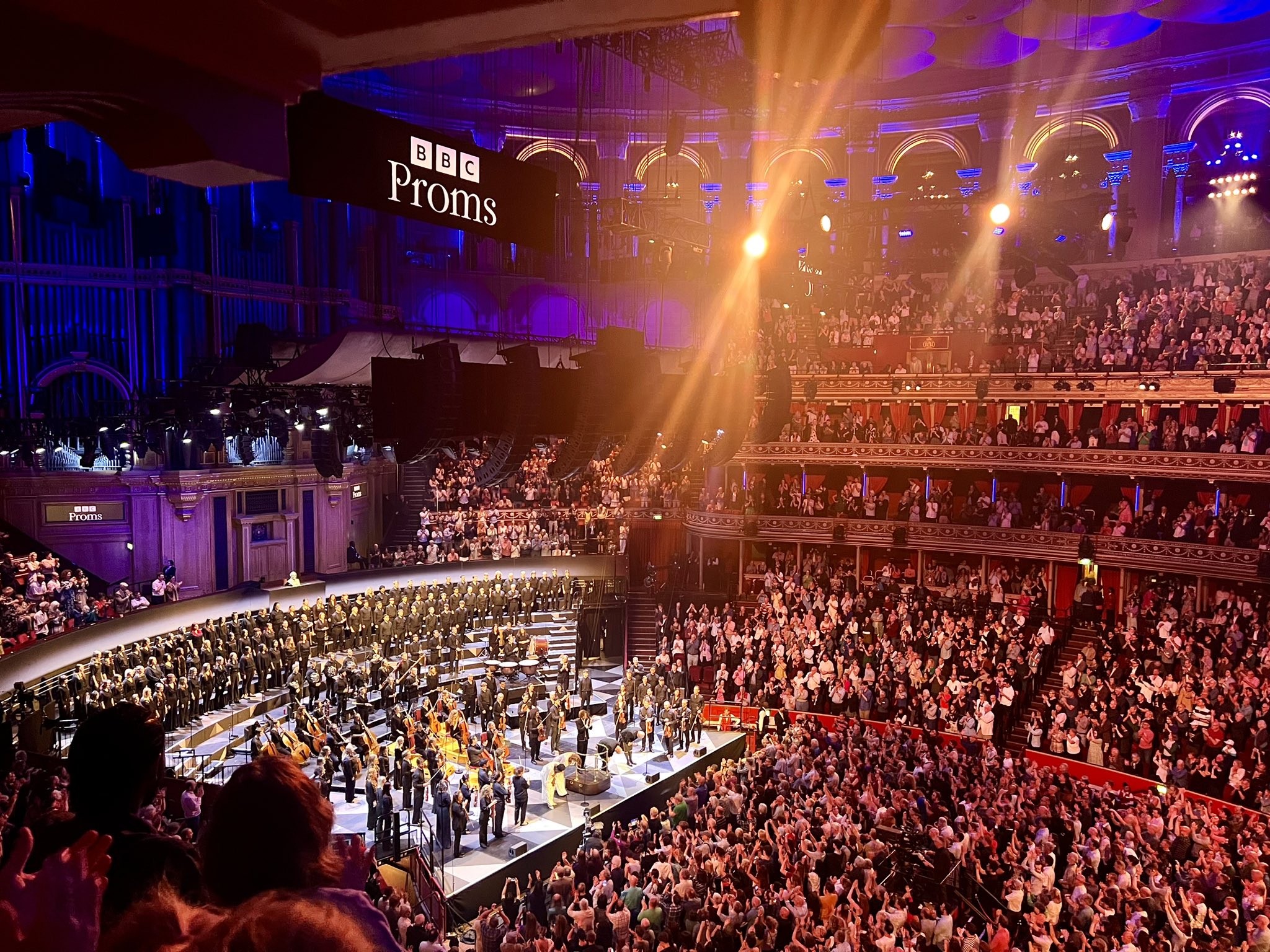
Part of Multitudes (“An electrifying new arts festival powered by orchestral music”), this concert opened with Leonard Bernstein’s dramatic, colourful, passionate, reflective Chichester Psalms (1965). I was a student in Chichester when Dean Walter Hussey commissioned it for the cathedral and vividly remember the excitement in the city, especially when the composer came to Chichester to conduct it a year or two later. I have loved it dearly ever since and miss no opportunity to hear it. I was probably the only person in the audience at this concert there primarily for the Bernstein, which seemed unfamiliar to most of the audience, most of whom were apparently there for the second half.

It was especially interesting to hear Chichester Psalms conducted by Marin Alsop who was famously mentored by Bernstein and close to him. It took off with panache and the Philharmonia Chorus found electrifying precision in the cross rhythms. The second movement was lovingly lyrical as an unnamed boy treble (Instagram identifies him as Hugo Walkom) duetted with the harp. The child singer was nervous and a bit breathy at first but it settled after a few bars. I really admired the arresting tension in the third movement string playing. Moreover the Philharmonia Chorus  solists did a grand job as did the cello quartet. It was, overall, a powerful performance of a splendid work.

And so to the evening’s main event: Dimitri Shostakovich’s tenth symphony accompanied by William Kentridge’s film “Oh To Believe in Another World”. Or should that be the other way round?. Well, silent film and live music is hardly a new idea but this collaboration seeks to put an innovative spin on it.

Dating from just after the death of Stalin in 1953, the tenth symphony is a pretty programmatic work expressing the composer’s pent up distress after years of trying to be creative within the Stalinist regime, of which he fell foul more than once. There’s a lot of anger in this symphony especially in the short, furious second movement – and only a tiny glimmer of hope for the future.

Now, I am probably not the best person to judge Kentridge’s imaginative filmic art, but personally I would have preferred to listen to the music without the film. As it was, the auditorium was in cinema style darkness with the orchestra almost invisible apart from their stand lights. And we were distracted from Shostakovich by actors, photographed heads, grotesque puppets, captions and inset contemporary footage unwinding, sort of, a visual narrative of mid 20th century Soviet Russia. Again and again we saw Shostakovich conducting with a red flag and lots of images of lamp shades (?) with pliers or other tools for heads to represent, I suppose, industry. We also saw a lot of Lenin and Shostakovich’s alleged lover among many other things.  Sometimes they swapped heads. The visual movement was more or less synched with the music but that didn’t seem to be the point. If there was a point, frankly it passed me by, but the fault may lie with me and my ignorance rather than in the film.

Meanwhile the orchestra, relegated to atmospheric background music, soldiered on admirably. Highlights included the immaculate flute playing in the Allegro and a very unsettling account of the Allegretto with its relentless motiv – beautifully introduced by Philharmonia concert master, Zsolt-Tihamer Visontay, the sound of his violin clear, clean and elegantly sinister.

Phot0 credit: Pete Woodward.

I recently spent a few delightful days in Cornwall where my host/friend, with whom I share a love of books and words, recommended Notes From An Exhibition which is set mostly in Penzance just a few miles from her lovely home. Well I’d read Patrick Gale before but had somehow missed this 2007 title so I ordered it on the spot.

Rachel Kelly, a hugely successful household name painter, has just died and we are walking round a posthumous exhibition of her work and getting a strong sense both of her abstract style and of her status. Gale uses the notices attached to the works on display as pegs for an account of her complicated, troubled personal life and the mental illness she was dogged by. It’s an unusual narrative method which involves a lot of time shifts and switches in points of view (although it’s written entirely in the third person) but he makes it work with aplomb.

Rachel and her very grounded school teacher husband, Antony, raise four children, the eldest of whom she was already pregnant with by someone else when she marries. That son, Garfield is happily married, living nearby and longing to start a family which doesn’t seem to be happening. Then there’s Morwenna, who has been out of contact for many years so we await the unravelling of her personal mystery. Hedley is in a happy gay relationship – although there’s a hiccup – with a London art dealer and the youngest, Petroc, is evidently dead although Gale keeps us waiting a long time to find out what happened to him. Moreover, there is a question mark over the circumstances of Rachel’s death given that her bi-polar condition has, in the past, triggered a number of suicide attempts and several hospitalised bouts of severe post-natal depression triggered by her refusal to take her regular medication during pregnancy. There is also a big hole in family knowledge about Rachel’s Canadian origins and the truth is gradually revealed.

It’s a richly layered novel about, in no particular order, marriage, adolescence, grief, art, Cornwall, mental illness, identity, Quakerism and siblings. I liked it a lot.


Yellow Things

Bridge House Theatre


Star rating: 3.5


This show is a double bill featuring three actors. The first half gives us Mothers Have Nine Lives by Joanna Norland and after the interval comes an adapted version of The Yellow Wallpaper by Charlotte Perkins Gilman. Overall we meet ten monologue-ing mothers. It’s richly truthful material and anyone who has ever been a mother will recognise and identify with parts of it which is why, in places, it’s funny.

First we meet Mira Morrison as a professionally high flying, middle-class pregnant woman trying to field all the questions and advice thrown at her by everyone in her life. Then, in another persona, Morrison becomes a woman we’ve all met who is so obsessed with work that she gradually subs her child out almost full-time to grandparents.

Then there’s Gina (Ellie Ward who also directs) as a desperate single mother with two very young daughters, on benefits, in desperate need of a double buggy and thwarted every way she turns.

All three actors are good, with notably skilled voice work to distinguish their many characters, but the real star of this show is Becky Lumb: wonderful as a fraught mother supervising breakfast for her daughters who have her wrapped round their little fingers. She also gives a lovely performance as a mother who desperately wants to spend Christmas with her daughter home from university but is, of course, disappointed. Joanna Norland’s play simply, and rather effectively, simply presents nine of these snapshots as a rounded exploration of motherhood.

The Yellow Wallpaper is darker and deeper. Becky Lumb presents a gay woman who bears a child but whose partner (who contributes the egg for IVF) separates from her and then dies of cancer before the child is even born. The thirty minute play alternates between her talking rationally to her baby and being sectioned with severe post-natal depression in an institution where she is completely spooked by the faded yellow wallpaper. It’s a sterling performance: moving, powerful and insightful.  And the video projection of the wallpaper and the sinister things which seem to her to be emanating from it is nicely done.

Between monologues we hear the voices of children playing mothers and babies – sound designed by Ellie Ward  – which adds another dimension because it makes us think about  the impressions of motherhood we form long before we get there.

Yellow Things is competent, thoughtful theatre.