Press ESC or click the X to close this window

Conventional casting still has an important role

It’s a good time to be a female actor. It would seem that, suddenly, all the barriers have lifted. This year saw Golda Rosheval at Liverpool Everyman playing Othello as a female general in a lesbian relationship with her white Desdemona. Last week we heard that Kathryn Hunter is to play Timon of Athens for the RSC and that Jack Lowden and Hayley Atwell are to alternate the roles of the Deputy and the Novice in Donmar Warehouse’s forthcoming Measure for Measure. Michelle Terry has played Hamlet at The Globe this year too. And don’t let’s forget Glenda Jackson’s recent, award winning Lear at The Old Vic.

Of course, none of this is new. Frances de la Tour played Hamlet in 1979 and Fiona Shaw did a stunning Richard II in 1995. Maxine Peake gave us her Hamlet in 2014 and Michelle Terry’s Open Air Theatre Henry V was memorable in 2016. And I could cite other examples all the way back to Sarah Bernhardt.

It’s just that now it seems to have become so ubiquitous that it’s if no director or casting director dares cast a Shakespeare play conventionally.  And it all feels to me a bit  manic and contrived – a sort of industrial over compensation for several centuries of doing plays according to the conventions of the social period in which they were written. I also sense some vying with each other to see who can come up with the most unlikely bit of gender blind casting.

I don’t want to see women side-lined, obviously, and there are some fantastic plays with plum parts for them –  all of Ibsen, Alan Bennett and Oscar Wilde for example to cite just three random examples. And Shakespeare did give us Cleopatra, Juliet, Viola, Isabella, Katerina and many more. Then there are dozens of roles within the plays which really can happily be played by either sex. Victoria Blunt, for instance, at Watermill Theatre this year was one of the best Bottoms I’ve ever seen. I saw a brilliant female Banquo (sorry – I don’t remember the actor’s name and I no longer have the programme) at Open Air Theatre a few years ago. And has anyone ever done a female Shylock? It could work well because there are no sexual politics in the role.

But when it comes to sexually charged roles such as Othello or Angelo then changing the genders completely alters the thrust of the play and flies in the face of the text. Measure for Measure is a case in point. Angelo is, initially to his own surprise and chagrin, a ruthless sexual predator. It’s Harvey Weinstein stuff. He’s a powerful male, threateningly and manipulatively demanding sex with a young woman in a vulnerable position. That’s the situation. It’s all in the script. Perhaps I’ve led a sheltered life but in my experience even the most tyrannical of women can’t actually force an uncooperative man to have sex with her whatever she promises him. She can’t rape him. And even if she could  there’s arguably less at stake for a man than a woman. But I digress. None of that it what the play is about.  And that is my point.

Actually if you want to cast Measure for Measure gender blind you could do it, successfully with almost any other part – The Duke, Escalus or Pompey, say – but not the two central ones. And that’s just an example of a single play. How long will it be before we see a contorted, distorted gender reversed Macbeth and Lady Macbeth  or Gertrude and Claudius and a text which has had to be heavily doctored to make it make any sense at all?

There is room, obviously, for as many interpretations as there are directors and actors and it’s good to experiment with innovative ways of doing these plays. But surely that’s all it should be? It seems neither sensible nor balanced to allow it to become the norm and if you have to rewrite the play to accommodate your innovation then perhaps you should do a different play altogether?  Personally I don’t want us to get to the stage that you actually have to hunt for a production which is remotely conventional in its casting and telling the story which Shakespeare dramatised.

I think the industry needs to be careful too. It’s all very well taking the view that you should cast as many women as possible even in wildly unlikely roles because we’re all very PC and liberal. What about the audience? I had lunch recently with a distant cousin whom I hadn’t seen for decades. To my delight she’s morphed into an enthusiastic theatre goer and we talked about lots of shows she’d seen. But she was utterly scathing about Sally Cookson’s Jane Eyre, which for the record, I liked very much. She dismissed it as “modernised and ridiculous with lots of running up and down ladders”. In other words, her tastes are traditional. I hate to imagine what she’d think about some of the more extreme gender-blind casting around at the moment. And there are millions of ticket buyers exactly like her out there.

A few years ago I saw a production of Don Giovanni in a gay night club (Heaven, at Charing Cross). All the genders were reversed except the title role. It was an interesting and quite enjoyable experiment although some of the numbers were in changed keys to accommodate different voices which took a while to get used to. Fun, but of course I don’t want all my Mozart served up like that. It’s the same with other forms of performing arts. We need balance and we need choice. The trouble with common sense, as Voltaire reminded us, is that it isn’t very common.
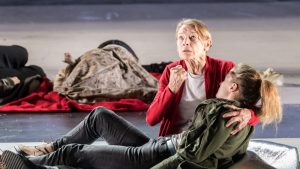
king-lear-glenda-jackson

Last week I interviewed an exceptionally lovely theatre director. At the end of our discussion he turned the tables and began to ask me warm, genuinely interested questions about my own life and work.

Very few interviewees do that. It’s as if journalists are a special breed of automata who don’t have mortgages and dogs like everyone else. And anyway they’re usually not interested. In fact it’s quite common to spend two hours in close conversation with someone and then be completely ignored when you see him/her at an event the following week.

So it was rather uplifting to tell this nice man a few things about myself and what I do in real life. And of course I ended up mentioning the presence of Ms Alzheimer’s in my marriage and home – it simmers near the top of my mind almost all the time even when I’m working.

Most people, as I’ve said before, immediately launch into an account of someone close to them who have died horrendously of the illness. Not this charming man who clearly had no experience of Alzheimer’s at all. “Oh dear” he said. “I’ve heard that’s a ghastly disease. What causes it?  Is there a cure?”

What refreshing questions. I hadn’t meant to go into details but of course I found myself trying to explain Alzheimer’s which was useful because – as every teacher knows – the best possible way of straightening something out in your own mind is communicating it to someone else.

It’s easy to say that nobody knows what causes Alzheimer’s. Actually we do. Amyloid proteins in the brain clump together to form Amyloid plaques – look at the large coloured blob on the right of the photograph at the head of this blog. That’s an amyloid plaque. It’s sticky.  And it’s very bad news. What we don’t know is why this clumping business happens in some people and not in others.

I’ve read dozens and dozens of theories in the last 15 months since My Loved One was diagnosed, many of them based on very serious, reputable scientific studies. Is it linked to diet? Or lifestyle? Or smoking? Or alcohol? Or whether or not you do mind puzzles? Is there a correlation with depression? Could it be hereditary? Is it triggered by drugs taken for a different health problem?

None of those fits MLO’s profile.  What about regular migraines which he used to suffer from quite badly in his twenties and thirties? As far as I know that possibility has not been explored but perhaps it should be.

On and on it goes. Scientists are doing their best (although there’s still too little money spent on Alzheimer’s research) but we’re not really much further forward. Even the drugs prescribed to hold back symptoms for a few months have been around for decades.

Then a day or two after my chat with Mr Theatre Director came a study reported at the Alzheimer’s Association International Conference in Chicago which could – just possibly – be a turning point.

Eight hundred and fifty six patients in US, Europe and Japan, all showing early signs of cognitive decline were given fortnightly injections of  BAN 2401 (no, I don’t know what that is, either). There was a control group in the experiment too who got a placebo. Cautiously described by commentators in the know as “encouraging”, the results show that this drug improves BOTH the physical changes in the brain tissue and the symptoms of the illness. And that’s a first.

Of course, even if the research is corroborated via much larger studies and the drug, or something similar to it, is eventually licensed it will come far too late to help MLO.  But I cling to hope for future generations.

Meanwhile MLO isn’t getting any better, as I say in my understated, double negative, English way to all the kind people who routinely ask.

On Sunday I wrote a birthday card put a stamp on it and said: “Could you pop over the road and post this for me, do you think?” I do this on the grounds that it’s vital to keep him involved and feeling useful although it’s a job I could have done myself in about 3 minutes.

He disappeared upstairs for 10 minutes, having apparently decided that he couldn’t walk the 150 yards to the post box in his sandals and needed to put on a pair of lace-up shoes. Then he asked whether I’d be here to let him when he got back because he struggles with locks. “Yes I’ll be here but please do take the keys from the hook because it’s feeble not even to try” I said. He trudged off.

Fifteen minutes later (he really does walk very slowly now) the door bell rang. I found him outside failing to open the outer porch door with the car key which was on the same ring.

Heavy, heavy weather. That’s life with Ms A as she tightens her grip.

Photograph by Simon Fraser/Science Source


CHICHESTER FESTIVAL THEATRE

At the heart of this production is some fine exceptionally fine acting especially from Lydia Leonard as Rachel and Jean St Clair as her deaf mother of which more anon. But powerful as it is in places the play itself creaks a bit not least because it tries to do too much at once.

We’re in a Quaker community on the south coast of England in the early Nineteenth Century. Napoleon and his forces are only just across the channel so the atmosphere is tense especially for pacifist Quakers. Childless Rachel, who has born three still-born sons, lives with her husband Adam (Gerald Kyd – strong) and her deaf mother for whom she has to interpret. Then an apprentice (Laurie Davidson – plausible) joins the household and the dynamics both of the family and of the wider community are changed for ever.

The trouble with all this is that it’s least three different stories and they don’t knit together very coherently. I yearned to see and learn more of the relationship between Alice and her mother. The mad moment between Alice and the apprentice (think John Proctor and Abigail in The Crucible) on which the plot of the second half hangs didn’t convince me at all. Then there’s a another ‘happy’ family Elder James Rickman (Jim Findley – good) and his wife, garrulous Biddy (Olivia Darnley – enjoyable) in which all is definitely not what it seems. She has married the ‘wrong’ man who “can be quite unquakerly” at night and she is a real Mrs Bennett to her daughter Tabitha (Leona Allen – excellent). I’d welcome a whole play about the Rickman family. I’d like to have known more about the apprentice’s sketchy back story too. As it is The Meeting leaves too many avenues unexplored and ends untied.

Lydia Leonard finds a deeply naturalistic intensity in Rachel. She is troubled, passionate and frustrated by being a thinker who isn’t always permitted to voice her thoughts. She is also held back by having to be her mother’s voice and half the time she doesn’t understand her own feelings all of which Leonard’s outstanding performance catches adroitly.

Deaf actor Jean St Clair is terrific too. She watches intensely and conveys as much with her eyes as many actors fail to do with their whole bodies. She also acts beautifully through signing and when she finally speaks orally at the end of the play it’s pretty moving.

I also loved the set (by Vicki Mortimer) and the sound effects (by Ben and Max Ringham) On one side of the Minerva’s in-the-round stage are tiers of rocks to connote the coast and the stone masonry which is Adam’s trade. Most of the action take place centre stage which represents indoors. Sometimes the space becomes the Quaker Meeting House when an ingenious ring descends and characters lift down chairs which hook into it and sit below it in the traditional Quaker circle of silence. As the ring goes up and down there is an atmospheric scraping noise which heightens the tension. At other moments you can hear Sussex sea birds.

Yes, this is a production with some good moments, ideas and performances but it also struggles to know exactly what it’s trying to do and where it’s going.

Review first published by Sardines: http://www.sardinesmagazine.co.uk/reviews/review.php?REVIEW-Chichester%20Festival%20Theatre%20(professional)-The%20Meeting&reviewsID=3268

Mr Stink continues at the Chickenshed Theatre, London until 4 August 2018.

Star rating: four stars ★ ★ ★ ★ ✩

This show is the sort of cheery, uplifting stuff which sends you home with a spring in your step and a smile on your face. It’s inclusive. It’s diverse. And it’s fun.

David Walliams’ whimsical story about a rather unhappy little girl who befriends a tramp, thereby transformatively rehabiliating them both, is a good fit for Chickenshed with its “theatre changing lives” mission. And it was, apparently, Walliams himself who suggested that they do it following the success of last year’s The Midnight Gang.

Lou Stein’s version embellishes the basic story by adding …

Read the rest of this review at Musical Theatre Review: http://musicaltheatrereview.com/mr-stink-chickenshed-theatre/

When you’re old enough to remember seeing Sir Adrian Boult and Otto Klemperer live it’s really quite exciting to see a conductor as young as Ben Gernon, 28, doing a fine job and reassuring us all that classical music is in safe hands for decades to come.

A crisp and intelligent performance of that glorious old warhorse, Beethoven’s Emperor concerto was the high spot of this concert – noteworthy for sensitive dynamics and a certain freshness, especially in the adagio.  Paul Lewis played it with warm maturity and precision.  And I always judge any performance of the E flat concerto by the handling of that beautiful link passage between the adagio and the rondo – maybe one of the most exquisitely lyrical few bars Beethoven ever wrote. Here the lingering rubato was nicely balanced before it danced triumphantly away.

The evening had begun with the world premiere of Tansy Davies’s What Did We See? – an orchestral suite from Between Worlds. A four movement suite extrapolated by the composer from her 9/11 opera, it is moving (once you’ve read the programme notes and understood what it’s about) and musically interesting. It uses, for example, a battery of unusual percussion and requires six percussionists to play gong, horizontal bass drum, cymbals sounded by passing a rod vertically through the centre hole, xylophone, glockenspiel, various rattles and shakers and a strange bowed bell – among many other things. There are evocative, chittering percussive sounds in the strings too – produced by specialist bowing and tapping as well as atmospheric glissandi. All this is, I suspect, pretty difficult to play but the BBC Philharmonic rose ably enough to the challenge.

After the interval came an uplifting performance of Brahms Second Symphony conducted without baton – as also for the Davies and the Beethoven. For the Brahms he didn’t use a score either. As always that creates a strong line of very direct communication between conductor and players. They gave us an articulately melodious first movement, a gently sombre contrasting adagio and an allegretto at cracking pace with emphasis on the busy strings, every note clear. Then came a resounding allegro with lots of energy, bounce and passion. The roar of applause at the end was well earned.

First published by Lark Reviews: http://www.larkreviews.co.uk/?cat=3

As soon as the 2018 Proms Youth Choir sang the first vibrant note of Eriks Esenvalds’s unaccompanied setting of Longfellow’s sonnet “A Shadow”, you knew that this was going to be quite an evening. Two hundred and fifty singers seated in one stage-right huge bank created a very warm strong sound which burst joyfully through the grandiloquent Royal Albert Hall acoustic. And if some of the exposed top soprano notes felt a bit strained, well I can live with that. It will be a long time before I forget this piece – a first performance – which ends with the choir whistling and the sound slowly dying away to the tinkling of bells and small glockenspiels in the hands of some of the choir members. The choir consists of University of Birmingham Voices, University of Aberdeen Chamber Choir, North East Choir and BBC Proms Youth Choir Academy. Each group had trained separately and then come together for a four day intensive rehearsal residency led by Chorus Director, Simon Halsey who conducted this fine performance.

Next, in a concert entitled War and Peace, came Britten’s Sinfonia da Requiem played by Georg Solti’s World Orchestra for Peace which draws players from orchestras based in several continents. They’d sat quietly waiting in position during the opener. And if I may be allowed a “girly” observation it’s good to see a band in which the women dress in different colours. Visually very jolly. Coloured shirts for the chaps next, please.

Donald Runnicles splits his first and second violins across the stage which, as always, makes the lower strings sound more integrated – especially in the pizzicato section in the third movement’s lush (hopeful?) conclusion. The second movement was memorable too. With its col legno tattoo rhythm, snare drum and trumpet tune it really was Dies Irae and – in a piece which ensures that all four percussionists work hard for their fee – the decelerandoending with all those offset notes from different sections is not for the faint hearted. This lot brought it off with all the passion and panache it needs.

But the jewel in the crown was the magnificent account of Beethoven’s Choral Symphony which formed the second half – the choir now re-grouped evenly behind the orchestra. I have actually sung this piece in the Royal Albert Hall and so understand well the problems of the conductor being a very long way away – not an issue at this performance, partly because the impeccably trained choir sang without copies so that their responses were impeccably precise.

Runnicles gave us lots of sensitivity and colour in the first three movement with effectively exaggerated piano passages in the first and close attention to the detail with some very crisp string runs in the second – as well as making the very best of one of my favourite moments when the timpani take over from the bassoon lead and we’re into anticipation and excitement.  The lilting lyricism of the third movement was tenderly clear too with emphasis on delicate pairings of instruments which sometimes get lost in the texture.

Introducing the Ode to Joy theme at a brisk tempo and very softly left Runnicles with plenty of colourful, dramatics places to go and he certainly did – inspired perhaps by the fabulous quality of the choral singing (four good soloists too but somehow – seated between the orchestra and choir they seemed almost secondary in this performance). Verbal precision and very accurate pitching drove the piece along to its triumphant conclusion – any nervousness now forgotten as the sopranos sailed through those sublime, long high notes. Bravo to all concerned.

First published in Lark Reviews: http://www.larkreviews.co.uk/?cat=3

Antony McDonald, director of this production, puts a modern, mildly feminist spin on Richard Strauss’s opera-within-an-opera and it responds rather well. The thirty five minute prologue, which forms the first half, gives us a female composer (Julia Sporsen) in jeans falling in love with Zebinetta (Jennifer France) when the latter arrives with her Burlesque troupe and threatens the opera. Veteran actor, Eleanor Bron, meanwhile, makes a cameo appearance as the party planner.

The point, of course, is an examination of high art and its relationship with “popular” art. The incongruous Gilbertian compromise that the opera company and the burlesque troop will stage a show about Ariadne collaboratively is – in this production – suitably entertaining and witty. It also heightens the poignancy of the bereft Ariadne (Mardi Byers) whose lover, Theseus has abandoned her. I shall long treasure the silly dance with tricks by Zerbinetta and her troupe of four – to Strauss at his most tunefully spikey – as they try, and fail, to cheer up Ariadne.

Jennifer France is in her element as Zerbinetta and her show piece number – with Queen of the Night-like top notes and vocal acrobatics along with delicious comic timing, nippy dancing and lots of panache – gets her a well-deserved round of spontaneous applause. Mardi Byers delights as a velvety voiced, soulful and then joyful Ariadne and there’s lovely work from Kor-Jan Dusseljee as Bacchus who eventually sweeps her off her feet – their concluding duets are warmly balanced and theatrically satisfying.

It’s one of Strauss’s richest, and best orchestrated operatic scores and conductor Brad Cohen brings out the colour – even though from my seat I could hear more stage left percussion than I could horns who were on the other side.

Antony McDonald’s set is an ingenious device. It consists of three scruffy caravans – all with doors for exits and entrances and one which can be (and is) climbed on. These are the backstage areas for the visiting performers and they sit well against the elegant residual brick and stone work of the Holland Park house to suggest that a couple of troupes of performers have arrived at a stately home. In the second half, for the opera, the caravans are moved to the sides to make room for the dining table which forms the main set item for Ariadne but we never forget that this is a show within a show.

I’m less convinced by the rather clumsy device of doing the prologue in English and the opera in German. I suppose it stresses the idea that first these people are being themselves and then they’re acting but it felt very false and certainly confused several audience members who were seated near me.

First published by Lark Reviewshttp://www.larkreviews.co.uk/?cat=3

Last week I  revisited two examples of theatre changing the lives of young people. Everyone in this industry – and those who directly or indirectly manages funding for such organisations – really should get into these places to marvel at what theatre can achieve.

First I went to Chickenshed to see their latest production – the very enjoyable Mr Stink. “Inclusivity” is an easy word but it’s rarely practised quite as fully as it is at Chickenshed which runs classes and activities for children and young people of ALL (and they mean all) abilities. Some members have Downs Syndrome, some cerebral palsy, some have illnesses, some have personality or behavioural issues and many have none of these things. They are just young people wanting to do drama. It’s fabulously, admirably and exemplarily diverse.

There’s a cradle-to-grave aspect to Chickenshed too. Several of the adults in the Mr Stink cast have been members since childhood. Having worked through Chickenshed’s BTEC and degree programmes they are now on the staff helping to deliver what Chickenshed calls “Theatre Changing Lives”. Some of the children the organisation works with would probably have difficulty fitting in elsewhere but here they are having a whale of a time, growing as people, learning a huge amount and taking part in high quality quasi professional theatre. As always after visiting, I was on a high all the way home.

A couple of days later found me at Intermission Theatre, based at St Saviour’s Church in Knightsbridge to interview artistic director Darren Raymond for a magazine article. Intermission works with 25 young people a year, drawn from all over London. Darren doesn’t want them “categorised” and he’s right. Let’s just say they lack opportunities in their own neighbourhoods and may be at risk of getting into trouble with the law.

As Intermission members they take part in drama workshops and stage plays based on Shakespeare which Darren adapts and directs. The most recent was Ring of Envy which is a version of Othello using a rather wonderful blend of street language and Shakespeare. I saw and enjoyed it the same night as Mark Rylance who is an enthusiastic patron. The organisation is now in its 10th year and Darren has lots of success stories of young people who’ve gone on to make a success of their lives after finding a sense of purpose and worth at Intermission.

The biggest success story is arguably Darren himself who discovered Shakespeare while serving a long sentence (he actually did three years) in Brixton Prison for possession of Class A drugs with intent to deal and money laundering. He was 19 at the beginning of his sentence. Thanks to London Shakespeare Workshop  – yet another example of how theatre can change lives –  he ended up playing Othello in a prison production as well as on tour after his release. Then he was invited to start Intermission Theatre and the rest is history. Today he’s a practising Christian, husband and father of three daughters.

QED. Drama is transformational. Would Arts Council England, the DfE and any Big Businesses with a sponsorship budget like me to act as a consultant?