Press ESC or click the X to close this window

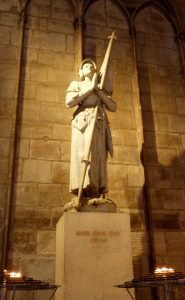
Joan of Arc: Under the influence (Daft Essays 3)

Joan of Arc (2)

A COLD START AND A HOT END

 Saintly voices drive medieval teenager to death by fire

 Rewind  604 years to 1412.  It’s a bitterly cold January night. We’re in a remote village called Domremy a few miles from Nancy in  war-torn northern France

Overview

La Belle France is at war with herself. Shooting herself in la pied, you could say. Two branches of the royal family are at loggerheads.  In one corner is The Duke of Burgundy. He wants to sell out to England which is in predatory mood, champing at the bit to get across what Shakespeare called ‘the narrow seas’ to conquer France.

On the other side are Count Bernard VII of Armagnac and his mate Duke Charles of Orleans. Duke Charles reckons that another Charles – Charles of Ponthieu, last heir of the ruling Valois dynasty, should be king, not that arrogant upstart  with the funny haircut, Henry V of England.  So of course he doesn’t see eye to eye with Burgundy.

That’s a potted version of the big picture.

Underview

Cut to the little picture at Domremy.  We’re inside a flimsy, drafty wooden hut. A humble shepherd’s wife named  Isabelle d’Arc is straining in childbirth – no anaesthetic, hospitals or mod cons in those days.  But she’s doing OK. Then hey presto, and against all the unhygienic odds Madame d’Arc pops out a bouncy daughter.

It’s a happy moment but it’s just as well that that weary Isabelle and her delighted husband Jacquescan’t foresee the trouble and heartbreak that this little miss is soon going to cause them.

Who should be king?

Before la petite Jeanne – Joan to you and me – is out of diapers King Henry Fifth of England has stormed France and wiped the floor with the  faction-ridden French army at the battle of Agincourt in 1415. He’s back two years later to grab  a lot more French territory.   By 1420 Henry has done a deal with the wily, eye-to-the-main-chance Duke of Burgundy.  Henry and his descendants will be kings of France after the death of Charles VI. Henry and Charles VI’s daughter Katherine are spliced to seal the deal.

Little Joan meanwhile is growing up fast back home in the sheep-full Barrois region of what is now Lorraine.  She’s pretty clever and a bit precocious. She knows what’s going on around her. But she doesn’t like it. So Mademoiselle d’Arc asks lots of awkward questions and soon comes to the conclusion that as far as she’s concerned there’s no contest. Charles of Ponthieu should be king.

Under the influence

By the time she’s 12 she’s under the influence of visions and voices in her head. Two early Christian martyrs, St Catherine and St Margaret, are busy telling Joan what’s what. And St Michael the Archangel – Biblically famous for commanding heaven’s armies against Satan no less – often chips in too.

‘Go see the local commander at Vaucoleurs and get him to take you to the royal court for a chat with Duke Charles,’ the saintly trio instruct her.  At age 14 in 1428 she obeys. But it’s a while before anyone takes any notice of this earnest, illiterate peasant girl and her visions.

Ninth grader commands the army

Then Charles finds himself in dire straits. He keeps losing battles, he’s got no money, he’s rapidly being driven back by his enemies. You could say he’s kind of desperate.  On her third attempt Joanie, dressed for the occasion in men’s clothes gets through – the unlikely answer to a beleaguered military leader’s prayers.  In the US today she’d be a ninth grader.

There’s something about Joanie’s tales of voices and visions that convinces Charles (well, he hasn’t much to lose) and he puts her in charge of fighting the English.  Joan d’Arc has, miraculously, a natural gift for human resource management. So she gets on and wins lots of battles, including the famous battle of Orleans in 1425. After that they called her the ‘Maid of Orleans.’

She didn’t need a life coach

Had she lived in our own times, and someone taught her to read and write, young Jeanne could obviously have knocked off a few best selling management text books – She could have thanked Saints Catherine, Margaret and Michael in the acknowledgements.

As it is, she reforms the troops by expelling the hookers from the camp. She insists that her soldiers go the church and attend confession. The men under 15 year old Miss d’Arc’s command are also required to give up swearing and to refrain from looting or harassing the civilian population.  Some little dame, this Joan.

Hot feet

But it can’t last and a hot, painful death awaits her at Rouen.  By 1429 Burgundy has more or less kicked the Armangac /Orleans faction out of the ring and is wheeling and dealing with the English right, left and centre. Joan is taken prisoner by the Burgundians and handed over to the English (in exchange for the mediaval equivalent of megabucks). They try her for heresy.

‘Your voices are demons. You are possessed by devils,’ her accusers say.  Have they forgotten that these voices always told Joan to go to church and to hang on tightly to her virginity?  Wise counsellors, saints. Poor Joan is also charged with cross – dressing and that’s heretical too.

So, still under the influence, she meets a fiery end when they tie her to a stake and light the fire beneath her on 30 May 1431. She’s nineteen and a half.

Heavenly ending

There’s a postscript to this sad tale of what listening to saints can do for you.  In 1920 on May 16, nearly five centuries after her death, Joan of Arc was canonised as a saint by Pope Benedict XV.  A case of if you can’t beat them join them?


Brighton Unitarian Church, 14 August 2016

The central plank and final work in this enjoyable hour-long concert, focusing mainly on the work of young composers, was Haydn’s String Quartet in B flat Op 1 No I. One of the earliest of all string quartets, its symmetrical five movement structure consists of two minuets sandwiching an adagio (warmly played by this group) and flanked by a presto at either end. It’s a delightful piece, brought joyfully to life by Roland Roberts, violin, and his colleagues especially during the first minuet when the texture splits into a typically Hadynesque question and answer sequence between the two violins in “conversation” with viola and cello. The rapport was nicely highlighted.

Three works preceded the Haydn. Mozart’s three movement String Divertimento, also in B flat major,  (K137) opens with a first violin lead – Roberts is an unshowy but assertive player – into the sonorous andante, which was thoughtfully explored. There was some fine work in the sparky, colourful finale too.

Two of Dvorak’s Zypressen (Liebeslieder) made an interesting contrast to the classical world of Haydn and Mozart. Originally written as songs for voice and later adapted by the composer these are intensely tuneful. The first opens with the melody – lyrically played by violist Morgan Goff and then passed lovingly round in an attractive performance of an appealing work.

An even greater contrast came with Fuzon (String Quartet in two movements) 2012 by John Hawkins who lives in Lewes and was present in the audience. This was certainly the most challenging, and probably the most satisfying, work in the programme for the players. At one point I could feel Roland Roberts counting (and he has my sympathy). Inspired by Blake’s poetry the first movement depicts the elderly sterile Urizen and the second Fuzon, the embodiment of fire who opposes him. The quartet managed the contrast dynamically and played with real clarity and precision in the busy, rapid second movement particularly during the rhythmic  harmonics which conclude the piece.

The Unitarian Church in New Road has a fine acoustic for chamber music which sounds both crisp and resonant therein. With the doors closed you feel sealed in with the music.  Even the sound of Street Brighton noisily enjoying itself outside on a summer Sunday afternoon seems a long way away.

Originally published by Lark Raviews http://www.larkreviews.co.uk/?cat=3

Shakespeare on Page & Stage: Selected Essays by Stanley Wells (Oxford)

9780198786542_Page and Stage

Stanley Wells is the UK’s foremost Shakespeare scholar. He is also one of our most accessible writers and anything he produces is reliably readable as well as informative and penetrating. This new volume is a selection of essays (introduced and edited by Paul Edmondson, Head of Research and Knowledge at Shakespeare Birthplace Trust) whose original publication dates range from 1963 to 2015. Thus you can share Wells’s journey of thought development over more than 50 years. I especially enjoyed and learned from the very detailed Staging Shakespeare’s Ghosts (1991) which examines how Banquo, Caesar, Hamlet’s father and so on might have been staged and perceived in Shakespeare’s day. The text is revealing. So is Wells’s immense knowledge of contemporary practice. Other highlights include an enlightening essay about Juliet’s nurse, an examination of critical response by, for example Hazlitt and Beerbohm along with Wells own thoughts about being a general editor – for both Penguin Books and OUP.

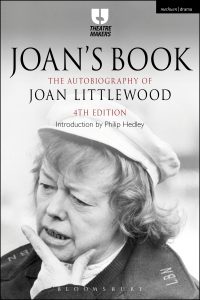
Joan’s Book: the autobiography of Joan Littlewood (Bloomsbury)

9781474233224 (1)(1)

To read this book is to plunge – literary total immersion – into the graphic world of Joan Littlewood from the very first page when she describes her unwanted, illegitimate birth in 1914 to a desperate, poor young SE London mother through to becoming a one-off theatre revolutionary who changed the way theatre works for ever and who upset as many people as she delighted. Her company, Theatre Workshop, developed and premiered shows such as Oh What a Lovely War!, Taste of Honey and The Quare Fellow. Her 500 page book which is as gritty and tradition-rejecting as her shows, and about as far as you could get from maudlin memoir, was first published in 1994, eight years before her death. This new edition aims to introduce her works, ideas, views, personality and background to a new generation of readers with introduction by Philip Headley who was assistant director to Littlewood at Stratford East.

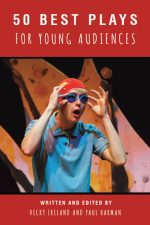
50 Best Plays for Young Audiences by Vicky Ireland and Paul Harman (Aurora Metro)

50-Best-Plays-New-Cover-Crop-150x225

This useful book is likely to help anyone who wants to stage young audience work. Two people who really know (Ireland is a former director of Polka Theatre and Harrison of Cleveland Theatre Company) provide the practical lowdown on plays ranging from David Wood’s The Gingerbread Man to Nick Wood’s Warrior Square and Peter Rumney’s Cosmos. What is the play about? How many actors does it need? Who premiered it? What do they say about it? Where can you get the script from? It’s all here along with advice about festivals, resources, sources of advice and a list of companies specialising in plays for young audiences.

Adder amongst heather

‘You spotted snakes with double tongues’ Shakespeare called adders in A Midsummer Night’s Dream with their ‘enamelled skin, weed enough to wrap a fairy in.’ Clearly the Bard of Stratford  thought they were alluring  exotic creatures and had seen plenty of them in the Warwickshire countryside. They often come out to hunt by scent on warm summer nights so perhaps he’d noticed them during his alleged boyhood poaching excursions?

Alas the adder (viperus berus) is now much less common than it was in Shakespeare’s 16th and early 17th century. Pesticides and pollution have done their worst. And the poor beast doesn’t enjoy a very friendly public image, so for a long time many people killed any adder they saw.  Even so, the adder is our commonest reptile. There are thought to be about half a million adders in Britain from Scotland to Cornwall, although not in Ireland.  The story about 5th century St Patrick having cast the snakes out of Ireland is nice but scientifically it’s more likely that The Emerald Isle is just too wet to sustain them.

I waited over forty years for my first glimpse of a live adder in its natural habitat.  And then, as luck would have it I saw two within a few weeks of each other – although they were at opposite ends of England.  The first was at Keilder Water in the Northumberland National Park on a cool August day. It was about two o’clock in the afternoon and there was a bit a watery sunshine as I walked along a streamside path. And there stretched out in front of me as straight as ruler was Mr  – or more probably Mrs – Adder.  They’re famously deaf (‘the deaf adder that stoppeth up her ears’ as Psalm 58 elegantly puts it) so it didn’t hear me coming. About eighteen inches long it was reddish brown in colour with a bright zigzag line running dramatically along its back.

It was in no hurry to move – they are sluggish creatures by nature – so it allowed my husband to move in with a camera about two feet above its head before turning with slow reluctance and sliding off into the undergrowth and making us feel guilty for disturbing its sunbathing. For that’s what it was doing.  Reptiles have variable body temperature. Unlike mammals they have no inbuilt ‘thermostat’. So they are very inactive until they’ve absorbed enough warmth from the sun to get them going. Only then are they able to hunt the small mammals, lizards, birds and eggs that they live on.

My second adder was at Bedgebury Pinetum, near Tonbridge in Kent in very different weather.  It was as blisteringly hot as Sicily and the adder had gone into the lake for a cooling swim.  Reptiles need warmth but they can’t afford to overheat.  It was swimming happily along, its tiny delicate head held aloft and its muscular  body spiralling along behind to provide the forward momentum. It was a lovely sight.

Adders are viviparous, which means that, instead of depositing them, the female retains her eggs inside the body until they are ready to hatch. Because the eggs are protected the adder can live and breed in northern climates which have only a short summer season.   Mating takes place in May or June. Then an average of ten young are ‘born’ to each female in midsummer. For centuries people mistakenly thought the adder ate her young in time of danger – which added to the animal’s bad press. This myth probably arose because living young had been found inside the bodies of recently killed female adders.

So what about the danger? The truth is there isn’t much.  Only 14 people died of adder bite in Britain during the entire 20th century which means you’re about as likely to die a Cleopatra-esque death as you are to be hit by a meteorite. No adder goes looking for human beings to bite and it will attack only if you’re silly enough to pick it  up or provoke it.  There have been cases of people being bitten after accidentally stepping or sitting on an adder while out in the countryside, and of course if this happens it will hurt a lot and the victim must be taken to hospital for treatment immediately. Children, the elderly and the already sick are more likely to be dangerously affected by the venom, which works on the nervous system, rather than adults in reasonable health.

Actually, the mechanism of the bite is interesting.  Two hollow fangs are fixed to a pair of rotating jaw bones and levered instantly into position as the animal strikes. Muscular contraction squeezes the poison along ducts into the fangs. It all goes into the victim or enemy as neatly as a jab at the doctor’s. Not a drop is wasted.

Fortunately I have  no personal experience of this, although a teacher friend in Kent tells a chilling story of something that happened during a very hot summer a few year ago. . ‘An innocent little boy in my class brought me a live adder in the brown paper bag he’d brought his packed lunch to school in,‘ she recalls.  He’d found the snake on the edge of the school site in the long grass during the dinner hour.  So he picked it up, popped it in the paper bag and brought it into school to show me.  It was a miracle that neither he nor I were stung.’ After that all the children in all the schools in the borough were warned that, although this is a every interesting creature, on no account must it be touched. Just fetch your teacher and show him or her where you saw the animal, they were told.

Interfering with adders is obviously foolish.  It’s also illegal.  The Wildlife and Countryside Act of 1981 gave legal protection to a wide range of animals and plants.  Under Section 9 and Schedule 5 of the Act it is against the law  to kill, injure, take, possess or sell an adder.  Neither may you damage or destroy its place of shelter or protection.

So enjoy ‘your’ adder if you’re lucky enough to spot one, but treat it with respect.  ‘It is the bright day that brings forth the adder,’ Shakespeare makes Brutus say in Julius Caesar. Absolutely.

13918646_10210446431465097_529503065_o-100x100

The Secret Garden continues at the Ambassadors Theatre, London until 31 August.

Star rating: four stars ★ ★ ★ ★ ☆

If you want charm and highly moral, traditional clean entertainment you can’t go far wrong with The Secret Garden.

Marsha Norman’s version (based on Frances Hodgson Burnett’s novel), pared down here to 75 mins for young performers and audiences, is linear and nippy. There are tuneful songs by Lucy Simon to drive the action forward and some ghosts that don’t appear in the original novel to make it clear that we’re in a house consumed by grief in a way that works on stage.

The British Theatre Academy works with …

Published by Musical Theatre Review. Read the rest of this article http://musicaltheatrereview.com/the-secret-garden-ambassadors-theatre/

Drama Studio London (photograph: Martin Richardson)

They’re on the home straight. Thousands of school leavers, post-gappers and post-grads are heading for drama school or drama course in universities next month. All that tense worry about auditions, recalls and nail biting anxiety while awaiting that letter offering a coveted place (or not) are behind you. A level and other results are due next week but for many they won’t affect anything much. The place is in the bag.

For a week or two it must have felt like the culmination of a long process. I’ve talked to students who have persevered with applications over several years before finally securing an offer. One student at Manchester School of Theatre told me cheerfully that she could probably have sustained a mortgage on what she’d spent on drama school audition fees.

In fact, of course, getting a place is the beginning and not the end at all. It means you’re heading for training which is so rigorous, intensive and different from anything – absolutely anything – you’ve done before that you and your life are about to change irrevocably and permanently. Even if (heaven forfend!) you never get a single professional job as an actor you will be a transformed person, both mentally and physically, after this far-reaching training.

For a start there’s the hard work and discipline that you’re about to experience. Most colleges have zero tolerance policies on punctuality. A 9 am start means just that and if you get there at 9.05 the doors will probably be shut which means you are letting down everyone in your group. And, typically you’ll be hard at work until 6.00pm or maybe longer if there’s a show in preparation. You’ll have to do homework too. Three years of that and you’ll never have any problems with the work ethic – which is one of the reasons that I would employ a trained actor to do almost any job.

Actors in training also learn to collaborate with each other – all day every day. Trust and mutual support underpin everything they do. Then there are the more obvious transferable skills like being able to communicate with clarity and confidence. Oh yes, three years at drama school will make you employable, all right and let no one tell you otherwise. I hope very much you’ll find acting work, obviously, but even if you don’t, then with your talents and training the world is your oyster anyway

But none of this comes without tremendous single-minded commitment so you’d be well advised (when you’re not busy earning money to help fund it all) to spend some time with your family and friends now because you won’t see much of them next term. Get as fit as you can too – regular healthy meals, exercise and enough sleep – because the training can be a bit of a shock to the system especially if you’re feeling sluggish before you start. And if you have time to read some novels and plays then that will stand you in good stead too.

Drama Studio London Acting Class (photo Martin Richardson)Starting to train vocationally at what you’ve wanted to do for so long is probably the most exciting thing which has happened to you so far. Make the very most of it. And I’ll try to contain my envy.
 

2502_1469844663

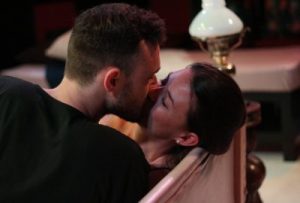
This two hander version of Macbeth is set entirely in the Macbeths’ bedroom where the most of Shakespeare’s plot, in the original language is presented. The script – which is by David Fairs who also plays Macbeth – condenses the play to 75 minutes and rearranges the text very ingeniously. It uses the dialogue between the Macbeths and most of their soliloquies although often not in quite the order Shakespeare intended. Occasionally they speak lines which were originally spoken by others and putting them in the mouths of the Macbeths adds insightful new nuances.

Here, for example, it is Lady Macbeth who speaks some of Banquo’s assassin’s lines. The first witches’ prophecy and the appearance of Banquo’s ghost become nightmares and the visit to the witches in Act 4 is presented as a sort of bedroom séance with Lady Macbeth in a trance. It all works very smoothly until the final five minutes when we get the unlikely and rather jarring arrival of a third actor. Macduff is hardly likely to appear in the marital chamber, speaking the lines which belong in the English scene and then watch Macbeth die lying across his wife’s body.

Sarah Lambie as Lady Macbeth has unusually expressive legs and quite a way with sobbing. Whether she is tossing and turning in bed, tensing in the horror of a terrifying dream or being raped by a furious, troubled adrenaline-fuelled husband, her legs tell their own story. And her anguished crying is deeply, movingly convincing. Hers is a very strong performance and her sleepwalking (where better to set it than in a bedroom?) is one of the best I’ve seen.

David Fairs is terrific too especially at the end when he is brittle, troubled, tearful, poignant – and of course, insane – as he addresses and cradles his wife’s dead body. The transition from relatively carefree young love to evil, horror and tragedy is well managed by both actors but what really distinguishes this show is the quality of listening and rapport between the two of them. It is very intelligent, reactive acting by two people who know, really know, how to play off each other effectively.

 Originally published by Sardines http://sardinesmagazine.co.uk/reviews/review.php?REVIEW-West End & Fringe-Macbeths&reviewsID=2502


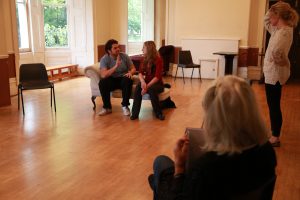
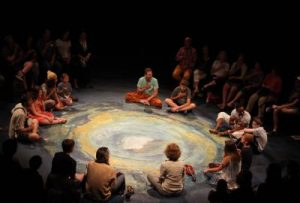
2500_1469805163A group of 15 young people, mostly teenagers, sit on the floor with six actors. They form a circle around the island painted on the floor (designer: Anthony Lamble) in the studio space which is the Blue Room at the South Bank Centre. Adults – parents, carers, journalists and so on – sit in an outer circle on chairs. Some of these youngsters use little or no speech, are seriously disturbed by the unfamiliar and clearly need very skilled support. Director Kelly Hunter gently, smilingly coaxes them in, holding and stroking hands as needed, She is an enormously reassuring presence as, eventually she begins some simple drama games in which everyone in the room joins, having impressed me by effortlessly learning every child’s name. She must have a well-practised memory technique which doesn’t show at all.

Yes, this show loosely tells the story of The Tempest, mostly in Shakespeare’s words. It isn’t a so much a show, however, as collaborative guided play and it made me think quite hard about the linked dual meaning of the word “play” because Kelly Hunter’s The Tempest is a play in every sense of the word. Sifiso Mazibuku as a powerful Prospero stands from his position in the circle and tells the twitching, mercurial Andrew Trimmer as Ariel to “Take this shape”. Gradually the children are brought in in twos and threes to take a turn at acting out that moment in the play. And that sets the pattern – again and again actors play with a line, make its meaning utterly clear so that young participants skilfully guided by the actors can “do it on their feet” as the RSC Education’s Manifesto advocates. The lines hang together enough to provide a narrative of sorts from Prospero’s first commanding Ariel to start a storm though to his setting him free.

All six professionals are fine, adaptable, sensitive actors totally attuned to the delicate needs, reluctances and enthusiasms of the young people they’re working with. And they make it look such infectious fun (especially Eva Lily Tausig and Chris Macdonald as Miranda and Ferdinand falling in love at first sight) that eventually even the most anxious audience members are actively wanting to be included. One boy in particular – probably with profound and multiple learning difficulties – whose parents had to take him out for a break eventually came into the ring and took part three times. Tas Embiata as Caliban danced with him very gently as the whole room chanted “Ban, ban c-Caliban”. Embiata unobtrusively adjusted his footwork and rhythm for each participant as he or she came forward to join in. For me it was the most moving aspect of the whole performance.
There’s a lot of humour in this show. Investigating “the monster of the isle” which ended up with six head, gave us Tricia Gannon, an engaging Trinculo lying down beside Caliban to hide as more and more participants joined in.

One boy, highly articulate, evidently an experienced actor and without language difficulties said joyfully at the end “The was the best two hours of my life!” Cast and creatives couldn’t ask for a better reaction.

Originally published by Sardines http://www.sardinesmagazine.co.uk/reviews/review.php?REVIEW-West%20End%20&%20Fringe-The%20Tempest&reviewsID=2500