Press ESC or click the X to close this window

Staying Alive (Susan Elkin reviews)

Staying Alive

Kat Roberts

Tower Theatre, Stoke Newington


Star rating: 3.5


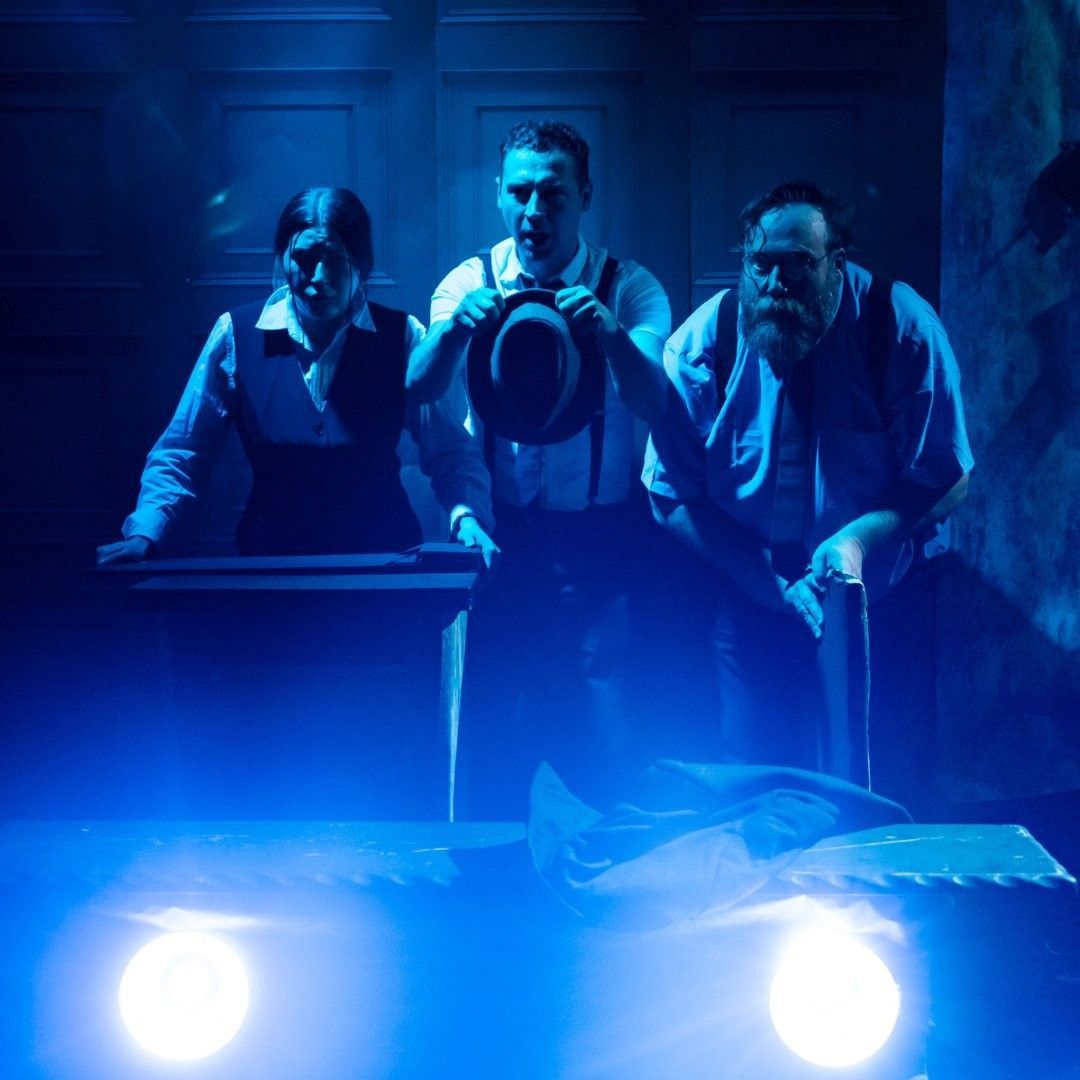
This searingly painful play about grief and loss is a brave choice and I commend director Olivia Chakraborty and her accomplished cast for running with it. It must be as emotionally draining to perform as it is to watch.

Mary (Saskia Connolly) has suffered some sort of appalling bereavement and the play, which is set around 2010, gradually reveals that her four year old son Henry has died in the sort of domestic accident which every parent dreads. But, just occasionally, these unthinkable things happen.

A professional violinist who has toured with the London Symphony Orchestra, she is a single mother supported (sort of) by her closest friends. The trouble is that they are ready to move on long before she can and they don’t know how to deal with her anyway. The play – and this cast – capture this awful awkwardness very truthfully. I remember once, in real life, walking up to a bereaved person and saying: “I have no idea what I can possibly say but I want you to know I’m here and rooting for you”. Anything rather than be one of those people who crosses the road to avoid a conversation. The trouble is that the bereaved person then ends up trying to put the sympathiser at ease and it’s that tortured issue – “the inconvenience of other people’s grief” – which Kat Roberts’s play ably confronts in most scenes. Moreover, Mary comments bitterly at one point that, whatever other people say, her grief doesn’t have a sell-by date.

There’s some fine acting in this cast of seven, especially Connolly and Jonathan Buckingham who plays her old friend, and once lover, Jack, who is now married to Jenn (Isabel Daly, good). Connolly does agony, loneliness, panic and anger very well. It’s a richly nuanced performance aided by Nick Insley’s lighting which supports Mary’s  frequent “disappearance” into a twilight world of her own even when she’s in a room full of people. Buckingham’s character, is now a successful and urbane doctor but he’s very troubled by Mary’s dreadful predicament and it, too is carefully observed acting.

Less successful are the time slips and doubling which take the audience by surprise so that we’re not always sure what’s going on although I loved the scene in which Mary remembers giving Henry his first violin lesson. The scene in which Jacky Rowland, as an administrator, questions Mary when she comes to register the death is so crassly insensitive that you really couldn’t make it up and I suspect that Kat Roberts who has worked with bereavement charities, has drawn this from someone’s actual experience. There’s also a scene in which Rowland, now a social worker, comes to question Mary relentlessly about the details of the accident. She does it well enough but you have to blink and work out who she is now because she is also the date of one of Mary’s friends at a party.  I’m not sure to what extent these abrupt shifts and switches stem from the structure of the play or are directorial decisions. Either way they don’t always quite work.

The sound track (Olivia Chakraborty and Samuel Jego) gives rather lovely – often poignantly atmospheric – ongoing classical music including Grieg’s Peer Gynt, Beethoven’s Moonlight Sonata, Barber’s Adagio and Vivaldi’s Four Seasons among other things. It fits Mary’s mood and her background imaginatively in this gruelling but courageous play.

Famous, respected and popular as he is I had never, until now, got round to reading any Robert Harris. It did occur to me, however, that I should after I’d seen the wonderful film Conclave (plot twist to die for) a few days after it started winning awards earlier this year.

Then my sister recommended Harris’s 2003 novel, Pompeii because she and I share very fond memories of visiting the site in 1966 on a road trip with our parents when it was relatively uncommercialised. So I read it  – with great pleasure.

Of course it’s one of those stories whose ending you know before you start – like Robert K Massie’s Nicholas and Alexandra (1967) Hilary Mantel’s The Mirror and the Light (2020) or even Antonia Fraser’s groundbreaking biography Mary Queen of Scots (1969). The interest is seeing how the author handles the intrigues before the blow finally falls. And in this case I loved the tiny signs in the days preceding the colossal 79 AD  eruption of Vesuvius: water in the piscina and wine in glasses shivering, rumbles underground,  and why has the aqueduct cracked – providing Harris with his core plot line as engineer Attilius sets out to repair it? It’s effectively dramatic irony because the reader/audience has foreknowledge denied to all characters.

It’s a skilfully plotted, ever-topical story about corruption. Ampliatus is a former slave who, through cruel and unscrupulous wheeling and dealing has become the richest and most powerful man in the city. Most of us have met, or know of, people like him. The real nobility regard him as a vulgar upstart but are very careful to keep on the right side of him because he’s a thoroughly nasty piece of work. As a lifelong ichthyophobe I couldn’t read the graphically described episode in which he has a slave thrown into his pool of moray eels to be eaten alive and you don’t need to be a vegetarian to be utterly nauseated by the feast he serves to mark Vulcanalia. It’s all testament, though to the power of Harris’s writing and I found myself hoping fervently almost from the start that he was going to give Ampliatus a really hideous death when Pompeii was eventually engulfed by volcanic ash.

It’s a novel full of strong characters some of whom you find yourself caring about. There’s Ampliatus’s daughter, Corelia, whom Attilius a young widower, finds attractive. She’s a pretty feisty critic of her cruel father so there’s a bit of feminism in the mix. The slave Polites is a decent sort too. And Pliny the Elder, knowledgeable, experienced and curious but obese and nearing the end of his life is nicely done too – because, of course, it was his writing that provided posterity with an eye-witness account of the (literally) devasting events in the bay of Naples in the first century.

Above all I admire Harris’s descriptive powers. He has researched volcano science pretty thoroughly and quotes from a number of reference books at the head of each chapter. The imagination he then brings to what he knows is breathtaking: the heat, the storms of pumice, the fires on the mountain side, the ash, the panic, the terror, the screams and the loss.

Another thing I liked was the way he deals with the Roman polytheism which our primary school teachers told us all Romans believed in. Well, of course, there must have been some commonsensible sceptics, especially amongst educated people. Harris has several characters who more or less reject the whole concept of the gods and that rings very true.

Of course I was curious about how he was going to end it because it’s a fact that most people died. I really liked the way Harris steps outside the confines of 79 AD and simply invites the reader to speculate and consider 2000 years of stories and myths. Under some circumstances this would be a cop out. Here it works perfectly.

Next week on Susan’s Bookshelves –  A Piece of Work: Playing Shakespeare and Other Stories by Simon Russell Beale

Miss Myrtle’s Garden

Danny James King

Bush Theatre

 Star rating: 3

Yet another (but welcome) play about dementia, this one is set in the titular garden nicely evoked by Khadija Raza’s set and Dan Balfour’s sound with soil, flowers and birdsong.

Miss Myrtle (Diveen Henry) and her husband Melrose (Mensah Bediako) are first generation Caribbean immigrants whose grandson Rudy (Michael Ahomka-Lindsay) has come to lodge in her house with his boyfriend Jason (Elander Moore). Eddie (Gary Lilburn) is a kindly Irish widowed neighbour, fond of drink.

She is now becoming confused and it isn’t long before we realise that she too is widowed but in continuous conversation with Melrose – not an original concept.  Flowers for Mrs Harris (adapted by Rachel Wagstaff from Paul Gallico for Sheffield Theatres on 2016 and Chichester Festival Theatre in 2018) uses the same device, for example. Nonetheless it’s effective and poignant especially when she mistakes Eddie for her late husband.

Henry brings a lot of sardonic humour to this piece. Her character is tactlessly forthright and capriciously unpredictable.  The well-observed dementia comes and goes, of course, like an old fashioned radio going in an out or tune as the dial is twiddled. Rudy, who speaks RP because he’s been to college and is a teacher, is worried about her and evidently very close to her.

The piece, however, effectively has two plots which are not always convincingly wound together. Jason desperately wants, full, open commitment – and honesty – from Rudy who is reluctant to come out as gay partly because it will upset his grandmother but also because he fears there will be repercussions at the Catholic school which employs him. When the coming our finally happens it’s a witty non-event. Moreover there’s a dangling secret about the premature death of Rudy’s father Rudolph which is never satisfactorily explored.

The dialogue is well written and sharp but sadly not always audible. This is, of course, a problem with theatre-in-the-round and the Bush seats its audience on four sides round a square playing space. It takes specific skill to make that work. Yes, we all know that theatre works much more inclusively without a fourth wall. On the other hand there was a reason why theatres evolved to be end-on and old fashioned drama schools taught actors never to turn their backs to the audience. I missed at least ten per cent of this play so it’s a good job I was issued with a play script in lieu of a programme – but I shouldn’t have to read it to fill in the gaps. Director Talo Lawson, please note.

Jesus Christ Superstar

Festival Players

ADC, Cambridge


Star rating: 3.5


It’s always a terrific treat to hear what is probably Andrew Lloyd Webber’s finest score.  Its angry cross rhythms, anguish and wistfulness complement Tim Rice’s lyrics perfectly. I’ve seen a number of productions over the years right back to the original London 1972 version which blew me away. And I’m happy to report that this high standard show, under Suzanne Emerson’s direction, ticks many of the boxes.

Andrew Ruddick is magnificent as Judas, one of the most complex roles in opera – and yes, I’ve always argued that Jesus Christ Superstar is every inch a rock opera rather than a “mere” musical. He agonises, argues, dances with cheeky panache at the end and has a splendid rock tenor top belt. It’s a bravura performance. And Emma Vieceli is as good a Mary as I’ve ever seen. She packs in all the warmth, sympathy, passion and anxiety the role needs and sings beautifully, especially in the show stopping number “I don’t know how to love him”. I also admired Matt Wilkinson’s suitably dead pan, gravelly take on Caiaphas and Rich Evans as Pilate, especially in his first number.

The ensemble is skilfully choreographed by Laura Saunders who has built in lots of original shapes and gestures. Moreover it accommodates cast members who aren’t professional dancers but who are slickly trained in a way which sustains the visual energy for every minute of the show. The ensemble singing (MDs Sam Kirby and Joe Griffiths) is generally strong too with only one or two ragged moments on the opening night.

There are a few problems, however. Normally I’m all in favour of gender blind casting and a female Jesus is a richly interesting idea. Moreover Vikki Jones is a highly talented performer who finds oodles of charisma in this role. Good as she is as a singer, though, the part is technically awkward for a female voice and she has to do far too much octave shifting. The text refers to Jesus throughout as “he” so we have to accept that this is a woman playing a man. Yet,  it’s a very feminine interpretation. That does, however heighten the vulnerability and makes the thirty nine lashes scene seem even more horrifying than usual.

It’s good to see, and hear, the five piece band centre stage on a platform behind the action playing the most pared down version of the score. It comes over well (one or two opening night, sound balance problems notwithstanding) although at times it could have done with an additional live melody instrument such as trumpet or trombone.

Despite those reservations, this Jesus Christ Superstar is well worth seeing. It pounds along and it works.  As ever I had to swallow a lump in my throat during that moving postlude from the band as we reflect, finally, on the horror of the crucifixion – and, on a personal note, for the record, I have always come to this show as a Christian non-believer.

The Croft

Ali Milles

Churchill Theatre Bromley and touring


Star rating  1.5


We’re in a croft in the remote village of Coillie Ghillie in the Highlands which had to be abandoned in the 19th century because of contagion. From that historical starting point Ali Milles’s play presents three pairs of women at different points in the history of the building. Or at least I think it does. The story telling is clunkily unclear.

This touring production of The Croft is a revival, now directed by Alastair Whatley. It was originally directed by Philip Franks but the tour had to be aborted in March 2020 at the beginning of the Covid 19 Pandemic.

It opens with two women arriving at the titular croft, in the present, after a long journey north from Letchworth. For the young one  (Gracie Follows) this is returning to the family holiday home for a quality time break with her older lover (Caroline Harker) whose mind is preoccupied by her two teenage sons and estranged husband. Of course there is little or no phone signal.

There are audibility problems in this production, right from the start: I struggled to catch many words even from Row G. This may be due to acoustic issues in the Churchill but either way it is not acceptable in a much hyped professional production.

It’s billed as a ghost story and chilling thriller but actually it’s simply a series of, sometimes baffling, time slip scenes with very loud clichéd “ghostly” sound effects (by Max Pappenheim) which quite often drown out the dialogue completely. The sound balance is woeful although the occasional snatches of traditional Scottish music are quite effective as a location reminder.

Attempts have been made, moreover, to ratchet up the ghostliness with devices such as pictures falling unaccountably off the wall and a rocking chair moving by itself – a trope nicked from The Woman in Black. Characters often ask, not always with convincing timing, “What was that?” and it gets wearingly predictable.

There are five actors in the cast which necessitates a lot of doubling and it’s often confusing. If you find yourself thinking “Oh it’s him again. Who’s he meant to be now?” which I did several times, then the piece is failing dramatically. Having said that, there is sense in Caroline Harker  – she is the best thing in the entire show –  playing both Laura’s older (mother figure?) lover, Suzanne, and her mother who has died from cancer and whose presence she still feels strongly. And Follows makes a reasonable job of playing Laura as an adult and as a child although the significance of her also playing a young unmarried pregnant woman in the nineteenth century scenes was lost on me.

The Croft runs for two hours including an interval but it feels much longer as you watch scene after scene, each flagging up possible story developments but failing to follow them through.

It’s always a pity to see, and report on, a show into which a great deal of hard work has evidently been invested but which ends up as a lacklustre muddle. But it’s a critic’s job to be truthful.


Of course I grabbed this book as soon as it was published. I interviewed Sheku Kanneh-Mason shortly after he won BBC Young Musician in 2016. Then in 2018 he came to Kent and gave his debut performance of the Elgar cello concerto with the Maidstone Symphony Orchestra. I’ve been the regular reviewer of MSO concerts for many years so I was there. Since then I’ve followed his stellar career and read with interest House of Music: Raising the Kanneh-Masons by his mother, Kadiatu Kanneh-Mason. I’ve also reviewed concerts in which his sisters, Isata or Jeneba Kanneh-Mason have played piano concertos.

And now comes this book which is effectively an impassioned plea for music education for all. Sheku uses the example of his own family – he is famously one of seven and they are all musicians – to show how it can be done. He paints a picture of seven children enjoying lots of noisy fun and laughter but also striving to excel because there’s no point in doing anything half-heartedly. Chamber music, and the interactive communication it requires, becomes a metaphor for family life because they played, and still do, in a range of trios, duos, quartets and, obviously, a septet. They were immersed in music: tapes in the family car, being taken to concerts, participating in festivals and competitions along with singing at church and in choirs. And there was a family concert showcasing work in progress every Sunday afternoon in their hall with the “audience” sitting on the stairs. You are left astonished that none of them ever rebelled although Sheku does hint that there was sometimes some naughtiness behind their parents’ backs and I was almost relieved to learn that he failed Grade 4 theory because he hadn’t bothered to put the work in.

The book, however, isn’t a family memoir. It’s a discursive examination of what music can do, how it communicates and why it matters. And we certainly need it set down like this because funding has been cut to such an extent that in many schools there is now no music at all. Sheku laments that – even at his own former state secondary school in Nottingham which used to be musically very rich –  STEM (science, technology, engineering and maths) subjects now overpower much of the curricular thinking. And there is no music in the English Baccalaureate – a set of core subjects which, if passed at GCSE gives the student an overarching diploma. Many people see music as a dispensable frivolity, especially in education policy making circles. Sheku visits many schools and meets children who play (where they’re lucky enough to get the opportunity) and some of his anecdotes are heart breaking.

Classical music shouldn’t be marginalised, he argues, although he likes blending it with other forms such as Bob Marley. And he makes the very valid point that having elite players in football teams doesn’t make it an “elitist” game. Football is for everyone and Sheku is personally pretty keen on it. The same should apply to music. Yes, there are some elite players and Sheku, who has done the Beethoven Triple concerto with Nicola Benedetti and Benjamin Grosvenor, knows most of them, but that doesn’t mean the music itself is elitist.

The other thing which the book centres on is “blackness” in music which should be irrelevant but isn’t. Black composers have long been ignored and/or excluded  although he observes, thankfully, that the tide is turning now. Far more black composers are being programmed and Errollyn Wallen is Master of the King’s Music. I was horrified, though, at Sheku’s account of the racist abuse which was hurled at him when he commented quite mildly that Rule Britannia at Last Night of the Proms makes him feel uncomfortable.

Sheku was 25 when he wrote this book and he’s 26 now. It reads like the work of someone much older and in places it’s quite world-weary in tone. Now that he has dispensed with his big fluffy hair he even looks a lot older than his years too. He talks about his childhood as if it were much longer ago than it actually is and the vocabulary is highly articulate, formal and sophisticated, considering that he tells us he isn’t good with words but talks, instead, through his cello. Perhaps all that world travel to play in magnificent concert halls hastens maturity. I’m puzzled, though, given his schedules, how he found the time to write it.

Next week on Susan’s Bookshelves: Pompeii by Robert Harris

REVIEW: THE FROGS, Music & lyrics Stephen Sondheim, at Southwark Playhouse Borough until 28 June 2025

Susan Elkin • 28 May 2025

‘Clever fun but too long’ ★★★ ½

Dating, in various forms, from the 405 BC and 1970s this pretty bonkers show tells the story of Dionysus (Dan Buckley – good) and his slave Xanthias (Kevin McHale – fine work) visiting Hades to rescue George Bernard Shaw so that he can save civilisation. As it turns out they meet Shakespeare while they’re there and set up a TV style reality competition. Of course he wins so they take him back to life and leave Shaw behind. The titular frogs, of which Dionysus is terrified, live in the river Styx.

It’s certainly very funny and full of anachronisms which make for good comedy. “We’re in Ancient Greece and the present” McHale tells us at the beginning and that sums it up. There is also a huge amount of self-referential joking about theatre itself which went down very well on press night when the house was full of actors, directors and theatre creatives. It might, however, be a bit esoteric for a mainstream audience on a wet Thursday night.

The writing is brilliant, however. Sondheim, with all that effortless rhyming was probably the best lyricist since WS Gilbert. And the music, played by a five piece band with Ed Zanderson (covering for MD Yshani Perinpanayagam) on keys, purrs along wittily. There are hints of other Sondheim songs and clever references to Shaw, both musical and verbal via Pygmalion/My Fair Lady.

The cast of ten are a talented bunch. It’s effectively a group of accomplished principals who form a well choreographed (Matt Nicolson) ensemble when required rather than an ensemble from which small roles emerge. There is, for example, bravura work from Karl Patrick, first as the laconic Charon bobbing up and down like a jack-in-a-box and treating his passengers to a dead pan cruise-style commentary. Then he is show-stoppingly funny as Pluto’s gatekeeper complete with a speech impediment characterised by perfectly timed sibilance. Bart Lambert, who sings in an attractive rich baritone, delights as the ever serious Shakespeare who expresses every thought in his own words – another bit of quite clever in-joking.


The ensemble, as and when it forms, is neat and vibrant. And the sequence at the end of Act 1 when they become frogs, all wide legs and leaps of both feet is suitably climactic.

Yes, there’s plenty to enjoy here but at over two and a half hours with interval, the show is too long for what it is.

THE FROGS at Southwark Playhouse 23 May – 28 June 2025

Music & lyrics Stephen Sondheim

Loosely Adapted from Aristophanes by Burt Shelgrove and Nathan Lane

BOX OFFICE https://southwarkplayhouse.co.uk/productions/the-frogs/

Photos by Pamela Raith

This review was first published by London Pub Theatres Magazine: https://www.londonpubtheatres.com/review-the-frogs-at-southwark-playhouse-borough-until-28-june-2025

REVIEW: SHUCKED a musical comedy at Open Air Theatre, Regents Park 10 May – 14 June 2025

Susan Elkin • 25 May 2025

‘It’s fun and you’ll laugh and probably enjoy the skilful timing’ ★★★ ½

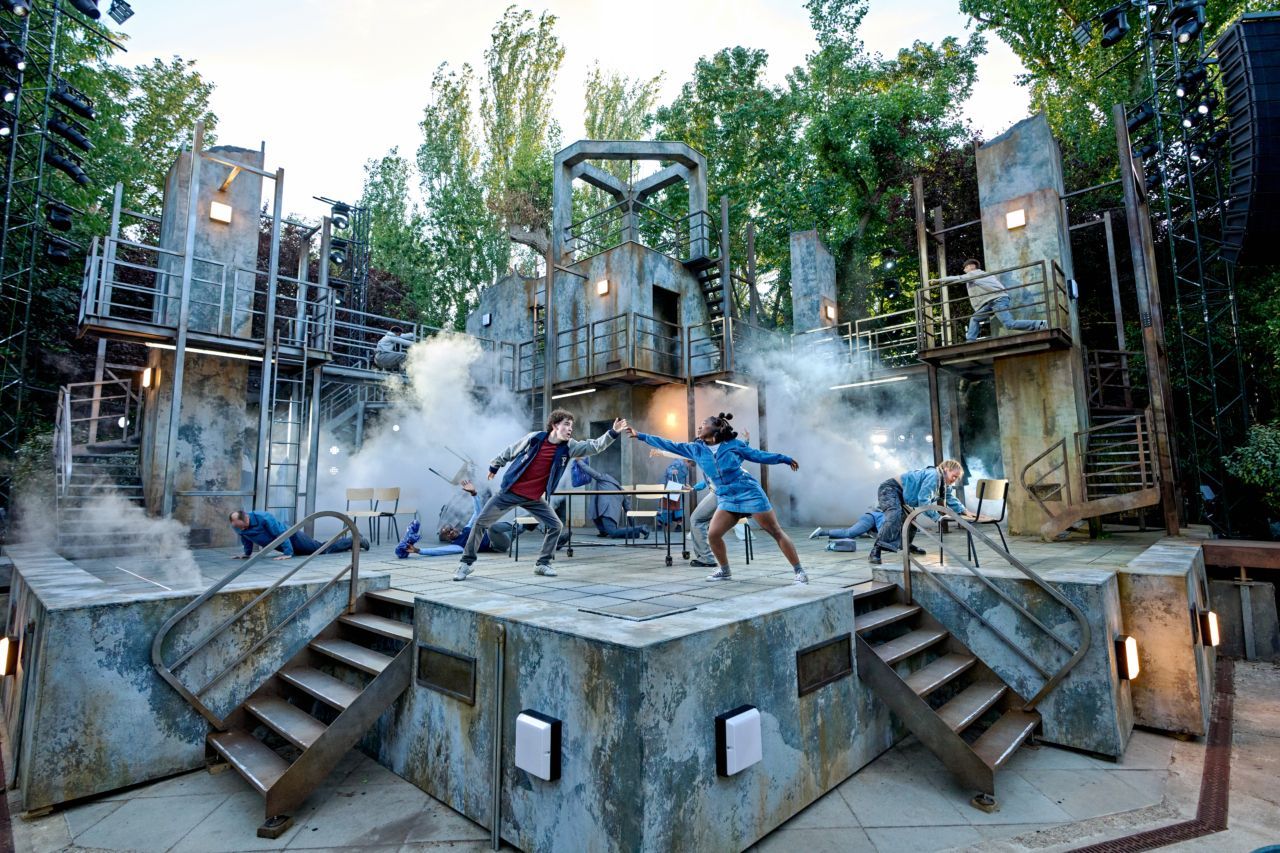
Who knew that corn could so versatile, both visually and practically? The opening number in this upbeat show, in which nothing is to be taken seriously, lays down the (often phallic, of course) parameters with slick clarity. We’re in Cob County which is somewhere in the remote deep South. The inhabitants enjoy their insularity and the economy rests entirely on, well, corn. Scott Pask’s set has thick rows of it growing on either side of the stage.

So of course something has to go wrong. The corn crop wilts and Maizy (get it?), played with faux innocence by Sophie McShera, goes to the bright lights of Tampa in search of a solution. She returns with a boat rocking con-man, Gordy (Matthew Seadon-Young) which leads, inevitably, to misunderstandings and sexy encounters.

The choreography in this show (Sarah O’Gleby) is splendid including some high speed movement work and a nifty trick with planks and barrels because corn whiskey is crucial to the plot. And the music from the unseen band is compelling with lots of rich country and western influence.

Of course this a comedy and it is very funny in places – gales of helpless laughter from the Saturday night audience I saw it with. There are more puns than in any pantomime and, for me at least, that becomes a bit wearing. Moreover the pretty daring double entendres come thick and fast and that too begins to feel a bit overdone after a while. The best line in the whole show comes when a young couple are falling out. “This isn’t an argument” she says. “I’m right and you’re just saying things.”

There are some excellent performances in the mix. Ben Joyce as Beau (that’s Maizy’s – err – beau) moves like an athlete and has a beautifully modulated tenor singing voice. He finds warmth, outrage and anxiety in his role as the young corn farmer who really doesn’t want his fiancée to go to Tampa. Georgina Onuorah is terrific as Lulu, Maizy’s cousin and corn whiskey distiller – plenty of common sense and wisdom and a magnificent full belt.

Monique Ashe-Palmer and Steven Webb do a good job as the multi-roling, all singing, all dancing story tellers although his hammed up, camp humour gets a bit predictable.

It’s fun and you’ll laugh and probably enjoy the skilful timing of all those silly jokes. But don’t go expecting to be stirred.

Images: Pamela Raith

SHUCKED

Book by Robert Horn

Music/Lyrics by Brandy Clark and Shane McAnally

Open Air Theatre, Regents Park

Box Office https://openairtheatre.com/production/shucked

This review was first published by London Pub Theatres Magazine: https://www.londonpubtheatres.com/review-shucked-a-musical-comedy-at-open-air-theatre-regents-park-10-may-14-june-2025