
Press ESC or click the X to close this window

Susan’s Bookshelves: Notes From An Exhibition by Patrick Gale

I recently spent a few delightful days in Cornwall where my host/friend, with whom I share a love of books and words, recommended Notes From An Exhibition which is set mostly in Penzance just a few miles from her lovely home. Well I’d read Patrick Gale before but had somehow missed this 2007 title so I ordered it on the spot.

Rachel Kelly, a hugely successful household name painter, has just died and we are walking round a posthumous exhibition of her work and getting a strong sense both of her abstract style and of her status. Gale uses the notices attached to the works on display as pegs for an account of her complicated, troubled personal life and the mental illness she was dogged by. It’s an unusual narrative method which involves a lot of time shifts and switches in points of view (although it’s written entirely in the third person) but he makes it work with aplomb.

Rachel and her very grounded school teacher husband, Antony, raise four children, the eldest of whom she was already pregnant with by someone else when she marries. That son, Garfield is happily married, living nearby and longing to start a family which doesn’t seem to be happening. Then there’s Morwenna, who has been out of contact for many years so we await the unravelling of her personal mystery. Hedley is in a happy gay relationship – although there’s a hiccup – with a London art dealer and the youngest, Petroc, is evidently dead although Gale keeps us waiting a long time to find out what happened to him. Moreover, there is a question mark over the circumstances of Rachel’s death given that her bi-polar condition has, in the past, triggered a number of suicide attempts and several hospitalised bouts of severe post-natal depression triggered by her refusal to take her regular medication during pregnancy. There is also a big hole in family knowledge about Rachel’s Canadian origins and the truth is gradually revealed.

It’s a richly layered novel about, in no particular order, marriage, adolescence, grief, art, Cornwall, mental illness, identity, Quakerism and siblings. I liked it a lot.


Yellow Things

Bridge House Theatre


Star rating: 3.5


This show is a double bill featuring three actors. The first half gives us Mothers Have Nine Lives by Joanna Norland and after the interval comes an adapted version of The Yellow Wallpaper by Charlotte Perkins Gilman. Overall we meet ten monologue-ing mothers. It’s richly truthful material and anyone who has ever been a mother will recognise and identify with parts of it which is why, in places, it’s funny.

First we meet Mira Morrison as a professionally high flying, middle-class pregnant woman trying to field all the questions and advice thrown at her by everyone in her life. Then, in another persona, Morrison becomes a woman we’ve all met who is so obsessed with work that she gradually subs her child out almost full-time to grandparents.

Then there’s Gina (Ellie Ward who also directs) as a desperate single mother with two very young daughters, on benefits, in desperate need of a double buggy and thwarted every way she turns.

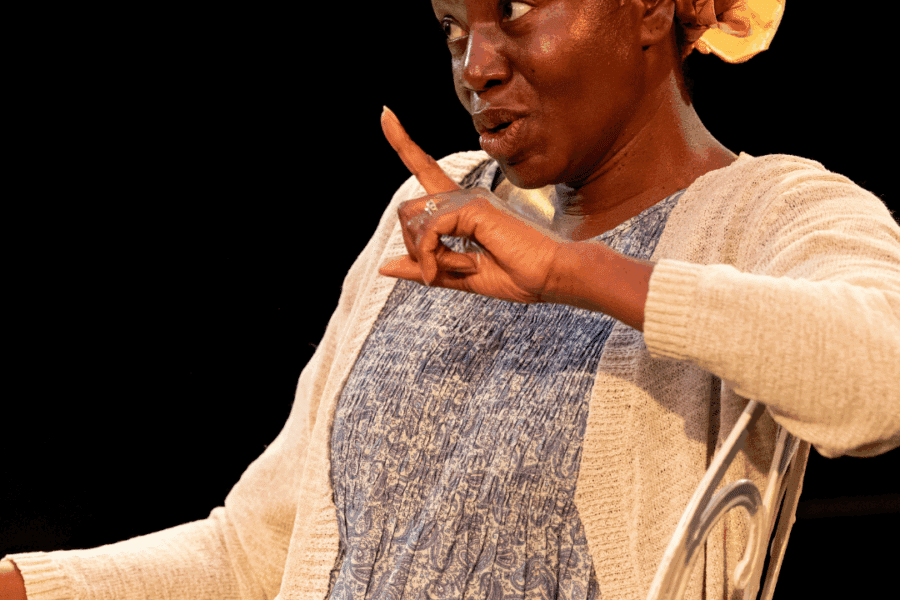
All three actors are good, with notably skilled voice work to distinguish their many characters, but the real star of this show is Becky Lumb: wonderful as a fraught mother supervising breakfast for her daughters who have her wrapped round their little fingers. She also gives a lovely performance as a mother who desperately wants to spend Christmas with her daughter home from university but is, of course, disappointed. Joanna Norland’s play simply, and rather effectively, simply presents nine of these snapshots as a rounded exploration of motherhood.

The Yellow Wallpaper is darker and deeper. Becky Lumb presents a gay woman who bears a child but whose partner (who contributes the egg for IVF) separates from her and then dies of cancer before the child is even born. The thirty minute play alternates between her talking rationally to her baby and being sectioned with severe post-natal depression in an institution where she is completely spooked by the faded yellow wallpaper. It’s a sterling performance: moving, powerful and insightful.  And the video projection of the wallpaper and the sinister things which seem to her to be emanating from it is nicely done.

Between monologues we hear the voices of children playing mothers and babies – sound designed by Ellie Ward  – which adds another dimension because it makes us think about  the impressions of motherhood we form long before we get there.

Yellow Things is competent, thoughtful theatre.

THE M-WORD

by Susan Elkin

“No, of course I won’t bloody well marry you, Vinnie” says Bella, angrily pushing a strand of long, straight coppery hair away from her eyes. “The very idea is preposterous. I can’t quite believe that you even said it.”

Both wearing bright orange lanyards bearing grey security passes, Bella and Vinnie are sitting in Starbucks round the corner from   their shared workplace. He, in his forties, is the editor of a famous national newspaper.  She is a 21-year-old intern. The coffee machine fizzes and hisses from beyond the counter. Someone calls out “Soya latte for Franny”. Chatter is humming. At the next table two men and a woman heatedly discuss forced marriage in Afghanistan.

Bella had been quietly enjoying a cup of mint tea, checking her emails on her laptop, seated alone in a corner, absently drumming the fingers of her left hand on the table. Then Vinnie strode in, grabbed a double espresso and joined her. Of course he was uninvited. On noticing him arrive in the queue besuited, tieless and faintly dishevelled as usual, she thought about making a dash for it but didn’t. It was time for a confrontation with this man and she was in the mood. This wasn’t the first time he’d casually intruded on her in off duty time.

Vinnie sighs as he eases the lid off his laughably small takeaway coffee cup with its feathery green logo and says: “OK – sorry if that was a bit abrupt. Only we’ve spent quite a bit of time problem solving together recently and I thought we had vibes between us.”

“Vibes?” says Bella, trying to not to shout. “Is that what you call it? If you contrive one more encounter like this, I shall report you for stalking”. She glares at him.  “But first, would you like me to tell you why I don’t want to spend the rest of my life with you or even a minute longer in your company than I can help?”

“Yes,” answers Vinnie leaning forward so that his torso strains against his shirt buttons, exposing tiny triangles of pink, hairy flesh. “because I really don’t understand. Forget what some people might regard as my ‘status’ and tell me frankly. From the top.”

“Oh, you just try and stop me, Vinnie,” says Bella, sitting up straighter and snapping her laptop shut. “For a start, it’s beyond me how a household name like you can edit a famous national newspaper, manage a staff of 350, be on first name terms with most of the Cabinet and the Royal Family and have so little understanding of real life and people. It’s called empathy. And you don’t have it. So let me explain where I’m coming from.”

Vinnie, takes a slurp of his coffee, smiles faintly and sits back to listen. He once attended a class on body language and he’s trying to look open, relaxed and receptive.

“First, you tell everyone you’ve got a sabbatical and you’re going away on jaunt, leaving Archie to run the paper. Archie of all people! You knew perfectly well that he’s tosser, womaniser and liar despite the holier-than-thou front he tries to present to the staff. You are aware, I take it, that he propositioned me? And there were death threats – death threats! –  against my brother Charlie who was quietly working on the sports page until Archie took against him, decided to fire him and send the vigilantes out. That man should be in prison.”

Vinnie shifts uncomfortably because Bella is right.  None of this is news to him.

“And as for you – what sabbatical?  You didn’t go away at all. You simply shaved off your beard and put on a pair of jeans and a hoodie. Then you covered your face with a Covid mask, like a Japanese tourist, and lurked in here every day on the assumption that you wouldn’t be recognised while you eavesdropped on staff getting their coffees. If that’s not the behaviour of a creep, I don’t know what is.”

She pauses to work up more invective. “Actually, Vinnie, you were still trying to control your empire anonymously from the sidelines. Not that you succeeded very well because Archie is so corrupt that even you struggled to fathom the depths of his awfulness.”

“That’s not quite fair,” protests Vinnie weakly “I wanted to try Archie out in the top job because he’s a good journalist and a promising deputy editor. I wanted to give him the chance to shine.”

“Well, I’ll take your word for it about his journalistic and editing prowess. I’m only an intern. What do I know?  But from where I’m standing, he is just a hypocritical, lazy sod who delegated all the everyday work to the long suffering Ed – lovely man, by the way –  while Archie got on with trying to get his hand, and more, into my knickers. And, for all I know, it wasn’t just my knickers. There are plenty of nubile young women floating about the paper’s offices who might have been willing to trade sex for promotion or a tasty assignment or two. The moment you got wind of this you should have put your work suit on, marched into the office, sacked him and reported him to the Met. But did you? Did you, hell.”

Noting Vinnie’s silence, Bella continues. “And I was still at Cambridge, quietly getting on with my theology degree in the all-female peace of Newnham College, when someone – was it you? – sent Luke the Letch to persuade me to come up to town ostensibly as an intern, but mainly to speak up for my poor victimised brother.”

She fortifies herself with a minty sip. “Luke is well suited to his job in the advertising department. Good appointment, Vinnie. He’s a slimy, disloyal, lying misogynist who struggles – like so many men round here –  to keep his trousers on. But he’s all persuasive, smooth talk, flippant jokes and very full of himself which I suppose  makes him perfect for the selling of ad space.  I loathed him on sight, but he claimed to be a good friend of my brother, although I’d never met him before, so I did as he asked and came because he said Charlie was in serious trouble.”

Vinnie drinks a drop more coffee. In the distance someone calls “Americano for Pompey” and the door to the slightly whiffy single sex lavatory at the back of the room bangs shut. Out of the corner of her eye Bella watches the paper’s affable Nigerian security guard and gives him a wave. She often chats to Pompey as she passes through the entrance hall. Now he settles at a table with his coffee and a top shelf magazine to enjoy his break.

“And I’m certain you know what happened next?” says Bella, refocusing her attention on Vinnie. “That appalling, predatory Archie waited until he and I were alone in his office where he ordered me to sleep with him in return for his going easy on his brother. When I threatened to report him he told me that because of his position – and mine –  no one would believe me.  That old, old story. My word against his,” says Bella, her face flashing red with fury.

“My god, Bella, you’re gorgeous when you’re angry” says Vinnie, forgetting himself.

“Oh, for fuck’s sake, shut it, Vinnie. Any more patronising talk of that sort and I shall walk out of here and away from your bloody paper without notice.”

“Whoops” says Vinnie, holding up his hands and pretending to back away. “I’m sorry. But most women like to be complimented.”

“Well, I’m not one of them. This is the 21st century, not the 17th. I may be twenty years younger than you but I am my own woman and I’ve recently had to grow up a lot and very quickly. I don’t need any flattery from you. I’m not going to be preyed upon or manipulated either.”

“So what are you going to do now?” asks Vinnie as meekly as he can. “I take it you don’t want a career in journalism although you have a lot of talent and I’d love to hire you permanently. Just say the word and a job is yours.”

“You didn’t really think I’d be up for that did you? I’m going back to Cambridge for a few weeks to finish my degree. Under the circumstances, my tutor has managed to pull strings and provided I can get my dissertation finished I’ll be allowed to graduate.” says Bella, calming down a little. “My title is ‘Is marriage a socio-religious construct which is now redundant?’ Would you like to read it when it’s complete?”

“And are you then going to stay in academia, as you originally planned?” asks Vinnie, ignoring the bait.

“No. I’m far too battered by the events of the last few months for that. I need to be out in the real world interacting with people in the hope that I can make a bit of difference and help others,” replies Bella.

“So, are you coming back to London.?”

“Yes but I shan’t be giving you my address or coming anywhere near your crappy newspaper.  I have a job, teaching RE, lined up in a girl’s school to start next term.  But I know I shall be needed out of school as well.”

“Needed?”

“Yes. Needed. My brother and his partner, Jules, have a new baby daughter. They’ve been through hell this year thanks to Archie’s vendetta. Charlie is struggling with his mental health because for ages they both really thought his life was in danger. And Jules, is inevitably struggling with quite bad post-natal depression at the moment – given the stress she’s been under I’m surprised it isn’t even worse than it is.  I’m the little one’s godmother and I want to be near them because they’re all three going to need a lot of support. Goodness knows what long-term effects, those awful death threats will have on them,” says Bella. “Although you have, at least, given Charlie his job back so that they don’t have to worry too much about money. I suppose I should thank you for that.”

She goes on: “But that’s not all. There’s also my friend Mary Ann who has now teamed up with shitty Archie, thanks to you and your bloody manipulative interfering. Somehow you persuaded him to take her back because she was in bits after their separation last year. She just couldn’t hack the rejection.”  Vinnie smiles faintly.

Bella adds: “Well, I know better than anyone what Archie’s really like and so do you. I think she’ll have an utterly miserable time, especially if there’s a child. But this is what she thought she wanted so I doubt that she’ll ever find the strength to walk away from him. I have to be nearby for her too. She is going to need a friendly face.”

“OK, I’ve got the message” says Vinnie. “A lot of bad stuff has happened amongst the staff at the paper and you blame me for all of it.”

“Yes, I do and I’m right. You have a lot of power and you’ve been abusing it for months,” says Bella.

“Well, I shouldn’t have mentioned the m-word as I did, Bella. It was crass. I have an Aspergers diagnosis and although I manage to control it most of the time, occasionally I lose the plot and get inappropriately direct.  I’m inclined to cut to the chase without doing the groundwork first. And I make bad decisions – as you’ve pointed out forcefully.  Not that any of that is your problem and I’m not asking for sympathy.”

Bella looks at him sharply and opens her angled hands in a “what can I say?” gesture. Then she drains her plastic cup before squeezing it and throwing it with finality onto the tray in front of her.

Vinnie, pauses, inhales and continues carefully. “But I was wondering if we might put all that behind us and start again? No pressure. Just friends for the moment.”

He adds: “I have a pair of press comp tickets for the new production of Measure for Measure at the National Theatre tomorrow night with Benedict Cumberbatch and Jodi Comer in the cast. The paper’s lead theatre critic, Olive Overdone gave it 5 stars so I have high expectations. Would you consider coming with me as my plus one?”

Copyright: Susan Elkin 2025


Sisters

David Storey

Directed by Elizabeth Elstub

Uncommon Theatre

Jack Studio Theatre


Star rating 3.5

David Storey’s 1978 play, written for Royal Exchange, Manchester, presents a gritty world where nothing is as it seems. It doesn’t get out much so this is a welcome revival in which the 1970s atmosphere is nicely observed both in the costumes and in Molly Agar’s set even down to the pattern on the tea cups.

On the face of it, a long estranged elder sister, Adrienne (Joanne Arber) is visiting her married sister in her Manchester council house. It’s very tense and this is clearly not an ordinary family home since a surprising number of people seem to live there or to be very familiar with it. Adrienne, who is clearly a heavy drinker, evidently has a troubled background and given to mood swings, doesn’t understand. The audience realises the truth long before she does and words like “knocking shop”, “brothel” and even “pimp” drop casually into the dialogue.

Arber is terrific in this role. She gets the initial awkwardness perfectly and we are soon wandering what exactly it is she is running from as she accepts drink after drink from the various people who pass through the sitting room. Later we see her in attractive seduction mode and ultimately in utter, screaming distress and panic. It’s a finely nuanced depiction of mental illness.

Also outstanding is Christopher Tomkins as Adrienne’s brother-in-law who styles himself a “businessman”. Given to ruthless violence especially towards his wife Carol (Laura Kaye – good) he has a chilling way of staring at other characters with a sneering half grin and he’s a powerful presence. Then there’s Stephan Guy making a  fine job of Cracker, a revolting, chauvinistic, conniving policeman.

This is the first production from a new company, Uncommon Theatre and it will be very interesting to see where they go next because Sisters is arrestingly thoughtful.

Credit: Burgin Photography

I was drawn to this book because the publisher describes it as “A powerful de-colonial retelling of Mansfield Park”. And, at present, for personal reasons (all to be revealed soon) I am particularly interested on spin-offs and reworkings. In the event, I don’t think it quite does what it says on the tin. I loved it to bits and recommend it warmly but it really doesn’t relate much to Mansfield Park.

Yes, at the heart of a complex and compelling plot are two cousins, daughters of sisters, Lizzie and Margot, who take very different marriage paths. One sister is now wealthy and living in an impressive family home for which some people have longstanding affection.  The other marries a Nigerian academic and takes a teaching job in Lagos. Then Lizzie’s daughter Funke, is sent by her widowed father from Nigeria to live with her cousin Liv and her family in the UK. Cue for a great deal of cultural adjustment. Eight years later she returns and has to adapt all over again. This is extent of the Austenian parallel. Had the publisher not run with it, I doubt that I would have spotted it.

It is, however, a magnificent novel in its own right, full of colourful characters. Margot, for example is utterly appalling (much nastier even than Austen’s Mrs Norris) and wantonly cruel to Funke, who is called Kate while she’s in England. Liv and Kate become very close but Liv comes perilously close to coming completely and permanently off the rails while Kate, without the “posh” education, eventually becomes a respected surgeon. Then (I’m trying to avoid spoilers here because this novel is a real page turner) Liv does something dreadful and Margot does something even worse which leads to a pretty dramatic “end” for Kate. Eventually, and you can see Nikki May skilfully winding her plot towards resolution, the misunderstandings are cleared up and there’s a satisfyingly quasi traditional ending.

Enjoyable characters include Toks, who is gay but cannot be so openly in Nigeria. Then there’s Kate’s delightful father, a lovely man in many ways, but who – for understandable if not excusable reasons – fails to do right by his daughter. The long-suffering family solicitor, Derek, in London is nicely observed too. So is Kunle, the widower who, with his small daughter, ultimately brings Liv some peace.

May’s narrative method is to tell her story in the third person but in alternating chapters entitled Funke (or Kate) and Liv. Thus she presents events from both points of view, and keeps the reader updated, as the years pass. It’s a meatily long read.

Best of all, perhaps, is the way May presents both cultures so expertly. She was born in Bristol and now lives in Dorset but was brought up in Lagos so This Motherless Land is written with compelling conviction. She really knows about food, houses, traffic, schools, social groups and all the rest of middle class life in Nigeria along with the many tensions, obsessions and intolerances. She also understands, of course, how it feels to be regarded as a misfit and writes about it with a real sense of truth.

Bravo Nikki May. Your work was new to me but I shall now read your earlier novel Wahala and I’m confident that it too will be quite a treat.

Next week on Susan’s Bookshelves:  Notes From An Exhibition by Patrick Gale

LPO: Jan Lisiecki plays Beethoven – Southbank Centre, London

Reviewer: Susan Elkin

Conductor: Tarmo Peltokoski

Piano: Jan Lisieski

This concert comprises Beethoven sandwiched with Sibelius, starting with the latter’s Phojola’s Daughter which is probably new to most of the audience in the packed Royal Festival Hall. It’s a tone poem inspired by an ancient Finnish story. This performance provides a rather good cello solo over growling percussion to set the scene and leans on the harp, which represents a spinning wheel. The final fade out from cellos, seated for once in the traditional position, at the end is impressive. As he shows many times in this concert, conductor Tarmo Peltokoski is very good at coaxing the quietest possible pianissimi from his players.

Then it is reduced forces and the usual fuss with furniture to position the piano for Beethoven’s Piano Concerto no 5 “Emperor” and Jan Lisiecki, who is very much the star of the evening. He is a highly charismatic young soloist from Canada who looks like a poised Greek god and whose body language makes it clear that he feels every nuance of the music even when he’s not playing. It is almost as if he were conducting from the keyboard. He and Peltokoski give a spirited account of the opening allegro with that all-essential blend of Beethovenian grandiloquence and lightness. The orchestra does a fine job too with some exceptionally fine bassoon work in the passage leading to the fugal descending scales.

The second movement – with muted strings – is slow even for an adagio but the tempo enables Lisiecki to deliver a tenderly controlled conversation between orchestra and piano. Then comes arguably the most magical moment in the entire Beethoven oeuvre: the link between the second and third movements done here with great elegance before Lisiecki dances off into the joyous sunny rondo, fingers flying and all the orchestral interjections carefully balanced especially during the sustained piano trills. It isn’t quite together in the final bars but by then we’re on a high and it doesn’t matter much.

After the interval, we get Sibelius’ Symphony No. 2, one of the most approachable (and playable) of all the Sibelius symphonies. It’s full of heavy brass, tense string work and big climactic melodies which evoke Finland and its political struggles so colourfully, Highlights of this pleasing performance include splendid trombone playing, sensitive timp work, warm and incisive pizzicato, a beautiful oboe solo, a dramatic final minute and some very effective general pauses – another of Peltokoski’s strengths.

Reviewed on 12 April 2025

The Reviews Hub Score  4*

Drama and elegance

REVIEW: SUPERSONIC MAN by Chris Burgess at Southwark Playhouse until 3 May 2025

Susan Elkin • 12 April 2025

‘Moving, evocative, funny and plausible’ ★★★★

Like most critics I approach anything enthusiastically labelled “new musical” with sceptical caution. This show, however, proved a pleasant surprise not least because it has a very powerful but plausible story at its heart. Add into the mix the talents of five richly accomplished, triple threat performers and some decent music and you have something quite impressive.

Adam (Dylan Aiello) and Darryl (Dominic Sullivan) are a gay couple living in Brighton. They are professionally successful as a journalist and teacher respectively and deeply committed to each other. They are also very fit and the action opens in a rigorous gym. Then disaster strikes in the form of Adam’s diagnosis with Motor Neurone Disease. Chris Burgess’s plot is inspired by the real life story of Peter Scott Morgan, a gay man whose fiercely pro-active resistance to MND featured in 2020 Channel Four documentary.

Well, I have personal experience of being the spouse/carer to someone with a terminal diagnosis although our circumstances were, obviously, different. But my own background means that my heart goes out to Darryl who tries so very hard to be positive, practical and supportive while also grappling with devastating grief. Dominic Sullivan more than nails the all-too-recognisable angst, loneliness and sometimes sheer frustrated anger because, like most sick people, Adam is pretty difficult. It’s a fine performance.

Dylan Aiello makes Adam a totally believable character too. He’s funny except when terror strikes and he sees his life being snatched from him as he has to use first crutches, then a walking frame and finally a wheelchair. But the journalist in him, supported by friend and PR expert Ben (James Lowrie – good multi-roler) agrees to an intrusive, comically insensitive TV documentary. It too is an immaculately observed performance as he ricochets from horror, fear, fury, bitterness and despair.

Two women Jude St James and Mali Wen Davies play their friends Ruth and Shaz along with a whole raft of minor characters and they’re both excellent. Davies, in particular, is a larger than life, very funny character actor with a terrific toolkit of accents and an unusually good singing voice for musical theatre.

Chris Burgess’s music (orchestration and musical direction by Aaron Clingham) is woven into the plot integrally so that characters drop almost imperceptibly in and out of song which becomes part of the dialogue as does Philip Joel’s lively choreography. The diction is crystal clear too which helps a lot with the story telling. It all feels perfectly natural and convincing. It’s even relatively tuneful and I left the theatre humming one of the final melodies which is pretty unusual these days on a first hearing.

Despite Adam’s controversial decision to have several vital organs (bladder, stomach and more) pre-emptively removed with a view to overcoming the disease with modern technology there’s only one way this piece can end, despite the dreams. And that’s nicely done too.

This is evocative musical theatre with legs and, I hope, a future. Catch it if you can.

SUPERSONIC MAN

Writer and director: Chris Burgess

LAMCO productions

Southwark Playhouse, Borough

9 April – 3 May

BOX OFFICE https://southwarkplayhouse.co.uk/productions/supersonic-man/

The Company

Dylan Aiello

Adam

James Lowrie

ben

Jude St James

Ruth

Dominic Sullivan

Darryl

Mali Wen Davies

Shaz

Chris Burgess Writer/Director

Aaron Clingham Musical Director

Steven Edis Musical Arranger

Philip Joel Choreographer

David Shields Designer

Richard Lambert Lighting Designer

Angie Lawrence Production Assistant

Kevin Wilson PR

Steve Caplin Graphic Designer

This review was first published by London Pub Theatre Magazine.

https://www.londonpubtheatres.com/review-supersonic-man-by-chris-burgess-at-southwark-playhouse-until-3-may-2025

Centenary Gala: Messiaen’s Turangalila Symphony

Brighton Philharmonic Orchestra

Conductor: Joanna MacGregor

Piano: Joseph Havlat

Ondes martenot: Cynthia Millar

Brighton Dome

13 April 2025


You have to hand it to BPO. This gargantuan work doesn’t get out much because the enormous forces it requires make it prohibitively expensive to stage. What better way, then, for BPO to make a grand celebratory statement than to perform the ten movement, 80 minute Turangalila Symphony as the gala final of its centenary year?

All credit to BPO’s music director Joanna MacGregor who programmed it and originally intended to play the piano part. Instead she conducted it in place of Sian Edwards and brought in  the excellent Joseph Havlat as solo pianist. Versatile flexibility is the name of the game.

This would have been a good concert to take a musically inclined child to so that he or she could see, hear and identify a spectacular range of unusual instruments. Nine percussionists is quite something in a piece which is effectively a massive scale concerto for piano and ondes. I had to Google the latter before the concert started: it’s an early electronic instrument played on keyboards whose sound comes from passing a loop over wires. In the hands of ondist, Cynthia Millar it makes an ethereal, haunting sound especially when whistling descending glissandi are set against Messiaen’s jazzy rhythms and col legno strings in the second movement and evocatively topping the love song melody in the fourth movement.

Other high spots in this performance included the five percussionists with their own rhythmic melody in the seventh movement plus a beautiful cello solo and the grandiloquent passion, of which MacGregor is clearly not afraid, in the filmic eighth movement. And at the very end we got the most sensational, triumphant sustained final chord I’ve heard in a very long time. And a word of praise for the wood block player who is kept busy through most of this work and does a fine job.

Well played as it was, Messiaen is pretty impenetrable and not everyone’s cup of tea. Although there were evidently many cognecenti in the audience, the hall was not full and a surprising number of people slipped out quietly long before the piece was over. The woman in front of me was knitting – yes knitting! – which I’ve never seen before at a classical music concert.

A bold and brave choice then, and atmospherically appropriate for the occasion but BPO must always be careful not to alienate its existing audience members in its quest for new ones. It’s not an easy balance to get right and I shall be interested to see the programmes for the 2025/6, 101st season which we are promised will be announced soon.