
Press ESC or click the X to close this window

Chasing Hares (Susan Elkin reviews)

Chasing Hares

Sonali Bhattacharyya

Directed by Krishmeela Rittoo

Tower Theatre


Star rating 3


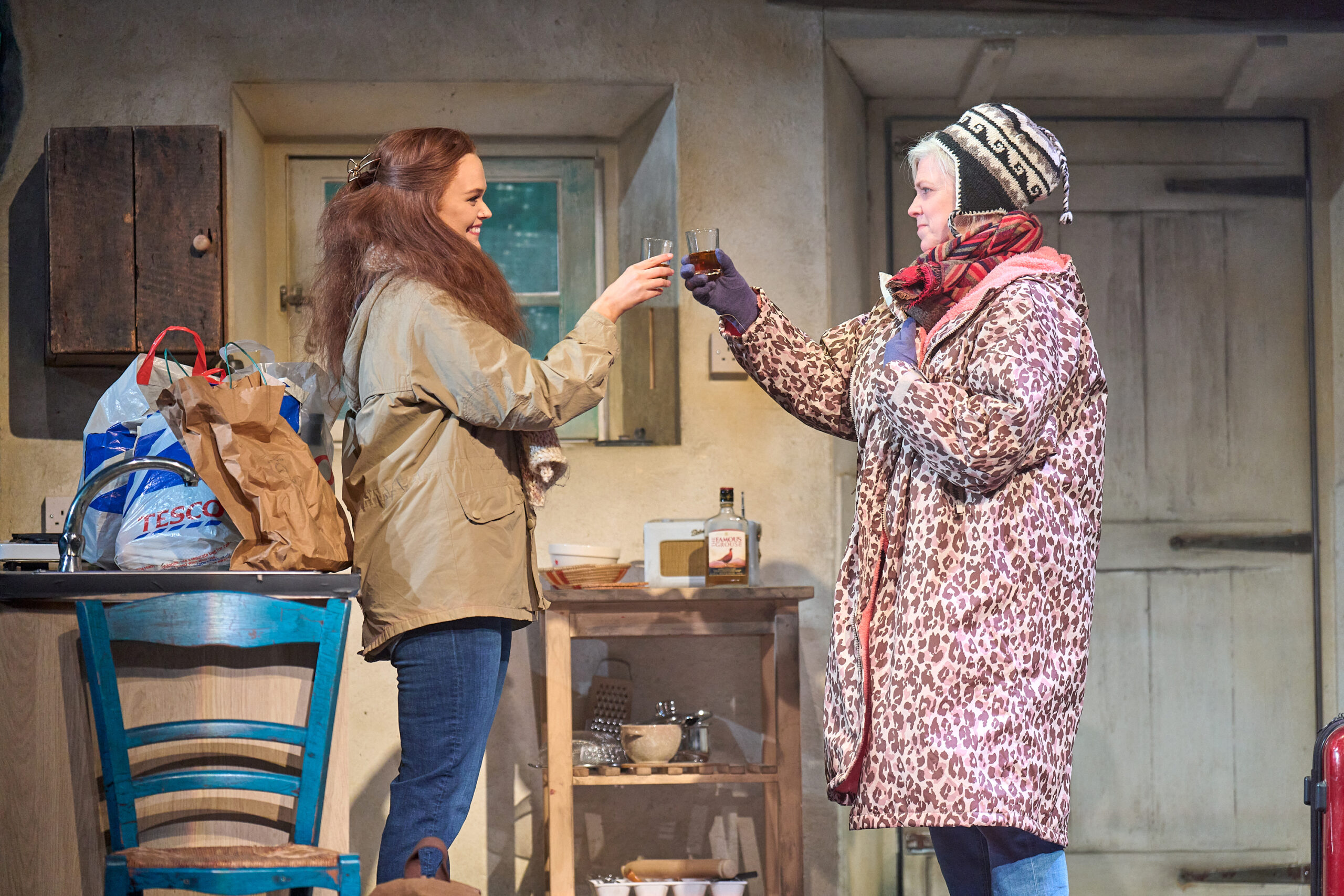
Bhattacharyya’s play depicts two generations of a family resisting exploitation first in Calcutta and then in London.

Prab (Sol Sarwar) is a sewing machine worker with a wife and baby and a talent for story-telling and play writing. His boss Devish (Salim Sharif), along with his girl friend  Chellam (Vaishnavi CG),  “befriends” him, shows interest in Prab’s play and finds him a better flat but of course, beneath the veneer he’s ruthless. Eventually Prab’s wife Kajol (Amirah Mannan) escapes to London leaving Prab to face whatever Devesh does to him. There’s a framing device whereby we first see Prab with his grown up daughter, Amba (Sadiyah Ahmed) and her own baby 20 years later in London and that’s also where the play ends and we realise … well, no spoilers. Enough to say that Amba is now fighting the shabby treatment of Indian workers in England, encouraged by her father’s example in Calcutta.

Director, Krishmeela Rittoo makes good use of Tower Theatre’s triangular playing space and Freya Alexander’s set combines a stage right office for Devesh and a crowded home – bed, sewing machine etc – for Prab at stage left. Much of the action takes place literally between the two worlds.

Salim Sharif, making his UK debut, after years of theatrical training and work in Oman and Mumbai, is outstanding as Devesh. He finds glittering charisma in this role which he inhabits with total conviction. I hope we see a lot more of his work very soon.

Also excellent is Vaishnavi CG. Hers is a role which develops from self interested flippancy to kind decency and she really makes us believe in Chellam who eventually rumbles Devesh for what he is, leaves him and helps Prab’s wife.

It’s a well crafted piece of theatre and it’s interesting to be taken to a world which is probably unfamiliar to most of the audience.

The Little Prince

Adapted from Antoine de Saint-Exupery by Paul Graves and Angharad Ormond, who also directs

Liminal Space

Cockpit Theatre


Star rating: 3.5


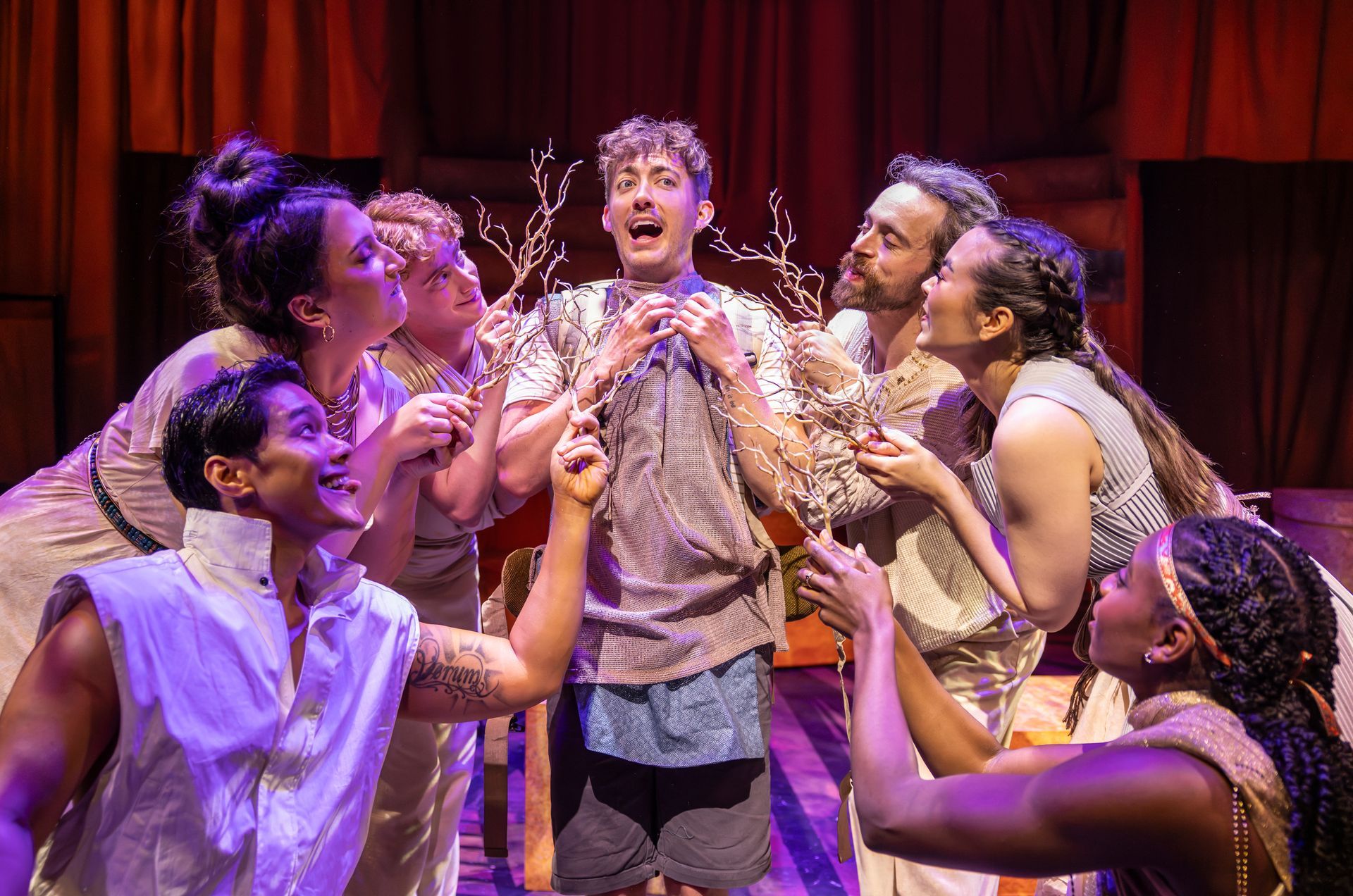
There is a great deal of charm, talent and expertise in this 75 minute take on Antoine de Saint-Exupery’s 1943 story about an extra-terrestrial child who goes planet-hopping and learns a lot about people on the way.

Thisakya Dias finds the right blend of wistful innocence and forthrightness in the titular Little Prince and, as the role requires, she produces laughter like a peal of bells. Matt Tylianakis, as the aviator, is convincing as a child at play and the improvised light aircraft is a theatrical mini tour de force. Then there’s an ensemble, all adept at physical theatre, each emerging for pleasing cameo roles. I’m fascinated, incidentally, as they draw on the long upstage black board to notice that most of them are left handed. Was it an audition requirement, I wonder jokingly?

It is, inevitably an episodic piece (with a whiff of Alice’s Adventures in Wonderland) as the Little Prince meets individuals and groups as he travels. Some of them are very short and their messages are pretty didactic and/or cynical. We’re told that heavy drinking is not a good idea, adults should take children seriously, ownership should be communal, vanity is pointless, caterpillars are a prerequisite of butterflies and a lot more.

The lighting and projection is magically effective, however and there’s some nice puppetry. I also admired the imaginative use of all four entrances on to the Cockpit’s central square playing space.

The show is too long though and could usefully drop some of the episodes. Moreover, it may be going over the heads of some of its target audience: presumably  age 5-10ish. There was some very restive boredom behind me.

The Play’s The Thing

William Shakespeare

Performed by Mark Lockyer

Directed by Fiona Laird

Regeneration Theatre

Wilton’s Music Hall and touring


Star rating: 5

This one-person take on Hamlet is a phenomenal showcase for Mark Lockyer’s acting talent. One of the most riveting, focused accounts of the play I have ever seen, it is fast paced, accessible, exciting and moving.

Lockyer leaps, often literally, from role to role initially characterising the young Hamlet as a sulky, eyes-down teenager with his hands in his pockets and Claudius as a revoltingly smug politician carefully placing every word with a fake smile. His Polonius is so gloriously obsequious that it put me in mind of Alan Rickman playing slimy Mr Slope in the BBC’s 1982 Barchester Chronicles.

The speed of the shifts, aided by Tim Mitchell’s evocative lighting design, is electrifying from the first moment when Lockyer snaps out of quietly asking the audience to turn off mobile phones to the loud terror of the battlements at Elsinore. The actor, who wears neutral black trousers and casual shirt, and his director Fiona Laird have found simple ways of conveying instant characterisation, at least the first time some someone speaks. As Ophelia, he coyly strokes his imaginary hair. His Rosencrantz/Guildenstern is instantly recognisable as a creep. And he’s a pretty accomplished mime artist so this is a prop-free show.

It’s the voice work, however, which really makes this a special piece of theatre. Goodness knows how he does that throaty growl, like a man in the final stages of emphysema, for the ghost. We also get a higher pitched voice for Ophelia, a spirited vernacular for the grave digger and a lot more. It’s all nicely observed and nuanced but never exaggerated.

The mood switches are impressive too. There’s a lot of weeping – Lockyer is good at that – and his instant rebirth as the insouciant grave digger following a deeply distressed Laertes is one of many remarkable, instant transitions.

The text is an abridged version (90 minutes) of Shakespeare with very occasional single word substitution for 21st century clarity. The willow grows, for example, by the brook rather than “aslant” it in Gertrude’s account of Ophelia’s death. And it works supremely well not least because Lockyer and Laird have found ways of stressing words which usually go unnoticed so that it sounds surprisingly modern. All the famous soliloquies, for example, come over as  spontaneous thought complete with natural pauses.  Moreover, and often related to the fresh interpretation of the lines, they have a gift for finding humour where there isn’t usually any.

This show is also a great feat of stamina. Hamlet is a gruelling role under any circumstances and when you do all the other parts as well it must be extraordinarily taxing. Lockyer does it with only the tiniest breaks – an occasional ten second retreat to stage left shadow to wipe his face and take a swallow of water.

On the night I saw this show there was a subsidiary drama in the form of a front row audience member, text in hand, who apparently wanted to redirect it and kept bobbing up and down and offering brief interjections. Front of house staff tried, to no avail, to ease him out quietly while Lockyer continued undaunted. In the end, half an hour in, the show had to be stopped and the man escorted out. Lockyer bounded after them. Then he returned to the stage, told the audience that he’d spoken to the man and made sure he was “OK” before speaking to the tech people across the audience and announcing where he going from. Then he dropped back into role as if nothing had happened. The whole incident was handled with commensurate, admirable, unruffled professionalism.

Do not miss this show. It runs at Wiltons until 12 April and is touring rurally and regionally this summer.

Borusan Istambul Philharmonic Orchestra

Conductor: Carlo Tenan

Cellist:  Pablo Ferrandez

Cadogan Hall, 08 April 2025


This pleasingly wide-ranging concert took us across more than two centuries and several countries. With a Turkish orchestra (part of Cadogan Hall’s Zurich International Orchestra Series) Italian conductor, Spanish soloist and works by German, Austrian, French and Turkish composers, the atmosphere was richly cosmopolitan.

First up was a seriously romantic take on Schubert’s “Unfinished” symphony. It may be very familiar to many of us but my plus-one, who is new to classical music, said she found it very moving – and it was. I really liked the gentle humour is sustaining the horn note on a much  longer pause than usual before the second subject melody and Tenan exaggerated it more at each repeat. He also found great tenderness in the Andante which included some rather beautiful lower string pizzicato and lots of carefully highlighted wind detail, especially oboe.

Moreover I have rarely seen an orchestral player so evidently enjoying every note of the music as principal cello,  Cag Ercag, He smiled at other players, looked back at the principal double bass or across at violas (seated on the outside) to ensure entries were effortlessly together. He really is quite something.

Then came a spirited account of the Cello Concerto no 1 by Saint-Saens with all its virtuosic contrasts. Pablo Ferrandez  (pictured) is a charismatic player who played it with striking purity of sound, plenty of passion, expressive glissandi and an unusually elegant Allegretto. For a complete contrast, and palate cleanser, he played Bach for his encore.

After the interval the orchestra brought in additional percussionists for Nasreddin Hoca Humoresque by Turkish composer Ferit Tuzun and suddenly we had shot forward to 1957. Off-beat rhythms, with kit drum and tambourine packed it with joie de vivre and a strong whiff of Stravinsky.

And so back to the well known fields, birds and weather of Beethoven’s “Pastoral” symphony. It’s not easy to make Beethoven, at his sunniest, sound fresh but with Tenan’s expansively fluid conducting style and his emphasis on dynamic range this account felt both sparky and affectionate without wallowing. The balance in the exposed string sections in the Andante, for instance, was good especially in the busy passages beneath the nicely played bird calls. The storm was as dramatic and graphic as I’ve ever heard it, with terrific timp and piccolo work. And by the time we reached the “Bye Baby Bunting” melody the orchestra was achieving an unusual blend of grandeur and lightness given that this is definitely not a chamber orchestra playing gut strings and trying to adhere to Beethoven’s unlikely metronome markings.

Finally, we got into party mode with an encore by a Turkish composer, Suleyman, which brought back the additional percussionists and created a lively finale, called in English “Change”. Tenan was now batonless and almost everyone on stage was visibly moving to, and having fun with, the powerful rhythms.


I am not a religious believer. I saw what was, for me, the light when I was eighteen and walked resolutely away from the high (ish) Anglicanism I’d grown up with, and been actively involved in. I have never wavered from the humanist, secular position I took then although the deeply conditioned legacy in my head of Bible knowledge, much of the Book of Common Prayer, psalms, hymns and so on, has often been useful at various levels.

I do, however, do my very best to be respectful of people who take a different view from mine and, provided I steer clear of extremist missionary evangelists, whether they’re on my doorstep or at extended family gatherings, my experience has always been that mutual tolerance is pretty effective.

And of course it goes beyond Christianity. I used to teach richly diverse classes including many very gentle, thoughtful Jews and Muslims along with the occasional Hindu or Buddhist. Today, as I go about my business in multi-cultural London, I meet adults of many persuasions although I’ve always been conscious that I don’t really know much about the faiths which drive them. I have therefore long thought that I should find out more about the Koran and now, at last, I’ve had a go.

I bought and explored Mulana Muhammad Ali‘s translation of the Koran. And I accessed a copy of Michael Cook’s The Koran: A Very Short Introduction. The latter is part of Oxford University Press’s A Very Short Introduction series. Handy pocket sized books, they usually provide a pretty detailed account of the subject in accessible language without patronising or skimping. And this volume is no exception. Cook is Professor in the Department of Near Eastern Studies at University of Princeton.

The Koran is, I learned, a series of verses which devout Muslims believe are the words of Muhammad (c 570-632 AD) who was a channel for God, whom Muslims call Allah. It is therefore, a much later text than other comparable monotheistic texts such as The Bible although it builds on the heritage of prophets such as Abraham. It reads like an instruction manual or constitution. All the rules about fasting, fighting, divorce and other advice for life are clearly set out.  Much of it  –  instructions about love, kindness, decency, modesty, worship patterns and the like – doesn’t seem to differ greatly from Judaism and Christianity or, indeed from the generally kind humanism I more or less try to live by.

Statements such as: “And your God is One God; there is no God but He! He is the Beneficent, the Merciful” (Q2 v38), for example. sounds very much like the first commandment: “Thou shalt have no other Gods but me” as delivered to/by Moses in the book of Exodus.

Famously the Koran condemns usury and usurers and “causes charity to prosper” (Q2 276.) It also, acknowledges Jesus as a prophet but not as Messiah and argues that he was illegally put to death. At the same time it repeatedly refutes the beliefs of Jews and Christians in a way which doesn’t seem quite consistent. It is fascinating stuff.

Michael Cook meanwhile is very good on the way the Koran evolved and was (and is) disseminated. Is it truth or dogma? What exactly is “scripture” anyway given the status and authority it acquires within communities? And, of course, like the Bible, it can be read by most of us only in translation so how can we be sure we are not being fed a distorted interpretation?

This was an interesting and rewarding exercise. I’m fully aware that I’m only scratching the surface but I learned a lot. Moreover, it’s as well to remind ourselves occasionally that real Islam, as practised daily by nearly 2 billion moderate people all over the world, is a very far cry from terrorism and the Taliban whatever the media would prefer us to believe.

Next week on Susan’s Bookshelves: This is Motherland by Nikki May


When I was teaching English I always listened carefully to my students’ accounts of what they were reading and quite often read their recommendations as a way of a) demonstrating my open-mindedness b) teaching respect and c) keeping up to date with the tastes of young people. Then, if I didn’t like what I’d read I was in a position to explain why, and I hoped, to model critical reading.

I was reminded forcibly of all that when my second granddaughter, 22, came to stay with me recently. She and her older sister are, I learned, very keen on Colleen Hoover, of whom,I had to admit, I had never heard. Still open-minded and no literary snob, I promptly ordered It Ends With Us which was published in 2016.

When I began to read, my heart sank. Set in Boston, Mass it’s a first person narrative presenting a young woman, Lily, who starts her own business, gets into an abusive relationship, and hankers for a gentle lad she knew as a teenager. That’s enough about the plot because you might decide to read it and you won’t thank me for spoilers.

My initial reaction was that it’s badly written: “Like all the air is being let out of his heart” or “my blood feels like it’s bubbling”. The narrative method is clumsy. As means of filling in the details of Lily’s backstory we are treated to lengthy extracts from unsent letters the teenage Lily wrote to a TV presenter which form a quasi-journal which she rereads now as an adult. And the characterisation is miserably shallow. Ryle is a stereotypical dishy doctor with issues and a good salary, Atlas is implausibly saintly and Allysa so jolly decent that you wish she’d do something reprehensible because, as it is, she’s a cardboard cut-out.  And to name her unfortunate child “Rylee” after her brother is nauseating. The vocabulary gets repetitive in places too. I soon wearied of the word “cute”. Moreover there’s quite a lot of sex which is tediously and unsexily described.  In terms of literary merit it sits somewhere between Flowers in the Attic and Fifty Shades of Grey. Nonetheless I plodded on out of fairness to my granddaughters.

Well, this novel is over 370 pages long and when I got into the final 60 pages or so I began, to my surprise, to warm to it a little when I realised Hoover’s quite serious purpose. Through her narrator, she is exploring the complex mindset of someone who is in an abusive marriage but still loves the abuser and knows that he loves her. Such a situation is nothing like as straightforward as “He hit me so I’m leaving” which is how outsiders, who don’t have this experience, usually expect it to be. There are some very confused and confusing emotions and anxieties, not least about children forced to grow up in abusive householders. Moreover, if love still draws you it’s extremely hard to quit. And when you get to the very end and read Hoover’s authorial note you learn that her own father was abusive and discover how that panned out for her family. That, of course, is why, when she eventually reaches the nub of her novel, it suddenly feels truthful.  I ended up, therefore, being quite glad I’d read it although I shan’t, I’m afraid, be adding Hoover to my list of favourite authors.

Next week on Susan’s Bookshelves: The Koran: A Very Short Introduction by Michael Cook

The Importance of Being Oscar

Micheal Mac Liammoir

Original Theatre & Reading Rep Theatre

Jermyn Street Theatre

 Star rating: 3

Photograph by Marc Brenner

Liammoir’s sombre 1960 play is a biography of Oscar Wilde presented by a single actor: Alastair Whatley is this calm, arguably understated, revival.

Wearing a gorgeous burnt orange three piece velvet suit (costume and set design by Madeleine Girling) Whatley unfolds the life of Wilde in the third person and impersonates him, quite gently, as the story unfolds. We meet the colourful camp man who couldn’t wait to leave Ireland, writes poetry, marries, becomes a successful playwright, fathers two sons, gets into relationships with young men and is eventually imprisoned for homosexuality. Whatley also depicts other characters such as the judge who sentenced Wilde.

The emphasis is on Wilde’s writing and the text includes, among other things, quite long extracts from The Importance of Being Earnest, De Profundis and The Ballad of Reading Gaol along with a semi-dramatisation of The Portrait of Dorian Grey. Whatley makes them funny or moving as required and Chris Davey’s imaginative lighting helps to heighten the mood especially during De Profundis.

There is, however, almost no dramatic tension in the mix. I understood (mainly from Richard Ellman’s excellent 1987 biography) that the two years of hard labour Wilde was sentenced to was what broke his health and caused his early death.  But it is made nothing of in this play. Wilde was devastated to have all contact with his children severed and although it is mentioned, it too could perhaps be made more of.

Sensitively directed by Michael Fentiman, this play is interesting, if low-key, and it’s fun to hear all those familiar Wildean aphorisms worked in (“I have nothing to declare but my genius”). Whatley, moreover, is a competent actor who inhabits the role and is to be congratulated on an astonishing feat of memorisation. This play runs for over 100 minutes in two halves and must be very demanding to do.

It’s a pleasing enough show in its way but it isn’t likely to set many fires alight.

Stiletto

Lyrics and music by Matthew Wilder

Book by Tim Luscombe

Directed by David Gilmore

Charing Cross Theatre until 15 June


Star rating: 2


A new musical about the horrors of 18th century castration of young boys is unlikely fare for a warmish Monday night but it’s a good way of testing one’s open mindedness.

Ceci Calf’s shadowy set really encapsulates the murky atmosphere of Venice in the 1730s and converts neatly enough to a noble salon with the wheeling on of chandeliers. The orchestra (MD Jae Alexander) seated on a balcony above are partly visible through two big arched windows and that works very well, especially for the harp.

Then comes the creaky  plot. Marco (Jack Chambers) has been “sold” to the Church by his impoverished parents for castration at the age of eight to preserve his treble voice. This was common practice involving around 5000 boys a year so that the church could furnish its choirs with adult sopranos at a time when girls and women were not allowed to perform. A handful of these boys acquired star status and that is the future envisaged for Marco.

The narrative, however is shot through with complicating issues such as Marco’s apparently pretty active bisexuality – yes, some men can enjoy sex even after full orchidectomy although it is usually low key. Marco’s enthusiasm doesn’t quite ring true although his anger is understandable. Also in the mix is the frustration of talented women such as Gioia (Jewelle Hutchinson – third time I’ve seem her in action and she’s good) who want to perform and aren’t allowed to. Then, just to complicate things further Gioia is black and therefore completely beyond the pale as far as the nobility are concerned. And there’s a sub plot involving Marco’s companion Nicolo, who has what would now be called post-traumatic mutism, which is never fully developed. On top of that is a another subplot about an innocent woman who’s about to be hanged for murder – although we all know she won’t be.  There’s far too much going on in this show.

Max Wilder’s dialogue seems forced and unnatural especially in the first half in which there’s a lot of declamatory shouting. I like, the way, however that it drops into rhyme and then, almost imperceptibly into song. The music, however, is a problem although it’s beautifully played.  It’s good enough in its way but we’ve heard most of this score before. It comes with many echoes of Oliver!, The Sound of Music, Fiddler on the Roof, Hamilton and Jesus Christ Superstar to name but a few. That, of course, is the very reason why this show might just catch on – some audience members will enjoy the sound of something which sounds comfortably familiar. Best to try, however, not to hear lyrics such as “Shaken as you were, like a kitten you did purr” although you’ll be hard put to miss them because the diction is unusually clear.

Greg Barnett puts in a good performance as Faustino, Marco’s promoter and soon-to-be-ex lover. And Kelly Hampson is pleasing as Azzura who spots Marco, wants to support Gioia and stands up to her own appalling husband Pietro (Douglas Hensell – strong)

There’s a large ensemble in this show and a great deal of walking on and off as in an amateur G&S production although each individual does a reasonable job and there are some quite nice choreographic groupings.

The trouble with a show about someone who is supposed to have exceptional talent is that somehow you have to present that talent convincingly. Stiletto uses a female mezzo double for Marco and, as a device, it falls disappointingly flat because he sings in a perfectly decent but standard tenor voice at other times.  Surely they could have cast a male actor who could have done this in showpiece falsetto? After all Sasha Regan finds plenty of them for her productions of, say, The Pirates of Penzance or HMS Pinafore.