Press ESC or click the X to close this window

The Score (Susan Elkin reviews)

REVIEW: THE SCORE by Oliver Cotton at Theatre Royal Haymarket 20 February – 26 April 2025

Susan Elkin • 28 February 2025
Photography: Manuel Harlan

‘Bitty play beautifully acted’ ★★★

In May 1747, the elderly JS Bach travelled from Leipzig to Potsdam at the invitation of Frederick the Great. It resulted in a composition of a set of pieces called The Musical Offering and allowed “the most famous composer in Europe” to catch up with his son CPE (Carl Philipp Emanuel) Bach who worked at Frederick’s court for 27 years. It’s an interesting starting point for a play.

The trouble is that it tries to fire on too many cylinders at once and seems unable to decide what it’s trying to do. Is it about personal conflict between two very strong men? Is it about music and the compositional process? Is it about three lesser known, sycophantic composers comically creating the great JS Bach with an “unfugable” theme and gambling on the outcome? Is it about the obscenity of land-grabbing war? Is is about the strength of religious conviction butting against Enlightenment atheism? Or are we meant to draw topical parallels? It had never struck me before that if you substitute Ukraine for Silesia, Putin is simply Frederick the Great without his flute although the play doesn’t stress this point. It simply muddles on for two hours and forty minutes including interval.

At the heart of this play is a magnificent performance from Brian Cox as JS Bach which almost redeems it. He blends irascibility with tenderness and fury about the earlier Prussian raid on Leipzig. His fearless berating of Stephen Hagan’s Frederick is fine theatre and we feel all the frustration of a sick old man when he finally gets home. The first and last scenes affectionately present him with his second wife Anna, played by Cox’s real-life wife Nicole Ansari-Cox. JS Bach, the cantor who had to serve up a new cantata every week, was a deeply religious man and it underpins everything Cotton’s version of him does and says – all convincingly nailed by Cox.

Hagan’s Frederick is variously chatty, urbane, imperious and ruthless. He glitters dangerously but makes everything he says sound reasonable until he gets angry and launches into nationalistic rhetoric. It’s another fine performance and a strong dramatic contrast to Cox’s Bach. There’s pleasing work too from Juliet Garrick as Emilia the servant and from Jamie Wilkes as CPE Bach.

Robert Jones’s set and costumes star in their own right although the occasional use of the revolve is a bit pointless. Flown in scenery includes a plain wall with Christian cross in the Bach family home which contrasts with rather lovely carved doors and a pair of ionic columns with lots of oil paintings at Potsdam. And he’s had fun with authentic late eighteenth century long velvet jackets and the inevitable wigs. It’s a nice touch that JS Bach’s comfy wig looks like a homely grey bonnet and we learn that he can’t be bothered to have it “dressed”. The harpsichords are pretty too.

Because this is, at least in part, a play about music, we hear snatches of great Bach works which shine through and one is left wishing for more. Sound designer and additional composer Sophie Cotton certainly knows what she’s doing.

It isn’t Oliver Cotton’s fault that when Peter de Jersey arrives as a hammed up Voltaire, I am immediately put in mind of an appalling OU programme which was part of my 1980s degree course – not one of the, usually excellent, OU’s finer moments. It created an imaginary dinner party at Potsdam in which every Enlightenment figure expressed a view which was meant to help us learn who thought what. In fact it was the most laughably bad acting I’ve ever seen. I still giggle to think about it. Of course The Score is a hundred times better than that.

THE SCORE at Theatre Royal 20 February – 26 April 2025

BOX OFFICE

A new play by Oliver Cotton

Starring Brian Cox and Nicole Ansari-Cox

Directed by Trevor Nunn

Theatre Royal Bath Productions

Ensemble: Peter De Jersey as Voltaire, Juliet Garricks as Emilia, Stephen Hagan as Frederick, Jamie Wilkes as Carl, Christopher Staines as Quantz, Toby Webster as Benda, Matthew Romain as Graun and James Gladdon as Helstein, with Geoffrey Towers, Jordan Kilshaw and Rebecca Thornhill. 

Review first published by LPTM https://www.londonpubtheatres.com/review-the-score-by-oliver-cotton-at-theatre-royal-20-february-26-april-2025

The Magic Flute

Wolfgang Amadeus Mozart

Charles Court Opera

Wilton’s Music Hall

 Star rating: 4

Photograph credit: Bill Knight

I had high hopes of this show and every one of them was fulfilled. This is Mozart as you’ve never seen it before. The Charles Court version is meticulously fresh, beautifully sung and very funny. Director John Savournin is himself an accomplished singer and actor so he knows exactly how to make this material work in a way which trusts the material but isn’t afraid of originality. The gloriously witty translation and Eaton’s musical direction from the keyboard ensures that the whole experience is a pleasure.

Matthew Kellet is outstanding as Papageno, played as a mercurial, down-to-earth man of the people who manages the leafy, jungly garden of Sarastro’s temple, including of course, the birds. Kellet hops about (often in rhythm)  engages with the audience and gets our sympathy. He is master of comic physicality and his diction is the clearest I’ve ever heard in this role.

Martins Smaukstelis gives us an earnest Tamino, an explorer with satchel (we’re loosely in the early 20th century) having first been freed from netting by the three ladies – conflating him with the monster that they’re usually dealing with in the opening scene which is an ingenious idea. He too, like everyone else in this fine cast of nine, is a compelling singer.

Peter Lidbetter’s Sarastro packs all the gravitas you could wish for – a well articulated contrast to Kellet’s Papageno – singing all those very low bass notes with precision. Of course The Queen of the Night is a challenging role because her two big numbers are very well known indeed and the audience awaits them expectantly. Eleri Gwylym, looking terrifying with a scarlet band of makeup across her face, long grey hair and lots of lace, rises to that challenge, hits every high note with aplomb and exudes malice.

This is a revival production with new work from revival director, James Hurley and revival designer Lucy Fowler (original design by Simon Bejer) and it sits happily in the space at Wlitons with its central steps leading downstage. The ultra-violet lit puppet snakes are a bit of a show stopper.

As you’d expect from Charles Court this is a bijoux take on The Magic Flute running just two hours plus interval. Cast size means that there is doubling of some roles but it’s done adeptly and it makes for some very clear singing of ensemble numbers. Die-hard traditionalists might object to the cuts but it flows and the story telling is much clearer than usual. The plot is bonkers but this version makes it almost coherent.

Charles Court Opera is celebrating its 20th year in 2025. Here’s to the next twenty and I’m looking forward to Patience at Wilton’s in September already.

REVIEW: BACKSTROKE by Anna Mackmin at Donmar Warehouse until 12 April 2025

Susan Elkin • 23 February 2025

Image: Celia Imrie (photographer Johan Persson)

‘pleasingly crafted domestic drama’ ★★★ ½

Anna Mackmin’s pleasingly crafted new play is about mothers, motherhood, matriarchy and matrescence. As such it tries, in places, to be slightly too clever and to include too many issues. Nonetheless, there’s much to admire – and my case strongly identify with – here.

Beth (Celia Imrie) has a stroke and is taken to hospital where she lies inertly. We see the hospitalisation scene with paramedics twice for no particular reason. Thereafter her life and complicated relationship with her daughter Bo (Tamsin Grieg) is gradually unpicked in a series of flashbacks.

Imrie is, of course, very good indeed as this colourful, outrageous, irrational, difficult, irritating and capricious woman, vacillating between affectionate support and cruel put downs. She flounces, grins, shouts. says things mothers shouldn’t say to daughters and we wince. And she’s sliding into dementia in an impeccably observed and cruelly recognisable way.

It is, however, Grieg’s outstanding performance that one leaves the theatre thinking about. She wears a simple T shirt, Levis and boots with only a cardigan and a scarf to indicate occasional mood shifts. We see her aged 6, 13, 18, 21, 30, 50 and 51 and she nails it with total conviction every time. And she has an extraordinary way of revealing her thoughts as she turns away from her mother in fury, frustration, disbelief exhaustion and more – because, like almost every woman in her position – she has a demanding life of her own mainly focused on, Skylar, a troubled child she has adopted, an aspect of the plot which is not fully developed.

Among the remaining all-female cast, Lucy Briars is strong as a dour but well meaning nurse with Anita Reynolds contrasting as cuddly kind one, Georgina Rich, meanwhile, gives us a very plausible, play-it-by-the-book doctor who doesn’t listen much, along with a gentle but businesslike funeral director.

Lex Brotherston’s set puts the play on three levels with most of the action downstage at stalls audience level, the hospital room in the middle and some distant scenes – including a rather effective one at a swimming pool – on a platform above. It works pretty well.

Then there’s the film aspect of the production. Sudden flashes – visual and aural – indicate the time shifts in Beth’s head and, maybe Bo’s memory and we get grainy film of past incidents This is, I presume, meant to connote home movies but it doesn’t add a great deal.

Backstroke is a domestic drama which will resonate with anyone who has had to manage the tragedy of worsening dementia in a loved one and/or had to deal with a beloved but impossible parent. And I’ve done both so it touched me quite deeply, despite its flaws.

BACKSTROKE  Written and directed by Anna Mackmin

Donmar Warehouse

24 February – 12 April 2025

Box Office

First published by London Pub Theatres Magazine: https://www.londonpubtheatres.com/review-backstroke-by-anna-mackmin-at-donmar-warehouse-until-12-april-2025

Trestle – Jack Studio Theatre, London

Reviewer: Susan Elkin

Writer: Stewart Pringle

Director: Matthew Parker

Stewart Pringle’s 2017 play debuted at Southwark Playhouse and won that year’s Papatango Award and was last seen as a live stream via YouTube in 2021 and a short run at Jack Studio. So it’s good to see it back now on stage with a receptive audience.

On the surface, it’s about two people and a table in a Yorkshire village hall. Actually, it’s about friendship, finding pathways through life and considering might-have-beens.

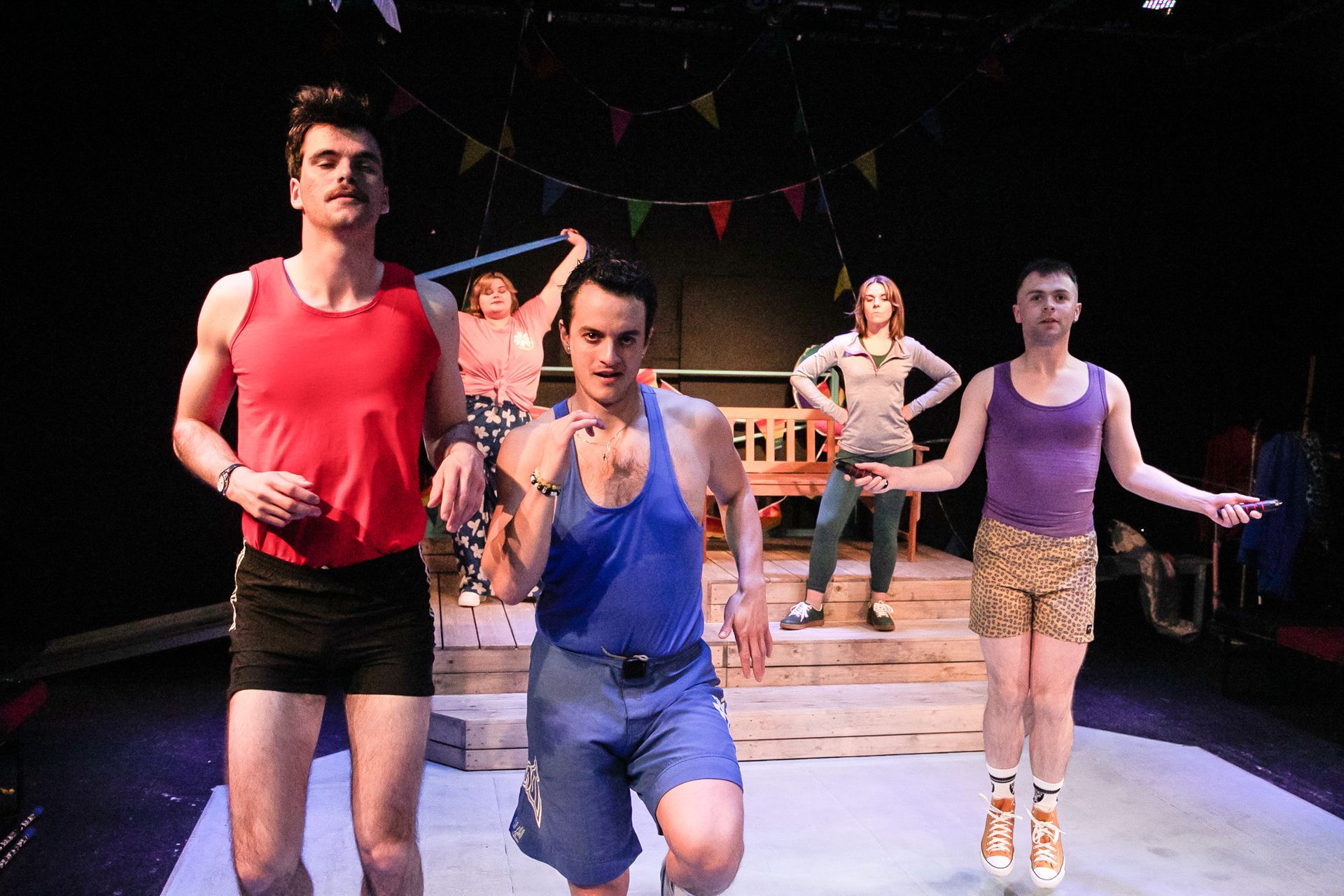
Harry (Timothy Harker) is chairman of the Village Improvements Committee. He’s a bit pompous, fussy, inhibited, unsure of himself and set in his ways as a widower. Denise (Jilly Bond) is an energetic 63-year-old who teaches a Zumba class which runs in the hall after Harry’s meetings. She’s warm and comfortable in her own body although not, we eventually learn, all that happy with her life situation in general.

At first, there’s a lot of awkwardness between them. Gradually over several months, they thaw and – with a lot of misunderstanding and some comedy – eventually establish a friendship of sorts. Most of the dialogue is deceptively banal but laden with subtext.

He, for example, is clearly attracted to her but held back by diffidence and very upset to learn that she’s married. She sits in on one of his meetings and discovers that it’s just a load of nimby-ish hot air. That means political tension between them and the second half is darker after a very funny scene at the end of the first half when she teaches him Zumba and he visibly relaxes and improves.

Both actors are convincing with an especially fine performance from Bond who has played this role before – with smiles, grimaces, elasticity and some evocative expressions when she looks away from Harry and reveals what she’s really feeling.

Andy Graham’s soundtrack is effective: lots of loud pop for the Zumba, obviously, because as Denise says “You can’t do this to Brahms” but Graham subtly pops in a few bars of Brahms later in the piece as the mood changes. Also imaginative is the lighting by Laurel Marks, especially in the final few moments when for the only time in the play, the action leaves the village hall and shifts to a garden.

Trestle is a tad too long for its subject matter and the continuous putting up and down of the Gopak table gets to seem tediously irritating but the piece is clearly determined to live up to its title. On the whole, though, it’s an entertaining piece.

Runs until 8 March 2025

The Reviews Hub Score: 3.5

Simple but savvy

First published by The Reviews Hub: https://www.thereviewshub.com/trestle-jack-studio-london/

Hangmen – Tower Theatre, London

Reviewer: Susan Elkin

Writer: Martin McDonagh

Director: Liam Stewart

Originally staged at the Royal Court, Martin McDonagh’s 2015 play is a good choice for a community theatre company because it’s studded with meaty roles and, without doubling, a cast of twelve.

The death penalty ended in the UK in 1965 and the play is set in the aftermath of the announcement, mostly in the Oldham pub owned by Harry (Ed Reeve), formerly the country’s second best hangman. Down the road, running his own pub is Albert Pierrepoint, famed as the last in the family business: hanging for the state. The drama – and it’s pretty taut – revolves around discussion about capital punishment, a journalist, a police inspector, a sinister stranger and the disappearance of Harry’s teenage daughter, Shirley. There are twists and turns, a dark denouement and it’s all spliced together with – literal – gallows humour.

Reeve is terrific as Harry who is anything but likeable. He brutalises his “victims” whose ends are for him, evidently not sacrosanct, despite what he hypocritically declares. Reeve makes him capricious, short-tempered and very impatient with his daughter. It’s a fine performance.

In a cast which is generally strong, Helen McGill as Reeve’s wife, Alice, finds all the cheerful landlady firmness the character needs and is then movingly convincing as she shows us the desperately anxious mother. Eloise McCreedy is perfect too as the “mopey”, gullible teenage daughter. Liam Brown finds plenty of urbanity in Mooney – but who is he and what does he want? The tension is spot on.

This production stands out for the chemistry between the cast and the quality of the attentive listening – the men who frequent the bar are immaculately observed and nicely played. And that, like the main action, results from skilled and imaginative direction by Liam Stewart.

Also noteworthy is Philip Ley’s ingenious set that starts with a prison cell and a glimpse of Harry, brutally in action in 1963. It then becomes the pub – with bar, pumps, bottles, stools and three doors superimposed on which are other scenes, such as one in a café.

This production of Hangmen is a gripping two and a half hours of theatre and well worth catching.

Runs until 22 February 2025

The Reviews Hub Score: 4 stars

Hanging issues and gallows humour

First published by The Reviews Hub https://www.thereviewshub.com/hangmen-tower-theatre-london/

I recommend this 2024 novel unreservedly. I read it because I’ve enjoyed Elif Shafak’s previous work but there has never been anything as riveting as There Are Rivers In the Sky.

It’s about rivers, water, love, cruelty and destruction, hope and redemption among other things and it’s split across four time zones. Ashurbanipal was King of Assyria, six centuries before Christ and gets a mention on the Biblical book of Ezra. He is famous for being a cultured man who built a beautiful library in Nineveh on the bank of the Tigris. He was also a ruthless tyrant and it can seem difficult to reconcile the two sides of his character until you remember that the Nazis were fond of Mozart and reflect that such patterns recur throughout history.

Fast forward to the nineteenth century and Arthur Smyth (inspired by real life Assyriologist, George Smith) is born into poverty but graced with a phenomenal memory and, although it’s never said overtly, is probably on what we would now call the autistic spectrum. He is reading Assyrian cuneiform tablets, from many centuries BC in the British Museum. His quest is to piece together the Saga of Gilgamesh.

Then there’s Narin who lives with her father and grandmother in Turkey in 2014. They are Yazidi people which means they are neither Christian nor Muslim although there are overlapping beliefs and stories.  All is fairly peaceful (notwithstanding developers gradually driving local people away) until they decide to go on a religious pilgrimage to Iran where they get caught up in ethnic cleansing of Kurds by ISIS and the sort of horror which makes the soles of my feet go clammy as I read.

Meanwhile Zaleekhah, leaving a failed marriage, is trying to find herself in present day London. Orphaned in childhood because her parents were drowned by the Tigris on a camping trip, she works as a hydrologist. We meet her wealthy, kindly but misguided Uncle Malek and her wise, new friend Nen. Zaleekhah lives in a houseboat on the Thames. Water flows through this novel like a life force.

Eventually – no spoilers – Shafak establishes links between these four narratives and my eyes shone as I read on, as it gradually and seamlessly comes together.  There are Rivers in the Sky tells a powerful, if complex, story very accessibly. And Shafak blends the intense power of love, in all its forms (Narin’s grandmother is a wonderful example of selfless, unconditional love) with the importance of storytelling itself as a force against evil whether it’s raping children despised as worthless infidels or, in 21st century London, using money to exploit children for your own ends, even if your intentions are worthy.

It’s a richly spiritual novel too – and I speak as a religious unbeliever. Leila whom Arthur meets on his expeditions to the Tigris has qualities and dimensions which go way beyond sexual attraction and cross the centuries. Narin who has worsening deafness which will soon be total, can sense and understand things beyond herself because she has been schooled by her sagacious grandmother.  And Zaleekhah, a 2020s working woman, is driven by decency, as well as struggling with depression but Nen has perceptiveness which goes way beyond ordinary common sense.

There is also a quasi-transcendental environmental message tucked into this novel’s myriad folds and crevices. A precious valley is about to be flooded near Narin’s home in Turkey. The new dam will drown many ancient buildings and artefacts. Water lies as the heart of everything which happens to everyone in the novel. We probably all know that there are a finite number of molecules in the world so that any drop of water has, in a sense, been naturally recycled many times. Shafak uses raindrops as symbolic link between her characters in this stunningly beautiful, multi-dimensional novel.

In short, I loved it. And I think you will too.

Next week on Susan’s Bookshelves: Hedda Gabler by Henrik Ibsen

It Runs in the Family

Ray Clooney

The Mill Sonning

 Star rating: 3.5

The only way to do farce and make it work is to hurl it at the audience fast and furious and I’ve known this since childhood when, after G&S, Brian Rix’s Whitehall farces were my favourite form of theatre. It’s what I always chose for birthday treats and the like. This jolly production of Ray Clooney’s 1987 comedy shows a clear understanding of exactly how to carry farce off with aplomb.

I’m not sure I can summarise the convoluted plot for anyone who is new to It Runs in the Family. Suffice it to say that it involves dotty doctors, misunderstandings, a stereotypically fierce matron, a pantomime, wives, mistresses, silly disguises, shenanigans with doors and windows and lots of “sua padre”.

And the best thing about it is the timing, especially by James Bradshaw as Dr Bonny who has a superb knack of adding high pitched incredulity to his petulant repeats of whatever daft thing someone else has just said. He – usually in partnership with Steven Pinder, (fine performace) as Dr Mortimore – is also terrific at allowing exactly the right length of silence for the joke to settle and the laughter to taper before saying anything else.

Francis Redfern, a recent Bristol Old Vic Theatre School graduate, turns in a strong account of Leslie, the aggrieved fatherless teenager  and the window sill scene with Elizabeth Elvin’s Matron is splendid situation comedy.

Alex Marker’s set – the play demands three doors and a window – is ingeniously, and neatly, contrived on the Mill’s wide, thrust playing space. The unmistakable hospital signage beyond the doors of the “doctors’ common room” (does such a thing exist in real life?) is a nice touch too.

The first half is arguably better than the the second but in general this pleasantly entertaining nonsense, is ideal for a Saturday afternoon alongside the good folk of rural Berkshire with the prettiest bit of River Thames I know lapping a few feet from the door.

The deal at the Mill is a meal/theatre package. So everyone eats lunch or dinner before the performance. This year it has changed from buffet to table service in the newly decorated and configured dining room. Full marks to the staff whose service is nearly as slick as the production which follows, although I wish there could have been more choice on the menu.

Photograph by Carter Joy Evans

John Steinbeck’s great gift is to be able to wrench the guts out of you and leave you moved, to near speechlessness. And he does that so powerfully that he is an almost incomparable writer. Have another look at his masterpiece The Grapes of Wrath, if you don’t believe me.

But his best known novel, in the UK anyway, is Of Mice and Men (1937), probably because it was once studied by 90 per cent of GCSE students. Take the 20-something chap who delivered my groceries the other day, for example, He spotted my half-reread copy lying on the table (it’s yet another novel germane to my current writing project) and told me that he had “done” it at school. He was of Afro-Caribbean descent, apparently unabashed – and that fact is relevant in this instance.

Of Mice and Men, which I have taught to many classes, is now falling out of favour because it contains racial slurs. Well of course it does. It contains slurs against disability (mental and physical) and women too. That’s the whole point. But John Steinbeck is testingly putting these prejudices into the thoughts and mouths of his characters. He isn’t condoning or agreeing with them – or expecting the reader to. That’s why it’s such a fine starting point for discussion. It works powerfully against racism, misogyny and “ableism”. Sadly it has now been dropped from the curriculum in Wales, and it won’t be long, I suspect, before it slides away from young people elsewhere too at the behest of ignorant, blinkered adults who really should know better. All the best fiction makes the reader think and that often means feeling uncomfortable. It’s one of the ways in which understanding is built and prejudice broken down. That’s the purpose of literature.

We’re on a ranch in California in the Depression of the nineteen thirties. The main crop is barley and most of the labour force is itinerant. George and Lennie arrive there, having have to leave their last job in a hurry.  Lennie has severe learning difficulties and phenomenal physical strength which he doesn’t understand how to control. George, who isn’t related to him, is a quasi fraternal carer who loves him and tries to keep him out of trouble, despite the frustrations. On the ranch they meet, Candy, a former labourer who now does the cleaning because he lost his hand in a farming machine. Another misfit, is Crooks, a black, disabled stable hand who lives separately from the other man. George and Lennie  dream about getting a small holding of their own and Candy offers to contribute his compensation money so, briefly, it looks like a serious possibility, perhaps with Crooks also on board. Then the boss’s daughter-in-law “Curly’s wife” (another pitifully unhappy person) saunters in and the whole thing ends in searing tragedy. As Burns put it: “The best laid schemes o’mice an’ men / Gang aft a-gley”.

Along the way, there’s the euthanasia of Candy’s old dog – a symbol of social “uselessness” – various small animals  which Lennie loves too much and some wonderful characters. Slim, for instance, works permanently on the ranch as the jerkline skinner, a mule driver who can control a line of animals with great skill. He is sensitive, watchful and intelligent unlike Carlson who doesn’t do empathy or subtlety. Even Curly, the boss’s son, is a man full of insecurities which he conceals behind aggression. There are no “baddies” or “goodies” in this superb novel – just a cast of struggling people and Steinbeck evinces sympathy at some level for every one of them.

Indeed they do casually refer to Crooks (nicknamed for his back which is bent by injury) as the “stable buck” and the words nigger and negro are bandied about, even by Crooks himself. This is, after all the 1930s and men on a ranch like this wouldn’t have thought twice about the language they used.  But we indentify with his loneliness just as we do with elderly Candy who knows he’ll be thrown on the scrap heap as soon as he can no longer sweep floors. And as for Lennie, every offensive name imaginable is used to describe him, “dum-dum” being one of the politer terms. Slim, however, recognises him for the gentle giant he is, and is the only person who understands George’s anguish at the end.

This remains one of the most humane novels I have ever read. If I were in charge of anything these days, I’d be compelling young people to read it rather than shielding them from it.

Next week on Susan’s Bookshelves: There Are Rivers In The Sky by Elif Shafak