Press ESC or click the X to close this window

Havisham (Susan Elkin reviews)

REVIEW: HAVISHAM by Heather Alexander at Jack Studio Theatre 11 – 15 March 2025

Susan Elkin • 11 March 2025

‘Excellence marred by inappropriate music’ ★★★ ½

This one woman show is a fine piece of writing and Heather Alexander’s acting is sensitively nuanced.

We first meet Miss Havisham, familiar as the deranged, jilted bride in Great Expectations (1861) as a child of four, motherless, frightened and fragile. Alexander then depicts her being beaten for wetting herself in church, growing up (the onset of menstruation is a bit hammy) and spending too much time alone. And there are experiences in her life which Dickens probably never dreamed of. It’s imaginative work. Ultimately she’s a very vulnerable young woman whose father shows her no love but leaves her the Satis estate in Kent on the marshes of the Hoo Peninsula when he dies. She blossoms and becomes more confident in London living with her aunt but then she meets James Compeyson and we all know where it’s going. 

Alexander is a talented actor, as convincing as a young child as she is as a suave conman. She communicates expressively with her face and fingers. And Havisham is a compelling piece of theatre in two short acts. The set is neat too – lots of white lace, stage smoke and it’s amazing what you can do with two orange boxes and a piece of sheeting.

The sound effects are strong but adding other voices feels like a cop out in a one person drama. Moreover the music is very odd. The folk songs are anachronistic because most people didn’t know them until they were discovered and popularised by Cecil Sharp and co in the early 20th century. A brass band would not have performed Seventeen Come Sunday in the 1860s. And why the repeated use of a Baroque concerto? The piece – presumably Hot Gossip because that’s where Alexander’s background lies – which accompanies tragic Miss Havisham’s final descent into disaster doesn’t add much either. If these choices are meant to make the piece feel timeless then they fall sadly flat.

Havisham is worth seeing, though, for at least two additional reasons. First, any one woman show is a welcome antidote to the large number of one man shows on offer and deserves to be supported. Second, back stories to familiar characters from well known literature are a fertile and very interesting concept.

Photographer: Peter Mould

HAVISHAM by Heather Alexander at Jack Studio Theatre 11 – 15 March 2025, presented by Emul8 Theatre

BOX OFFICE https://brockleyjack.co.uk/

This review was first published by London Pub Theatres: https://www.londonpubtheatres.com/review-havisham-by-heather-alexander-at-jack-studio-theatre-11-15-march-2025

Vienna Tonkunstler Orchestra

Conductor: Yutaka Sado

Pianist: Yeol Eum Son

Cadogan Hall, Zurich International Orchestra Series 2024-5


There are several things to note about this enjoyable concert before we even get to the music. First, a splendid Austrian orchestra, conducted by a Japanese and working with a South Korean soloist is a fine demonstration of the inclusive internationalism of classical music. Second, it’s a joy to see an orchestra of this calibre led with energetic panache by someone so young. Jacob Meining is only 29. Third, even in 2025, it is still unusual to see, and hear, a female timpanist so bravo Margit Schoberleitner. You did a grand job.

Because Sibelius’s Symphony No 7 is “through-written” – that is without breaks between movements – and relatively short, it makes an satisfactory, if unusual, overture-like concert opener. Yutaka Sado leaned on Sibelius’s trademark big brass tunes and ensured we heard lots of crisp, incisive, distinctly Austrian string sound especially in the long slurred runs. An ascending scale is not, I have to say and always think, the most inspiring of recurrent motifs but this performance made it sound pretty fresh and arresting.

If you’re Austrian, as most members of this orchestra are, Mozart is in your blood and his Piano Concerto No 21 was accompanied here with charm and lightness. And Yeol Eum Son delights. She has an attractive feathery touch and blends her sound perfectly with the orchestra’s. She found plenty of elegant drama in the first movement’s cadenza and I really liked the flute and bassoon work in this movement. We then got an affectionately elegant account of Mozart’s most famous andante and a resounding allegro. She followed the concerto with a witty little encore, which I was unable to identify, in which her fingers moved so fast they disappeared.

After the interval the full orchestra returned for a warm and imaginative account of Brahms Symphony No 1. Sado rarely consults the score and often turns his baton into his sleeve in order to get deep and personal with his fingers. Sometimes he barely conducts at all. He simply sets them off and they play. He exaggerates tempi – especially in the opening of the concluding adagio which was very slow and played at the softest possible dynamic to allow for exciting crescendo and accelerando passages. Arguably, when he got to the big melody with trombones and muted violins it was a bit self-indulgent but it pleased the crowd by this point in the evening. Other highlights included nicely balanced horn interjections in the first movement and poignant string work in the andante with the leader’s solo at the end as moving as I’ve ever heard it.

Then there was an encore. Of course there was. Brahms’s Hungarian Rhapsody No 5 was a perfect choice with its almost absurd alternating swoops and fast string passages topped with lots of exciting wind parts. Fun to listen to and fun to play.

Journalist Tim Devlin is once more on an investigative trail of nursery rhymes and, as ever, the depth of his research is very impressive. He goes all over the country, interviews descendants of families who may be featured in the rhymes and spends many hours in The British Library, The Bodleian and elsewhere. This new book which examines another fourteen rhymes is a welcome sequel to Cracking Humpty Dumpty, and is again rather beautifully and informatively illustrated by Katarina Dragoslavic.

Of course Devlin is by no means the first person to have done this and he now has a honed technique. He examines all the other explanations for each rhyme – in a pleasingly business-like but accessible style – debunks, the fanciful or impossible and finally comes to a tentative conclusion of his own.

Who or what, for example, were those four and twenty blackbirds? Well for a start, huge pastry containers out of which dwarves, animals or birds would burst as entertainment  at courtly dinners were a Tudor commonplace so the hapless “birds” hadn’t been baked at all. Were the birds the 24 letters of the Tudor alphabet in celebration of the first printing of the English Bible in 1535? Were they an allegory for the number of hours in a full day? Was the rhyme poking fun at Henry James Pye, appointed poet Laureate in 1790, whose verse was full of lines such as “vocal groves and feathered choirs”? Some versions feature “naughty boys” rather than blackbirds. Pirates? Probably not. As so often, it turns out that the dates are wrong. But, bearing in mind that the first sixpence was minted in 1551, Devlin wonders whether the rhyme could have been written in celebration of Edward VI’s birthday in 1553. He has studied the hapless young king’s “chronicle” (diary) in the British Library via microfiche and discovered a keen personal interest in the coinage. Fascinating stuff.

And what about that “cock-horse” so familiar to anyone who, in childhood, has ever been jogged on the leg of a strong male relation? Is it literally a mythical creature which is half-cock and half-horse as depicted on an Etruscan vase? Aristophanes used the hybrid in The Birds to characterise a “cocky” character. There’s a pub in Kent on the Pilgrim’s Way near the bottom of Detling Hill, called The Cock Horse. According to a recent issue of Dover Kent Archives: “The name is derived from the need to supply a cock [ie extra] to get stagecoaches and heavy wagons up a steep hill”/ Then there  are traditional hobby horses as children’s toys – a stick with a horse’s head at one end – which dates back, delightfully, at least to Sparta in the fourth century BC. And so Devlin goes on gleefully and filling me with glee too as we unpick Mother Goose, Pop Goes the Weasel, London Bridge, Little Miss Muffet and more.

In his epilogue, Devlin proposes the setting up of a National Centre for Nursery Rhymes because he is concerned (as am I) that they are rapidly disappearing from our culture. And he has some inspiring ideas about what this might include and how it might work. But it needs support and sponsorship. Contact him via  www.crackingnurseryrhymes.co.uk if you’re interested.

This book, ISBN 9781399985734, is published by Susak Press and available from www.crackingnurseryrhymes.co.uk 

Next week on Susan’s Bookshelves: The Frozen People by Elly Griffiths

Philharmonia

Conductor: Ryan Bancroft

Pianist: Michelle Cann

Royal Festival Hall

07 March 2025


It’s hard to think of a trickier concert opener than Charles Ives’s otherworldy The Unanswered Question which – shades of Bruckner 7 – starts almost imperceptibly, relies on pianissimo strings , gently shifting harmonies and must require exceptional levels of concentration. Ryan Bancroft, conducting without baton for the whole of this concert, brought out the best in the Philharmonia and created a compelling sound world, especially given the trumpet interjections with the trumpeter (Jason Evans) in a box elsewhere in the auditorium.

Thence to the much more familiar territory of Beethoven’s Piano Concerto No 4 and an arresting performance by American pianist Michelle Cann, wearing a wonderfully glittery dress with inbuilt cloak and working with Philharmonia for the first time. She set a gentle tempo with her initial piano statement and we got mellifluous orchestra playing with lots of loving detail in the rest of the movement. It is, however, the ground breaking (for 1806) andante which really distinguishes this concerto and Cann played it with masses of colour and exaggerated elasticity which added to the integral intimacy, while the accompanying string work was pleasingly incisive. Then came a cheerfully insouciant account of the Rondo with some pretty stunning left hand work in the cadenza. There is something faintly incongruous about using natural trumpets and timps alongside a Steinway concert grand but the piano tone was pretty bright and it worked.

I have long since come to the conclusion that the best way to take Also sprach Zarathustra is to “read” it as a fine symphonic work rather than getting too hung up on the Nietzschian philosophy which inspired it. With that in mind I enjoyed the Philharmonia’s take on the famous opening statement which becomes the theme for the rest of the work – delivered with as many fs as possible and exactly the sort of full-blooded live performance I hankered to hear during Lockdown when I couldn’t have it. And the orchestra then gave a magnificent and moving account of all those individualised string parts, often building from the back. My “plus one” at this concert observed that Also sprach Zarathustra, written when Strauss was only 32, is Brahms meets Stravinsky and that’s exactly the quality which Bancroft brought out in this rendering. The performance of the whole piece was eloquent, controlled and dramatic with excellent work from timpanist, Antoine Sigure. And Scott Dickinson’s viola solos added a richly plaintive element.

REVIEW: One Day When We Were Young by Nick Payne at Park Theatre 26 Feb – 22 Mar 2025

Susan Elkin • 4 March 2025

Photography: Danny Kaan

‘Well directed, elegant poignancy’ ★★★★

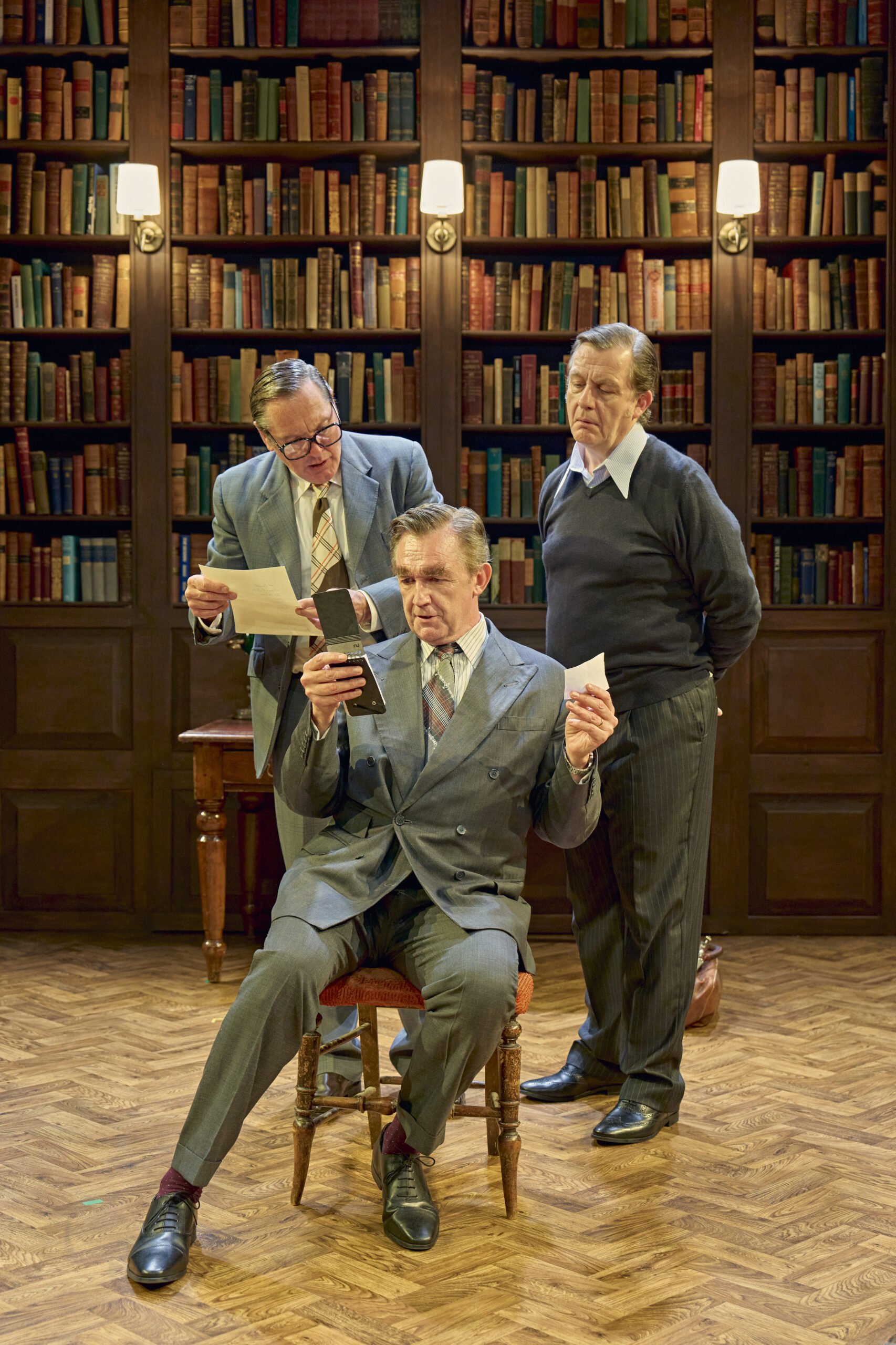
Violet (Cassie Bradley) and Leonard (Barney White) are spending the night in a Bath hotel during a 1940s bombing raid, He is about to leave for the Far East as a conscript and is terrified. Fast forward to the 1960s, when they meet in a park and we learn that they didn’t have a happy ending together (no spoilers). Then we join them in their eighties when she visits him in his bachelor Luton home. The title fits this poignant play perfectly.

The Day When We Were Young, which dates from 2011, runs for just 85 minutes and is, in its way as elegant as a Mozart concerto with its three “movements”, solo lines and tempo changes.

Both actors catch the awkwardness and hesitancy of these taut interchanges and they are very good at strained silence and at one nice moment near the beginning when they jump up and down in the bed in sheer joy. Director James Haddrell knows exactly how to develop the required chemistry in a simple but powerful two hander.

In the final scene they have convincingly aged 60 years. They move with well observed, careful slowness. Barney White’s Leonard painfully repeats himself a lot and clearly has the beginnings of dementia as well as declining physical health. As Violet, Cassie Bradley – who, unlike solitary Leonard has enjoyed a successful, happy life – struggles to open a packet of Jaffacakes and to text to her daughter on her Nokia phone. Even their voices are modulated differently. It is fine, moving acting.

Pollyanna Elston’s design delights too. The window shatters during the air raid and it’s achieved in a low-tech but effective way as are the two scene shifts, managed by the actors, which convert the bed into a park bench and then into Leonard’s sofa. And Aidan Good has done well with the sound – from escalating, whining explosions to the distant sound of children playing in the 1960s to the gentle patter of relentless rain, every inch the “pathetic fallacy”, in the final scene.

This is impressive, compelling theatre and well worth catching. It is good moreover to see Greenwich Theatre getting out and about. This is the first show to be staged anywhere other than at its home venue.

One Day When We Were Young by Nick Payne at Park Theatre

26 Feb – 22 Mar 2025

Produced by Greenwich Theatre

BOX OFFICE https://parktheatre.co.uk/event/one-day-when-we-were-young/

Cast

VIOLET | CASSIE BRADLEY

LEONARD | BARNEY WHITE

Creative Team

WRITER | NICK PAYNE

DIRECTOR | JAMES HADDRELL

DESIGNER | POLLYANNA ELSTON

LIGHTING DESIGNER | HENRY SLATER

SOUND DESIGNER | AIDAN GOOD

STAGE MANAGER | CORA PARKINSON

PRE-PRODUCTION PHOTOGRAPHY | SIMON HILDREW

PRODUCTION PHOTOGRAPHY | DANNY KAAN

VIDEOGRAPHY | ADAM NIGHTINGALE

GRAPHIC DESIGN | TOM MANN (GHOSTLIGHT

Review first published by LPTM: https://www.londonpubtheatres.com/review-the-day-when-we-were-young-by-nick-payne-at-park-theatre-26-feb-22-mar-2025

After Life

Tower Theatre until 08 March

Star rating: 3


You have to hand it to the Tower Theatre Company. The range of what they produce is impressive – probably the most varied, diverse and eclectic programming of any theatre in London. After Life by Hirokazu Kore-edo, adapted by Jack Thorne and directed by Alexander Kampmann is firmly in the tradition of their doing something pretty different rather competently.

The premise is that we’re in what the Catholics used to call “limbo”: a place where the dead go immediately after death for sorting. But this is not about God, religion or judgement – other than each individual’s own about his/her future. Instead each person has to choose a single memory to be reconstructed and re-enacted by the resident “staff” and then it, and only it, will be carried into permanence by the person who owns it. The ambience is clearly Japanese with a huge transparent, red full moon (set design by Angelika Michitsch) with lots of autumn leaves and cherry blossom.

It’s poignantly autumnal and fairly thoughtful even though it’s theatrically well off-centre. Moreover. there are several fine performances amongst this cast of eleven. The five staff have an air of melancholy about them because, businesslike and kindly as they are, they have each failed to find an appropriate memory so they are stuck where they are. Then Romain Mereau’s character discovers he has a connection with one of the newly dead and it gives him the lift he needs – it’s sensitive, intelligent, imaginative acting. And Jess Shiner, whose character (a young death) is ebullient and inappropriate provides lots of enjoyable dramatic contrast.  James Taverner is moving as Hirokazu, desperately missing his wife, and Katie Smith is strong as the stereotypical staff member who strides about bossily.

After Life is a wordy play and won’t be everyone’s cup of tea but it  has its moments. There’s humour there too because Jack Thorne has these people speaking as casually as if they were in an office and the incongruity of that is quite fun in places.

When I arrived at Bishop Otter College, Chichester to train as a teacher in 1965 all I knew about Ibsen was Grieg’s Peer Gynt music. I hadn’t done English A Level either. That’s a long story – all explained in my 2024 book, All Booked Up (Amazon and via bookshops if you’re interested). But back in 1965 I opted to do main course English which is what led to my becoming an English teacher. At Bishop Otter “English” meant literature in English, including translation. Thanks Miss Marjorie Hiller for opening the Ibsen door for me: You were truly inspirational.

Thus I first read Hedda Gabler – and saw a production not long after – in a classroom at Bishop Otter and I still have my old Una Ellis-Fermor, Penguin Classics translation, annotated as we went along. This I’ve just reread alongside the Patrick Marber version which the National Theatre commissioned and staged in 2016 with Ruth Jones in the title role – a production I saw and reviewed. I’ve lost count of the number of times I’ve seen Hedda Gabler. It must be at least six.

Hedda, the daughter of the famous General Gabler, has married Jorgen, an enthusiastic but run-of-the-mill academic and they’ve just returned to their new home in Oslo (called Kristiania in 1890 when Ibsen wrote the play) after a six month honeymoon/research trip. She has married for status rather than love and clearly isn’t happy. She is reluctantly, but not openly, pregnant, detests Jorgen’s beloved aunt, despises her “school friend,” has history with two male visitors and treats the family retainer with patrician contempt. The obsession with her father’s pistols signals, almost from the beginning, that this can’t possibly end happily.

Rereading the text now, after a long absence from it, I’m struck by Ibsen’s long elaborate stage directions which Ellis-Fermor gives us at length and, I presume, in full although I can’t read the original in Dano-Norwegian to check. He is effectively both directing and designing the play in great detail. He must have been both a man of his time and a control freak. Marber, of course, like other writers of more recent versions (including Cordelia Lynn’s 2019 take on it, Hedda Tesman, for Chichester Festival Theatre) strips all that away and leaves the director and designer some space. He loosens the setting too. We’re in a “A city in Europe” in the present. The trouble with that is the inevitable anachronisms. You can’t have characters debating whether to use first names one minute – which seems about 50 years out of date – and commiserating with parking problems the next.

Plays, however, as I used to remind my students in almost every lesson, are meant to be seen not read. The text is dead until actors bring it to life. Nonetheless it is worth studying the text of any worthwhile play in order to consider the nuances and, if it’s something which has to be translated (Cf Chekhov and Strindberg) then it’s illuminating and sensible to read more than one translation.

And I never read a play text without thinking of Sylvia Young, she of Sylvia Young Theatre School fame. She once told me in an interview that, as a voracious child reader, she had soon read all the novels in the junior library but was regarded as too young to be allowed access to adult ones. So she read plays because they were the nearest thing she could get to novels and nobody noticed the “unsuitable” content.  And that was where her interest in theatre began.

So read a play or two for an occasional change. It’s quite rewarding.

Next week on Susan’s Bookshelves: The Mother Goose Mysteries by Tim Devlin 

Mao Fujita plays Mozart part 1

Royal Festival Hall, 02 March 2025

It is a privilege to hear such an assured performance of Mozart’s final piano concerto (no 27 K595), probably written just months before the composer’s death in 1791.

Mao Fujita, still only 25, has an exceptionally sensitive technique and took a delicate approach to the first movement especially in the expansive cadenza. He then gave us an expressive larghetto with lots of nicely done musical dialogue especially from the cellos who were seated next to first violins, with double basses immediately behind them for this concert. The allegro came with an unusual, charismatic blend of intensity and insouciance particularly in the passages where the piano is counterpointed with the wind and in the impressive cadenza  which I’ve rarely heard played with quite so much rubato.

With Giedre Slekyte on the podium for her first concert with the Philharmonia the afternoon began with Kodaly’s Dances of Galanta and ended with Brahms’s Symphony No I both of which require larger forces and neither of which was quite as successful as the Mozart.

She has a bold conducting technique using lots of circular left hand movement and wide armed gestures as well as signalling with her fingers. The start of the Kodaly – which is not an obvious concert opener anyway – was awkward and although it soon settled with lovely string sound  in the Andante maestoso and lots of gypsy excitement, the tempo changes and the joins between dances were not always seamless.

Slekyte – expansive conducting and plenty of colour –  leaned heavily on the dynamics in the first movement of the Brahms which packed it with more tension than it often gets but the tempo change was ragged. The beautiful oboe melody (Timothy Rundle in fine form) in the Andante was neatly controlled and movingly picked up by Philharmonia leader, Zolt-Tihamer Visontay who, incidentally, seemed to be even more alert than usual in this concert. The orchestra was playing together very well by the Adagio which got a poised opening, incisive horn and flute solos along with plenty of Brahmsian grandiosity with some pleasingly judged contrasts.

I had an unusual experience at this concert in that I took with me, as my plus one, a septuagenarian friend who had never before been to an orchestral concert and knew none of this music. She enjoyed it a lot and that means that the performance was a great success in every way that matters, a few flaws notwithstanding. It is essential, given the parlous state of classical music in this country, that we attract and please new audiences and, QED, it can be done without dumbing down.