Press ESC or click the X to close this window

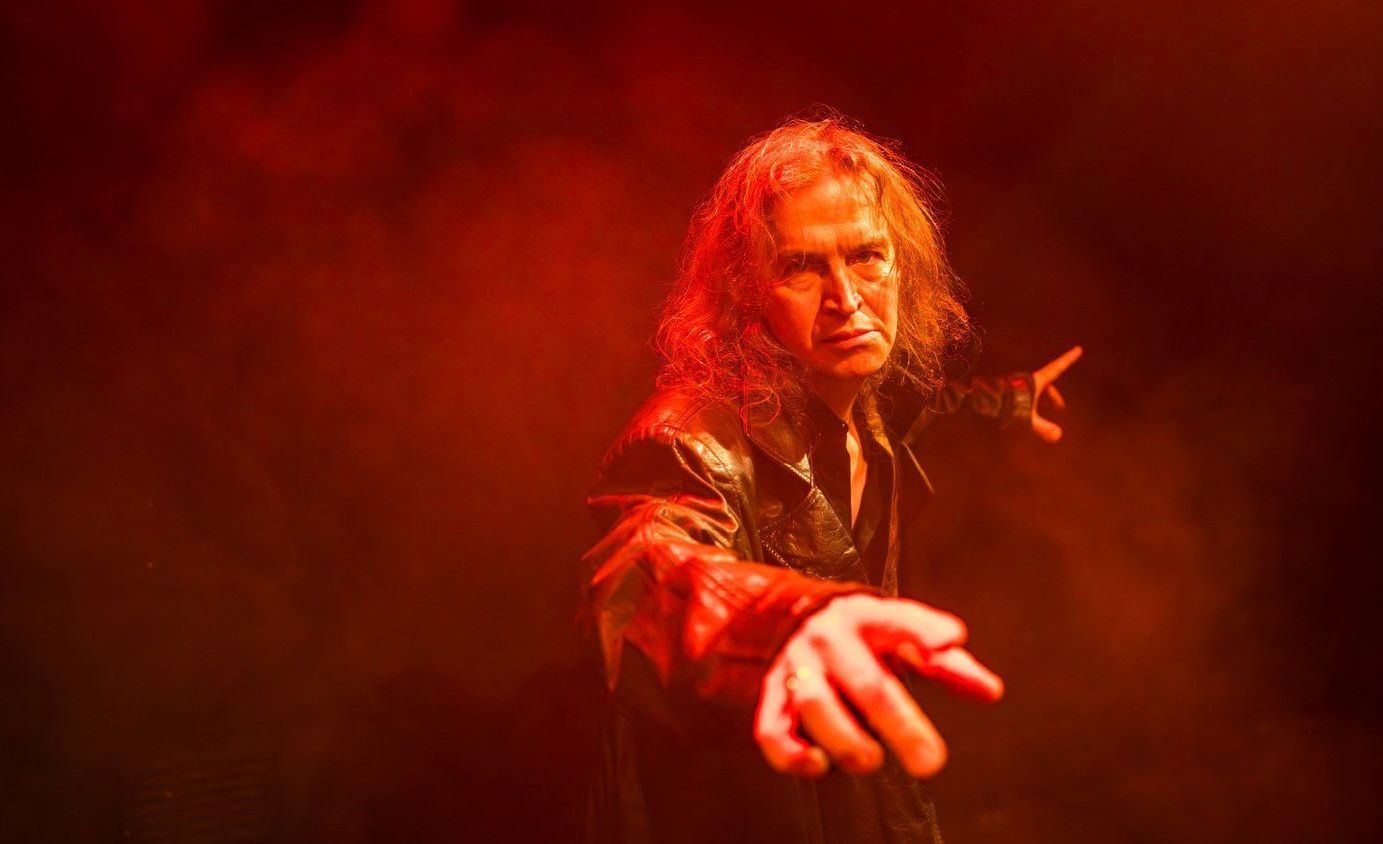
Folkestone Symphony 09 November 2024 (Susan Elkin reviews)

Folkestone Symphony

Holy Trinity Church, Folkestone

09 November 2024

Conductor: Rupert Bond

Viola: Robin Ashwell

Folkestone Symphony, more formally known as Folkestone and Hythe Orchestral Society, chose a hugely ambitious programme for this concert but, by and large, they carried if off with aplomb.

We began with Listz’s Les Preludes which opens with some promising, pizzicato chords, perfectly timed under the baton of Rupert Bond, who has recently celebrated 10 years with the orchestra. Full or colours and moods, it’s not an easy work to deliver but Bond found lots of drama with some excellent heavy brass moments in the storm – resonating well in the lofty acoustic of Holy Trinity. The dramatic cymbal clashes at the end were fun too.

Thence to Arnold Bax’s 1921 Phantasy for Viola and Orchestra. Written for Lionel Tertiss, it was originally called a concerto which – three movements played attaca – it clearly is. It was, I suspect as new to the majority of the players as it was to most of the audience. Robin Ashwell, violist in the Sacconi Quartet, played it beautifully, leaning on all the mellow folksiness that the piece is full of. The lento section – with viola, horns and lower strings – was particularly lovely with Ashwell presenting plenty of lyrical, tuneful Irish flavour. Bax, apparently was an enthusiastic hibernophile despite being born in South London.


And so to the Symphonie Fantastique which requires massive forces and barely fitted into the space. As it was the double basses were tucked under an arch, almost in a side chapel, and the percussion section was placed right back on the other side in a side aisle. The tubular bells were behind the raking in the chancel so that they were invisible to the audience. Yet, somehow, Bond held it together through those five gruelling movements, parts of which always sound to me as if they were written a century later rather then in 1830, just six years after the composition of Beethoven’s ninth and last symphony.

Although the upper string sound was wispy in places, especially at the beginning – even five desks of first violins was not enough – there were some terrific moments in this performance.  The exuberant valse was as lilting as it should be, with some finely judged rubato, dynamic shading and outstanding work from principal flautist, John Hall. And the adagio was splendid with some delightful, very exposed, playing from Hilary Sell on cor anglais.  Assisted by the acoustic, Bond made the end of the adagio with the timp rolls sound really quite creepy as this extraordinary work gets ever more “fantastique”. Next, in the allegretto tubas were produced from their hiding places in the chancel and we bounced into the symphony’s increasing eccentric originality with some good bassoon work.

Berlioz regarded this, his most famous work, as a piece of programme music and left detailed notes which are not, in my view, always helpful. He does, however, explain the madness of the final movement which is a “Dream of a Witch’s Sabbath”. And what fun Folkestone Symphony had with the funeral bells, terrifying piccolo and screeching chords, By then the orchestra was fully warmed up and playing very well indeed – with no sign of the tiredness which they must, surely, have felt at the end of this manic marathon.



The Dark Room

Angela Betzien

Directed by Katia Elsianli

Tower Theatre. Stoke Newington


Star rating: 3.5


An intriguing and compelling play, The Dark Room takes us to a motel room somewhere in Australia’s Northern Territory where three pairs of people intersect – mostly across the boundaries of time and space.

First comes Anni, a social worker (MK, Melissa Kathryn, Rose) who is trying to help a deeply troubled “feral” child, Grace (Eloise McCready). Rose gets the sensible, not-quite-maternal but kind and patient Anni pretty convincingly. And McCready gives a fine performance, shouting and being as provocative as she knows how and on her knees  childishly begging to be taken home the next. The details of her past which gradually and tantalisingly emerge are extremely disturbing. Dogs and blood are just two of the themes which thread through this 95 minute, one act play.

At a different time the room is used by Stephen, a policeman (Matt Tylianakis) on his way home from a wedding with his wife Emma (Sarah Tiplady). We watch the unfolding of their volatile relationship, partly predicated on her early-stage pregnancy and his fondness for booze. Both are fine and sensitive actors. And all the time they’re talking Anni and Grace are silently and unobtrusively, occupying the space engaged on activities which reinforce their characters. Then we switch back to Anni and Grace while Stephen and Emma retreat into silence. Eventually it transpires that Stephen and Anni know each other professionally so the two narratives are tangentially linked.

Finally – and, arguably, unnecessarily because it dents the narrative cohesion – come Graig (Stephen Grist), a policeman whom Stephen knows. He is haunted by the memory of Joseph, a criminal with whom he feels bonded but has been instrumental in getting convicted. And this part of the play feels bolted on although the two actors do a good enough job.

Stanley Piper’s sound design supports all this rather well – tense ticking at several points, low level buzzing and sounds which connote Australia effectively. There are, however, too many blackouts which feel clumsy.

This play is a brave and ambitious choice for a non-professional company although there is a lot of talent at Tower Theatre and in general they carry The Dark Room off successfully. I was saddened, though to see only 14 people in the audience. At one point I thought the cast of six was going to outnumber us. I suppose it’s because the play is not well known, although it’s published by Nick Hern books, and some people are reluctant to try something they know nothing about. I think it’s a play which deserves more outings so well done, Tower Theatre for running with it.

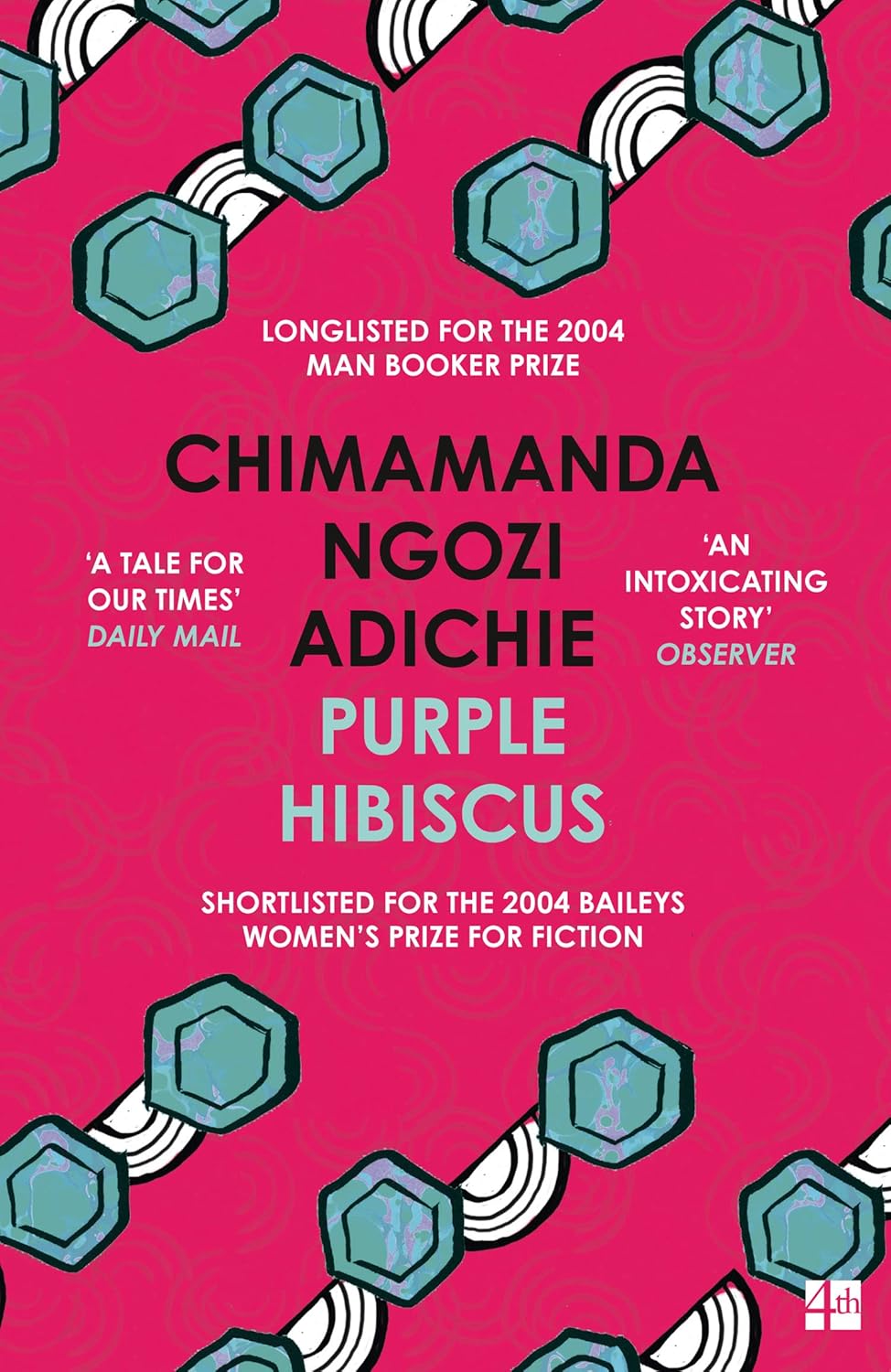
I first read Purple Hibiscus not long after its publication in 2004. Then, because it had found its way onto one or two GCSE specifications, in 2010 I was commissioned by Philip Allan Updates (later taken over by Hodder Education) to write a book-length study guide. And that, of course, meant intimate knowledge of the text rather than casual acquaintanceship. Rereading it now, I am struck more than ever by its poignant power and the number of themes and issues it ranges over – a pretty extraordinary achievement for a debut novel, which I don’t think has dated at all in the twenty years since its publication.

The narrator, Kambili, is the younger child of a prominent, very wealthy and staunchly – bigotedly –  Catholic Nigerian (Igbo). We know from the first page that beneath the religiosity and altruism that this is not a happy home.  Eugene (“Papa”) is guilty of appalling domestic abuse, the details of which make the soles of my feet go clammy so I’m not going to describe his actions here. Yet, Kambili almost worships him and is totally absorbed in his brand of Christianity because he’s a very complex character rather than a straightforward monster. He is a more generous financial supporter to hundreds of people than even his own family realises and is deeply respected in his community. He genuinely believes that ALL his actions are the will of God.

The novel, which eclectically but seamlessly discusses colonialism, imposed religion, the significance of language, political corruption, education, adolescent sexuality and a lot more along with ruthless dictatorship within family life, opens on the day when things fell apart. That’s a reference to Chinua Achebe’s most famous novel which took its title from WB Yeats. Chimanda Ngozi Adiche was (and is) richly influenced by the work of the much older Achebe who died in 2013. It is Palm Sunday when the falling apart occurs. Jaja, Kambili’s older brother, finally rebels by refusing to take communion which results in his father hurling a heavy missal at him. It misses Jaja but breaks all Mama’s figurines on the étagère – which are symbolically significant. Thereafter three quarters of the rather neatly structured novel is an expositional flashback working its way back to that momentous Palm Sunday and what happened thereafter.

Adiche is very good at contrasts to draw attention to what she wants you to notice. When Kambili and Jaja go to stay with Papa’s widowed sister Aunty Ifeoma, who is a university lecturer, they find three cousins who are encouraged to explore ideas and respectfully express views. They laugh a lot but live very humbly. The university is full of corruption and rebellion. Aunty Ifeoma’s job is under threat because she speaks her mind. She and her family live in the sort of make-do and mend poverty, the like of which Kambili has never before seen or imagined. But there’s real happiness there. The same contrast comes through the family of Ade Coker, editor of the newspaper Papa owns although he is denied the positive ending which Aunty Ifeoma gets.

The first time I read this novel I simply couldn’t imagine how  Adiche could end it and the denouement took me by surprise so of course I’m not going to spoil it here for readers new to Purple Hibiscus. It is, actually, quite clearly flagged up but I doubt you’ll notice at first reading.  Suffice it to say that we eventually get tragedy seasoned with muted positivity.

There is nothing overtly didactic about this fine novel. It’s a well told, warmly accessible story, compellingly presented but, my goodness, there’s a lot there if you look for it and take the time to think about it.

Next week on Susan’s Bookshelves: Offshore by Penelope Fitzgerald

Photograph by Mark Senior

‘A gloriously joyful affirmation of everything that’s enjoyable about theatre’ ★★★★ ½

This is the third time I’ve seen this show and, like fine wine, it just goes on getting better despite only one cast member (David McKecknie) having done it before. As in Shakespeare’s plays, the material in Gilbert and Sullivan operas is so strong that it bounces back whatever you do it – as Sasha Regan understands better, almost than anyone. Goodness knows what WS Gilbert, known for intractable preciousness, would have thought of an all male cast but for 2024 it’s a gloriously joyful affirmation of everything that’s enjoyable about theatre.

The opening white clad male chorus suggests a Victorian gymnasium and is very muscular. Lizzi Gee’s choreography is one of this production’s great strengths as the cast leap about and form arresting tableaux. From this, the principals emerge: Robert Wilkes as Ruth, the 47 year old maid of all work, in the first instance. Wilkes makes her very funny, pegging out washing with incongruous asides as she explains in song how Frederic (Cameron McAllister) came to be an apprentice pirate but there’s rich pathos there too. When we get to the Major General’s daughter’s daring to paddle on the beach the cast are simpering, fainting, grinning, enjoying innuendoes and never still which is one of the many things which makes this show so electrifying. Eventually the posse of daughters is reduced to a plausible five including delicious Mabel (Luke Garner-Greene, good in his first professional job.)

In the middle of The Pirates of Penzance there’s a magical moment when Gilbert gives in to Sullivan, who was famous for his church music among other things, and allows him a short, unaccompanied anthem. The words of “Hail Poetry” are ridiculous but the music is glorious harmony. Some misguided directors try to create gratuitous comedy out of this but Regan is too wise for that. She has the whole cast turn forwards like a choir and sing it standing absolutely still while, Giannis Giannopoulos (MD who accompanies excellently from piano throughout) conducts. And they sing it superbly. Hurrah. 

Tom Newland gives us an engaging and attractive Pirate King but he’s young for the role and there isn’t (yet?) enough bass timbre in his voice although he hits every note. Lewis Kennedy is splendid as the Chief of Police – a gift of a part – although it’s not easy to make it feel original given how well “A Policeman’s Lot is Not a Happy One” is known. There’s a lovely double chorus, too, when the policemen are singing from the stage right aisle next to the audience which makes it feel nicely immersive,

In some ways though, it’s the ensemble work which makes this show zing. I often comment on slickness but this lot take it to another level. And watch out for Boaz Chad who drew my attention every moment he was on stage with his evocative body work and talkative eyes.

Regan De Wynter Williams Productions present

a new production of Sasha Regan’s

THE PIRATES OF PENZANCE at Wilton’s Music Hall

Tuesday 29 October to Saturday 23 November

Box Office https://wiltons.org.uk/whats-on/the-pirates-of-penzance-autumn24/

Director Sasha Regan

Cameron McAllister (Frederic). Recent West End credits include Back to the Future (Ensemble/cover George McFly). Love Never Dies, Asian Tour (Ensemble/cover Raoul).

Luke Garner-Greene (Mabel). A recent graduate of Mountview, making their professional stage debut. Roles in training include Charley Kringas in Merrily We Roll Along.

Lewis Kennedy (Sergeant of Police). He returns to Wilton’s Music Hall and the company after playing the title role in Sasha Regan’s All-Male The Mikado in 2023.

David McKechnie (Major General). Recent credits include Standing At The Sky’s Edge (Sheffield Crucible/National Theatre/Gillian Lynne Theatre), Flowers For Mrs Harris (Riverside), HMS Pinafore, The Pirates of Penzance and The Mikado (Sasha Regan productions)

Tom Newland (Pirate King). A rcecent graduate of the Royal Academy of Music, making his professional stage debut. Roles during training include The Baker in Into The Woods and Charles Guiteau in Assassins.

Robert Wilkes (Ruth). Recent roles include Gus and covered and played Old Deuteronomy in Cats, Chitty Chitty Bank Bang (West Yorkshire Playhouse/UK tour).

with Thomas Griffths (as Samuel), Joe Henry, Kirwan Kaanan, Thomas Alsop Aaron Dean (as Sisters)

and an ensemble featuring Joshua Molyneux, Patrick Cook, Samuel John Taylor, Alfie French, Boaz Chad, Davo Storey.

Creative team: Director Sasha Regan, Designer Robyn Wilson Owen, Choreographer Lizzi Gee, Lighting Designer Ben Bull, Musical Director Ioannis Giannopoulos, Musical Supervisor Richard Baker, Associate Choreographer Lee Greenaway, Casting Adam Brahm, Producers Regan De Wynter Williams.

Review first published by London Pub Theatres Magazine: https://www.londonpubtheatres.com/review-the-pirates-of-penzance-at-wiltons-music-hall-until-23-november

REVIEW: THE STRANGE CASE OF DR JEKYLL AND MR HYDE at Bridge House Theatre, Penge 22 Oct – 2 Nov 2024

Susan Elkin • Oct 30, 2024

Photography credit: Tom Godber

‘Paul Winterford’s central performance is riveting’ ★★★ ½

Let me come clean. I have never liked Robert Louis Stephenson’s 1886 novel and the many adaptations I’ve seen over the years have done little to change that. Of course I understand that it’s a philosophical exploration of the “profound duplicity” of human nature but, on an entirely personal level, I struggle to relate to anything remotely fantastical. I have exactly the same issues with Frankenstein.

That said, this British Touring Shakespeare production is as decent a crack at the old chestnut as I’ve seen anywhere. Adapted by David Hobbs (who also directs) and Andrew Hobbs, it is remarkably faithful to the novel and much of the dialogue is pure Stephenson. The trouble with that is that it sometimes feels slightly stilted for a 21st century audience, especially in the first act. However, it is good to see it done firmly in period for once, rather than pulled in “topical” directions.

Paul Winterford’s central performance is pretty riveting. He gives us a deliberately understated Jekyll, tossing a coin and ruminating. The first transformation scene, when it comes – all stage smoke and coloured lighting – meets all gothically dramatic expectations. Winterford writhes, yells, goes into paroxysm and exudes amoral malice and terror.

Tom Thornhill as Utterson and Megan Carter as Cordelia Carew make a good fist of presenting the contrasting reality as they gradually discover and reveal the horror of Jekyll’s dual personality. They are rather good at flagging up the gently developing affection between them too.

Among the support cast, Maximillian L’Olive excels as the gravelly rough-at-the-edges but punctiliously conscientious Inspector Newcomen. And I’d like to have seen more of Jessamy James who plays Elsie Baker the woman who witnesses Hyde murdering Carew. I’ve seen her at work before and she’s an intelligently sensitive actor. I see no sense, however in making the housekeeper Mrs Poole (Meghan Louise Taylor) into a comic character. Taylor is quite good at it but it feels incongruous in what is actually quite a serious piece.

Underneath all this is Alistair Smith’s original, atmospheric music: mostly piano music in the Victorian “salon” style, it works well.

It’s a patchy production – some of the acting is a bit wooden and then it feels wordy – but there are definitely things here to enjoy, whether or not the concept is your cup or tea.

THE STRANGE CASE OF DR JEKYLL AND MR HYDE Facscimile Productions, British Touring Shakespeare

Directed by Andrew Hobbs

Bridge House Theatre, Penge

Box Office https://thebridgehousetheatre.co.uk/shows/the-strange-case-of-dr-jekyll-mr-hyde/

Conductor: Mark Elder

A concert presenting three quite different works starts with Ravel’s Mother Goose (1911), which is, of course, full of orchestral colour, most of it pastel and very French in tone. Conductor Mark Elder creates a pleasing balance between double basses and wind, and there’s strong work from contrabassoon player Simon Estell, whose instrument represents the Beast in conversation with Beauty in this medley of fairy tales. The “pecking” strings are effective, too, with the woodwind bird calls.

Next up is James Ehnes with Bruch’s second violin concerto (1877). Unlike the composer’s earlier first concerto, an instant success which has remained popular for over 150 years, this one gets very few outings. And that is a pity because it’s full of melodic interest and is, at this concert, given pleasing treatment by Ehnes and Elder who are clearly happy working together.


Ehnes makes the melodies sing out with warmth in the opening adagio and gives us a lovely last note. The middle movement is, unusually, entitled “Recitative”, in which Elder provides incisive, measured orchestral sound in dialogue with the soloist. The finale combines lyricism with well-managed musical fireworks delivered at virtuosic high speed by Ehnes. His encore – Sonata Number 3 by Eugene Ysaye – enables Enhes to demonstrate his considerable skill at double stopping, of which there isn’t a great deal in the Bruch.

After the interval comes the work by Richard Strauss, which gives this concert its title: Ein Heldenleben (1898). It’s an almost outrageously huge and flamboyant piece requiring, among other things, eight horns, five percussionists, two harps, five trumpets, three bassoons and batteries of strings. It’s a loosely autobiographical piece expressing, in six sections, the 34-year-old composer’s views about his own life and life in general.

Highlights in this performance include the sumptuous, almost sensual lower string sound in the second section and the frisson of the three off-stage trumpets (they slip off a few minutes before), which herald the dramatic Des Helben Friedenswerke part. There is a lot of work for solo violin in Ein Heldenleben delivered here with verve by LPO leader Pieter Schoeman, whose “voice” evokes Strauss’s mercurial wife Pauline. Also noteworthy is the fine cor anglais playing (Max Spiers) in the final peaceful resolution and the glorious ending, which Elder tapers away perfectly.

Travelling from wafty French impressionism to Strauss-ian grandiloquence via late German romanticism doesn’t make much narrative sense, but each item in this concert is enjoyably played in its own way.

Reviewed on 25 October 2024

THIS REVIEW WAS FIRST PUBLISHED BY THE REVIEWS HUB https://www.thereviewshub.com/london-philharmonic-orchestra-a-heros-life-southbank-centre-london/

I am working my way through the Booker Prize shortlist. This is something I routinely did when I was teaching English so that I could talk to the students about what was current. I still do it most years because it’s often a way of finding authors who are new to me but whose work I find like very much. This is how, for example, years ago I discovered David Lodge and the late, much-missed Carol Shields. I was also the only person I knew who had actually read The Satanic Verses, several months before the appalling Fatwah was announced against its author, Salman Rushdie.

Anyway, this year I have just got to Creation Lake and it’s a powerful novel. An unnamed narrator, using the fake name of Sadie Smith, is a professional, freelance spy and very good at what she does. Her current job in a remote part of western France involves penetrating a fairly peaceful group of eco-activists, the Moulinards, who live in a colony. She is tasked to the  secret setting up of the assassination of a politician who is scheduled to visit a nearby town. Her responsibility is the ground work. She is not the assassin.   That involves getting into a relationship with a man whose family own a house in the area and whose close friend leads the Moulinards – and a lot of very convincing acting. She’s American but speaks several languages including French.

The philosophy of the Moulinards is driven by the thoughts and discoveries and  of Bruno Lacombe, a recluse who sends them emails. “Sadie” hacks into these and is gradually drawn into his views about how homo sapiens and homo erectus may have interacted, overlapped and interbred with the Neanderthal. Of course caves were vital to all these people and that’s what the Moulinards are trying to prevent the destruction of, because the government plans to despoil some ecologically and anthropologically important subterranean lakes.

It’s fascinating, cerebral, impeccably researched stuff and I was intrigued to see how Kushner would end it. Surely this Villanelle-like woman wouldn’t succeed in her aims and then just drive away to safety and her next assignment? What actually happens at the placard-waving demonstration is quite neat but “Sadie” is changed by it all and chooses a denouement for herself which I didn’t see coming.

A long and meatily absorbing novel, Creation Lake is well worth reading.

Next week on Susan’s Bookshelves: Purple Hibsicus by Chimamanda Ngozi Adiche

Philharmonia

Emilia Hoving

Royal Festival Hall, Southbank Centre

27 October 2024

Emilia Hoving, one of the most fluid and manually balletic conductors I’ve ever watched, kicked off with a delightful performance of Grieg’s Peer Gynt suite which, familiar as it is, she managed to make feel enjoyably arresting. Morning was appropriated sensitive with pleasing horn work, she coaxed an evocative grey sound from the muted strings in Death of Asa and the lilting pizzicato in Anitra’s Dance was elegant. And when she got to In the Hall of the Mountain King Hoving wisely left herself plenty of scope by starting very soft and slow and delivering the whole with humour.

Outi Tarkiainen’s Mosaics (2024) was a disappointment. I’m an unrepentant traditionalist.  I do not go to a classical music concert to watch a wildlife film – a very dark and grainy one at that.  Yet a film of an endangered, bottom-trawling fish was imposed on us for the full 15 minute duration of the piece. The disparate, melody-free music meanwhile – from which we were thus distracted –  featured tubular bells, a violin solo, lots of remote string harmonics and strange percussion effects which I couldn’t always identify. The trumpet fanfares and cymbal clashes towards the end did at least signify that it was nearly over.  The applause at the end was polite but far from rapturous

Part of the Philharmonia’s Nordic Soundscapes season, the concert ended with a splendid account of Sibelius 2 – the finale of which moved my plus one to tears which is always a good sign. Hoving, a Finn so this music is in her blood, created an electric sense of expectancy right from the start with those quivering strings and joyfully worked up to the many mountainous climaxes. There was some delightful bassoon playing against the double bass pizzicato in the andante. Hoving has a knack of silently “orchestrating” the rests and pauses so that the next entry slides in seamlessly. And as for the Finale, well, it was powerful, warm and intense. The woodwind melody with solo cello was very beautiful and the wonderfully bombastic trombone writing at the end was delivered with all the fortissimo panache it needs.

It almost made up for the fish.