Press ESC or click the X to close this window

Kidults (Susan Elkin reviews)

Kidults! The Musical continues at the Bridewell Theatre until 26 October 2024. The show is also playing at the Courtyard Theatre from 29 October to 2 November and at 229 London from 4 to 6 November.

Star rating: one star ★ ✩ ✩ ✩ ✩

Mark Tunstall’s poems about adolescence, school and growing up make a rather uneasy two hours of plotless theatre.

There’s some dialogue, spliced together with musical solos, duets and ensembles based on the words which are quite poignant and witty in places. Imagine a second-rate version of TS Eliot when he was in Old Possum’s Book of Practical Cats mode.

Lulu Chen is the composer but some of the songs have been composed by others which may, in part, account for the unevenness and lack of cohesion.

This was the first-ever performance of this show so I won’t dwell on the clunky cueing, the ragged entries to many numbers and the ensemble singing which wasn’t in tune. Presumably, these things may improve as the show beds in …

Read the rest of this review at http://musicaltheatrereview.com/kidults-the-musical-bridewell-theatre/

The Worst Witch

Adapted from Jill Murphy’s original books by Emma Reeves with music by Luke Potter

Tower Theatre

Directed by Ruth Sullivan

 Star rating 4

When Jill Murphy’s first book about an academy for witches was published in 1974, my children were aged two and minus two. JK Rowling was nine. No wonder these books featured prominently in our household and, presumably, in hers where the germ of an idea must have been forming. Emma Reeves’s  sparky adaptation enjoys a bit of amiable sideswiping to the effect that these engaging books came long before the first Harry Potter title in 1997.

And it’s in good hands with Ruth Sullivan and her fine cast of eleven along with a live five piece band, led,  at the performance I saw, by Adam Pennington.

Of course Hecate Hardbroom is a gift of a part and Janet South does it beautifully. She looks cross and unsmiling and exudes chilly authority until she is finally led by events to thaw a little. And what a well observed stereotype that is: The warm, slightly dappy headmistress (Miranda Cheeseman) all sweetness and light while her fearsome deputy actually runs the place and does the dirty work. Cheeseman gives us a fine performance too especially when she has to double as her dastardly twin sister – cue for lots of wigs and rather neat video work to present them together.

The new kid on the block at Miss Cackle’s Academy is Mildred Hubble in whom, as required in all the best school stories, Laura Fleming finds delightful naivety, decency and ultimately the strength to triumph. It’s a strong performance and, like, the other five “girls” in this production she’s satisfactorily convincing as an adult playing a child.

The really outstanding work, however, comes from Abi Cody as the sneering, bitchy Ethel Hallow. She never stops being visibly disdainful even when she’s singing or dancing. It’s a wonderfully sustained piece of work with engaging head twitches and knowing looks at the audience. She even morphs into a snail. Cody is a secondary school drama teacher. I hope her students have been to see her in action because this is exactly what teachers should be doing: ably demonstrating, in their own lives, the skills they teach,

Luke Potter’s music ranges over lots of styles and genres. “These boots are made for witching” with angel voice oohs, rhythmic clicks and oom-pah accompaniment is fun, for example.

At one point in the chanting lesson the singing is meant to be dire as part of the narrative. It isn’t. however, always quite in tune in some of the ensemble numbers even when it’s meant to be. But I doubt that any of the delighted young audience members, many clad in colourful witchy costumes for their trip to the theatre, noticed. And the children were thrilled to be invited on stage to help with the action at the end so it was resounding, rather moving, end to a piece I thought was slightly too long but it seemed to hold the attention of the little people it was meant for.

As an adult I enjoyed the affectionate teasing of theatrical convention too. At one point Mildred’s tabby cat is pulled apart at which the audience gasps in horror. “Oh for goodness sake! It’s a puppet!” snaps Miranda Cheesman’s character at the audience. “Look – she’s been there all along!” she adds pointing to puppeteer Trinidad Prieto. It’s a witty moment.

In short this was as good a piece of community theatre as I’ve seen in a while and perfect for half term.


Academy Chamber Orchestra

Trevor Pinnock

Duke’s Hall, Royal Academy of Muisc

25 October 2024

It is a real privilege to hear a talented group of young aspirant professionals working with, and responding to, a musician of Trevor Pinnock’s gentle but inspirational calibre. As he said himself, at the end of the concert, technique is only the starting point. What matters is the development of the collective thinking which leads to musical joy. “And wherever you are in your music career, we all learn at every concert. It’s infinite” he said.

In the elegance of Duke’s Hall which has a pleasing acoustic and was almost full for this concert, we began with Brahms’s variations on a theme of Haydn. I’ve never seen double basses tucked in so tightly next to first violins and a long way from the cellos but it enabled Pinnock to draw out colourful detail which might otherwise have been lost. Moreoever, the leader of the double basses, Ahouo Werenskioid Mandan, exudes engaging musical charisma.

Pinnock, batonless and unassuming, often smiling and clearly enjoying himself, delivered all the variations with fine balance. There was delightful work from contrabassoon and the piccolo worked plenty of magic at the end of this evergreen, very satisfactory and cheerful piece.

The second work was Mendelssohn’s “Scottish”  fourth symphony and I admired the clarity of the upper strings at their first entry which is very exposed. Thereafter in the first movement there was some fine bassoon work and the modulatory passages were played with exciting tension into the storm. The vivace was then distinguished by well articulated woodwind playing, particularly from the oboe.

This adagio is arguably one of the most sublime melodies ever written and it was played on this occasion by these young people with such delicacy and intelligence that I had to blink away tears, especially when we reached the climactic horn solo: splendid playing.

The Allegro vivacissimo goes like the wind and is one of those “see you at the end” movements but Pinnock ensured that it felt precise and never rushed. The woodwind pulsing was engagingly slick and Christian Inman, on timps with hard sticks, did a good job. And again there was lovely playing from the horn in the final maestoso – right at the top of the texture, exactly as it should be.

Philharmonia

Conductor: Marin Alsop

Mezzo-soprano: Sasha Cooke

Royal Festival Hall

24 October 2024


An all Mahler concert – both Gustave and Alma –  makes an interesting programme. Mahler famously didn’t want Alma to compose but eventually gave in and her four songs (1910) orchestrated by David and Colin Matthews, sung here by Sasha Cooke, formed a fascinating centrepiece.

Cooke is adept at “acting through song”, to borrow an expression often used in musical theatre, and her vocal sound is richly arresting. The gentle ending and control in Die stille Stadt was striking as were her legato notes in Bei dir ist es traut. And I enjoyed the story telling in In meines Vaters Garten which came complete with yawns, stretches and finger wagging.

The concert had begun with a piece new to me: Blumine which was originally conceived as a symphony movement which got dropped. It’s gently lyrical piece, played at this concert with some fine string work – both that pianissimo quivering, which is so hard to bring off, and the lush sound towards the end. The trumpet melody then picked up by the flute was pleasingly brought off too.

And so, after the interval, to the real meat: Mahler’s mighty fifth symphony at the end of which I imagine Alsop and all players were exhausted because it’s a long and demanding piece given, on this occasion, exceptionally energetic treatment. There were times when both Alsop’s feet left the podium at once.

The many high spots included the contrast between the brooding passages in the first movement and the grandiose drama, followed by the richness of the lower strings in the second movement especially in the beautiful passage launched by the cellos and then picked up by the violas. The shift into 3|4 melodies and the rather otherworldy ambience of the scherzo was impressive too.

There is a film of Edward Elgar, late in life, conducting his Pomp and Circumstance March number 1. “Play this as if you’ve never heard it before please” he says, briskly, setting a cracking pace. Well, the fourth movement of Mahler 5, the famous adagietto, faces similar challenges. Alsop rose to them well in this performance coaxing some lovely harp and double bass work from the orchestra and controlling the recap with tight sensitivity. It sounded really quite fresh. Then we got a rousing resolution in the Rondo finale with especially fine work from tuba, bass trombone and timps.

All in all it was a rather rewarding concert.


Well, this one is something different. A female narrator lives with her eccentric uncle in Brittany. The short novel’s title is unequivocal. It’s a wonderfully graphic account of a reclusive, war veteran given to hoarding, gluttony and geriatric eccentricity. Some of his habits are best not read about while you’re eating – which, incidentally is how I do a lot of my reading.

Gisler is an award winning author and poet who writes in both French and German and translates between the two. About Uncle is translated by Jordan Stump, a professor of French at the University of Nebraska-Lincoln. So the English is American. Stump has won prizes for translation which makes me reluctant to criticise too assertively although I did wonder whether anyone, on either side of the Atlantic, really talks about “a pair of underwear” or maybe he’s reflecting euphemism in the original French. Moreover, I have never seen the verb “to surveil” used in English although it’s common enough in French so perhaps I’ve learned something.

Uncle eventually becomes ill and is admitted to a strange hospital which doubles as a veterinary unit – or are the characters hallucinating? And the end, when Uncle wanders away from the house on his yellow crutches and she follows him, it is moving. Gisler is a talented descriptive writer.

About Uncle (2024) is published by Peirene Press, based in Bath, a company which specialises in introducing new, shortish novels by foreign writers to a new audience. My attention was drawn to its list by a French friend (not the same one who alerted me to novelist, Valerie Perrin earlier this year) who loves the fiction produced by Peirine so much that she buys them in batches as a regular subscriber.

An interesting discovery and a refreshingly long way from Times and New York Times best sellers. Variety, spice of life etc.

Next week on Susan’s Bookshelves: Creation Lake by Rachel Kushner

REVIEW: Idle Women at Bridge House Theatre 15 – 19 October 2024

Susan Elkin • Oct 18, 2024

´Charming songs but too long` ★★★

This show is like an almond fondant in an old-fashioned box of chocolates. It’s very sweet but there’s crisp kernel at the centre of it.

During World War Two, women were hired and trained to take barges, laden with coal or other products through the canals of England because the regular bargemen were conscripted. We hear a lot about land girls but much less about these “barge girls” and it’s a story which deserves to be told.

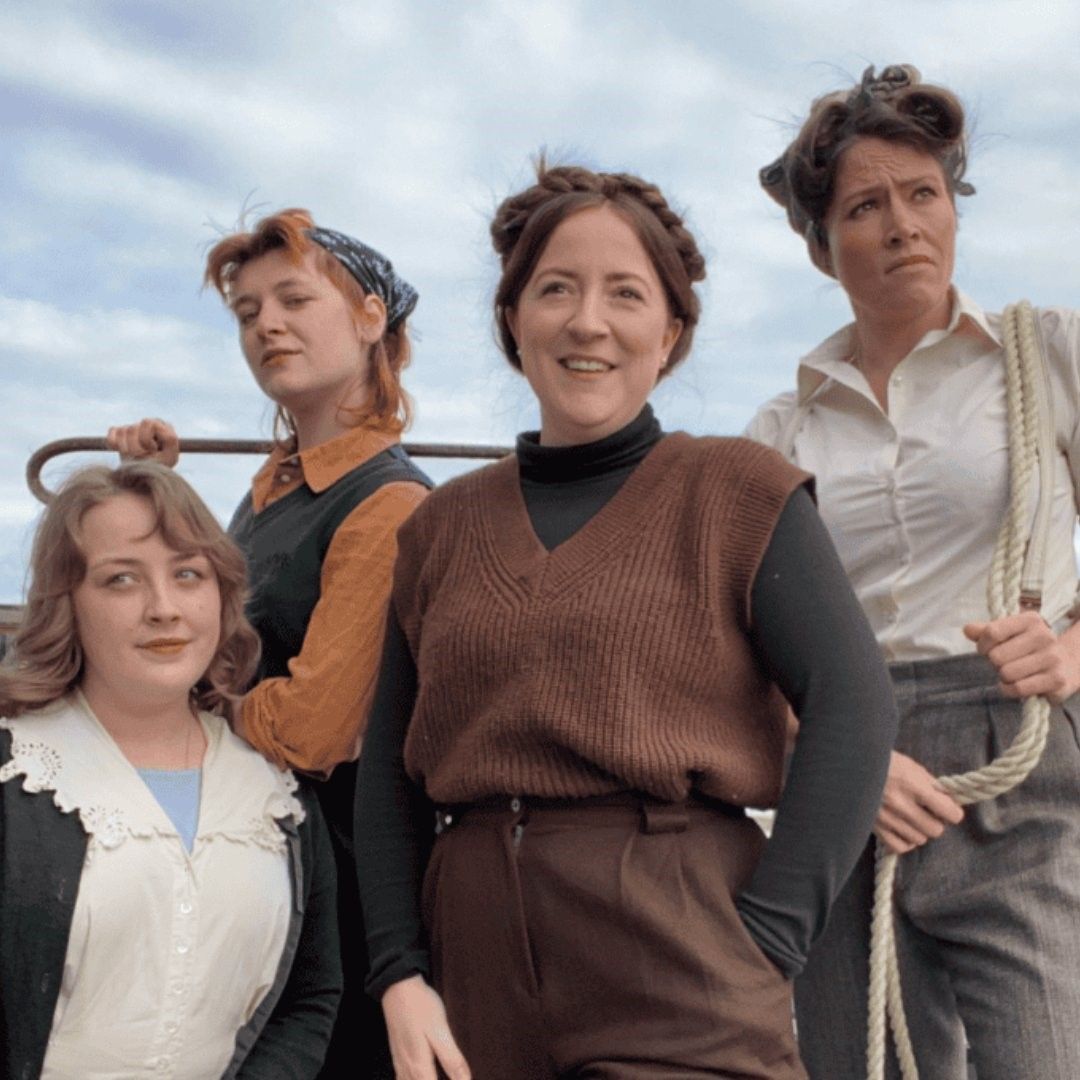
´Idle Women` is a collaborative venture by members of Busy Lizzies Theatre Company who wrote, composed, directed, produced, designed and choregraphed it. It’s effectively, therefore, a devised piece in which four women are on a coal barge. Edna (Emma Barnes) is in charge assisted by Ginny (Elizabeth Kroon). They are joined by two raw recruits, Meg (Maple Preston-Ellis) and Ruth (Catriona Judt) who, it fairly soon emerges, are a gay couple.

Most of the first half is spent exploring the dynamic between the four of them with some delightful folksy songs accompanied by two guitarists, who also play other instruments, along with a rather charming, muted trumpet which connotes nostalgia. Judt singing a lilting 3|4 quasi-music hall song “We Stroll Through the City” and then bursting into a gravelly jazz number is theatrically effective, for example.

In the second half trumpeter Aaron Coomer (good) morphs into a German soldier, the sole survivor of a shot down aircraft. Injured, he takes refuge on the barge and suddenly the plot feels like Robert Westall’s `The Machine Gunners`. Predictably, all four women are initially terrified but eventually the five of them become friends with clear but supressed “feelings” developing between Alfred and Edna, although she has to hand him over to the authorities as soon as she can.

We are dealing, obviously, with serious issues here. Gay relationships between women are not illegal (they never were) but definitely taboo in the 1940s. Alfred is “the enemy” but they learn that they have more in common with him than they would ever have expected to. Edna has a very “well bred” husband and three evacuated sons but, beneath her patrician (matrician?) authoritative manner is a yearning, vulnerable, lonely, unfulfilled woman valiantly doing her duty. So, we’re made to think about split loyalties, and understandable fears especially as Ruth is Jewish. Thus we crunch on the almond at the heart of the piece.

It’s all quite enjoyable and nicely done but there are issues with this show. Some of the dialogue is spoken too fast and not audible, even in a tiny space such as Bridge House Theatre. And the singing is dramatic (clever, neat words) but not always particularly musical although Barnes is an excellent singer. The harmony is pleasing, however, and as an ensemble they often sound a bit like the folk group, The Watersons.

However, `Idle Women` is far too long at 150 minutes including a short interval. It feels like a show which wants to be a single act piece at 60-80 minutes, and I suspect that’s what it has been at some stage in its development. The second act seems very drawn out. There is no need, for instance, to revisit the status of the gay relationship or read out everybody’s letters from home in song after the despatch of Alfred. It feels like a clumsy bolt on and destroys the narrative shape.

This review was first published by London Pub Theatres Magazine  https://www.londonpubtheatres.com/review-idle-women-at-bridge-house-theatre-15-19-october-2024

Susan’s Bookshelves: Orbital by Samantha Harvey

 Early in 2020 (good timing as it turned out) my son Felix and I went to Texas on holiday, where among other delights, we spent a wonderful day at the NASA centre in Houston. Learning about the unfathomable wonders of space, and human achievement within it, is profoundly moving and there were many lumps in our throats that day. Last month I visited the Science Museum in London with my younger two grandchildren where again, on a smaller scale, I was several times overcome with awe.

And now  here’s Samantha Harvey’s 2023 novel which is shortlisted for this year’s Booker prize and is totally unlike any fiction I’ve ever read before. The setting is the International Space Station which, manned by six people, orbits the earth sixteen times a day. That means (and this had never occurred to me but it’s obvious) a continuously unfolding display of sunrises and sunsets on the earth, which is 250 miles below. If fiction is putting yourself into someone else’s place and imagining what they’re seeing and feeling then this novel is a truly extraordinary example of it.

Aboard the ISS are two Russians, one American, one Brit and one Japanese and one Italian, each on a nine month placement. It’s never clear what language they’re speaking but it’s presumably English as a lingua franca as they go about their tasks – maintaining the vehicle from within and without, servicing the lab mice and the plants, carrying out a strict exercise routine to prevent muscle loss, receiving instructions from the ground crew and receiving and sending emails to and from home where each of them has left a life. They “swim” round the capsule, hooking themselves into hanging sleeping bags at night like bats.

And all the time the profound beauty and wonder of earth is rotating beneath them. In some ways, the novel is a heartfelt hymn of praise to the glory and wonder of our richly coloured planet and a timely reminder that national boundaries and all the hostility they cause are an irrelevance. We just need to take care of our magnificent environment because who knows how long we shall have it for. Harvey’s characters marvel at the countries and continents they pass over – it’s a novel full of geography – and see, but not ruefully, how much of it is illuminated by man-made development.

At the same time,  from earth is launched a new, manned Moon probe which is sending four people to land on the Moon as in 1969. “The lunar astronauts are catapulted  past them in a five-billion-dollar blaze of suited-booted glory”. Each of the characters reflects on childhood memories, families and the strange ambivalence between homesickness and a wish never to be anywhere but in that weightless, quasi-religious isolation.

It’s succinct, poetic, philosophical and breath-taking at every level and has certainly given me an insight into the realities of everyday life on the ISS, where boundaries don’t matter except that, oddly, the Russians have to sleep in a separate compartment. Orbital is a veritable Everest (which you can see from the ISS, apparently)  of imaginative writing since, of course, Samantha Harvey, who lives and works in the UK, has never been an astronaut. It’s an outstanding, probably at present unique, example of just how far good research, and the hotline between a novelist’s mind and a reader’s, can take you. Literally.

Next week on Susan’s Bookshelves: About Uncle by Rebecca Gisler

Piano Concert, The Four B’s, with Robert Taub

Saturday evening 12 th October 2024 at the Levinsky Hall, Plymouth University

A Musica Viva concert

As always Robert Taub began with a lively and informative talk, demonstrating each
point by playing short sections from each work about the choice of programme. The
four Bs of the concert’s title being, in the order of performance, Bach, Bartok,
Beethoven and, after the interval, Brahms. The principal link between the disparate
genius  of these four is the experimental nature of each of the chosen works.
Taub is a charming host and a natural teacher. As a pianist I have always admired
the aura of absolute concentration he builds round himself – that communicates its
intensity to the audience too. And he needed that – all four of these works are
ferociously difficult.

Johann Sebastian Bach’s Chromatic Fantasy and Fugue

Playing Bach, Taub makes each of the separate voices of the piece sing. I have
always admired his left-hand work especially: it is balanced and clear, especially
important with this composer as the hands appear to compete at first but then weave
a harmonious melody. There were dramatic changes of tempo in this fantasy. It is the
nature of fantasies to be playful with pace, balance and structure. The pace was
often very fast indeed and then leavened by contrasting moments of seemingly
thoughtful hesitation. The last moment of this fantasy stays in the memory, ending
with a lovely slow resolved chord held for a long moment before breaking into the
fugue section.

Of course Bach was a master of the fugue form. The balance of the two hands,
which are separate voices, is imperative and was beautifully and evenly executed.
The whole keyboard is used, lending the piece at times a haunting distance as both
hands work at different ends of the keyboard. This is a three-voice fugue, lending
extra richness to the effect. It ends in a memorable run up to the final triumphant
chord.

Bela Bartok, Sonata [1926]

Bartok follows the classical three movement sonata form, with a slow movement
sandwiched between two variations of allegro, the final movement being set at a
cracking pace.

Seemingly Bartok’s work contrasts the preceding Bach, but there is a lot in common
between the two masters. The differences lie in the strongly emphatic discords and
modernist phrasing but this piece is as playful as Bach’s and as daringly
experimental. As in the previous piece Taub’s hands moved around the whole
keyboard. Individual notes were suddenly emphasised and repeated and the whole piece was driven by extraordinary energy. It my not be as easy to listen to as the more familiar classical modes, but the drive of it compels and the sudden melodious phrases charm.

Individual repeated notes appear again in the contrasting slow movement, leading
into slow darker-toned chords. Adding to its thoughtful, sombre mood is the new
minor key in contrast to the first and last movements. There is a simplicity to the end
of phrases, which often end in single next-door notes, taken slowly and dwelt on, as
if an idea is being tentatively worked out. Which it is, as the piece asserts with loud
outbursts that lead into the final movement.

Here the energy of the first movement is recaptured and repeated in staccato notes.
The hands fly apart along the keyboard and back together again, each time with witty
variations as the music turns into a folk melody and Taub’s hands mimic the
stamping of the dancers.

Ludwig van Beethoven, Sonata in A-flat major, Op.110

Composed towards the end of his life, this piece shows the composer pushing the
form of the sonata in experimental ways. Once again, the entire
keyboard is used, delighting in the range and variety of which this instrument is
capable. It is in total contrast to Bartok, or so it seems, with its clear melodies and its
more familiar intervals and yet it isn’t. This movement is full of little threads of
melody, followed by runs up and down, snippets of chromatics, thoughtful pauses, as
if the composer is testing himself, seeking to break out of the mould.

The first movement resolves beautifully before moving straight into the slow
movement, full of repeated and sometimes long-sustained notes that feed into
melodious, often single-note phrases. From here we move seamlessly into the final
fugue, with its separated hands suggesting question-and-answer, its
swooping between bass and treble and its steady pace so that we can savour the
precision of each hand’s individuality. Some of the themes of the first movement are
echoed and the movement becomes meditative, using single separated notes and
chords that grow louder and fade away to turn back into fugue mode, with more
variations. These work up to a fast crescendo, full of echoes of past motifs from the
rest of the work.

Johannes Brahms, Variations on a Theme by Paganini, Op.35, Books I and 2

The piece begins with the well-known Paganini tune, embellished by extra flourishes,
which moves quickly into a series of variations. These begin by playing recognisably
with that opening theme but quickly spin away into more and more fantastical
versions of the melody, until each new tune becomes a playful re-invention of the
starting-point.

It is extraordinary how many inventions Brahms could find. There are melodic ones,
tricksy jokey ones, some very short, some fast, some slow, all leading to a repeat of
the main Paganini tune. This ends the first Book, but in the second which follows on
immediately, Brahms discovers even more variations he can play with. In this second
set lovely melodies abound. There are more jokey ones and some where the time
signatures of the right and left hand are different. One has both hands in unison,
another has them in contrary motion. They get more and more delightfully
outrageous! Some variations deconstruct the previous one but in the end, with a
mighty flourish, the triumphant end arrives.

How the audience – quite rightly – cheered and gave Robert Taub a standing ovation,
in response  to which he finished with a pretty Scriabin Nocturne as an encore.
Congratulations to Taub for a challenging and thought-provoking programme. These
composers may seem far apart in style and content but these particular pieces share
particular motifs: chromatics, fugues, drama, playfulness, use of the entire range of
the piano and above all a daring experimentation.