Press ESC or click the X to close this window

Macbeth (Susan Elkin reviews)

Macbeth

William Shakespeare

Directed by Liz Love

V&L Productions

Jack Studio Theatre

Star rating: 2

It seems to be the 1960s and three hospital operatives (or is it a slaughterhouse they work in?), dressed in plastic coveralls with hygiene hats are chattering about the weather and meeting again. Of course I knew it was a take on Shakespeare’s famous witches but you’d have been hard put to know what on earth they were if you weren’t a seasoned Macbeth goer. And that rather sets the tone for a 75 minute version of the play in which the story telling is anything but clear.

First, though, the positives: In a cast of eight, Vince Mathews is excellent at Macbeth showing us his character’s chilling downward spiral with passion and flair. It’s a lot of development to pack into such a short time but Mathews takes us convincingly all the way from a weary but decent soldier for Scotland to a beleaguered tyrant with a nice flash of last minute humanity at “Tomorrow and tomorrow and tomorrow”

The other outstanding performance is  Reece Lewis as Banquo who brings likeable wamth to the early scenes, chilling stillness to the banquet and then successfully doubles as a soldier with a different accent in the final scenes. Both men have a lot of talent and plenty of that hard-to-nail or define quality: compelling stage presence.

Sadly, the production itself is a muddle. Who actually becomes King at the end? Malcolm or Macduff? What we get is an odd conflation which doesn’t fit what remains of the text. And are we really supposed to believe that Lady Macbeth (Rosa Gensdale) would go and warn Lady Macduff (Annabelle Gardner – good) of her impending doom, given that ten minutes before she’s been announcing that she would cheerfully have bashed her own infant to death against the wall as well as plotting, and helping to carry out, regicide? As soon as you start fiddling to this extent with what Shakespeare did you throw up one anomaly after another.

Yes, it’s perfectly possible to abridge Macbeth substantially and I’ve seen many successful short versions but this one feels rushed possibly because there are too many lines left in to get through, Some of these actors gabble them far too fast and throw away all sense of meaning and even those that speak more slowly often sound as if they’re just reciting the lines they’ve so painstakingly learned.

I approve of some of the cuts. The English scene, which can seem very wordy, has gone apart from informing Macduff of the murder of his family. It seems a shame to cut the porter, though and this must be the shortest sleepwalking scene ever. On the other hand, we do get a bit of Hecate and that scene (thought not to be by Shakespeare) is almost always omitted so that’s a strange decision too.

Well done Annabelle Gardner though for speaking these lines with such power: “ I am in this earthly world, where, to do harm / is often laudable; to do good, sometime /Accounted dangerous folly”. They’re not the most obvious or famous lines in the play but they’re remarkably pertinent for our times.

This Macbeth is a valiant effort and I can see that a huge amount of work has gone into it so it gives me no pleasure to say report that it falls short in so many ways.

Artificially Yours

By Aaron Thakar

Parkhouse Pictures

Riverside Studios

Star rating 3

This is the first theatre show presented by Parkhouse Pictures and it’s a pretty decent, workmanlike effort which combines the very traditional with the very topical. It is structured so that all the scenes take place in a sitting room – although it moves seamlessly between three homes – which is a nod to an old fashioned drawing room play. On the other hand it’s about three couples and their reliance on an automated counselling programme called Agape which answers back, anticipates and sometimes makes decisions. Yes, Aaron Thakar’s debut play is a strong piece of writing for our times and it’s fun that he is also in the cast playing the likeable Ash who’s an out-of-work actor. Thakar, we were told at the end by producer Ella Jarvis, who plays Ellie, is only 21. One to watch, I think.

What the play actually does is to explore the dynamic of relationships between men and women whether they have met only quite recently, have been living together for a while or have been married for years and are now divorced. In each case – and we gradually see the links between these six people – there’s taut tension between the quarrels, disagreements, misunderstandings and betrayals and the chemistry which attracts them to each other.

The six actors work successfully together and all are competent with Leslie Ash as Pippa being especially convincing as the older woman who has a health condition and thinks she would like a new relationship – or maybe not.  The other actor who really stands out is Jake Mavis as Noah in his first stage role. His character is bombastic, tiresome and as an ambitious runner, self-obsessed – not to mention not over bright.  And Mavis gets that nicely. But Noah changes and develops during the play’s I hour 40 minute run time. And I really liked the way Mavis nailed the much more serious Noah towards the end of the play.

It’s a witty play with some very funny lines. But it also poses some serious questions about AI. Surely, if your relationship is developing cracks then you need to talk to each other, or possibly to a flesh-and-blood counsellor? How can what Destiny Mayers as Lilah reminds us several times is just a programmed robot possibly be better?


The Hunchback of Notre Dame


Music by Alan Menken, lyrics by Stephen Schwartz, book by Peter Parnell, based on novel by Victor Hugo with songs from the Disney film


Artform


Bob Hope Theatre, Eltham


Star rating: 4

This show was completely new to me and I am very surprised it isn’t better known because it has everything: strong plot, thwarted love, loss and good songs. I haven’t seen the Disney film and, very unusually for me, I have never read Victor Hugo’s novel. So I followed the story with bated breath, chuckling to myself that we seemed to be stumbling from Measure for Measure to The Yeomen of the Guard –  but we all know there are only seven stories in the world.

Artform brings a huge cast of thirty to this production which is impressively directed by Matthew Westrip. Many amateur shows have a few extra singers in the wings making sure that the ensemble doesn’t founder. On this occasion – because we are of course mostly inside Notre Dame in the fifteenth century – there is an onstage, mixed choir sitting, behooded as grey monks on two levels behind wooden pew markers as if they were in choir stalls. Sometimes they sing well but there are problems with sightlines and noses-in-copies so MD Hannah Ockenden-Rowe has to work very hard to keep it all together. But they look, and usually sound, suitably atmospheric.

Quasimodo (Daniel Lawrence) is born disabled to the brother of the future Archdeacon of the cathedral (Frollo – played by Guy Plater) and his Gypsy girlfriend. Because the child is orphaned, Frollo takes Quasimodo in and keeps him confined in the cathedral where his only friends are statues and gargoyles. Then along comes Esmeralda (Jani Nelson-Ferns) an attractive Gypsy who is kind to Quasimodo and captivates him but comes to love someone else (Phoebus – played by Shane King). Don’t go to this show for a happy ending although good does eventually triumph over evil.

I like very much the sensitive exploration of what it means to have a disability and/or learning difficulties – then and now.  Everyone is a human being with needs and feelings. This is also a piece about racism and intolerance. Why does the Church loathe the Gypsies so much? There are answers in this show.  And people like the chilly and chilling Frollo are all around us in 2024 so it feels very topical.

The story is told by the ensemble who speak or sing short narrative statements – rather in the manner of a Greek chorus. It means that everyone on stage has a solo role and they are all strong and convincing – whipping their hoods and robes on an off as they transform from monks into citizens or members of the Gypsy community. Choreography by Rochelle Bisson is outstanding. She creates intriguing tableaux for the gargoyles on the cathedral roof. When a group of monks stand in a line, they’re in height order. When the Gypsies dance it’s so infectious you want to leap up and join in.

And so to the principals and what a fine line-up they are. Lawrence, whose character is  physically created on stage with a back pad and dismantled again at the end, finds all the pathos and unhappiness in Quasimodo but also invests him with poignant dignity. And Plater, tall and icy in his white robes beneath which are urges he isn’t supposed to have, is a fabulous contrast. Both men sing beautifully too.

King is warm and decent as Phoebus and he too sings impressively. And I really liked Chris Hopkins as the mercurial, irrepressible Clopin who cheerfully leads the Gypsies and packs the role with fun and joy to create a colourful contrast with the dourness of the cathedral.

If, however, there’s a star in this show it’s Nelson-Ferns as the feisty Esmeralda. Gypsy she may be, but the character has more kindness, decency and principle in her than any monk or priest and Nelson-Ferns brings that out in spades. Whether she’s making friends with Quasimodo, falling in love with Phoebus or repelling Frollo she is totally convincing and her singing voice would grace any stage anywhere.


At quarter past two, on a Wednesday afternoon in the 1990s Anna’s eighteen year old sister disappears. Police are involved, enquiries are made and bodies are viewed which turn out to be other people’s tragedies. Nobody knows what has happened to Rose and the trail eventually goes cold.

Twenty years later Anna, now in her early thirties, is still haunted by the sister she looked up to so much and the agony of not knowing whether she is dead or alive. Rose was, we gradually realise, very different from Anna although both sisters are talented artists.

Now, there’s a wonderful moment – perhaps my favourite although it’s a hard choice – in The Marriage of Figaro when Figaro discovers his unlikely parentage. Mozart (and his librettist, Lorenzo Da Ponte) then treat us to a sparky quartet in which each character in turn incredulously sings and points: “Sua madre?! Sua Padre?!” Ever since I first got to know lovely Figaro decades ago, I have called this the “sua madre, sua padre” moment and it’s astonishing how often parentage revelation occurs in fiction of all genres and periods. Missing Rose is no exception. All is not as it seems. Sua madre, sua padre.

Told in a series of carefully dated flashbacks Newbery’s narrative gradually reveals the story of Rose and Anna’s parents along with the experiences of Anna and Rose as teenagers. Thus it’s rather beautifully multi-faceted. We see, for example, Cassandra, their mother, who appears now to be succumbing to dementia but actually isn’t, from several perspectives at different times in her life. And I admire Newbery’s 1960s research. I was there and know that this is an accurate picture of how it was. My mother-in-law was a social worker with a case load of girls like Cassandra and her furious parents. Every one of us knew a girl like her too, despite the taboo which meant we weren’t supposed to talk about it.

I also liked this novel because it’s full of decent, likeable people such as Anna’s longsuffering boyfriend Martin and his ex-wife Ruth. Michael Sullivan, originally a science teacher at the school Anna and Ruth attend, but now something rather different is the sort of nice man we’d all like to have in our lives too.  Don, Anna’s father, is delightful too. Everyone is totally believable.

And of course, losing a child without trace or information, is every family’s worse nightmare but it happens. Newbery is very good at conveying the anguish and tension. It isn’t just Rose either. Cassandra’s talented brother Roland drowned (suicide?) as a troubled teenager – another thing which hangs over the family and is explored though Newbery’s flashbacks.

When I spoke to Linda Newbery recently she told me that this novel was originally titled Quarter Past Two on a Wednesday Afternon (2014) but that a publisher merger led to the new title in 2016.  She dislikes the new title but I don’t agree. The cryptic ambiguity works perfectly in my view. Rose is missing. She is also being missed.

Anyway – a rose by any other name, as it were – it’s a compelling, thoughtful read. Add it to your TBR pile.

Your Lie in April

Based on the Manga Your Lie in April by Naoshi Arakawa

Director and Choreographer Nick Winston

Star rating 3

Your Life in April is a Japanese musical with English Language book by Rinne B Graff. Apart from the cherry tree and the ethnicity of most of the cast we might as well be in America. It’s a high school musical but a rather engaging, poignant one in which all the characters are decent, well meaning people and nobody is being nasty to anyone else. And this concert, semi-staged version both entertains and moves. No doubt there were dozens of hard-bitten producers in the audience assessing this show’s potential for further development. I think it has a future.

Kosei Arima (Zheng Xi Young) is a talented pianist driven hard in infancy by his perfectionist mother who then dies leaving her son traumatised and unable to play. Then he meets an attractive, talented young violinist Kaori (Rumi Sutton) who desperately wants him to play with her – he has previously been quite well known as a prodigy. Well it doesn’t quite reach the happy ending that, at the interval, I assumed it was heading for and the second half is rather darker than the first. In general, though, it’s a pretty positive celebration of the healing power both of music and of friendship.

I very much liked the centre stage positioning of Chris Poon’s fine 13-strong orchestra. And there’s fine work from Akiko Ishikawa and Chris Ma who play the necessary violin and piano lines while the actors mime. Then came a neat little theatrical tour de force when Zheng Xi Yong’s character finally found his feet and played a Rachmaninof prelude on piano – the actor is, actually, an accomplished pianist.

Frank Wildhorn’s music is wide ranging from the richly lyrical to heavy beat. “One Hundred Thousand Million Stars” for example is a particularly attractive number based on interwoven descending arpeggios for two voices.

Everyone sings pretty well although at one point Sutton was showing signs of voice strain at the top of her register. And I presume that the out of tune singing by Harrison Lui as the young Kosei was deliberately left “raw” to heighten the tenderness of the young Kosei duetting with his older self.

All this is supported by a talented ensemble – convincing as school teenagers and I loved the batwing sleeves on the dresses (costumes by Kimie Nakano) when the girls are pretending to be orchestral violinists at music competitions.

Yes, this is almost certainly a show with “legs” but it needs work. The ending, for example, is too drawn out and the plot gets blurry in the last half hour.

Brighton Philharmonic Orchestra

Adam Hickox, Ragnhild Hemisng, Joanna MacGregor

 Brighton Dome 07 April 2024

It was a consistently watery, or at least maritime, concert in which two very well-worn pieces bookended two much less familiar ones.

BPO, led on this occasion by Nicky Sweeney, launched the concert with Britten’s wonderfully evocative Four Sea Interludes from Peter Grimes. They negotiated the very exposed opening with aplomb, gave us some dramatically percussive rain drops and a reasonably balanced storm. And if the syncopated passage in Sunday Morning got a bit slippery, then Hickox and Sweeney soon hauled it back.

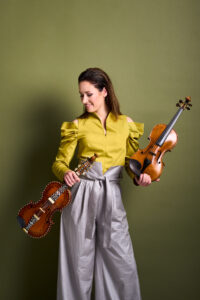
Then came the Geirr Trevitt’s Violin Concerto no 2 Op 252 for Hardanger Fiddle Three Fjords and the charismatic Ragnhild Hemsing. As I suspect it was for most of the audience, this was terra nova for me. The Hardanger Fiddle which developed in Norway in the 17th century has eight strings and is usually elaborately decorated. It is also slimmer and therefore quieter than a violin so Hemsing had a small microphone at her feet. Four of the strings are simply there to resonate so all the dramatic rhythms in this engaging piece rang out with an interesting drone effect. The section in which the soloist is accompanied by snare drum and then xylophone was particularly effective. Of course, when it was done, her encore comprised two traditional dance tunes in which the orchestra cheerfully added the requisite foot tapping. I am now longing to have a go on a Hardanger Fiddle (in private!)

Joanna MacGregor, BPO’s very hands-on, impressively polymathic Artistic Director, appeared after the interval to conduct Ryuichi Sakamoto’s Still Life, Bibo non Aozora and Happy End from the piano. Moving from piano stool to stand in front of the second violins or, for the third piece, to the podium, she found plenty of warm richness in these three miniatures. The section in the last one in which the string melody sits on clucking underpinning from the wind was attractive and of course MacGregor is, as ever, a commensurate team player playing her rippling part without gratuitous showiness. It must, for all concerned, be a pleasure to explore a piece so relatively unknown but with so many melodic rewards.

And so to the warhorse which finally brought the tide in. As Hickox and MacGregor agreed during a short discussion while the piano was moved off stage and the full orchestra restored, Claude Debusy’s La Mer is one of the most cherished orchestral pieces in the repertoire. Interesting moreover that MacGregor attributes that unmistakable “French” sound to the passion which Debussy and his contemporaries had for gamelans

Hickox really leaned, as you must to La Mer work, on the oceanic climaxes with some stylish brass and percussion  contributions in the first movement. The second movement with the two harps was a highlight too. It was a business-like performance of what is, effectively, a highly programmatic symphony in three movements. MacGregor calls it “an orchestral triptych”.

A concert which gave us two hours on the water – in a range of settings and moods – was an imaginative way of ending BPO’s season (they’ll be back in September) given that The Dome is only a few hundred yards from the sea. It’s fun, too, to reflect that Debussy went to nearby Eastbourne to correct the proofs for La Mer so the Sussex links are alive and well.

Mine (or Unapologetically Autistic)

Daniel Toney

Directed by Zailyn Cuevas

Bridge House Theatre

Star rating 4

It’s Autism Awareness Week and Daniel Toney’s one man, 60 minute play certainly raised mine. Diagnosed with autism at an early age, he is a skilled and charismatic actor whose play shares a great deal of information with the audience. It’s entertainment (funny in places) seasoned with a large pinch of documentary but none the worse for that.

As the audience finds seats in the Bridge House’s intimate space, Toney is sitting solemnly at a table with a glass of beer and there’s a lot of ambient pub-style noise. He starts – chatty and naturalistic – by explaining how difficult that noise makes communication for a neuro-divergent person because his brain is hypersensitive. Aircraft and train noise can be very frightening for an autistic child and there’s a rueful recollection of having to be taken, terrified, out of an ABBA tribute concert. Toney, who trained at East 15, captures childhood plausibly with good physicality.

I’m sure a lot of this is autobiographical but I took it at face value as fictional drama, trying to separate the actor from the character he’s portraying. I liked the account of trying, aged 17, to have a  relationship with a girl (cue for a bit of Mozart’s clarinet concerto) when you have no idea what you’re supposed to say. And I laughed aloud at the G&S society at university being seen as the place where all the rejects go, including the protagonist of this play.

There are some strong messages. In general, hard as they try, parents and teachers just “don’t get it” or they didn’t in the early 2000s when Toney was a child. Laisez-faire isn’t the answer. A child with an autism diagnosis needs as much discipline as any other child. And it’s not being understood which leads to frustration, anger and “melt-downs”. What is needed is empathy. And we all need to be more curious about autism.

Another interesting point is that books are written about autism in children and guidance offered but there’s very little on offer for autistic adults. Toney is funny, moreover, about job interviews and the predictable reactions of interviewers to his declaration of autism. And however many times you’ve read, or seen, the The Curious Incident of the Dog in Night-time, don’t assume that all autistic people are brilliant at maths. Toney’s character is hopeless at it.

This is a very thoughtful, sensitive piece of drama and I hope it helps to change attitudes.


The Light House

Alys Williams

Directed by Andrea Heaton

Park90, Park Theatre

Star rating: 4

This engaging, one woman show finds power in tenderness and that’s what makes it both uplifting and hopeful.

We seem to be at sea on a dark stormy night. Ed Heaton’s sound and Matthew Carnazza’s lighting are pretty evocative. And there’s a man overboard. High drama.

Then, gradually, we realise that this is a metaphor for a mental heath crisis in Alys’s beloved, but suicidal boyfriend Nathan who is not actually there but is neatly portrayed by an old fashioned angle poise lamp (set by Emma Williams). There’s no tragic ending. Alys Williams assures us at the outset that “everything’s going to be OK” and it is.

We return to the ship metaphor at intervals throughout the piece and it’s a stroke of genius to get two audience members to echo the “Man overboard” call because it sounds theatrically convincing (or at least it did on press night) as well as stressing that when someone is adrift there’s a network of people and a protocol to return them to dry land. He or she is not alone.

She also enlists audience members to play other small parts such as Nathan when she first meets him and her parents who used to take her rowing. I suspect there were a lot of actors “in” on press night and it all went as smoothly as if it had been rehearsed.

It’s unusual to see a mental health play presented from the point of view of the outsider/carer and that makes this piece particularly effective because while we ache for him, most of us identify with her: desperately and lovingly wanting to help while not really understanding what is happening inside the head of the “sad” person. No wonder there’s a well being practitioner (Noelle Adames) listed among the creatives.

This fine, perceptive, 60 minute play has toured in the north and Midlands before coming to the Park Theatre. I hope very much that it gets revived and that more people get the chance to see it in the future.