Press ESC or click the X to close this window

Fanny (Susan Elkin reviews)

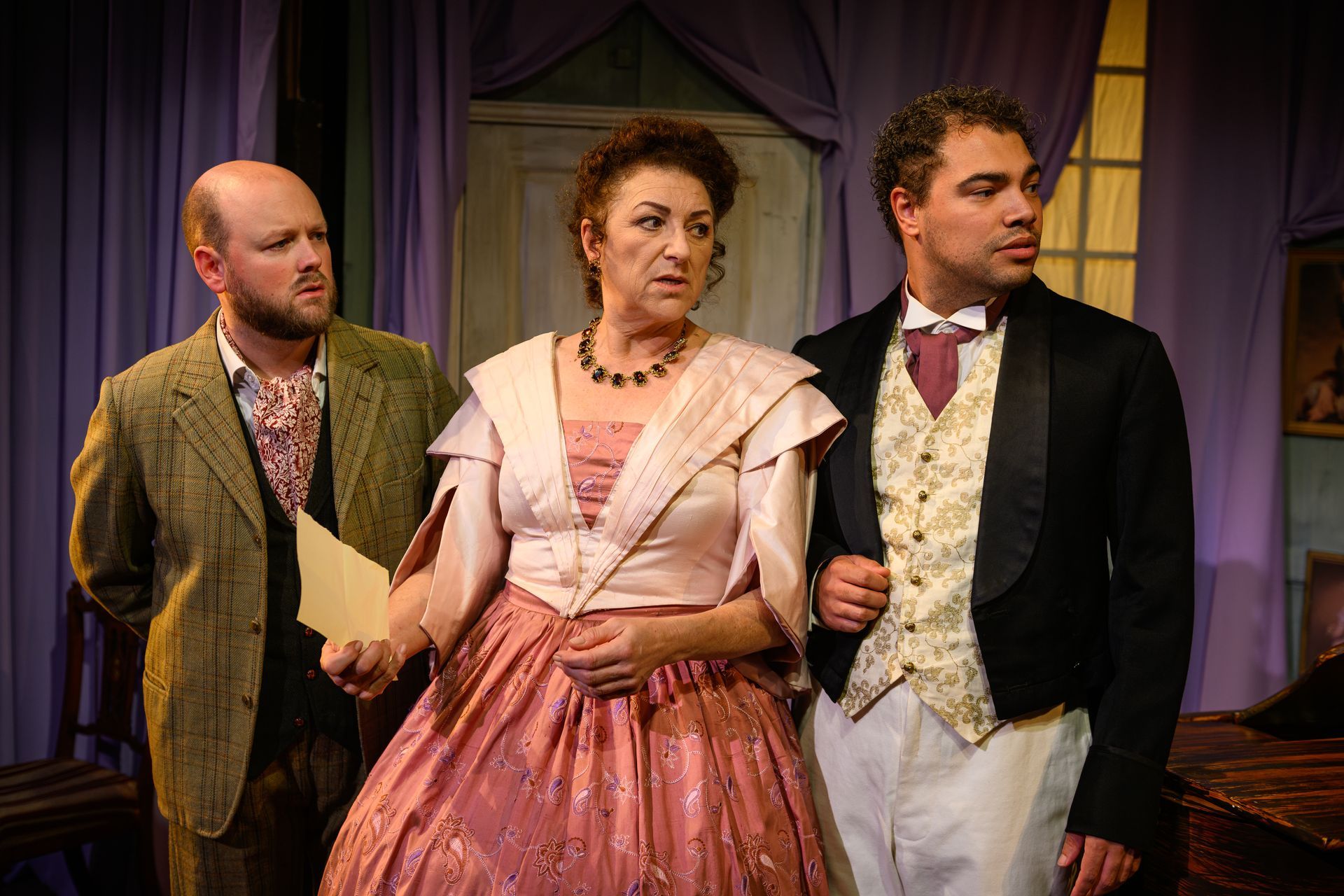
REVIEW: Fanny by Calum Finlay at Kings Head Theatre 25 Oct – 15 Nov 2025
Susan Elkin • 25 October 2025

.

‘Funny, feisty, feminist farce’ ★★★★


It’s quite an achievement to create a fast-paced farce which, beneath the gales of laughter, makes some quite serious points and never quite stoops to frivolity.

We’re in the 1840s (as the witty mobile phone warning reminds us at the start) in the Mendelssohn family home in Berlin. Fanny is passionate about, and very talented at, music but because she’s female she must not flaunt this. Her destiny as a woman is to marry, run a household and preside over a family. Meanwhile her younger brother, Felix, is Queen Victoria’s favourite composer. Fanny Mendelssohn wrote a lot of chamber music (over 450 pieces)  and one orchestral work but little of it was published in her life time. Modern music scholars now believe that she had far more input into her brother’s work than was previously thought and it is known that six of her songs were published under his name.

It’s a fine premise for a feisty feminist statement, swathed in humour, and Charlie Russell’s Fanny is a force to be reckoned with – leaping on the piano to conduct an imaginary orchestra, pretending to obey her draconian mother (Kim Ismay), falling out with the serious, tiresome Felix (Daniel Abbot) and plotting with her future husband Wilhelm (Riad Richie). She talks with her eyes, does a good line in fury, places every comic word with precision and when she gets the audience to create a piece of music with her she is more in command of the room than ever.

A fine cast of six works seamlessly together. Ismay and Jeremy Lloyd (basically Paul, a talentless younger Mendelssohn sibling) are adept multi-rolers, whose continual appearance in different guises becomes part of the joke. And I loved the drinking song, led by Ismay. Danielle Phillips meanwhile gives us an enjoyable angry, shouty, scheming Rebecka Mendelssohn, the fourth sibling who is always aggrieved.

As Fanny’s long-suffering, non-musical beau, Richie is fun. His Hensel has a passion for puns and at one point launches into a whole accelerating series in Sir Humphrey style. It got well deserved spontaneous applause at the performance I saw. The running Puccini, Verdi, Rossini, Linguini gag grates a bit, though, as Puccini wasn’t born until 1858, eleven years after the early deaths of both Fanny Hensel and Felix Mendelssohn.

There’s a great deal of dashing in and out of doors and rapid on-stage shifts all done with admirable slickness usually with climactic music: Vivaldi, Beethoven and, anachronistically, Tchaikovsky all get into the mix courtesy of composer MD Yshani Perinpanayagam. It gets ever more manic as the crazy plot moves on and the scene in which most of the cast is in two colliding carriages is beautifully done although it’s strung out too long.

In short this is two hours (plus interval) of hilarious theatre. You’ll need tissues to mop the tears of laughter. You will also come away reflecting on the injustice faced by women composers in the past and rejoicing that they are, at last, getting a voice now.

Fanny by Calum Finlay

Directed by Katie-Ann McDonough

Kings Head Theatre

BOX OFFICE https://kingsheadtheatre.com/whats-on/fanny-qft1

CAST

Fanny | Charlie Russell

Felix | Daniel Abbott

Lea | Kim Ismay

Paul | Jeremy Lloyd

Rebecka | Danielle Phillips

Wilhelm | Riad Richie

Photography: Photographise

THIS REVIEW FIRST PUBLISHED BY LONDON PUB THEATRES MAGAZINE

I’ve tried reading Michael Arditti before and, frankly, not warmed to his fiction. But I was curious about The Choice because it was handed to me by a friend who said it was a novel for intelligent, grown up people. Since she clearly thinks I fit the bill, I was part amused and part flattered. And, of course, I felt obliged to read it.

Michael Arditti is deeply interested in moral and/or religious issues and clearly knows the Church of England like the back of his hand. I am a defiant and determined recusant which is partly what has put me off his writing in the past. This wide ranging 2023 novel explores women priests, male domination, relationships between parents and children at various ages, including damaged childhoods. Abuse, incest, suicide and AIDS are in the mix too. And in the end we enter the troubled realm of whether or not you can, or should, separate art from the personality of its creator, incidentally a topic I visited here with respect to Beethoven only two weeks ago. Arditti’s scope is vast and his novel intensive. It’s much more compelling than I expected.

Clarissa Phipps is Rector of Tapley, where the church houses some religious paintings by Seward Wemlock which are highly regarded, nationally and internationally. By the end of the novel you feel as if you’ve visited and studied them minutely. Wemlock also happened to be “Lord of the Manor” although long after his death, by 2019 the Big House has been sold off. Clarissa is married to an art curator, Marcus, who doesn’t share her Christian beliefs. He has a mistress in London in an arrangement which the three of them are somehow managing for the moment, although Xan, son of Clarissa and Marcus. is a pretty troubled, truculent teenager.

An ambitious novel in every sense The Choice plays with time and narrative method. When we’re in 2019 it is told in the third person but he uses Clarissa as narrator in the central section which takes us back to 1987.

Characters have serious conversations in this novel. The discursive sections sometimes remind me of Graham Greene in, for instance, Burnt Out Case (1960) although they always feel like plot drivers and are never didactic bolt-ons.

Clarissa, a former BBC Religious Affairs producer, really does believe in what she’s doing. Now she’s ordained, she’s often conflicted. There has been a troubled relationship with her father, the Bishop who commissioned the Wemlock paintings, and who does not approve of women priests. Then there’s the terrible illness of her brother Alexander who has AIDS, graphically and moving depicted. Neither of her parents ever acknowledges the truth about their son. Denial is thematic in this novel.

What should Clarissa do when she discovers a fifteen year old boy alone in the belfry in a compromising position with an older congregant who is respected by the entire community? The decision she makes has terrible repercussions. And once you discover uncomfortable truths about an artist does showing his work in a church tacitly condone his sins? Moreover what do we mean by “sin” anyway? It’s a novel full of rather fascinating, unanswered questions.

I think, on balance, my friend is right. This is an intelligent, uncompromising novel with a serious purpose and probably not one for a long flight or the beach. It is however, a powerful story which pounds on and certainly gripped me, despite my initial misgivings. It would be an excellent choice for a book club.

Next week on Susan’s Bookshelves: The A-Z of Independent  School Leadership by Guy Holloway


Safe Space

Jamie Bogyo

Directed by Roy Alexander Weise MBE  

Minerva Theatre, Chichester


Star rating: 3


Jamie Bogyo’s first stage play, is a sassy and perceptive exploration of the vexed debate about the “cancelling” of historic slavery enthusiasts. Based on real events at Harvard in 2016, Safe Space takes us to Calhoun College which, following student protests, was renamed Grace Hopper College in 2017 because John C Calhoun didn’t just own slaves but was a vociferous advocate of the slavery system. We meet five students, all of them fictitious, and follow the changing dynamic between them as events unfurl.

Khadija Raza’s effective set provides a big downstage open space dominated by a statue of Calhoun, which slides on and off and eventually gets vandalised. Behind it is a mini platform which moves in and out to forms a student dorm, a panelled corridor and a wealthy student’s bedroom.

Connor (played by the playwright) and Isaiah (Ernest Kingsley Jnr) are room-sharing best friends – until they disagree about the renaming of the college and a fellow student named Annabelle (Céline Buckens) comes between them. Then there’s  the ruthlessly determined Stacey (Bola Akeju) and Omar (Ivan Oyik) both holding influential, elected positions within the student body so they have political power. Getting the college renamed is top of their priority list, although they have very different personal agendas.  All five actors play well off each other and we get moments of humour along with the serious stuff neatly packed into fairly tight drama. Director Roy Alexander Weise ensures that the pacey dialogue packs maximum power because of course there are complicating sexual elements to the way these students relate each other.

There is a second dimension in this play in that – like many Ivy Leaf and other US universities and colleges – Calhoun has an accomplished collegiate a cappella choir. The singing is beautiful: Bogyo and Kingsley are both outstanding singers. We hear student songs, folk songs, popular melodies and hymns.  Now, the whole a capella movement is, in its many American manifestations, a very interesting subject and a play about that would be welcome. Unfortunately, it adds little to this one because it has little to do with the subject at hand and feels like a self-indulgent bolt on.

The Wanderers

Anna Zeigler

Directed by Igor Golyak

Marylebone Theatre

Novel Productions and Grapevine Shoot Productions


Star rating: 3.5


It’s a refreshing change to see a thoughtful, grown-up, dialogue-driven new play as opposed to a two-a-penny anguished/banal musical. Actually The Wanderers is not technically new. It was written in 2016 and has played in various US venues but this is the UK premiere.

Zeigler, who originally conceived this as two plays, presents two Jewish marriages. Abe (Alex Forsyth) and Sophie (Paksie Vernon) are a modern, educated New York couple, both novelists but he is dealing with inner demons. Schmuli (Eddie Toll)  and Esther (Katerina Tannenbaum) are a 1970s traditional Hassidic couple and the scene in which they are first alone together is stunningly well written in its gentle awkwardness. For a long time it seems like two separate stories. The link – yes, there is one – is slow to become apparent.

Also in the mix – and this is less convincing – is Anna Popplewell’s Julia, a movie star with a strong online presence. Abe becomes infatuated with her image and strikes up an increasingly flirtatious correspondence with her. Or thinks he does. The truth turns out to be quite fun as well as posing some pretty powerful questions about the nature of long-term marriage. Jewish culture and values prevail – even when you’re modern, sophisticated and not particularly religious. It’s an underpinning that you’re born with. Not easy, as mixed race Sophie quips, when you have both the Holocaust and slavery in your heritage.

The play features some strong acting especially from Alex Forsyth, headphoned, troubled, passionate, worried and often distanced. And Tannenbaum makes a fine job of developing Esther from a timid new bride to an assertive mother of three with a mind of her own.

The scenes melt seamlessly into each other using a table which doubles as a bed (beneath which Forsyth sometimes hides) and a versatile long bolt of white muslin. Otherwise Jan Pappebaum’s set mostly comprises some shiny chairs, a hat stand and few other bits. The back screen is a mirror which reflects the audience as we find our seats and, I suppose, makes a statement about parallels between the play’s two marriages. Less effective is the glass screen upon which characters write and draw props (such as a radio), symbols and rather tiresome chapter headings which presumably relate to the book Abe is writing but it’s not developed as an idea.

Characters in this play really are wanderers in the desert just as their ancestors were. It’s the nature of the desert which has changed.


I met Dick Dixon at interval drinks for the Great and the Good (not sure which I am) at a recent Brighton Philharmonic concert which I was reviewing. Instead of “Have you come far?” his opening gambit was “Are you interested in books?” And that, of course, hooked me instantly.

We chatted for a while, swapped business cards and the next day I looked at his website (www.dick-dixon.com). Then I ordered his latest book. His claimed genre is humorous poetry although as soon as began to read I noticed that, of course, there’s a wistful undertow in many of them. “The Witching Hour” for example is a sardonic reflection on the process of dying and, while amusing in concept, is quite thoughtful. And “Borrowed Time” is about grief and regret, movingly done.

He uses a range of verse forms and rhyme schemes – some of the latter are sometimes a bit forced but generally it flows effortlessly especially when he’s in Hilaire Belloc mode. I admired “Cousin Prue’s Lament” which comes in six-line stanzas with a technically accomplished ABCCCB rhyme scheme.

And sometimes his writing gleams. I’ll forgive the anti-vegetarian stance of “Bone Cuisine” because he can come up with “Do you harbour inner fires / That stimulate your wild desires / To hoover up pink pork and ham  / Fat duck and chicken, shanks of lamb?” Or take “What’s your poison?” in which we’re invited to get “frisky with whisky” or “with sherry make merry.” There’s a hint of Pam Ayres here spliced with, say, a bit of John Betjeman.

I liked “A Mistaken Identity” which is about Helen of Troy and the poet’s search for her. It ends with a pun so groan-worthy that it’s hilarious. “Lazy Susan” (of course it caught my eye) celebrates the whizzy cake stands which are named for people like me. The poem “Appraisal” is effectively an ode to an apple. And as an English teacher how could I not like “Modern Parlance” which wittily hooks together all those ghastly, meaningless expression now favoured by most vernacular speakers  and language manglers– innit?

Moreover this jolly book is sumptuosly and liberally illustrated by French artist, Reine Mazoyer.  Every one of her full page, brightly coloured interpretations is arresting but I liked her koalas the best – as Dixon reflects on their strange diet or eucalyptus leaves which would poison human beings and other mammals.

Yes, Dick, I AM interested in books. They are the main driver in my life, actually. Witness this eclectic weekly blog now well into its fifth year and my 2023 book  All Booked Up which details my personal reading journey and celebrates everything bookish.

Next week on Susan’s Bookshelves: The Choice by Michael Arditti

Brighton Philharmonic Orchestra

Conductor: Alice Farnham

Violin: Elena Urioste

Brighton Dome, 19 October 2025


Entitled “The Romantics” this concert presented two works written within in a few years of each other in the early twentieth century: the final flowering of romanticism with modernist twists.

Despite its early success Samuel Coleridge-Taylor’s violin concerto has long since ceased to be mainstream repertoire. Enter Elena Urioste who champions it enthusiastically. After the decisive opening orchestral statements she sailed into the complexities of the first movement right through to the mysterious, captitvating cadenza played over a sustained timp roll. Like all good soloists she makes it look effortless as well as energetic. The middle movement is gently attractive and played with warmth by Urioste, in her bright floral dress, with a stunning harmonic at the end. And the many moods of the last movement – Elgar meets Dvorak – were nicely nailed.

Urioste’s witty, poignant, encore: variations on “Somewhere Over the Rainbow” then came as a miniature delight.

Throughout this concert I was struck by Alice Farnham’s conducting style. It’s big-scale but business like with clear attention to beating time. It’s also lively: at times both her feet leave the ground. And there’s a clear rapport between her and the orchestra’s charismatic leader, Ruth Rogers.

Now I have to admit that most Mahler is not quite to my taste. In general I find it too fulsomely self-indulgent. This, however, was as good an account of the gruelling fifth symphony as I’ve ever heard. I do wish, however, that it hadn’t been populistically advertised as the “Death in Venice” symphony. Yes, the famous fourth movement Adagietto, scored for strings with harp, is stunningly beautiful but it works much better played in context, after the third movement’s troubled waltz as here, than when it’s extracted or cheapened.  Alice Farnham allowed it to emerge like the mist clearing from a shimmering lake with masses of vibrato and elasticity.  And I, for one, certainly wasn’t thinking about Visconti and Dirk Bogarde as I listened, in awe at the quality of control.

Other highlights in this performance including noteworthy work from the tuba, some terrific trumpet playing especially in the first movement and a pleasing bassoon solo at the opening of the final movement. Nonetheless I left thinking first, that after 70 minutes or that intensity every BPO player must be exhausted and second, that I am still not greatly enamoured of much of Mahler’s music.


Maidstone Symphony Orchestra

Conductor: Brian Wright

Mezzo soprano: Susan Legg

Mote Hall, Maidstone

18 October 2025

This imaginatively programmed, quite full, concert made a pleasing start to MSO’s 115th season.

It’s a delightful change to have a song cycle in lieu of a concerto and a treat to hear Elgar’s Sea Pictures live because it doesn’t get out as often as it should.  Susan Legg is a warm singer who communicates with her eyes as well as her voice. She gave Slumber Song  all the tenderness it needs while Wright balanced the accompanying orchestra, especially the harp, behind her impeccably.  Sabbath Morning came with requisite Elgarian grandiloquence. The off-beat orchestra work in Where Corals Lie, the best known number in the cycle, was crisp and witty. But the crowning moment was probably Legg’s encore: Blow the Wind Southerly which she sang with haunting poignancy. Katherine Ferrier would have approved.

The concert began and ended in nineteenth century Russia. Tchaikovsky’s Romeo and Juliet – with its heart-in-mouth exposed wind opening – got careful attention to detail. All those upward scales rose rousingly to Tchaikovsky-ian melodic climaxes as the drama twists and turns: a competent enough performance although it never quite soared.

Smetana’s Vltava, which launched the second half, is an attractive, busy little pot boiler and surprisingly difficult to bring off, not least because it calls for much stamina especially from the strings. It was a commendable effort but the tension was palpable. I could actually see some string players counting frantically in order to place the pizzicato accurately and almost heard the relief when they reached one of Smetena’s most evocative big tunes and the titular river surged on. Full marks to brass and cymbal at the end.

Possibly because players were still on a high from having got though Vltava decently, the opening of Borodin’s second symphony was ragged although it soon settled rather well into its grandiose, mysterious mood. Like Wright, who said so in his introduction, I remember when this symphony was frequently performed and recorded but it has unaccountably slipped into semi-obscurity in recent years. So well done MSO for reviving it. Highlights of this performance included the insouciant horn part played with aplomb in the Scherzo and, in the Andante the beautiful harp and oboe duet, picked up by horn and nestled over string continuo: the quality of lyrical sound at that moment was exceptionally well nuanced. Then the Finale gave us lots of cohesive melody and drama with particularly fine work from trombones, piccolo and tambourine.

I drove home from this pleasant concert with my head happily rattling with competing melodies.


Brno Philharmonic

Conductor: Dennis Russell Davies

Pianist: Maki Namekawa

Cadogan Hall

Photograph: Sisi Burns

Part of Cadogan Hall’s Zurich International Orchestra series, this concert presented an unusual programme in which two Czech composers bookended something very different from America.

First up was Janacek whose Lachian Dances, a very early work (1876), set the Czech scene. It was a bit odd, however, that six dances were detailed in the programme while Davies informed us, in his otherwise completely unnecessary introduction, that we were to hear just four. The opening “Old time dance” was tunefully businesslike  and the minor key horns were good in “A Blacksmith’s dance”. Davies has an unshowy but incisive conducting style and is strong on dynamic contrast.

The most interesting item of the evening was Philip Glass’s Mishima Piano Concerto (2024). Soloist Maki Namekawa, who is married to Davies, has been involved with the development of this concerto which originated in a film score. She played this, its London premiere, bare footed with her music on an iPad. More or less in three movements it begins with lots of rippling arpeggios,  impassioned playing by Namekawa, followed some nicely pointed trombone work and nifty snare drum. The middle section comes with wistful lyricism and an ethereal quality, reminiscent of Holst’s Neptune. She’s a player who communicates palpably with the orchestra, frequently turning left for eye contact. Her duet with cello, then picked up by woodwind was a high spot as were the cadenza of many moods and much rubato and the final chords with tubular bells. I look forward to hearing this concerto again and getting to know it better.

Thence, after the interval and the clearing away of the piano, to the rich familiarity of Dvorak’s seventh symphony played as competently as you’d expect from a Czech orchestra because this stuff is in their blood. Nonetheless it never quite packed the fresh fizz that I was hoping for possibly because the tempi were generally gentle. I liked, however, the vibrant double basses in the opening Allegro maestoso and the strings achieved real tenderness in the Poco adagio. The scherzo was fairly sparky and the unexpected mysterious “tip toe” moment in the final Allegro worked well. Davies brought out the major/minor tension and the brass section, especially trumpets, were allowed a field day.

Not, however, until the encore – a Dvorak Slavonic dance of course – did the Brno Philharmonic sound like a crack Czech orchestra enjoying itself. And it was glorious: loud, high octane and crazy.

Zurich International Orchestra Series 2025-26