Press ESC or click the X to close this window

EIGHT: The One (Wo) Man Drag King Musical Parody (Susan Elkin reviews)

EIGHT: The One (Wo) Man Drag King Musical Parody

Written, performed, designed and produced by Hannah Clift

Bridge House Theatre, Penge


Star rating: 3.5


Imagine Henry VIII back 478 years after his death to defend himself against the slurs cast by those women pretending to be his queens in a theatrical piece called “Six.” It’s a clever idea for a show and Hannah Clift is an accomplished performer, working her audience to the manner born and managing to sing in a wide range of spoof styles including Meatloaf, Celine Dion and Ed Sheeran.

She does sexy male hip thrusts perfectly and delivers her script’s many double entendres with impeccable timing. She also gets three audience members up to dance a gloriously silly galliard. She nips in and out of role to good effect too.

Her costume is neat. It’s a dress (sort of) which looks like armour complete with codpiece, over which she wears a swirling red cloak and really does look the Henry we know from portraits. When the cloak comes off and she discards the cap it makes a point about different moods.

In general it’s a very funny, pretty original show which has already been to Edinburgh, Brighton Fringe and other venues.

The problem with it, however, is that it must – by convention for this sort of show – run for 60 minutes but seems to run out of ideas about 45 minutes in. It needs another song or two about some of the other Queens – maybe poor 17 year old Katherine Howard who was effectively pimped to 49 year old Henry by her uncle, The Duke of Norfolk and then set up for adultery and beheaded. Clift could have a field day with Henry’s take on this.

Nonetheless I drove home still chuckling at Clift’s playful anachronisms. Her Henry would send his 21st century victims to the Tower but it would be tourists – shock horror –  they’d have to face as punishment rather than beheading. And of course, Henry was born second in line and only became heir after the death of his elder brother Arthur – cue for a whole routine about heirs, spares and a different Prince Harry.

I have long argued that you have to separate artists from their art. I can admire the Eric Gill frieze above the entrance to Broadcasting House without for a second condoning the sexual abuse that appalling man subjected his daughters to. Gesualdo murdered his wife but that doesn’t stop me liking his madrigals. Henry Williamson was a member of the British Union of Fascists but Tarka the Otter is still a good book. The Siegfried Idyll is a charmingly beautiful piece but its composer, Wagner, was so virulently antisemitic that the Nazis saw him, and his music, as their inspiration. I could go on.

Beethoven was a difficult, troubled, misguided unlikeable man but almost every note of his music is sublime. Think of the finale of the fifth symphony (with the piccolo!) or the opening of the Pathetique piano sonata or any bar of the violin concerto. And the odd thing as, John Suchet finds, is that the more appalling the composer’s behaviour got the more celestial Beethoven’s music became.

Suchet, who has written extensively about Beethoven in the past, and delivered hundreds of talks on the subject, calls this eminently readable 2024 book a “personal journey”. Although it is, in part, a biography of the composer it also discusses Suchet’s own discoveries about, and relationships with, Beethoven from his childhood to the present day. The Eroica symphony, in particular,  provided inspiration, solace and courage on more than one dangerous, war zone mission in his ITN reporting days.

He travels to many places  associated with Beethoven in Germany and Austria and, by sheer serendipity, manages to hook up with several descendants of Beethoven’s sponsors and supporters. Any Beethoven lover, for instance, knows the Waldstein piano sonata (and Suchet explains how it got its name). Then 200 years later we are almost as moved, as he clearly is, when he catches up with Countess Waldstein in 2024 along with several others from families who had links with the composer.

Beethoven was a sick man for most of his life. His hearing, as everyone knows, went in his twenties although no one knows why. He also suffered all his life from debilitating gastric problems. Recent DNA analysis from hair samples suggest that he had cirrhosis of the liver and kidney failure resulting from mercury poisoning. Almost unbelievably to us in the 21st century, the wine was routinely sweetened with mercury which would also have been all around him in eating utensils, paint and so on.

Feeling permanently unwell does not, however, excuse his behaviour and Suchet eventually admits that while he adores the music in which he is steeped, he finds Beethoven the man hard to understand or like. The composer cared for nothing but music and had no empathy. Repeatedly he took money and other help from influential people and then lost his temper with them and walked away. He had a massive sense of entitlement and no concept of gratitude. Performers were treated with disdain when they tried to negotiate about “unplayable” or “unsingable” passages. Parts were often delivered only at the very last minute so there was no time to rehearse properly, if at all. Working with Beethoven was like teetering on the rim of a volcano.

Worse, however, is the very well documented treatment of his widowed sister-in-law, Johanna, whom he relentlessly sought to separate from her son Karl. She may (or was it exaggerated?) have been a bit free with her favours but, as Suchet observes, she was also a mother who naturally wanted to be with her son. Beethoven disapproved of her with venomous passion and fought for years through the courts to prevent Johanna and Karl from meeting, while, astonishingly, also composing some of his best work. It resulted in turning Karl into a very screwed up teenager. Eventually the young man tried to take his own life and, really, Beethoven was to blame.

Suchet has a pleasantly chatty style which includes conversations with his wife Nula and his late wife Bonnie, both fellow enthusiasts and active supporters as he goes about his research. As you read you can hear the music that sustains him (as it does me although I’ve never had to report from a war zone). And it’s like a mysterious alchemical process. How one earth did this irascible, awkward, misguided, ruthless genius produce this exquisite stuff? It feels like a massive contradiction but it proves my point: appreciate the art irrespective of what the artist was or did.

I’d now rather like to hear one of Suchet’s talks which he says have changed over the years because Beethoven research never stands still.

Next week on Susan’s Bookshelves: Tricked by the Kippers’ Knickers by Dick Dixon and Reine Mazoyer

This book, first published in 2014, has been grinning beckoningly at me from my digital TBR pile for several months. I simply cannot remember who recommended it but someone must have done or I wouldn’t have bought it. Anyway, whoever you are, if you’re reading this, thank you very much. I loved it.

It’s the most bookish book I’ve read in a while but that doesn’t mean it’s remotely abstruse. Rather, it’s a sparky work of fiction that celebrates the power, importance and joy of books and reading – with much warmth, affection. wit and, sometimes poignancy.

The titular AJ Fikry owns and runs a bookshop on fictional Alice Island which is off Cape Cod. We first meet him at the point when he has turned to hard drinking in a search for oblivion to blot out the agony of his wife’s recent death. He can’t run the shop without her so he’ll probably retire on the proceeds of his most valuable possession – a rare, early copy of Edgar Allan Poe’s Tamerlane. One night, while he’s blotto, the book is mysteriously stolen. Once you remember Silas Marner’s golden guineas there are no surprises at what comes next. Yes, that’s right:  A toddler is abandoned in his shop.

What follows is a joyful story about AJ’s rehabilitation,  born of the need to look after Maya. You have to suspend disbelief a bit and accept that the authorities permit him first to foster, and then to adopt her. She is bright and engaging and AJ talks to her as if she were at the very least a post-doc intern so she becomes highly articulate. Each chapter is headed with an introduction to another (real) book addressed to Maya. Eventually he finds a love interest too with books and the book trade always underpinning everything he does and lives for. I chuckled at AJ’s fury when his mother turns up with e-readers for Christmas. Of course I understand his position but there’s room for both. I read The Collected Works of AJ Fikry on Kindle after all.

It’s a gloriously positive book. I relished, for instance the character of Lambiase,  local Police Chief who becomes a friend to AJ and godfather to Maya. He doesn’t read much but starts a crime fiction book club for his colleagues. Ever more hooked, he has evolved into an irrepressible bibliophile by the end of the novel which spans a couple of decades.

An affectionately affirming novel, it never stoops to banal sentimentality. We do learn, eventually, what happened to Maya’s mother and she doesn’t get a happy ending. And the end of the novel itself is bitter-sweetly rooted in realism rather than resorting to anything chocolate-boxy.

You don’t need to adore books and bookshops to enjoy this novel but if you do, it adds an extra dimension. And why “collected works”? Well, the literary reference is obvious but it’s also how AJ sums up life. Our lives, he thinks, are simply our collected works and I rather like that.

Next week on Susan’s Bookshelves: In Search of Beethoven by John Suchet

Blessings

Sarah Shelton, who also directs

Riverside Studios


Star rating: 2


It’s like a time warp in every sense. Very clearly set in 1969 (clunky topical references aplenty), Sarah Shelton’s new play is also the most straightforward drama I’ve seen in decades. It’s family dynamics without any sort of theatrical innovation. That could be refreshing but in reality it feels oddly flat although you can’t fault it for story telling.

Frank and Dorie Deacon are the parents of four children in a town somewhere in England: Martin and Penny have flown the nest and are working in London. Frances and Sally are still at home. It’s a Catholic family and Dorie is a staunch devotee. As soon as we see Frances (Hannah Traylen – strong performance) we know that the boat is about to be rigorously rocked.

Arguably it’s a play which, in acknowledging the rapidly changing social mores of the late 1960s, tries to cover too many bases in 90 minutes. We ricochet from teenage pregnancy and the “unmarried mother” stigma to the status of women, education, parenting and the questionable role of some “celibate” Catholic priests in some communities along with a bit of drunkenness and domestic violence. There’s a nod to recently legalised abortion too. Odd, come to think of it, that the new and controversial contraceptive pill isn’t in the mix given that this is a Catholic setting.

Some of research is inaccurate. No one was telling pregnant women not to drink alcohol in 1969.  Moreover at that time the minimum entry requirement to teacher training college was 5 O Levels and maths and English were not specified. You didn’t need A levels although many students had them.  Trust me. I was there. These are very minor details but things like this somehow dent the credibility of the whole play.

There is, however, some fine acting in this show from an accomplished cast of six. Emily Lane, as the youngest daughter Sally who absorbs all the flack while trying to develop a life plan of her own, is excellent. She’s a very versatile performer. I last saw her in the banal, all-singing, all-dancing Anne Boleyn at Hever Castle in August where her talents were somewhat wasted but she’s gets her head in Blessings.  Milly Roberts doubles pleasingly as the acidic older sister and as Sally’s rather more likeable school friend.

Both men (father and son in real life) are accomplished multi-rolers, switching so convincingly that you almost don’t notice it’s the same actor. Thus Gary Webster is compelling as the angry, troubled but sinned against pater familias and then as the over-friendly, Father O’Brien. And Freddie Webster gives us a patronising, bossy older brother and doubles nicely as Sally’s gentle boyfriend, Peter.

Anna Acton presents Dorie as a put-upon, middle aged woman, pulled in every direction. And it’s powerful on the whole. I am not, however, remotely convinced by the earlier liaison with Father O’Brien and the “suo padre” story (strange how so many stories hang on that). Neither actor conveys that sort of illicit chemistry.

Moreover, the ending of this play is a cop out. It simply tails off as if the playwright has run out of ideas.

I’m delighted to have met Mrs Laetita  “Letty” Rodd having stumbled upon her by chance. Sadly our acquaintanceship will be shortlived bacause her creator, Kate Saunders (lots of children’s and young adult titles), died in 2023 aged only 62. So there are only three titles in the series.

It’s 1850. Mrs Rodd, who narrates, is the impoverished widow of a clergyman. We feel we know her late husband, Matt, because she thinks about him a lot and theirs was a very happy marriage. Now living simply in Hampstead with her landlady and friend Mrs Mary Bentley (wonderful character) she works occasionally as a sleuth for her lawyer brother, Fred. Mrs Rodd, you see, has Marple-esque powers of perception and Mrs B, who stays at home, is a terrific contributor of sensible suggestions, good food and obliging grown up children. They make a formidable pair.

Now Fred – tiresome wife, lots of children and shared happy childhood memories with Letty – has a case involving a proposed unsuitable marriage between wealthy young Charles Calderstone and Helen Orme.  And he wants his sister to go to Wishtide, a grand house in Lincolnshire as governess to Sir James Calderstone’s daughters. This she does, travelling by smutty train, although the disguise doesn’t hold up for long. She meets Helen, and her sister Winifred, who are living nearby and eventually hears the story which renders the marriage out of the question.

What follows at this point is a homage to David Copperfield (as Saunders acknowledges at the end). I recognised it instantly because Little Emily features in a current project of my own so I’ve thought a lot about her lately.  Poor Helen, like Emily has succumbed to a glamorous but unscrupulous cad and wrecked her marriage chances for ever. But someone, apparently, needs to shut her up.

Then – no spoilers – we are suddenly in whodunnit country. There are some pretty gruesome deaths and the culprit must be found. The intrepid Mrs Rodd isn’t fazed by dead bodies because she has, in her years as a clergy wife, had to lay so many out.

Eventually, of course, she susses out the truth after a few red herrings. I like Mrs Rodd a lot. She’s feisty and often funny. And Saunders is good at period detail while also making all these people seem a lot more human than they sometimes are in mid nineteenth century novels. I look forward to the other two titles which followed The Secrets of Wishtide (2016) in 2019 and 2021.

Next week on Susan’s Bookshelves: The Collected Works of AJ Fikry by Gabrielle Zevin

Brighton Philharmonic Orchestra

Conductor: Joanna MacGregor

Pianist: Junyan Chen

Brighton Dome, 28 September 2025

Entitled “A New World” the opening concert of BPO’s new season featured three works by 20th century composers, all delivered with the orchestra’s usual panache. MacGregor beats time firmly but expressively with commendable clarity and complete lack of histrionics. She must be good to work with.

First up was the notoriously challenging Rachmanoff Piano Concerto no 3 with the charismatic, gloriously talented Junyan Chen at the piano. You can see her breathing and feeling every note of the music even when she’s not playing. And she made the  first movement cadenza sound like a series of passionate but effortless improvisations until the flute, oboe and clarinet solos lead to the tender conclusion. The middle movement brought lush lyricism interspersed with drama and jazzy insouciance – and a great deal of palpable, careful concentration in the orchestra because, although it has gone mainstream in recent years, this concerto is still less familiar than the composer’s second one. As we segued into the finale the chemistry between MacGregor and Chen shone though as, between them, they balanced the grandiloquent piano passages with the woodwind entries which included some lovely oboe work. The many dramatic contrasts in the piece were highlighted right through to the high octane final pages.

Chen concluded her fine performance by whisking us off to a totally different sound world in her encore: a short Gershwin arrangement.

After the interval came the always unsettling La Valse which Ravel began before the 1914/18 war and finished after it so it connotes the collapse of the old Viennese world. In this performance MacGregor and the BPO stressed the sense of a musical way of life  breaking down even as we admired all those virtuosic solo parts – especially notable work from bass trombone and percussion section – and the well managed rubato.

The final work was Bartok’s Suite from The Miraculous Mandarin which tells a  story very descriptively just as, for example, Paul Dukas’s The Sorcerer’s Apprentice does.  Famously, the ballet was performed only once in Bartok’s lifetime because the critics slated it. But he salvaged a narrative suite from the score. BPO made the busy beginning – not a million miles from Gershwin’s An American in Paris – sound vibrant. Other high spots included the clarinet solo which depicts an old man lured in to be robbed, followed by off beat col legno from the strings and snappy trombone work as the crime is committed.

Generally speaking I loathe talks by conductors at concerts. Anyone who wishes can read the programme notes. Otherwise let the music do the talking. Joanna MacGregor, however, is exceptionally good at it. So I’ll forgive her.

Lord of the Flies

Adapted from William Golding by Nigel Williams

Directed by Anthony Lau

Chichester Festival Theatre


Star rating: 3.5


Lord of the Flies is about much more than a group of boys from different backgrounds, air-wrecked on a remote island, tying to sort themselves out. I have always read William Golding’s 1954 novel as an allegory for a post-war world in chaos. As such it touches on huge issues such as democracy, leadership, religion, fear, power and division of nations.

Nigel Williams’s adaptation is more visceral and disturbing than any dramatisation I’ve seen before which is, perhaps, appropriate for these troubled times. 72 years after the novel was written, things are arguably even worse today than they were then.

Georgia Lowe’s dramatic design gives us the unadorned stage in all its massive depth:  a cavernous thing of bare scaffolds and gantries. And there’s no attempt at realism. The conch, a symbol of democracy which has to be held in order to speak – at least until democracy breaks down – is here represented by a microphone and there’s an upright piano on stage along with several prop trunks.

Director Anthony Lau makes good use of silences, very loud explosions and sudden house lights – there’s nothing predictable about this show. And he goes to town for the end of the first half as the boys run amok and kill one of their number who is somehow conflated with the pig.  We get strobe lighting, a lot of chanting, mounting tension and so much blood that it takes the stage crew the whole interval to clean up the mess. If there’s a point to a 1950s pop song being played on piano and sung at this moment, I’m afraid it passed me by. Similarly why do we get recordings of “Shake, Rattle and Roll”, “Blue Moon” and the like as we take our seats?

It’s a young, all male cast and there’s much strength here.  Sheyi Cole commands the stage as the troubled, decent Ralph struggling with unlooked for responsibility. Alfie Jallow delights as Piggy, the boy who comes from a much humbler family and represents the voice of reason and commonsense. And Tucker St Ivany is terrific as Jack,  who leads the breakaway group and goes native. St Ivany has unusually expressive feet.

Sound design by Giles Thomas adds to the menacing atmosphere by providing near continuous, unsettling music under the dialogue. Moreover, it’s effective when it stops suddenly in one of the production’s silent moments.

It’s a nice touch to have Jallow deliver a send-up trigger warning at the beginning and I liked the way Lau deals with the arrival of the British Navy at the end – but I won’t give it away here.

It’s interesting theatre and an imaginative reworking of the novel although I’m not totally convinced by some of its departures. The model pig is far too jokey for something so serious, for example. and the ripping up of the floor in the battle is a bit daft. In places it feels as if everyone, including Lau, is trying slightly too hard.

Photographs: Manuel Harlan

Writer: Ava Pickett

Director: Christopher Haydon

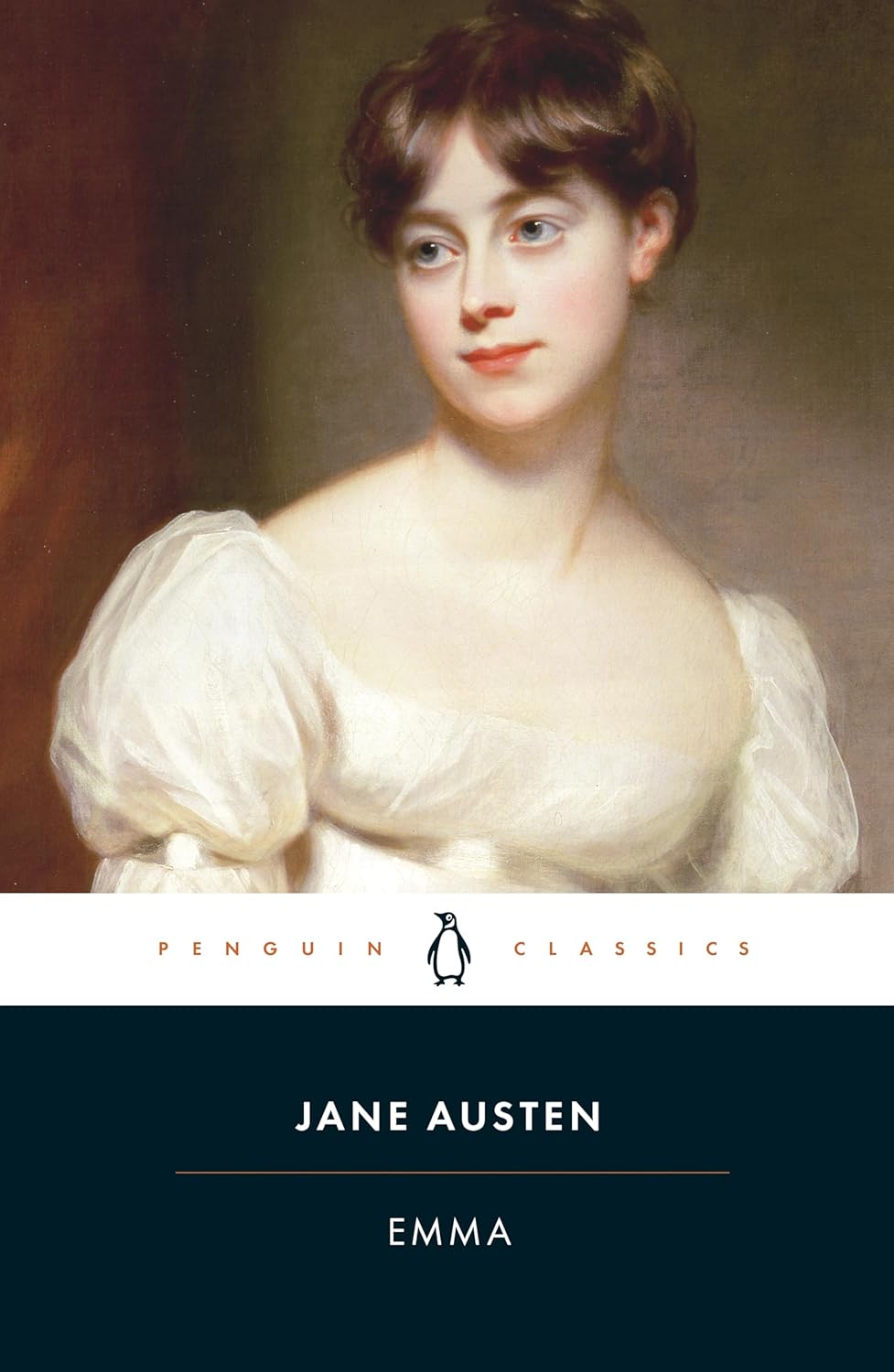
Take tissues to mop the tears of laughter.  This show succeeds in spades as long as you take it on its own terms: Ava Pickett’s very funny comedy is loosely based on, or inspired by, an idea by Jane Austen rather than being adapted from her 1815 novel, whatever the programme claims.

Thus, we’re in a gaudy, loud, flashy stereotyped Essex where Emma (Amelia Kenworthy – terrific) has just returned from Oxford. She’s very bright but has failed her history degree because she didn’t bother to turn up for the exams. She keeps this to herself, and situation comedy swirls around because everyone assumes she’s got a First, although no one else in the room has been to university.

All the young people have been to school together, and there’s a lot of shared history and bantering. Emma’s friend Harriet (Sofia Oxenham) works in the local co-op. George Knightley (Kit Young – delightful) is a builder, and the plot is centred around the imminent, vulgar wedding of Isabella Woodhouse (Jessica Brindle – spot on) to John Knightley (Adrian Richards – good fun).

Two hours and thirty-five minutes of misunderstanding and subterfuge follow as self-deluding Emma tries to manipulate everyone with fake news and misguided plans. Eventually, of course, it all comes right, “Anyone would think we were in a period drama”, quips Lucy Benjamin as Mrs Bates, raucously towards the end.

Nigel Lindsay is a joy to watch as Mr Woodhouse. He is one of our most versatile actors, and although he can do serious (The Lehman Trilogy, for example), he really excels at these cor blimey, wheeler-dealer roles. His Mr Woodhouse owns a comfortable home, sounds like an Essex man and is making good money buying and selling dubious goods. Lindsay drops every hilarious line with panache, although there’s a warm and relatively serious scene with Kenworthy in the second half, which is surprisingly moving.

And in Ava Pickett’s crazy take on Emma, widowed Mr Woodhouse has a thing going with garrulous, gravelly Mrs Bates (Lucy Benjamin), who is a beautician. She is brassily coarse, forthright, and her drunk scene is terrific. There are misunderstandings between them, too, as Emma secretly tries to abort the house sale that would enable them to live together.

All the cast of nine do a fine job, although the shape of the Rose makes for some minor audibility problems from the side of the auditorium when an actor is facing away. A particular shout-out, though, for Sofia Oxenham, whose stage debut this show is. Her Harriet is initially gullible, tearful, immature – and she plays it perfectly. Then, eventually, she begins to grow up and takes charge of her own life, and it’s convincing. She, too, delivers the comedy with impeccable timing.

Lily Arnold’s set is a self-parodying homage to the traditional drawing room comedy. We’re in Mr Woodhouse’s main room, at the back of which is a diagonal staircase leading to a first-floor balcony. There are six doors, which means much speedy dashing in and out to further the confusion, as in a Brian Rix farce. It worked then, and it works now in this happy, slick show.

Runs until 11 October 2025:

The Reviews Hub Star Rating: 4 stars