Press ESC or click the X to close this window

Vera; Or, The Nihilists (Susan Elkin reviews)

Writer: Oscar Wilde

Adaptor and director: Cecilia Thoden van Velzen

Star rating: 3.5

This play is a theatrical curiosity. It was Oscar Wilde’s first play, first staged in 1883, when it flopped. This is the first London revival.

It tells the story of Vera Sabouroff, who leads the Nihilists to the murder of the Tsar, Ivan, initially because she is incensed at the cruel imprisonment of her brother. It is loosely based on the life of Vera Zasulich (1849-1919), although the play is set earlier.

Wilde is trying to interrogate the nature of democracy in conflict with totalitarianism, which is, of course, as topical now as it was 142 years ago. And he was adamant that, political cynicism notwithstanding, this is a serious play and not a comedy, although there are some witty Wildean aphorisms in this text. And “I’d not intended to die” as the Prime Minister’s last words feels more like panto than tragedy.

The language style is peculiar too, although it’s not clear whether this is down to Wilde or to Cecilia Thoden van Velzen’s adaptation. It rattles along in modern English, interspersed with awkward Elizabethan borrowings such as “Methinks…”, “Wherein are they different from us?”, “You shall not escape vengeance” or “I loved him not”.

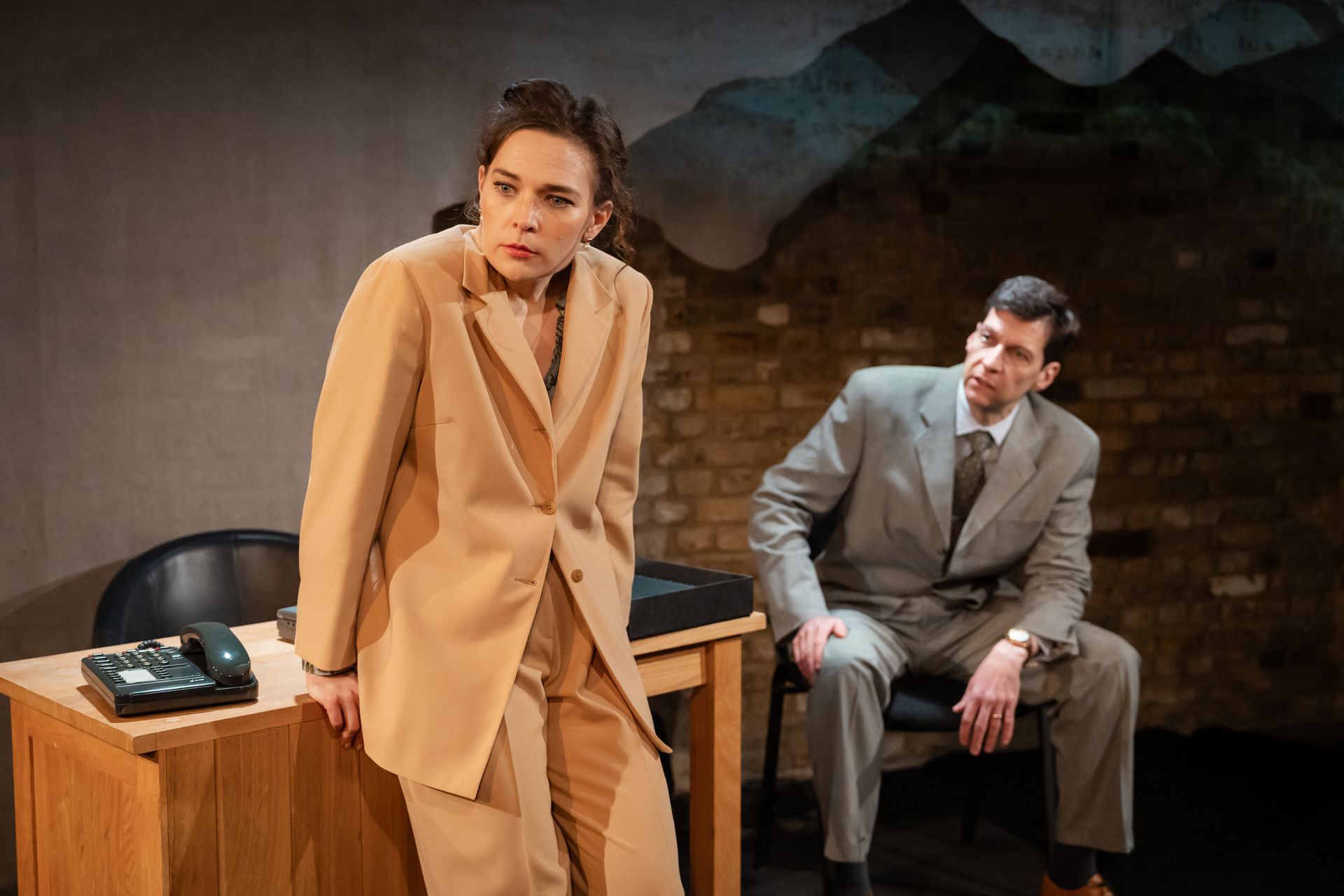
Ruth Varela’s simple but effective set consists of five white triangular screens moved into various positions and configurations as walls or towers. When George Airey (very good), as the new Tsar, produces a white crown and offers it to Vera (Natasha Culzac), with whom he has complicated history, the shape mirrors the set. It’s ingenious cross-referencing. All weapons are made of white paper, too.

The best thing about this show is the quality of the acting. All seven actors are strong, with especially noteworthy work from Jonathan Hansler as the autocratic Tsar who is sick, stumbling, trembling and ruthless.  Natasha Culzac brings steely determination to Vera, and Finn Samuels is a talented multi-roler. Most of the cast have to play more than one part, which is sometimes momentarily confusing, and there are minor ensemble roles, all done quite neatly.

At 85 minutes without interval, this take on Vera; Or, the Nihilists is quite gripping theatre, not least because it’s such a novelty that few audience members know where it’s going, so there’s suspense. And it just about stops short of being too wordy. It gains little, however, from a voiceover to introduce scenes and certainly doesn’t need a mini lecture about Oscar Wilde at the end.

First published by The Reviews Hub https://www.thereviewshub.com/vera-or-the-nihilists-jack-studio-london/

The Full English

Written and Performed by Melanie Branton

Barons Court Theatre


Star rating 2.5


This account of the development of the English Language is an animated lecture rather than a piece of theatre. Melanie Branton, a lively and clever poet, takes the audience on a whistle-stop tour which starts with the Celts and ends with Covid.

She’s a former English teacher and would, I think, have been inspirationally enthusiastic in the classroom but sadly her acting skills are not great. For nearly two hours we listen to her speaking too fast, often stumbling over words, nodding her head forcefully and same-ily sawing the air for emphasis. And it wears pretty thin.

The poems she incorporates are fun, though, from the opener in which she uses as many of her favourite words as she can through to the final one which works in many words and phrases which have come into common usage in the last ten years. There’s a poem rooted in Covid, making the point that some of the vocabulary has already been and gone. Remember when we were all talking about “lateral flow”? American English, she contends, was deliberately steered to be different from British English and treats us to an illustrative poem. Along the way we also get Robert Lowth who wrote the first prescriptive grammar book and William Caxton, on whom Branton tells us she has a crush, because he established the first English printing press with moveable type.

Well, I’m a former English teacher too and I used to teach a lot of this stuff so as far as I was concerned most of it it was pretty familiar territory. I didn’t know, however, that the Chinese invented printing in the 9th century and had moveable type by the 11th so they were well ahead. Moreover the Muslims had highly developed knowledge of science and mathematics which is why most of the vocabulary (zero, algebra etc) is derived form Arabic. We are also lectured about the great vowel shift, the shame of colonialism and told that the Normans were men of the North (that is Vikings) rather than French – among many other things at high speed.

I was surprised, though that Branton barely mentions Shakespeare and ignores the King James Bible, both of which had a major effect on the evolution of the English language. So, in recent years, has immigration and that doesn’t feature in this show either. Wherever people come from they bring words which find their way into the melting pot of English.

It’s mildly entertaining and faultlessly informative but I’d hesitate to call it theatre. It is, however, a commendably original idea.  The childish audience participation (shouting out when she puts on a Viking Helmet, having to answer questions and more) makes it feel like Horrible Histories  spliced with pantomime and did nothing for me.

Photo credit: Lidia Crisafulli

Hamlet

William Shakespeare

Directed by Justin Audibert

Minerva Theatre, Chichester


Star rating: 4


Chichester’s first ever production of what is, arguably, Shakespeare’s finest tragedy tells the story with commendable clarity. I have rarely heard the text spoken so accessibly and I’ve seen dozens of Hamlets, including some very famous ones, over the years.

It is the longest play in the cannon and the Hamlet speaks more lines than any other Shakespeare character so – even with plenty of judicious cuts, this production still lasts 3 hours and 30 minutes. Never at any point in all that time, though, is it anything less than focused and most of the time it’s needle-sharp. The period it’s set in is a bit vague, however – perhaps Edwardian

Giles Terera doesn’t give us a particularly youthful Hamlet or stress his adolescent hang-ups. Rather he presents a thoughtful adult grieving for his father and desperate to do what seems right, given that his mother has just married her brother-in-law who murdered her husband and is now king. He captures many moods and carries audience sympathy.

Ariyon Bakare is a fine Claudius – an imperious controller in public and a ruthless manipulator in private. Politically, he’s totally plausible.  I really liked the dignity, elegance and stillness which Sara Powell brings to Gertrude too because it is then very effective when she loses control in the closet scene – which Terera makes as uncomfortable as it can possibly be. A son telling his mother how her sex life should be managed, in colourful detail is always disturbing and Terera really brings that out.

Keir Charles’s Polonius is just an anxious father trying to keep in with the new king and a little less tiresome here than in some interpretations. And Eve Ponsonby as Ophelia ensures that the mad scene is excruciatingly painful. It is a stroke of genius to have her in a dirty white cotton dress with a  blood stain on the front of the skirt and a huge one at the back. It feels almost obscene and emphasises her total loss of self awareness. In the end a horrified Gertrude wraps a cover round her waist and helps her off stage at the end of the scene.

Lily Arnold’s design is interesting. There’s a mezzanine playing area with side steps which works perfectly for the battlements and enables Gertrude to have a cosy private sitting room for the closet scene. At one point Terera soliloquises sitting casually on the edge of it.  On the main stage below it is an all purpose rocky mound behind a large tiled open space. Characters leap on and off it and it opens to create an effective grave for Ophelia with Beatie Edney as an engaging grave digger.

The lighting (Ryan Day) is both imaginative and evocative – there are rows of glowing lights and a huge centre quasi-chandelier. It enables some very dark scenes and some very bright ones. And the production makes strong use of blackout – especially at the end of the first half when Hamlet creeps up on the praying Claudius, dagger raised. So it becomes a cliff hanger.

This production is a richly worthwhile take on a magnificent play which succeeds because it is of its time – and of our time. Spying, betrayal and lack of trust are as topical today as they have ever been.

Of course at the midweek matinee I saw there were large numbers of retired people but there was also a school party – GCSE students, I should think – and it’s encouraging to see Hamlet making an impact on people of different backgrounds and levels of experience.


Of course plays should be seen rather than read. It’s what I used to tell my students and it still holds true. Nonetheless if, for whatever reason, you can’t see a play then reading it is probably the next best thing. And, for the record, if I see a new play I often buy the text afterwards so that I can read it and absorb it fully after the event.

Nye, at the National Theatre, with Michael Sheen as Aneurin Bevan was so successful and admired, that it returned recently for a short-run revival. Sadly, for various reasons, I didn’t see it either time although I would have liked to. Then a doctor friend told me that she and her husband, also a GP, had been so moved by Nye that they’d cried at the end. “We’ve devoted all our lives to the NHS. All our lives, Susan! ” she said, welling up even as she spoke. “And look at it now!” That clinched it. As soon as I got home I ordered the text.

Fortunately, I see so much theatre that I’m pretty good at reading a script and staging it in my head although, obviously, it can never be the same as seeing it performed. Tim Price’s play gives us Aneurin Bevan dying in a hospital bed in 1960. It’s a framing device. The morphine he’s given takes him back to a hallucinatory re-enactment of his life through which we occasionally hear the voices of his wife Jennie Lee, their friend Archibald Lush and medical staff at his bedside.

Born in the Welsh valleys to a mining family, Nye is profoundly influenced by the death of his father to coal-triggered lung cancer. He worked as a miner himself for eight years before working for the union. The play leaps backwards and forwards in time occasionally returning to the “reality” of the hospital. He is elected MP for Ebbw Vale in 1929  and there’s a fine scene with Winston Churchill in the House of Commons tea room because he’s every inch the awkward agitator and doesn’t allow the war to dent his principles. Also nicely done is the scene in which Clement Attlee, now prime minister after a Labour landslide victory in 1945, offers him the post of Minister of Health and Housing – to Nye’s incredulity.

We hear voices, like a Greek chorus, of many people who have suffered or died because of inequitable, often unaffordable, health provision. Taking his home town of Tredegar as his model Nye comes up with the idea of nationalising the hospitals, converting doctors and other medical staff into state employees and providing free health care for everyone. The play presents his struggles with cabinet colleagues and the fierce opposition he faced from doctors via the British Medical Association. Eventually, as we all know, he triumphed against considerable odds – and the play’s take on Nye can die in some sort of peace.

The stage directions require the house lights at the end so that the cast can see the audience and audience members can see each other to make the point that every single person present has benefited from Nye Bevan’s legacy. I cried at that point too and can vividly imagine what a powerful moment this must have been in the Olivier Theatre.

Nye is well worth reading and it certainly makes you stop and think about Bevan’s original vision and the extent to which it has (perforce?) been dented in the 80 years since 1945.

Next week on Susan’s Bookshelves: Is A River Alive? by Robert Macfarlane

The Producers

Music and Lyrics by Mel Brooks

Book by Mel Brooks and Thomas Meehan

Directed by Patrick Marber

Garrick Theatre, London


Star rating: 4


It’s quite a skill to be outrageous without being offensive but it’s what Mel Brooks’s masterpiece has managed to do for nearly 58 years.

A film for 24 years before it became a stage show, The Producers tells the story of two men who work out that you could make more money out of a Broadway flop than a hit so they set out to make something truly terrible. The trouble is that their gay romp, Springtime for Hitler is a huge hit.

And The Producers is very funny, not least because it sends up theatre in general and Broadway in particular, and since, on opening night, nearly everyone in the audience has industry connections, the jokes and stereotypes went down a storm. The hilarious auditions scene, for instance – with Trevor Ashley as the campest possible Roger DeBris – is only a slight exaggeration of the truth.

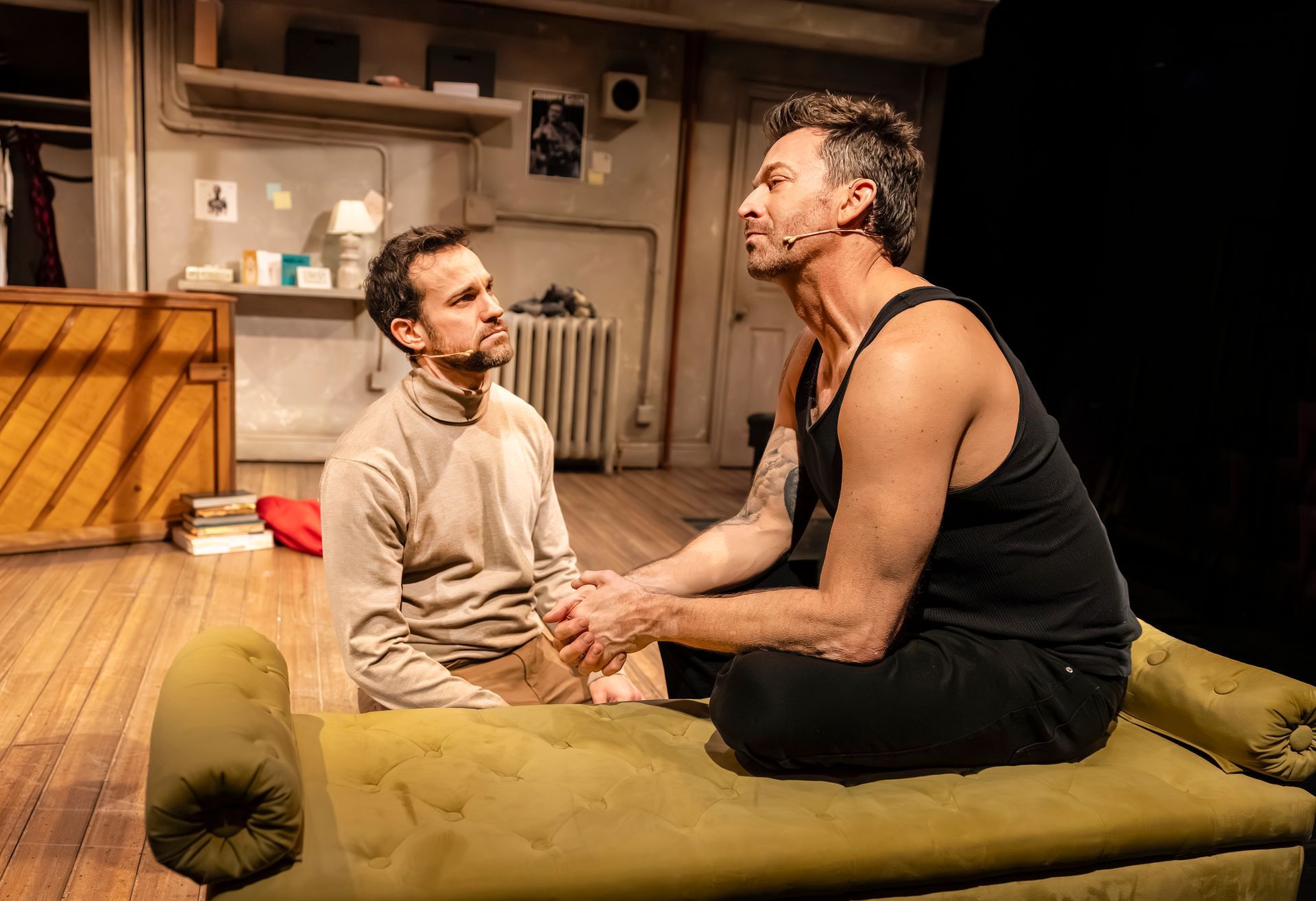
Andy Nyman is deliciously sleazy as Max Bialystock who routinely beds rich elderly ladies because he needs their cheques.  And Marc Antolin is a good contrast as the nerdy, nervous Leo Bloom who gradually blossoms as he finds love with Ulla (Joanna Woodward – great fun).

Lorin Latarro’s choreography ensures that the ensemble is as tight and slick as it could possibly be. The walking frame number is masterly. So is the upbeat, cheerful “Keep it Gay”.


And, of course, Brooks’s lyrics – all delivered here with immaculately clear diction – are always a delight. Anyone who cheerfully rhymes “true sir” with “producer”, “well aware” with “Delaware” and “elan” with “Milan” gets my vote.

Above the stage is an orchestra on a mezzanine, mostly unseen, doing a fine job especially in “We Can Do it” in which the Jewish/Klezmer rhythms are as prominent as I’ve ever heard them.

Paul Farnsworth’s costumes are quite something too – especially the absurdly excessive ones for Springtime for Hitler. And I don’t know whose idea the naked classical statue was but it’s a coup de theatre when he turns to face the audience.

The Producers is a witty show full of humour, much of it gloriously ribald, but like all the best comedies it has also has a lot of heart: the friendship between Max and Leo and Ulla and Leo’s getting together, for example. This enjoyable production never lets you forget that there’s rather  more here than laughter.

And it’s good to see yet another fine Menier Chocolate Factory show transferring into the West End.

Unfolding

Emma Vieceli

Directed by Cat Nicol

Between the Bars

ADC Theatre, Cambridge


Star rating: 5


I see dozens of new musicals in professional fringe theatres every year. Most of them are unmemorable and unlikely to go anywhere much. Unfolding is in a completely different league.

I have rarely seen a new piece so perfectly developed and ready to fly away to a bright future. And these people are, remember technically “a bunch of amateurs”. They all have day jobs and no one has been paid for this show.  Actually, in this instance, the word “amateur”, so often used pejoratively, couldn’t be less appropriate. Unfolding gleams with professionalism.

Rose (Emma Vieceli who also wrote the piece) has corresponded with an American pen friend, Mark (David Barrett) since her early teens. They know a great deal about each other and become close  friends although they’ve never met. As the years pass he marries and has a daughter while she remains single. Now, as her 40th birthday approaches, she is under pressure to go to New York to be matron of honour at the wedding of her school friend, Florence (Vikki Jones – delightful work) in a Greenwich Village bookshop. Would it be a good opportunity to meet Mark at last? But he hasn’t written for a year. Then a devastating letter arrives.

It is an intensely powerful story which, as it unfolds, takes in some pretty brave issues including female to male domestic abuse, suicide and, maybe less contentiously, persuading ultra-conservative parents to accept gay marriage. Fear of flying is in the mix too. Yet there’s a lightness of touch which brings in plenty of affectionate humour. It’s warmly compelling.

There are no weak links in the immaculately directed cast of ten. Vieceli herself is a magnificent singer and stage-commanding actor and her scenes with Barrett (lots of warmth and emotion) are very moving. Danielle Padley does a fine job as young Rose, a crisp publisher and a toffee nosed American matriarch and Helen Petrovna is funny but totally believable as Florence’s in-your-face friend Carly, delighted (sort of) to “escape” from her husband and children for a few girlie days in New York.

There are some stonkingly good theatrical ideas in this show too. Director Cat Nicol and choreographer David Mallabone, for example, create the best airport scene I have ever seen using slick ensemble repetitive commands and actions to a create a fascinating rhythmic counterpoint. It’s both funny and clever. And the simple beginning with spotlighted young Rose singing her letters to stage left young Mark (Ed Chancellor – lots of adept multi-roling) works nicely.

Behind the back curtain is a six piece live band playing in a pleasingly wide range of musical styles – at one point we get a rag time number which incorporates a tap dance. Musical Director, Liz Townsend conducts from keyboard and everything flows and coheres seamlessly. We hear a lot of Kaat De Backer on cello and it brings a mellow warmth to several numbers.

I am not given to gushing, as regular readers of these reviews will know but Unfolding really is something very special and I hope passionately that there are people out there who will take it to more stages in more places. After all it has begun life in the ADC – as did Six.

Incidentally, 5* shows seem to be like buses. You don’t see one for months and months and then suddenly it’s two in a week. Yes, both  Unfolding and Patience, courtesy of Charles Court Opera Company, really have made this crusty critic purr.

[email protected]


National Youth Choir

BBC Scottish Symphony Orchestra

Conductor: Ilan Volkov

Soloists: Jess Dandy and Ashley Riches

Royal Albert Hall


It was worth my nightmarish journey across London, gridlocked by the tube strike, to hear the National Youth Choir in Stravinsky’s Requiem Canticles. The quality and musical nuance of their sound (chorus-master Nicholas Chalmers) had me on the edge of my seat from the first note of “Exaudi”. It, like the rhythmic speaking in “Dies irae” (a Stravinsk-ian homage to Verdi), resonated electrically in the Albert Hall’s rich acoustic.

Then in the same work came Jess Dandy singing Lacrimosa. We are so used, these days to hearing mezzos, that it’s a real treat to hear a “proper” contralto, her voice so cavernous that it sounds almost like a man at times. The female equivalent of a counter-tenor, perhaps? The sound is very attractive and Dandy’s Lacrimosa was profoundly moving.

It must have been a pleasure for Volkov to conduct these young people. He’s one of those unassuming but effective conductors who smiles a lot as he works. It is also, incidentally, very encouraging to see much more diversity across the group than one normally sees in adult choirs.

Each half of this unusually programmed concert opened with a short piece by Gabrieli reworked by Bruno Maderna in the 1960s and 70s. In excelsiis and Canzone a tre cori are both choral pieces arranged here for full orchestra including two harps and tubular bells. Happily, though, Maderna was no Baroque-murdering Leopold Stokowski and I admired the retention of the early 17th century ambience in the delicate orchestration. And Volkov is very good at balancing the wind, particularly the brass, with the strings.

And so to the familiar sunny uplands of Brahms Symphony No 2 in D Major in which Volkov brought out delightful detail I’ve hardly noticed before – and I have played this symphony.  There was delicacy which showcased the work of lower strings in the first movement with admirable precision in the off-beat pizzicato at its end. I admired the balance and enjoyed the bassoon line in the Adagio and the highlighted contast between the “busyness” and lyricism of the Allegretto. Then Volkov gave us lots of the requisite “spirito” in the final movement. Moreover, he achieved phenomenal speed at the end – bravo trumpets! – without ever losing crispness.

At the end of the concert, after the applause, Volkov, unexpectedly, used the podium to make a resolute statement condemning the war his native Israel is waging on Gaza. Of course, there was some mild hostility both to the substance of what he said and to what some regarded as “abuse” of position. For myself, I support him in principle. You cannot divorce music from politics. Both are existential.

Patience

WS Gilbert and Arthur Sullivan

Directed by John Savournin

Charles Court Opera Company

Wilton’s Music Hall

Star rating: 5

I grew up with big scale G&S featuring big choruses and full orchestras. I still sometimes see these operas done that way courtesy of say, ENO or one of the few amateur companies still devoted to this wonderful material. But every time I see Charles Court Opera Company in action I realise that I have actually come to prefer chamber versions, I love the clarity of sound that a good cast of nine can produce under David Eaton’s musical direction from stage left piano. And director John Savournin knows exactly how to use every inch of the stepped stage at Wiltons to maximum comic and visual effect.

Arguably Patience has worn less well than Gilbert’s other satires because few 21st century audience members are au fait with absurdity of the late nineteenth century aesthetic movement . So the challenge is to bring out its innate funniness which this production does – in spades. It reinevents milkmaid Patience as a barmaid and the setting is a pub. The original “twenty lovesick maidens” become “melancholic maidens” which scans seamlessly (and alliteratively!) into the music and makes sense because they are now a well-sozzled, frustrated  trio, not a crowd.

Catrine Kirkman is woefully, wistfully hilarious as the elderly Lady Jane (“Silvered is the Raven Hair” beautifully sung). Meriel Cunningham as Lady Angela oozes stage presence and Jennie Jacobs in turquoise tights with matching plait tips adds gleeful gloom.

Matthew Kellett always delivers. His Bunthorne hops about in silly attitudes, curly hair flopping about and pale face ridiculously serious. And Matthew Silviter, who has a much bigger build, provides a rich contrast as rival poet Grosvenor.

Patience herself has to be a striking contrast to all this posturing and Catriona Hewitson nails it perfectly – all common sense and plimsolls with her warm Scottish accent. And like everyone else in this accomplished cast she sings with passion, accuracy and verve,

High spots in this delightful production include the big double chorus in Act 1 when the women are counterpointed against the men, a device Sullivan claimed to have invented. Whether he did or not, it’s unfailingly effective here. And the anthem in Act 2 (another Sullivan trademark) is impeccably sung as a sextet with characters carefully positioned to sing without stage business – which is exactly how it should be done.

This show is a revival of a production which I’ve seen before but it was a pleasure to revisit it because it simply goes on giving. And if, at the performance I saw, there was a moment of raggedness in the final chorus, most people won’t have noticed it.