Press ESC or click the X to close this window

The Olive Boy (Susan Elkin reviews)

The Olive Boy

Written and performed by Ollie Maddigan

Directed by Scott Le Crass

Free Run Productions

Southwark Playhouse

Star rating: 5

The power of this show lies in its visceral truthfulness. It tells the arresting story of a teenage boy losing his mother at age 15 and is firmly rooted in Ollie Maddigan’s own experience: the confusion, the denial, the jokey front and the preoccupation with sex. After all life and hormones don’t stop simply because you’re grieving.

Maddigan is a phenomenal performer. There’s a lot of physicality in this show: sometimes almost balletic. His range of voices is riveting. When he speaks direct to the audience, he has beautifully clear articulation but sounds totally natural. He commands both the stage and audience attention. And he oozes charisma.

The structure of the show presents Ollie remembering events and reconstructing them from the characters in the school canteen, to the girl he’d like to get close to at a party and to angry conversations with the formerly absent father he now has to live with.  And there are scenes with an unseen counsellor voiced by Ronni Acona which work rather well. It’s all very fast paced with video footage on the back wall of a home movie of Maddigan as a child and his mother which is used as a framing device.

Olives are thematic. The Ollie who’s a character in his own play says that he was born with a green tinge owing to a minor birth issue, soon rectified. It led to his mother nicknaming him “My Olive Boy”. At the same time he loathes olives which doesn’t stop him scoffing them at a party with disastrous (hilarious) effect. And at one point he recalls that his mother had red and green mottling on her body like an olive before she died.

This play is very funny – teenage boys can be ridiculous and Maddigan runs with that – but it’s also deeply serious. Grief is an expression of love and it’s a universal experience. You can’t get rid of it by burying it. If you face it and live with it, it’s richly empowering and means that the person you’ve lost lives on in you. It’s quite a message.

On the other hand I’m still chuckling at why sex is like fishing: if you leave your rod out in the water for long enough, sooner or later a fish will come along and put it in its mouth …

The Olive Boy started life at The Hope in 2021. That was followed by the Camden Fringe, Edinburgh Fringe, a national tour and now this run in London. It deserves to live on.

Ghosts

Henrik Ibsen, adapted by Richard Eyre

Directed by David Emmet

Questors Theatre, The Studio

16-26 January 2026

Star rating; 4

It’s a dark, brooding play about how the past can devastate the present. It also explores some very difficult issues including  congenital syphilis, incest and assisted dying. No wonder it was widely banned almost as soon it was written in 1881. It’s Ibsen at his best, boldy challenging the assumptions and conventions of his day.

All credit to Questors Theatre for tackling it and for bringing it off with such aplomb. Richard Eyre’s adaptation pares it down to 90 intense minutes although he retains the three act structure but we’re in period. Juliette Demoulin’s set gives us 1880s furniture spaced to give the impression of a comfortable middle class home and it sits well in The Studio with seating on four sides.

Mrs Alving (Caroline Bleakley) is a widow who has just welcomed home her only son Oswald (Usmaan Khan) after a long absence. She and Pastor Manders (Darren Chancey) are in the process of setting up an orphanage as a memorial to her late husband. Also in the mix are a sparky servant girl Regina (Stella Robinson) and her rather unpleasant father Jacob (Martin Halvey). Nothing is at it seems – this is Ibsen after all. The titular ghosts haunt all five characters mainly in connection with the late Alving, who has left a great deal of damage in his wake.

Khan is terrific as Oswald – initially casual and hiding his feelings but eventually subsiding into a form of hell not of his making. He is a recent East 15 Acting School graduate, and it shows. He has that very distinctive way of immersing himself in role with charisma and conviction that I’ve often noticed in other who’ve trained at East 15.  And Caroline Bleakley is outstanding as his anguished, misguided mother. I haven’t seen an actor having to mop the tears and visibly bring herself back to the real world at curtain call, since I saw Sharon C Clarke in Death of a Salesman.

Chancey does well as the manipulative, patronising, hypocritical, self-interested Manders. He’s so convincing that I wanted to hit him. Robinson finds plenty of warmth in Regina and her anger scene is strong. And Halvey imbues Jacob with the right level of cunning and sycophancy.

I first encountered Ghosts as a 19 year old student when I both studied and saw it. I’ve seen it several times since, most memorably directed for the RSC by Katie Mitchell with Jane Lapotaire and (a very young) Simon Russell Beale in 1994. This Questors production is as powerful as I’ve ever seen this play.


Hadestown: Teen Edition

Anais Mitchell

Directed by Cat Nicol

Behind the Bars

ADC Theatre, Cambridge


Star rating: 4


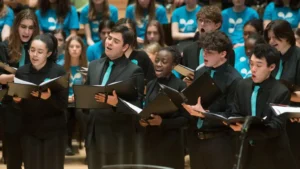
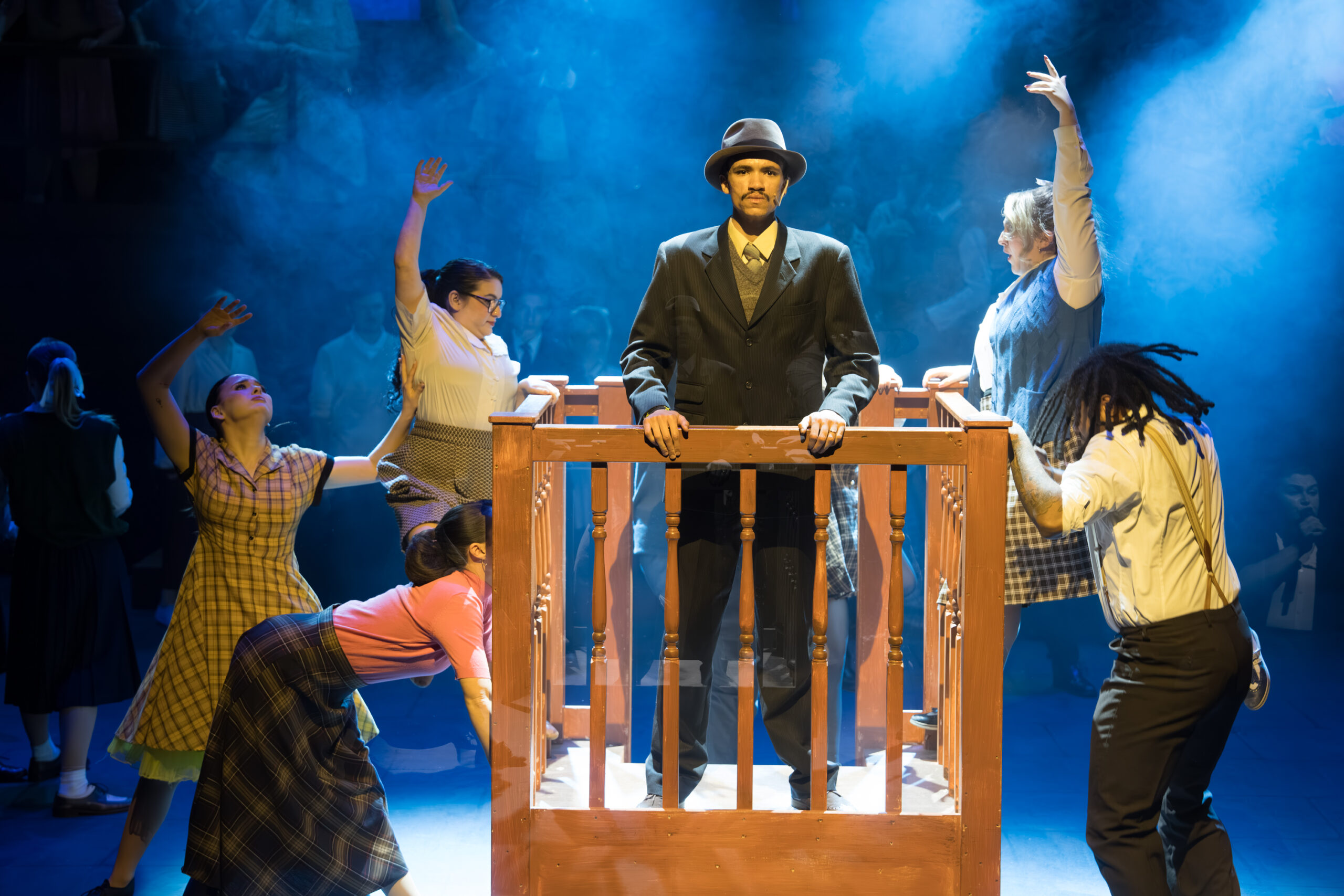
Hadestown is a hauntingly mesmeric piece and to see it carried off by a company of talented 14 to 19 year olds is quite a treat. Their  work buzzes with energy and enthusiasm.

The catchy folk/jazz music, often very lyrical, captivates from the first bar of that exposed trombone solo (Ellie Curson – excellent) at the start. The rest of the band does a fine job too, under Sam Kirby’s direction from keys. Musicians are seated upstage with a corridor through so that cast and players become an integrated unit.  There are also two very competent actor musos in the ensemble (George Ducker and Nafsika Kazani.)

Jennie Youngs, as Hermes who narrates and directs the two timeless love stories within the plot, finds exactly the right level of sassy insouciance. She’s a very engaging performer to watch with the wings on her bomber jacket and wild blue green hair. Youngs sings in a rich mid range voice too, every note and every word made to speak with just the right level of American inflexion.

Hades is a gift of a part for stage dominance and drama and Laurie Jones carries it off with aplomb. His Hades is suitably chilly, ruthless and dominant until we finally see him, softened, with his beloved Persephone once the agreement is made. Jones has an intensely powerful bass voice which belies his 15 year old stature. Naomi Mallabone more than matches him. She’s an unusually mature actor and singer and has a gift for nuanced facial expression.

Then there’s Elin Gregory as the vulnerable, wistful Eurydice and she tears your heart out with her anguished singing. And Charlie Dawe, complete with guitar creates a charismatic Orpheus with the requisite beautiful singing voice.

The Fates (Ceana Arnold, Grace Maynard and Isabelle Holme) work well together as a menacing trio and provide some attractive harmony singing.

And so to the backbone of the show: the ensemble who are workers in the hell which is Hadestown. My goodness they’re slick. Movement director Frances Sayer has them providing repetitive angular movements to represent machines and it’s seamless. So are the dance interludes.

Behind the Bars has been producing theatre in Cambridge for fifteen years. This is their first foray into youth theatre and they did it, the director told me after the show, by holding open auditions. The result is an achievement to be proud of and I hope the company has are plans for more youth theatre very soon.


It was my eldest granddaughter’s partner (they’re to become parents next month) who recommended this interesting novel to me. He is a bookish chap and has gradually become one of the many people with whom I often chat about reading. And, given that he’s half a century younger than me and male, it’s surprising how often our tastes and interests coincide.

The Memory Police (2020) is set on a fictional Japanese island at some point in the not too far distant future. Memories are illegal. And for a long time random things – roses, hats, specific fruits, photographs, novels and eventually body parts – have been being forcibly made to disappear one by one and erased from memory. The titular Memory Police are ruthless enforcers of this policy so we’re somewhere between George Orwell’s Nineteen Eighty Four and Franz Kafka’s Metamorphosis with nasty Stasi undertones.

The narrator is an unnamed female (shades of Daphne du Maurier’s Rebecca) who lives alone and writes novels – until novels are “disappeared”. Her friends are her publisher whom she calls R and “The Old Man” who is the widower of her old nurse. They trust each other implicitly and R retains the gene which means his memories are intact. Once – no plot spoilers – he and the narrator are obliged by circumstances to spend a lot of time together he works hard at trying to re-programme her brain to enable her to recover some of her lost memories. And that, of course, is subversive, illegal and dangerous.

Meanwhile the Old Man lives on the shabby, damaged boat he used to run as a ferry to the mainland until such trips, concepts and ideas were “disappeared”. The use of “disappear” as a transitive verb is sinister and effective. Then natural forces change things. And I really admired Ogawa’s invocation of landscape, weather and climate.

So what is all this really about? I found myself thinking a lot about Orwell’s “thought police”. If you condition or coerce people into believing there are things they must not say or think – and that happens all around us every day – then memories become distorted and you lose trust in your own mind and judgement. Patrick Hamilton’s play Gaslight (1938)  of which I coincidentally saw and reviewed a production at about the same time as I was reading this novel, makes the same pretty terrifying point. If you bully people insistently enough you can make them believe anything – as every tyrant understands very well from King Herod to … well, supply your own names. This is not the place for me to engage in international political judgements.

In The Memory Police R represents the central voice of reason, morality and humanity. We need people like him at every level of every society.

Next week on Susan’s Bookshelves: One Hundred Years of Lenni and Margot by Marianne Cronin

Writer: Lyle Kessler

Director: Al Miller

Two adult brothers, Treat and Phillip, live together in a house in North Philadelphia. Their carefully managed Pennsylvanian accents, voice-coached by Rebecca Clark Carney, take a few minutes to tune into.

Philip (Fred Woodley Evans) is cowering, anxious and unable to leave the house, although fascinated by the street outside. Treat (Chris Walley) – all aggression and control – is a professional mugger bringing home what they need to live on. Then one day, he kidnaps drunken Harold (Forbes Masson), who is cleverer than Treat. He quickly sobers up and takes charge. Lyle Kessler’s 1983 play is a powerful, often darkly funny, exploration of fraternity, loss and family – all three men are orphans – along with the dynamics of power. And the dialogue is admirably pacey.

As Treat, Walley is an exceptionally eloquent listener. He can communicate a whole raft of emotional depth with the tiniest twitch of a facial muscle or subtle body movement. And Phillip is supposed to be disturbed, vulnerable and backward, but he has potential which Harold recognises and exploits. Woodley Evans brings a hollow-eyed attentiveness to Phillip, and it’s riveting to watch.  As Harold, actually a long-exiled gangster from Chicago, Masson does the bright-eyed, almost mercurial, manipulation very well.

All three characters are, in a sense, tragic, and director Al Miller knows exactly how to point that out by allowing silence to speak. He also uses every inch of Jermyn Street Theatre’s wide but awkward playing space to interesting effect, especially during the fight scenes (fight director Enric Ortuno), with actors almost spinning across the stage at times.

Sarah Beaton’s set is ingenious. There has to be a window which opens for Phillip to look out of, and it’s neatly contrived here. So is the table, which moves centre stage for Act 2, which is set two weeks later.

Anyone new to this modern American classic will struggle to anticipate the ending. In Miller’s hands, it’s as poignant, moving and unexpected as it could be.

Runs until: 24 January 2026

The Reviews Hub Star Rating;  4

Brothers, bonds and blood
This review was first published by The Reviews Hub

5 Lesbians eating a Quiche

Evan Linder and Andrew Hobgood

Directed by Holly Causer

Tower Theatre, Stoke Newington

Star rating: 3.5

It’s 1950s America and this 2012 play has a lot of fun satirising it along with dresses and shoes (costumes by Kate Els) which catch the mood nicely.

Five women, members of the Susan B Anthony Society for the Sisters of Gertrude Stein and having their annual quiche breakfast which is a competitive event. The motto is “No men. No meat, All Manners” and there’s an anthem. Thus we are somewhere between the WI and the Suffragette movement presented with that smiley, all-American faux-innocent, enthusiasm which grates on many taciturn Brits. And these five actors have that mood nailed as they address the theatre audience and single people out as if they were the members of the meeting.

The point of course – the clue is in the title – that these quite disparate women profess to be widows but are actually secret gays.  In some cases they haven’t acknowledged the truth even to themselves. At one level it’s a play about coming out – especially when the going gets difficult because air raid sirens signal a nuclear attack and they know they will be closeted together for four years. It is possible that they are the only survivors.

At another level it’s a pretty funny comedy which gets ever more outrageous as it works through its 70 minute span. The moment at which Clara Caughan as Ginny buries her face in a quiche while … err .. interesting things happen to her body is hilarious. Much of the humour though comes from fine timing and the use of facial expression. All five actors and their director, Holly Causer, who isn’t afraid of eloquent silence, work well together – especially when the revelations start to emerge.

It’s a strong cast although the American accents (apart from Caughan whose character comes from Yorkshire,) are patchily inconsistent. There is, however, an outstanding performance from Olivia Peacock as Dale. Her accent is beautifully sustained and she lights the stage wherever she is on it.

God, the Devil and Me

Fionnuala Donnelly, who also directs

Lion and Unicorn Theatre


Star rating: 1


It’s a good idea for a play: psychotic teenage boy subjected to two conflicting voices/figures in his head/bedroom in the form of God and the Devil. The basic set gives us a pile of LPs, a record player and connotes a hint of adolescent untidiness. No sign of anything more modern so what period are we supposed to be in?

The devil (Campbell Maddox) and God (Neo Jelfs) spar with each other affably while Gabe (Noah Edmondson) looks from one to the other and chips in angrily. We certainly feel his angst especially when they tell him he’s really an angel so he sprouts wings. The angelic status is not fully explored however.

And that’s one of this show’s several problems. It’s full of undeveloped ideas. There is a suggestion that  the whole contrivance is a play within a play, with playwright/director Fionnula Donnelly coming on as stage manager (she also plays Gabe’s mother) but it falls puzzlingly flat.

The script actually contains some quite witty lines and ideas but they are never given space to land so the show falls sadly short of its “comedic” billing. God, who keeps telling people not to blaspheme, shouting “my son on a bike” could be funny, for example, but it races past unnoticed. So do the Devil’s quips about God not having raised his son very well along with would-be jokes about the Bible.

Actors, especially Maddox and Edmonson, often gabble so that we barely hear what they’re saying. It’s almost as if Donnelly, as director, doesn’t trust her own writing. Or perhaps she is concerned about the 60 minute parameter? In that case, though, why do we get a pretty pointless game of truth or dare with audience participation and an awkward, silent, quite lengthy blackout scene change simply to bring on two folding chairs?

In short, this clunky show is bemusing. More work might help but I’m not holding my breath.


Chatting to me about books the other day, my nephew – a scientific type – mentioned this one which had intrigued and fascinated him. And I’m so glad he did because it’s the most enthralling non-fiction book I’ve read since Entangled by Merlin Sheldrake which I wrote about here in February 2024.

William Smith (1769-1839) was the son of an Oxfordshire blacksmith who eventually created what this book’s title refers to – the world’s first geological map.  I had, to my shame never heard of him and neither, I think, had my nephew. Smith was a self-educated canal engineer and surveyor who became fascinated with the rocky strata he was working though only a few years after the term “geology” was coined. His major observation was that different sorts of fossils are found in different sorts of rock even as they run in massive seams across the country. He concluded therefore that it is possible to date the fossils from this data, thereby negating all the orthodox religious views about creation as a seven day event which took place four millennia before Christ – a doctrine in which many people still believed. His work, almost literally, paved the way for Darwin and Wallace and their theories of natural selection later in the nineteenth century

Eventually Smith began to map his conclusions and one of his masterpieces hangs behind a curtain at Burlington House Academy in Piccadilly – which is Simon Winchester’s starting point for his engaging biographical story. The trouble was that others were beginning to draw similar conclusions and Smith was very badly treated.  His work was plagiarised and stolen – mostly by dilettante, well-born amateur geologists who, among other slights, snobbishly denied him membership of the Geological Society when it was formed in 1807, because he wasn’t the right sort of chap. So severe did his problems become that he spent eleven weeks in a debtors’ prison. Meanwhile he had made an unfortunate marriage to a woman who sounds like a cross between Mrs Rochester and Tchaikovsky’s wife Antonina,  although Smith’s diaries, a rich source of information for Winchester, say little about her. When he was discharged from prison he left London and went to live in Yorkshire where he seems to have found peace and at least some of the acclaim he was more than entitled to. The Geological Society which soon ceased to be a lunch club and became much more focused on serious science, eventually awarded Smith its first Wollastaon medal in 1831 which was very prestigious and remains so to this day.

Winchester, ever inch a story teller, writes very compellingly and one senses that his heart really is in this book because he studied geology himself at Oxford before branching into political and other journalism. There are one or two dating errors in the history. For instance he mentions wisteria-covered cottages in Oxfordshire in the late eighteenth century but wisteria didn’t arrive in the UK (from China) until 1816 and it this leapt off the page at me because, my a strange coincidence I researched this for a story of my own only a few months ago. But this, and couple of other similar tiny things,  are very minor gripes in a fine book.

Next week on Susan’s Bookshelves: The Memory Police by Yoko Ogawa

PERSONAL NOTE

 This blog is, for me, rather a special one. It is five years since I posted the very first one about Death of Grass by John Christoper on 13 January 2021. So I’m celebrating the quinquennial anniversary of Susan’s Bookshelves. And I as I do so, of course I can’t help but look back. It was originally a project to give me something to do when we were locked down and there was no other work. But I found I enjoyed doing it and the feedback has always been encouraging.  So 260 blogs and book titles later, here we are. I said at the start that I planned to be as eclectic as possible so I’ve ranged over short stories, poetry, non-fiction, children’s books and, of course novels from all periods including rereads and new discoveries. I’ll read pretty much anything but I can’t stand dragons, giants, trolls and their mates and I’m not keen on ghosts or horror as you might just have noticed …

 Join me in raising a glass to the next five years.