Press ESC or click the X to close this window

Susan’s Bookshelves: The Daughters of the Late Colonel by Katherine Mansfield

I wouldn’t normally write about a single short story here but this one is such a gem I think it deserves a space all of its own. Actually it’s a miniature masterpiece structured like a tiny novel in twelve mini-chapters. So that’s my excuse –  if I need one.

Written in 1920, The Daughters of the Late Colonel was published in 1921 by John Murry to whom Mansfield was married. She was from New Zealand but settled in England in 1918. She and Murry were close friends of DH Lawrence and his wife Freda – all four of them convention breakers. Aged 34, she died of tuberculosis in 1923  as Lawrence would seven years later. It was a hideously common disease.

The titular daughters are Constantia and Josephine whose domineering father has just died. They are virgins in their fifties – their younger brother is old enough to have an adult son. Their mother has been dead for 35 years.  But they have no emotional maturity so they still share a room, giggle like nervous teenagers and struggle with everyday tasks and decisions. They are, moreover, limited by genteel poverty. It’s beautifully imagined and observed – and extraordinarily poignant.

LateColonel

These women were terrified of their father, who has dominated their lives, and Mansfield drips in flashbacks to show how awful it was as the reader is allowed to look “past” them objectively. Now they are frightened even to “trespass” in his bedroom even though he’s dead. He’s been the dominant presence in their arid lives for so long that they can’t switch him off.

They are frightened of the nurse who looked after the old man and allow her to take advantage of them. They’d like to sack the insolent maid Kate, who sees them as “old tabbies” but they haven’t the courage. They have never met their sister-in-law who lives with their brother in Ceylon but get occasional duty visits from their nephew, Cyril and these are painful, tortured occasions.

I think of The Daughters of the Late Colonel a lot when I struggle to communicate with deaf friends. It is true that once you have, perforce, repeated a piece of everyday, conversational trivia three times it begins to sound ridiculous so you give up usually to the fury of the person you’re trying to talk to. Then I remember Katharine Mansfield, Cyril and the meringues.

I know this story well because it features in many school anthologies and I used to teach it. Coming back to it now I marvel at the tension of sentences like this: “They only gave the blind a touch, but it flew up and the cord flew after rolling round the blindstick, and the little tassel tapped as if trying to get free.” Of course, Mansfield, despite her early death, was a prolific story teller and since I first read this one – still my favourite – I have read most of the others in various collections and more recently in  Katharine Mansfield: The Collected Stories with introduction by Ali Smith (Penguin Classics,2007) which is a fat 700-page volume They’re all worth reading although some are stronger than others. And I don’t think she ever bettered The Daughters of the Late Colonel.

LateCol2

Next week on Susan’s Bookshelves: Whichever title of the six on the 2023 Booker Prize shortlist I have, by then, decided I like best!

19 Ocober 2023

Well if you wanted the cobwebs blown away, this all American programme,  part of a series entitled Let Freedom Ring, would certainly do the trick. Freedom dominated the evening at every level. The repertoire was a long way from Mozart and Brahms, we watched/listened to the Philharmonia play syncopated jazz rhythms till the whole hall bounced and there was the wondrous joy of a soloist who is both black and blind.

Marin Alsop is beginning a new collaboration with the Philharmonia to develop some different and innovative projects. This concert was a resounding start and encouraging too because the Royal Festival Hall was fuller than I’ve seen it in quite a while.

We began with a Symphonic poem by James P Johnson of Charleston fame which gave us some virtuosic timpani playing and  energetic kit drum work. Two hours later –  ensemble and audience thoroughly warmed up – they rounded the concert off with another piece by Johnson, Victory Stride, with Alsop almost dancing as she excitedly raised sections of the orchestra to their feet to play their solos like a gigantic jazz band.

Back in the first half of the concert came a nod to European tradition with Samuel Barber’s single movement first symphony.  Lush string work preceded a fine melody led by oboe and harp. Alsop is very attentive to each player and section, leaning on every mood change and nuance, moving round the podium to cue entries. She conducted the entire first half of this concert, incidentally, without score or even a music stand.

The second half started with Copland’s Fanfare for the Common Man which was a nice showpiece for brass and percussion and a reminder of how rarely we hear this very familiar piece played live. It was then mirrored (sort of) by Joan Tower’s Fanfare for the Uncommon Woman (1986) which is dedicated to Alsop and involves some virtuosic, complex tongue work.

The big event, however, was Rhapsody in Blue. Now I’ve played the second violin part of Gershwin’s most famous piece and heard it many times in concert but this was a rendering like no other. Downstage behind Alsop on the podium was the Marcus Roberts Trio who gave us part-improvisatory cadenzas. In truth I would probably never have chosen to hear a jazz trio but in this context their work was spell-binding.  Roberts, who has to be led onto the stage, is a sensitive, unshowy pianist finding depth and colour in the rhythms and subtleties of Gershwin’s themes. Martin Jaffe is a terrific bass player and Jason Marsalis a fine drummer – and my goodness, how well the three work together.

download

It must be daunting for Alsop to conduct a work of such complexity when she knows the main soloist can’t see her but she has, apparently, worked with Roberts a lot and they do it on breathing and body language. Interesting to see Jaffe, though, turning to look at her in almost every bar. Alsop exudes supreme confidence as well as establishing a friendly casual rapport with the audience. During the long cadenzas she simply and unshowily turned on her podium and watched him. The orchestra, meanwhile, played their familiar passages with a lot of incisive warmth.

And here’s my trivial woman thought for the evening: Alsop looks gloriously, unassumingly elegant in her scarlet-lined long jackets. But how on earth does she manage to do all that leaping around without the  jacket riding up? I reckon she has them made with a generous extra gusset under the arms – like a classical male dancer’s blouson. Please can I have the name of her tailor?

National Symphony Orchestra of Ukraine

Conductor: Volodymyr Sirenko

Pianist: Antonii Baryshevskyi

Fairfield Halls, Croydon

18 Ocotber 2023

This orchestra must be supported on its UK tour, I reasoned. So I gave up my regular Wednesday night (musical) commitment and took myself to Croydon. Clearly, many people agreed with me. There were audience members dressed in blue and yellow and, delightfully, lots of children – all silently rapt.

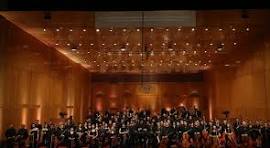
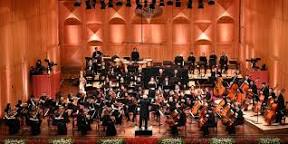
The NSOU’s style is distinctive. They were led formally on to the stage by their leader, Maksym Grinchenko, as the lights dimmed. Second violins sat to the right of the conductor with cellos next to the firsts and the harp at the heart of the orchestra.

This was my first visit to the concert hall at Fairfield Halls (although I’ve been to the Ashcroft Theatre several times) since its  long closure and expensive refurb before the pandemic and I have to say that it is now acoustically superb. I should think Volodymyr Sirenko was pleased with the balance he and his band were able to achieve at this rather splendid concert in an outwardly unpromising venue on a wet October night.

First we got Richard Strauss’s tone poem Don Juan – a big sound and lots of passion with some especially pleasing work from trumpets. Sirenko coaxes effects from his players with his hands and doesn’t use a baton.

I think the fourth is my favourite of all Beethoven’s five piano concerti (although I am inclined to say that of which ever one I happen to be listening to). I love that beautiful piano solo entry which still feels unexpected even when you’ve heard it hundreds of times before. Soloist Antonii Baryshevskyi, who looks like a young Dante Gabriel Rossetti, found aching poignancy, especially in the big runs in the first movement. I was intrigued by the cadenza which was very different from the ones I’m used to. It wasn’t remotely Beethovenian but felt full of anguish until we reached the final trill which triggers the re-entry of the orchestra. I think it was probably a heartfelt political statement and wondered if Baryshevskyi wrote himself in the traditional way. Thereafter came a delicate slow movement, with exceptionally sensitive rapport between the conductor and soloist at every entry and a crisp transition into the Rondo. And I tried not to smile too much at Baryshevskyi’s black jeans, trainers and coloured socks while evey other player was conventionally, formally turned out in black with bow ties for men. His playing more than made up for any sartorial oddity.

The real discovery of the evening, though, came after the interval: the second symphony of Boris Lyatoshynsky, a Ukrainian composer who died in 1968 having, like Shostokovitch, lived and worked for many years under a regime which expected music to be “patriotic” rather than “decadently” experimental. All new music was required to conform to the doctrine of “socialist realism”.

Lyatoshynsky’s work was completely new to me. Dating from 1936 and revised in 1940, the second symphony is a compelling, three movement work of bleak tonality with a lot of angst lurking amongst the rich orchestral colours. Inevitably, it was not approved of and heard very little until the 1960s. The NSOU clearly now plays it as commitedly and knowledgably as the Vienna Philharmonic plays Strauss or the Czech Philharmonic plays Dvorak. It’s in the blood.

I particularly liked the cello solo in the first movement, the soulful brass canon in the third and the grandiloquent, heavy denouement with tubular bells. The NSOU’s double bass section is especially good. Positioned behind the cellos and first violins, they played every note – bowed or pizzicato – with panache and, unusually, it contributed a very vivid part of the texture.  I sympathised with Sirenko at the end of the first movement, though – he evidently wanted no applause to break the mood and he was right.

It made sense, although it became a longer-than-average concert, to finish with Finlandia. Yes, it gave the audience something rousing and familiar to go home humming but more importantly it was written as a nationalistic statement in support of the independence movement in Finland. The Fins were resisting the Russians so it’s a good fit for NSOU now. And played with percussion and brass sections as strong as this orchestra has, it sounded incisively powerful.

NatSympORcUkraine


It was one of my former A level student who emailed me around 2010. “Mrs Elkin, have you read this?” she asked excitedly. “If you haven’t I know you’ll love it. It made me think of you such a lot”.

Well I could hardly resist that, could I? So I bought Anne Fadiman’s Ex Libris: Confessions of a Common Reader (1998) and admired every word. It’s a witty series of essays about books, reading and the effect it has had on the author’s life. Anne Fadiman is an American journalist from a Very Bookish Background.

The quality of her writing is so magical that I hardly dare make the comparison but I’ve come back to Fadiman’s book now – with great pleasure – because I too have just finished a semi-autobiographical book about books and reading. All Booked Up: A Reading Retrospective will be published by The Book Guild on 28 March. I was asked by my publisher (standard practice) which other books/authors my new effort could be likened too. So I cited Anne Fadiman and of course, once I’d picked her book up again I had to read it right through.

She starts with a very amusing account of merging her personal library with her husband’s, several years after they got together. This “transfer of books across the Mason-Dixon Line that separated my northern shelves from his southern ones” was arguably a much more significant step for a pair of bibliophiles than sleeping or living together. George’s books “comingled democratically, united under the all inclusive flag of literature” whereas hers were “balkanised by nationality and subject matter”.

In other essays she writes about sitting in a restaurant with her parents and brother (like George and her two children, they feature a lot) where they all, habitually, vie with each other to spot the errors in the menu rather than choosing food – a whole family of soi-disant proof readers. I liked her essay about Gladstone, Victorian Prime Minister, and one of the most enthusiastic readers ever. In another mood she depicts her eight month old son devouring literature – literally. And she’s thoughtful on the not exactly snappily named The Mirror of True Womanhood: A Book of Instruction for Women in the World which she inherited from her grandmother.

She is hilarious about her own compulsive attachment to mail order catalogues especially when there is nothing else to read but where on earth do they come from? “Although it is tempting to conclude that our mailbox hatches them by spontaneous generation, I know that they are really the offspring of promiscuous mailing lists which copulate in secret and for money”  I joyfully marked that sentence, as I read the book. Like Fadiman I am not much interested in the sanctity of bindings and paper – it’s the content I want. That’s why I’ve taken so readily to reading on a digital tablet, as perhaps Fadiman has by now too. You do, however, miss the scribbles, biscuit crumbs, stains and folds in the old editions which date from student days and have become part of a book’s history as well as of yours. She’s right about that.

It’s quite an art to be intelligent, accessible, thoughtful, funny and scholarly all at the same time but that’s what Fadiman achieves. Thank you, Rachel, You were right. Ex Libris and I were made for each other.

Next week on Susan’s Bookshelves: Daughters of the Late Colonel by Katherine Mansfield.

If someone gives you short shrift in a new fangled way it probably puts you on your mettle because you don’t want to eat humble pie or be hoist with your own petard.  Common, easily understood expressions – but have you ever stopped to think about shrift, newfangled, mettle, humble pies and petard?

It’s actually very odd how often we unthinkingly use words without knowing what they mean.  We’re confident that getting away with an exploit scot-free is  to achieve something vaguely risky without incurring any penalty, payment or injury but  what exactly was, or is, a scot (as opposed to a Scot which is a native of Scotland)? It was an English municipal tax, or the payment or levying of it, and it comes from an old Norse word skot meaning a shot or contribution.

Words are organic. They develop. They are born, they live and they die. The life cycle of a word often spans a millennium or more.   But sometimes they retain a last gasp of immortality by living on in the language idiomatically, the lexical equivalent of a biological throwback.

‘My teenage children  are  beginning to kick against the traces’ you might hear a parent say.  Kicking against the what? A trace was one of two straps chains or lines of a harness for attaching a horse to a vehicle and the word comes via Old French from the Latin word tractus, which is the past participle of the verb trahere to pull or to draw. A lad (or lass) who is kicking over the traces is therefore resisting restraint. Still in the realms of bestial metaphor, he or she might just as easily be kicking against the pricks – or not responding to being prodded by the sort of spurs or goads used to control domestic animals in the past.

So what actually was short shrift? Remember Romeo and Juliet? The Nurse has to find a plausible way of getting Juliet out of the house with minimum supervision and fuss as cover for her secret marriage to Romeo. ‘Have you got leave to go to shrift today?’ she asks in perfectly balanced iambic pentameter. Shrift was confession of sins and the granting of absolution so it meant a convenient private appointment with a priest. The past participle of this delicious word was ‘shriven’ and the associated adjective ‘shrove,’

In Britain the Tuesday before the first day of Lent (Mardi Gras in most of Europe and the US ) is still called Shrove Tuesday because it was the day on which it really was essential  to get a sin-free clean slate with which to begin  of the Lenten fast.

Anyone who got ‘short shrift’ received very little time and sympathy from the priest and so felt put out.  And that’s what getting short shrift still means. Someone who gives it to you is not giving you the time and attention you think you deserve.

New-fangled is a nice word too.  Laden with negative connotations, it means, of course, modern and unnecessarily complicated or gimmicky. It stems from the Old English word fangen, the past participle of fon – to take or seize. Thomas Wyatt’s early 16th century poem ‘They Flee From Me’ describes his former lover leaving him to ‘use newfangleness.’

Mettle – that you might be put on – is just an alternative to ‘metal’ meaning strength or defensive, but humble pie and that petard that you, like Hamlet, might be hoist with, are interesting.

Obliged to eat humble pie, means you have no choice but to abase or humble yourself by apologising. The expression is actually a pleasing pun on an obsolete word. ‘Humples’ were the offal of deer and anything made with them was very lowly, or humble, food. So if you put yourself in the wrong you must swallow your pride as if you were eating this unglamorous dish.

A petar or petard comes form a jolly, Early French word peter which means to fart.  It was a case for carrying explosives for military detonation and later it came to mean a firework with a loud report. To be ‘hoist’ with it means in effect that you’ve blown yourself up with your own bomb or yourself suffer  from a misfortune you were planning for someone else. Hamlet, through whom Shakespeare coined the phase, meant that Rosencrantz and Guildenstern, who are in the pay of the King Claudius to despatch Hamlet to a watery grave in the middle of the North Sea, would be outwitted and themselves drown instead.

And while we’re on the subject of Hamlet, what about that useful old suffix  –monger from Old English manger, itself from the Latin mango, mangonis – a dealer, especially in slaves.  It now means a trader or dealer, or a person who attempts to stir up something petty or disreputable.  That’s why Hamlet, in his simulated madness, pretends to think that the obnoxious Polonius is a fishmonger. The old trade names such as fishmonger and ironmonger have all but died out now, but we still use the suffix in coinages like war-monger or lie-monger.

One of the interesting things about the mangere-derived monger is that, surprisingly, it has no etymological kinship with the two separate meanings of ‘mangle.’  A mangle, meaning a  machine with rollers for pressing the water out of laundry, comes from a Dutch word mangel via High German and Middle High German and originally from Latin manganum  from the Greek manganon, a pulley block.

Mangle, on the other hand, meaning to hack, crunch or spoil, comes from an Old French verb maynier to maim.

Another delightful word which survives idiomatically, but not otherwise, is fettle. If you’re in fine fettle you’re fit and ready for action. It originates in the Middle English verb fetten, to shape or prepare, which in turn developed from the Old English word fetel, a girdle. So the sense is that if you’re appropriately belted you’re ready for anything. But don’t try taking your filthy lucre (from the Latin lucrum, a gain and related to ‘lucrative’) and asking for a fetel in your local department store.

If you do, you might end up with a pig in a poke – the most attractive thing about which is the monosyllabic alliteration.  What use would a pig be to anyone if it were small enough to fit in a pocket? A poke – which often had female sexual connotations because of its hollowness – is an old form of the word ‘pocket’ and both are related to ‘pouch’ from the Middle English poket and Early French pokete.

 And while on the subject of alliterative plosives do you ever describe anyone or anyone as ‘plain as a pikestaff’? If so, do you actually know what a pikestaff was? It was a spiked walking stick for use in picking your way across slippery ground – a practical safety device, not renowned for beauty. It was also the staff of a foot soldier’s pike, a weapon consisting of a long rod with a pointed steel head. An unlovely item, its name derives from early French piquer, to pick and originally, rather charmingly, from the Latin word for woodpecker picus.

 Ramshackle is a faintly onomatopoeic word meaning badly constructed, in need of repair or falling down.  It is the past participle, and only surviving part, of the obsolete verb to ransackle [sic] although we still have the parent verb to ransack. Ransackle took a –le suffix because it was a frequentative. To ransackle was to ransack often, just as to suckle was to suck repeatedly and to sparkle was to spark again and again.

‘I believe in the quick and dead’ states the Apostles’ Creed. Quick meant living from Old English kwic, alive. That’s why, until recently, a mother or midwife would talk of an unborn baby ‘quickening’ once the pregnant woman had felt foetal movement. It also accounts for the expression ‘It cuts me to the quick’ meaning that the speaker is so deeply hurt that it’s as if living flesh is damaged.

So one way and another you probably need to watch what you say – or mind your Ps and Qs. Your what? There are three possibilities.  Perhaps the expression came from telling children learning to write to take particular care with two easily confused letters. But the explanation that in ale houses customers would order pints and quarts (two pints) and have therefore to look carefully at the bill when it came, is much more fun. Better still is the theory that Ps and Qs were pieds (feet) and queues (wigs) at the French court of Louis XIV who reigned from 1643 to 1715. Dancing masters would tell their pupils to mind their Ps and Qs when bending low to bow formally.

books-4515917_1920

Show: DOLLS & GUYS

Society: London (professional shows)

Venue: Bridge House Theatre. Bridge House, 2 High Street, London SE20 8RZ

Credits: By Sabean Bea and Alanna Flynn. Directed by Julia Sudzinsky.


DOLLS and GUYS

3 stars

Susan Elkin

Photo: Courtesy of Dolls and Guys.


The seven hander, sixty-minute play has toured before and this revival is a good fit for the intimacy of The Bridge House. Moreover it was good to see the house almost full. There is some interesting work coming through this venue and I’m glad that word is evidently getting out.

Dolls and Guys is a quirky, surreal, but pretty telling exploration of the dating app world and the fine line between some aspects of it and the sex industry. We’re in a futuristic toyshop in which five humanoid dolls are on sale. When a customer appears, they freeze as dolls. At other times they chat, joke, dance, bitch, worry and reminisce as five very different women thrown together probably would. One by one they are purchased but always returned to the shop because, in some way, they fail to please.

It’s a good idea for a play but it’s a bit choppy with two many short scenes. It feels like work in progress and maybe it is. There are storylines which are underdeveloped. I was desperate, for instance, to know what had really happened to Lucy (Violet Verigo) who is repeatedly returned to the shop because she has broken. Then, oddly, in the last ten minutes, which is arguably the best bit of the show, we seem suddenly to be in a completely different play as Sabean Bea as Juliet and Dorothea Jones as Billie share  heartbreaking memories of their schooldays and growing up.

Dolls and Guys showcases some good acting, however. Jones has riveting intensity and Kerry Boyne is perfect as Soraya whose attention grabbing, flaunting self confidence masks a lot of vulnerability. Nicholas Pople (excellent voice work) plays a whole series of customers and Alex Akindeji is naturalistically convincing as the shopkeeper.


 Subsc

Show: A View From The Bridge

Society: Chichester Festival Theatre (professional)

Venue: Chichester Festival Theatre. Oaklands Way, Chichester PO19 6AP

Credits: By Arthur Miller. A co-production with Headlong, Octagon Theatre Bolton and Rose Theatre.


A View from the Bridge

3 stars

Susan Elkin |

Photo The Other Richard.


I watched this moving production of a powerful play in the midst of a large secondary school party – year 9, I think. They clearly didn’t know A View from the Bridge so their very fresh reactions became part of my experience too. They were, for example, shocked into stone-still horror at the visceral climax. No Arthur Miller play ends happily, after all, and the effect of Eddie’s inevitable downfall is profoundly shocking in Holly Race Roughan’s take on the play. And the spaciousness of CFT’s big stage along with Max Perryment’s menacing sound design psychs it all up effectively.

Nancy Crane is the first woman to play Alfieri, the lawyer who functions as a quasi Greek Chorus or narrator in what is effectively a Greek drama set in Brooklyn. Continuously on stage, often she’s in shadow or half-lit. She is pleasingly naturalistic particularly in the scenes when she is consulted by other characters for advice. There is an audibility issue though with her, and sometimes with other cast members, especially when she’s on the balcony/bridge which is upstage and high. The combination of the adopted flat New York accent and the inevitable masking caused by working on a big thrust stage means that words, or even whole sentences are lost – at least from Row H where I was sitting along with all those 13 and 14 year olds. This is a great pity because an audience, by definition, needs to hear the play and if they can’t then, however good the production, the experience is marred.

Famously, the play tells the story of Eddie who has lovingly but over-protectively brought up his orphaned niece Catherine (Rachelle Diedericks – good) and accommodated illegal Italian immigrants in his hard won Brooklyn home. He is appalled when she falls in love with one of the lodgers whom Eddie regards as despicably effeminate. It’s an exploration of changing patriarchal values and, of course, immigration is as topical now as it was in the mid-1950s.

It’s generally a strong cast among which Kirsty Bushell as Eddie’s wife, Beatrice, is outstanding. She pleads, frets, loses patience and completely inhabits a very three dimensional character, torn between her love for Eddie and the voice of reason and common sense. And her “pieta” tableau at the end is beautifully poignant. Beatrice is one of§ the best of Arthur Miller’s long suffering, troubled women.

There are symbolic things in this production the rationale for which isn’t clear. I could have done without the ballet dancer, the garden swing and the slow motion hefted wooden chairs. That school party certainly went home with plenty to reflect on and discuss but I’m glad I wasn’t one of the accompanying teachers attempting to explain some of the more obscure directorial decisions.


First published by Sardines: https://www.sardinesmagazine.co.uk/review/a-view-from-the-bridge-2/


The opening item in the first concert of Maidstone Symphony Orchestra’s 113th season was Smetana’s overture to The Bartered Bride. It’s one of those “lot of notes” pieces with an terrifyingly exposed second violin passage  but in Brian Wright’s warmly safe hands, MSO delivered it at a nippy tempo and with appropriate exuberance. The orchestral sound was, as ever, beautifully balanced. This is Wright’s 33rd season with the orchestra and that total, long established trust between him and the players shines through.

Brian Wright


Then came British cellist Maxim Calver to play Shostokovitch’s first cello concerto (1959) – his third concert with the orchestra. This bleak, anguished but beautiful concerto has become quite well known since at least two people (Guy Johnston and Sheku Kanneh-Mason) have won BBC Young Musician of the year with it. Calver’s playing was both intense and insouciant as he hammered out those relentless, menacing rhythms in the first movement. I loved the brooding, legato lament he dug out of the slow movement and his mellow mournfulness of tone in the cadenza – carefully applying vibrato to some notes and not others as much Shostokovitch string writing seems to demand. He followed the concerto with Pablo Casals’s  sorrowful Song of the Birds as his encore, and hinted it was a way of marking these “sad times”.

artist-maxim-calver


And so to Brahms’s first symphony, often regarded as a homage to Beethoven, although it’s a lot more than that. Wright set it going with all the grandiloquent panache it needs and brought out plenty of nicely balanced lyrical wind detail in the first movement. The andante gives us one of Brahms’s many lovely oboe melodies played here with gentle passion and the violin solo (leader Andrew Laing) with the horn at the end of the movement was arrestingly moving. After a lilting allegretto – a sort of descendant of the classical minuet and trio – Wright delivered the big Beethovenian melody in the final movement with all the right Brahmsian spin and some attractive flute work. And all this was achieved with commensurate professionalism despite a distracting problem with Mote Hall’s lighting rig in the second half.

It was a fine and enjoyable concert overall and if one or two players were, unusually for MSO, not having the best of nights the hiccoughs were pretty brief and would have passed almost unnoticed by most of the audience.