Press ESC or click the X to close this window

Susan’s Bookshelves: The Virgin Suicides by Jeffrey Eugenides

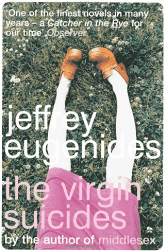
I read Middlesex by Jeffrey Eugenides in 2003 when it won the Pullitzer prize and was fascinated by the glittering originality of the style  as well as by the subject matter: Greek immigration into the USA and the experience of “daughter” who is genetically male. Even the title is a stroke of genius. So I read it again during one of those interminable lockdowns and was just as riveted 20 years on. That led me to an urge to explore (reading is a lifelong journey of discovery, after all) anything else that Eugenides has written – and thus to The Virgin Suicides, his debut novel which was published in 1993.

It’s set in Grosse Point, Michigan, not far from where Eugenides was born in Detroit (1960).  It’s a small, insular, lakeside community. According to Wikipedia it still had only just over 5000 inhabitants in real life in 2010. The unnamed  narrator is one of a group of teenage boys looking back investigatively two decades later on the time when they watched the Lisbon house obsessively back in the 1970s. They still have numbered items of evidence salvaged from the house and they have obsessively conducted interviews with people who remember what happened.

And the reader knows the outline of what happened almost from page one  and the title is a giveaway, obviously.  All five Lisbon daughters commit suicide. For Cecilia, who dies a year before her sisters, and  for Mary it takes two attempts. Bonnie, Therese and Lux manage it first time each using a different method.  No one – in that claustrophobic environment –  really understands why although it appears to be some sort of pact.

What  Eugenides does so beautifully is to build up the tension as we learn – very gradually – how events unfolded and there’s a faint stylistic whiff of To Kill Mockingbird as he tantalisingly shifts back and forth in time.  I love the idea of five girls – shades of Pride and Prejudice – all immaculately differentiated. One is promiscuous and  finds a way of secretly allowing a whole succession of boys to get to her on the roof of her family home. Another habitually wears a tattered wedding dress.  A third lights candles. There’s a lot of mystery and weirdness.  They are rarely allowed out although the boys see them at school where their wan, troubled father teaches maths until he’s dismissed. There is one memorable date night when all five are taken to a school dance by five boys and one tightly chaperoned party at the Lisbon house but otherwise it’s the unanswered questions surrounding the girls which makes them so alluring to the boys of the town. Their mother is misguided, confused and strictly dictatorial which is maybe why her daughters, eventually, do the only thing they can control.

As, in Middlesex, the writing style fizzes and dances freshly and, partly a study of adolescence, it’s often gently lyrical  No wonder The Virgin Suicides has been translated into 34 languages and was adapted into an acclaimed film (1999) by Sofia Coppola. As for me, I shall now investigate the rest of Eugenides’s back list, including some short stories
2VirginS

Next week on Susan’s Bookshelves:  Laurie Lee Selected Poems
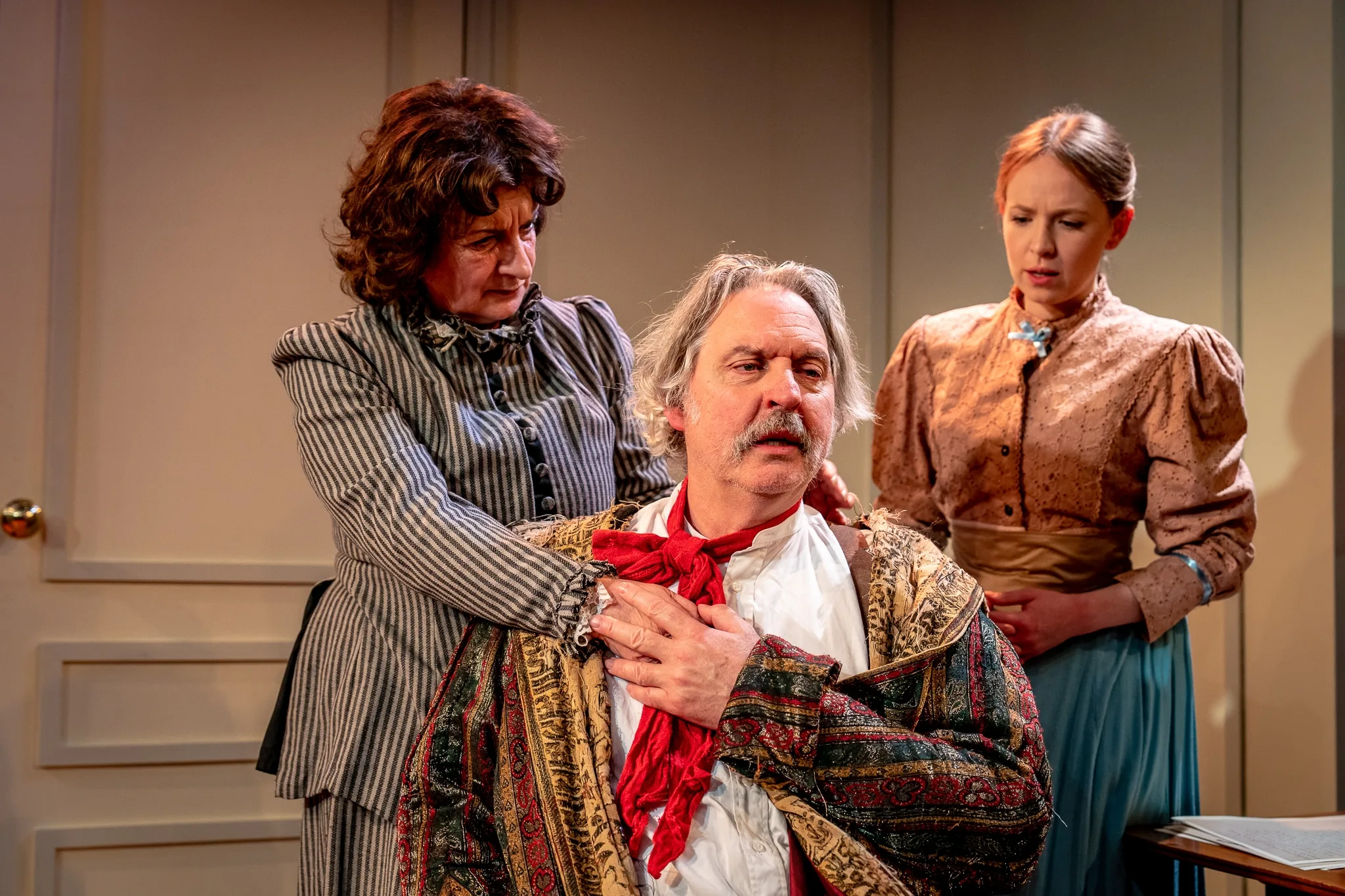
 

Norma Atallah Bob Barrett and Rosalind Lailey in The Oyster Problem at Jermyn Street Theatre. Photo: Steve Gregson

Show: The Oyster Problem

Society: London (professional shows)

Venue: Jermyn Street Theatre. 16B Jermyn Street, St. James’s, London SW1Y 6ST

Credits: BY ORLANDO FIGES. DIRECTED BY PHILIP WILSON

The Oyster Problem

3 stars


When I was working for my O.U. degree in the 1980s, and studying the Enlightenment, the teaching included an execrable short film. It proposed a dinner party (which never happened) at the court of Frederick the Great. The idea was to give us an easy handle on what the likes of Voltaire, Diderot and co actually thought.  All it did in my case was to make me giggle at its awfulness but I suppose it provided a job for a few D-list actors.

I was reminded of all this by the first act of The Oyster Problem. It’s far better (it could hardly be worse) than that weary old OU effort but there’s a whiff of similar contrivance. Flaubert, Turgenev Zola and Georg Sand  are in a café in Paris – introducing themselves as well as making us aware of their problems, issues and points of view. It is trying very hard not to be clumsy.

Flaubert and Turgenev, almost contemporary in age, were actually close friends and met a lot in the 1870s to share oysters among other things. They were sometimes later joined by the younger Zola. Sand – the only one of these four writers I haven’t read – was nearly a generation older and probably better known today for her long liaison with Frederick Chopin in the 1840s than for anything she wrote.

The problem with this play is that a lot of the dialogue has been adapted from letters. Orlando Figes is a historian and this is his first play. Sometimes it feels more like people making long, often clunky, statements than having a conversation. And that inhibits the actors. It’s also too long.

Bob Barrett does very well though with his forceful, often rude Zola, whose bladder problems are – apparently – well documented. He finds plenty of pugnaciousness blended with confidence in his own ongoing success along with genuine concern for and kindness towards Zola. Somehow his broad Scots accent helps to stress his difference from the others.

Giles Taylor galumphs about the stage being infuriating as Flaubert who is a one hit wonder (Madame Bovary), a profligate spender (oysters!) and now threatened by bankruptcy. Rosalind Lailey is sweet and anxious as his painter niece and Norma Atallah presents the voice of common sense as Sand.

Full marks to Isabella Van Braeckel for her imaginative set and costumes. The absurdly flamboyant, tatty Prospero-type robe Flaubert insists on wearing at home is splendid and as for the pale green dress worn by Lailey – where can I buy one? The set – never easy in Jermyn Street’s very restrictive playing space – ingeniously gives us white shutters which open to reveal the windows of Flaubert’s home. Closed they suggest the bare walls of a restaurant or railway station.


Standing at the Sky’s Edge continues at the National Theatre (Olivier) until 25 March 2023.

Star rating: four stars ★ ★ ★ ★ ✩

A show whose central character is a 1960s high-rise housing estate in Sheffield – “a man-made monolith” – sounds unlikely but Robert Hastie’s direction, imaginative theatre craft and plenty of heart make it both dramatically arresting and moving.

We’re inside a flat in Park Hill, Sheffield. The views, we’re repeatedly reminded, are fabulous. Ben Stones’ grandiloquent set gives us brutalist balconies and concrete pillars around which the choreography (Lynne Page) is woven.

Someone, in real life, scrawled “I love you will you marry me” on the building in 2001. Later cleaned off but reinstated last year, these seven words are neon-lit above the set.

And in this setting writer Chris Bush gives …

Read the rest of this review at Musical Theatre Review: https://musicaltheatrereview.com/standing-at-the-skys-edge-national-theatre/

I blame Jermyn Street Theatre. I was early for a show there recently (review job) and the doors weren’t open. So I retreated to the warmth of Waterstones round the corner in Piccadilly. There, I spotted a new, very appealing brand line from Penguin – Little Cloth Bound Classics. I chuckled as I browsed. Penguin famously pioneered pocket sized paperback books in the 1930s  in order to make reading more affordable and portable. Has it now gone full circle?

Naturally I bought one. And chuckled again. The Cossacks dates from 1863. It was styled as a short story and Penguin has previously presented it in a fat volume with other stories. Well “short” is a misnomer and I’d defy anyone to read it one sitting. In this edition it runs to 261 pages. I suppose by then Tolstoy had already written his “loose baggy monster”, as Henry James called War and Peace  which was published eight years earlier. Once you’ve written a novel of nearly 600k words your concept of “short” is bound to have shifted a bit.

Dmitry Andreich Olenin is a wealthy aristocrat who has tired of the shallowness of Moscow life. He therefore goes as an officer cadet to the Caucasus to assist the Cossacks in their war against the Chechens. There he meets a girl named Maryana and is very taken with her beauty, naturalness and verve but she’s committed to marry a local boy. There is no happy ending for any of them.

Tolstoy is very good at evoking life in the remote Caucasus – at times it reads like notes for a TV documentary. These people live in what translator David McDuff gives as “settlements” as opposed to villages although they seem to have everything they need such as guns, horses and material to make new clothes for festival days. They hunt a lot in woodland which seems to be rich with game and make their own very potent wine chikhir from their abundant vineyards.  Olenin is billeted with one of the families and we see most of this from his point of view. It is exotically attractive to him and remote, in every sense, from Moscow.

Tolstoy has based much of this – the picture he paints of the scenery is good too – on his own experience of serving in the Crimea. He subtitles it “a Caucasus tale of 1852”. There’s a great deal of drinking, shooting and wistfulness.

Of course I have read Tolstoy before although I much prefer Anna Karenina, which I have enjoyed five or six times, to the Loose Baggy Monster.  Written in the 1870s when Tolstoy was a mature man in his fifties Anna Karenina is much more measured and grown up than War and Peace which was published two decades earlier. It’s half the length too.  I didn’t, however, know much about his “short” fiction which I shall now explore further.

cossacks2

Next week on Susan’s Bookshelves: The Virgin Suicides by Jeffrey Eugenides

Show: Our Country’s Good

Society: Tower Theatre Company

Venue: Tower Theatre. 16 Northwold Road, London N16 7HR

Credits: by Timberlake Wertenbaker. Directed by Peta Barker.

Our Country’s Good

4 stars

Timberlake Wertenbaker’s 1988 play is probably her best and it’s certainly my favourite because, of course, it’s a play about theatre and a huge clarion call for the redemptive power of the arts. So it’s always been topical and never more so than now.

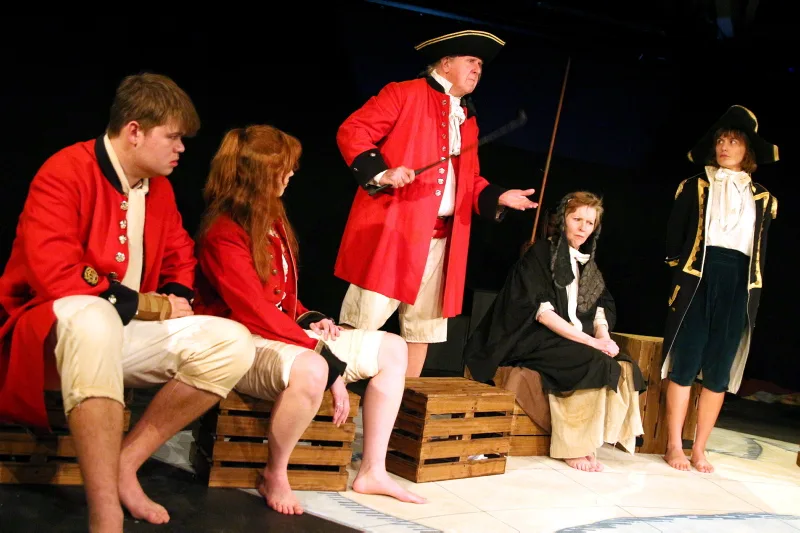
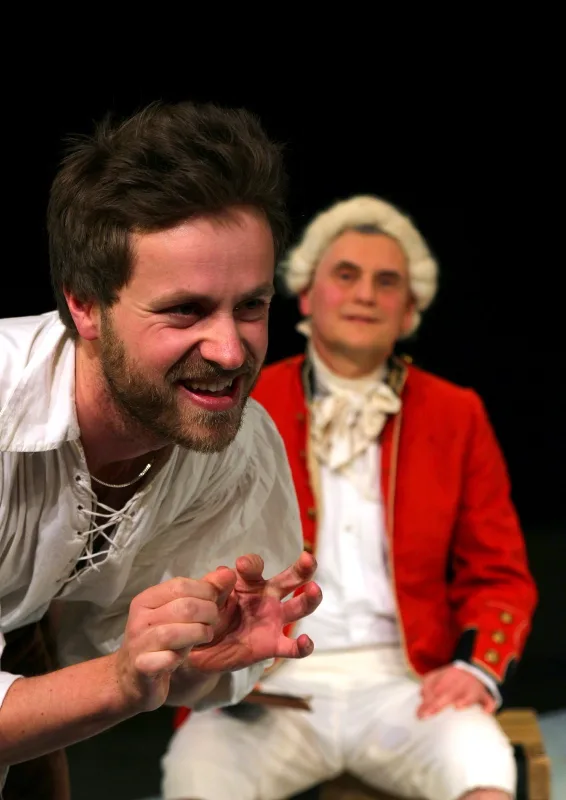
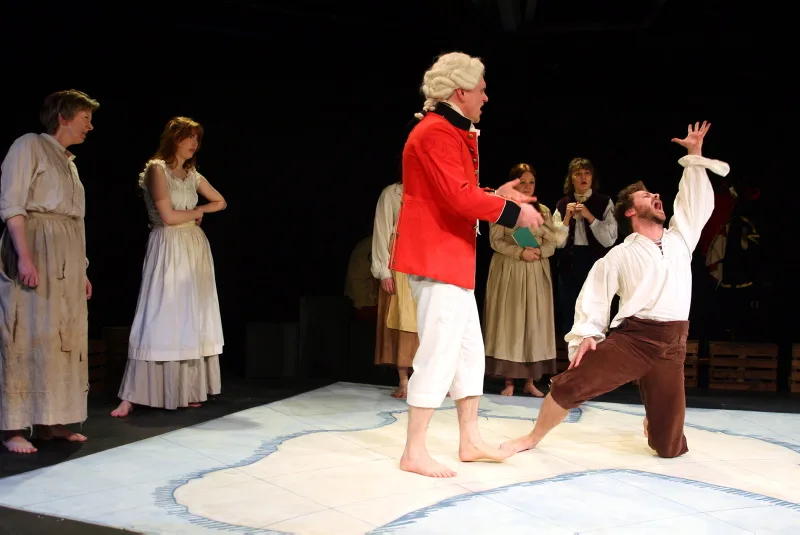
Adapted from Thomas Keneally’s 1897 novel The Playmaker, the play takes us to the early days of the penal colony in New South Wales.  Everyone is there for the “good”  of the motherland – or  for “our country’s good”. The governor of NSW Captain Arthur Phillip (Georgia Koronka) wants to move away from the hanging and flogging culture. He is ridiculed by some of his die-hard staff for wanting to “civilise” the convicts through drama (sounds like the situation in many a 21st Century inner city comprehensive school). Eventually he gets Second Lieutenant Ralph Clark (Jonathan Wober – good) to direct a production of George Farquar’s The Recruiting Officer and as rehearsals progress and repeatedly stall we watch the change and development of his motley cast. Our Country’s Good is indeed a fine and powerful  play.

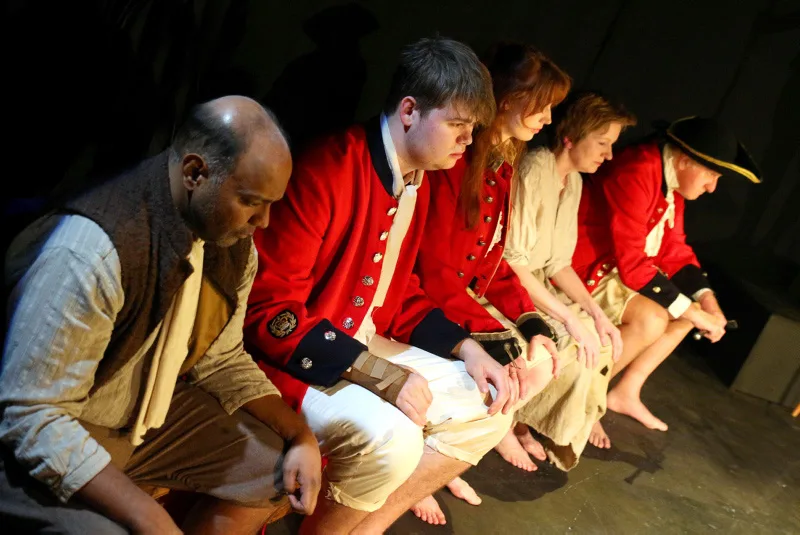
Peta Barker’s imaginative direction places all the cast on stage sitting around the edge of the playing space in the dark beneath an awning visibly managing their costume changes.. Thus they are, in every sense, a company of actors able to chorus the chapter/scene headings effectively. Their seating is a row of small crates which are brought on stage to suggest various things such as a rowing boat or chairs at a meeting.

I admired the role doubling and enjoyed a shared chuckle when the play itself comments that an actor playing more than one part would confuse the audience. Koronka is especially good as the governor, using gently heightened RP and presenting plenty of authority and then, in complete contrast,  as Wisehammer the intelligent, sensitive Jewish convict who wants to write plays.

Casting is cheerfully gender blind too. Rebecca Allan is totally convincing as Midshipman Harry Brewer, deeply in love with his live-in convict Duckling Smith (Georgina Carey who is also excellent as the sneering Captain Jeremy Campbell). Allan brings lots of pushiness and attitude to Dabby Bryant too. And we are all “ “paying attention” as the play instructs us that theatre goers should, so nobody is in the least confused.

This is a commendable production of a play which is warmly familiar. Most of the cast are strong and it has been made to sit very happily in the Tower’s triangular playing space. As ever I had to swallow a lump in my throat at the end. Let’s hope some of  those people – in government and elsewhere – wont to beliitle the power of the arts in education and elsewhere know the way to Stoke Newington.


 First published by Sardines: https://www.sardinesmagazine.co.uk/review/our-countrys-good-6/


Show: Much Ado About Nothing

Society: National Youth Theatre of Great Britain (NYT)

Venue: Duke of York’s Theatre. St Martin’s Lane, London WC2N 4BG

Credits: William Shakespeare remixed by Debris Stevenson. Performed by National Youth Theatre Rep Company.

Much Ado About Nothing

4 stars


So how do you make sense of a patriarchal Elizabethan play for an Instagram-obsessed world? Set it as a production of Love Island, of course. You can always rely on National Youth Theatre to come up with an interesting and original slant, but this time it has really excelled itself with this whackily, clever take on a play written over 400 years ago in 1598.

Nothing Island is a TV programme in which five young men and five young women are lined up to pair off. The producer sits at the side with a screen while her head-phoned minions scamper about with i-Pads. Over-stage screens comment on what’s happening with social media comments – a lot of fun has evidently been had in making these up.  We see the characters both in action and at times when they’re meant to be off-duty but they’re continuously observed. The production is the king to which everything must defer.

Most of the language is Shakespeare with occasional asides, interjections or comments in modern English and liberal word substitution to make it all hang together. Debris Stevenson has also had fun slipping in the odd line from other plays which makes a few people in the audience chuckle. I love the rap dance performed by Beatrice (Isolde Fenton) and Benedick (Daniel Crawley) the first time we see them together. It’s a perfect match to Shakespeare’s iambic pentameter as they fence verbally and in dance with each other.

I also admire the decision for each actor to play in his or her own accent because these young people come from all over the country and it means we get a gloriously diverse aural mix. Fenton, for example, is Irish while Crawley is Scottish.

The cast – the  sixteen actors who form the 2023 NYT rep company – are all strong and there’s some pleasing ensemble work. Both gulling scenes are beautifully directed (Josie Dexter) and very funny. A female Don Jon and Verges as a dappy therapist are among the play’s many good ideas.

Thuliswa Magwaza’s Hero is giggly, girlish and convincingly in love and she does the anguish when she’s wrongfully accused with conviction. Fenton is warm and witty as Beatrice and manages to make the eventual capitulation to Benedick feel natural. And I liked the way Crawley really stressed the innate decency in his character underneath the banter and joshing.

Zoe Hurwitz’s set is terrific. She gives us a window which swivels to become lots of other things including an absurdly excessive floral wall for Hero and Claudio’s wedding. At the end of the play, the production is over and the cast clears the set off the stage – another neat touch.

I’ve seen many way-out attempts to modernise Shakespeare in my time. I have rarely seen one as intelligent as this. It works a treat and never feels forced. Keep ‘em coming, NYT. The Rep Company project is celebrating its first ten years in 2023. Here’s to the next decade and beyond.

First published by Sardines: https://www.sardinesmagazine.co.uk/review/much-ado-about-nothing-12/


I read James Baldwin’s Another Country around 1968, when it was only six years old and therefore quite a recent book. Baldwin lived on until 1987.

I remember it vividly for two reasons. First,  post-Lady Chatterley, I was fairly accustomed to graphic literary (not always) sex between men and women. But Another Country was the first account I’d ever read of sexual love between men and it was quite an eye opener. I’d led a pretty sheltered life and had never knowingly had a conversation with a gay man. And my parents were of their generation – homophobes by today’s standards.

The other reason I recall it with such clarity is that I was sitting reading Another Country in the family home waiting for my beloved fiancé to arrive. When he did and I went off to find coffee he picked it up, flicked through it and said: “I don’t think this is the sort of book you should be reading”. To say I was astounded would be an understatement. When I had picked myself up off the floor, I said firmly: “If you and I are going to spend the rest of our lives together, let’s get one thing straight now. No one tells me what I’m allowed to read”. That sorted it and I had no more of that sort of thing for the next 50 years.

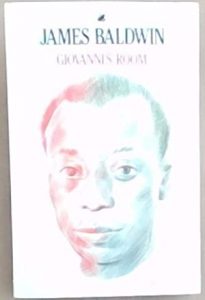
Thinking about all this recently reminded me that I had not read Baldwin’s other novels – and that was what led me to Giovanni’s Room (1956) and its elegant  descriptive prose: “Flakes of snow have drifted across the shawl which covers her head; and hang on her eyelashes and on the wisps of back and white hair not covered by the shawl” or “The table was loaded with yellowing newspapers  and empty bottles and it held a single brown and wrinkled potato in which even the sprouting eyes were rotten.”

Narrator David is an American in Paris – it would be nice to hear some of this novel read aloud against George Gershwin’s piece of that name. I wonder if anyone has ever done it? In part it’s a reflection of Baldwin’s nine year stay in that city from 1948 – we certainly get a very clear picture of  the ambience of post-war Paris.

David’s girl friend Hella has gone travelling elsewhere in Europe, mostly Spain, and he is at a loose end. He falls in with a group of gay men and meets and falls in love with a glitteringly attractive  Italian barman named Giovanni. For several months they live together in the titular Giovanni’s room. Baldwin is very good indeed at the physical ache David feels for Giovanni even when, eventually, he leaves him because he thinks he should marry Hella and Giovanni becomes very self-absorbed and manipulative. About half way though the novel the reader realises that a very tragic end is coming. David is narrating from the South of France. He is alone. Giovanni is … well, no spoilers.  And Hella has seen the truth and gone home to America. David feels a wonderfully well observed mix of guilt, hatred, passion, longing and despair.

I learned something from this novel. I had no idea that sex between men was decriminalised in France in 1791 after the Revolution. It was socially frowned upon especially by the church but wasn’t a crime as it remained in Britain until 1967 and until various 20th century dates in US as each state gradually did the same. Thus David,  in the early 1950s is not going to be arrested for his relationship with Giovanni as he would be in his own country. Italy, where Giovanni comes from, decriminalised it in 1890 and that surprised me too.

And that’s why David feels such a tug – what he wants to do is at variance with what, conditioned by social pressure, he thinks (and convinces himself for a while) that he ought to do. And the tension is very powerful.

Next week on Susan’s Bookshelves: The Cossacks by Leo Tolstoy

Giovanni2

Venue: The White Bear Theatre. 138 Kennington Park Road, London SE11 4DJ

Credits: By Jonathan Guy Lewis and Jasper Rees. Presented by The White Bear Theatre.

I Found My Horn

4 stars

Susan Elkin | 03 Feb 2023 01:08am

Photo by: Max Hamilton-Mackenzie


This is a show which exudes heart. It is also very funny and beautifully observed.

Back in 2008, journalist Jasper Rees wrote a book about how, at a time when his life was troubled, he rediscovered the French Horn he’d played decades before at school but abandoned. Setting himself the challenge of playing the third Mozart concerto to an audience at the end of the year he then took lessons, studied, practised and consulted top horn players worldwide. I read this with fascination at the time because I know from my own experience,  the frustration, wonder and joy which comes from returning to a musical instrument after a long absence.

Jonathan Guy Lewis worked with Rees and his book to develop a one man stage show a few years later and this White Bear Theatre production ably directed by Harry Burton is a welcome revival. The casting, of course, is perfect because Lewis, like Rees, played the horn as a boy, gave it up for a long time but is still a competent player.

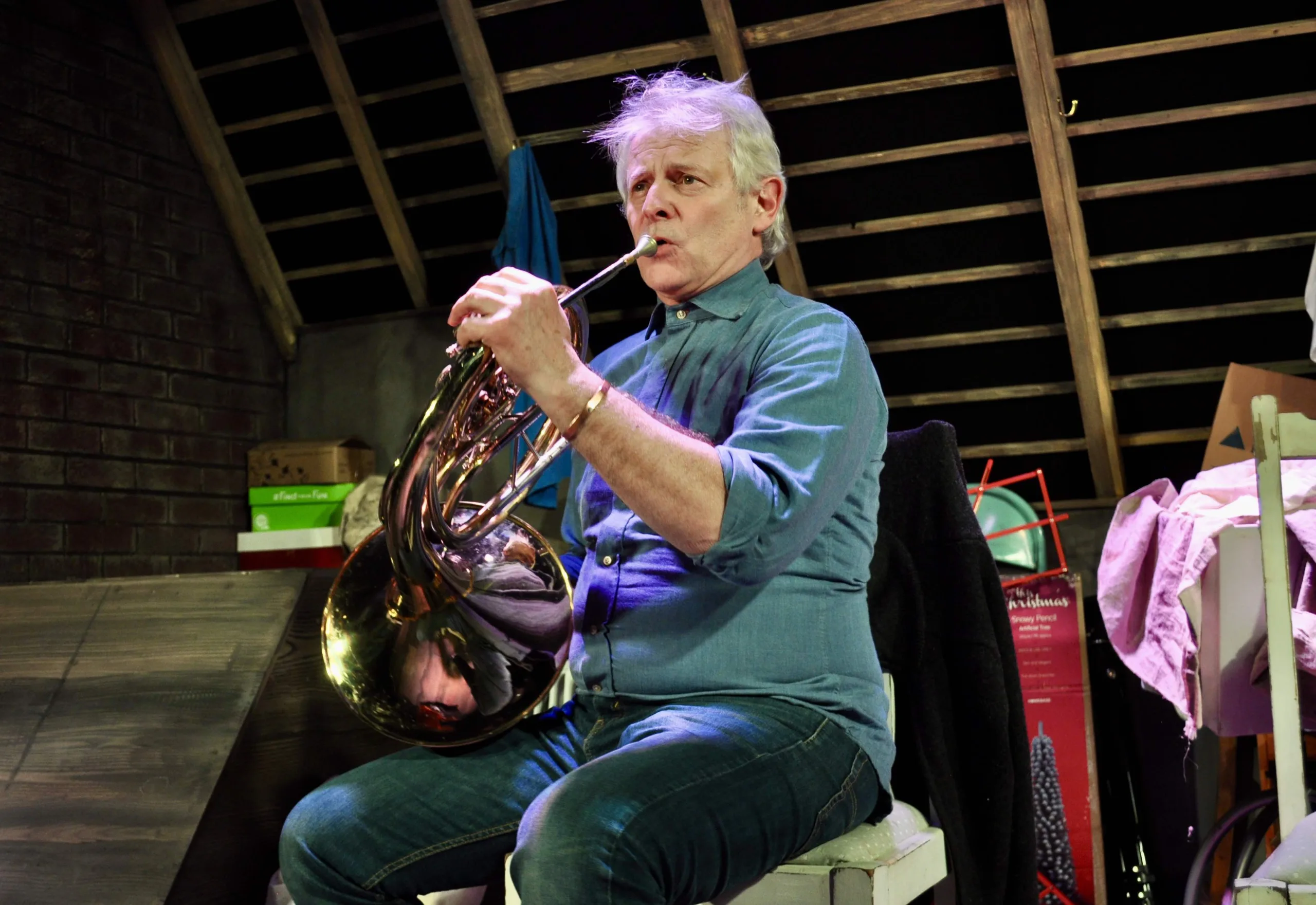
The play opens with Lewis as Rees turning out the attic in the house he has had to leave for his wife and son after divorce. Then he finds the horn which delightfully, has a personality and speaks to Jasper in a Czech accent because that’s where it was made. Lewis is very good indeed at morphing into different characters. Along the way, among others, we get the sulky son, Daniel (all troubled grunts and shrugs), an eccentric music teacher at Jasper’s school, a Yorkshire horn player who becomes a mentor, and several differently accented Americans when he attends Horn Camp in New Hampshire. The characterisation is often hilarious but the accuracy of portrayal is sharp edged.

And of course we hear lots of music as Jasper talks to different people and thinks about different aspects of horn playing – frequently tempted to give up completely and permanently. Finally, of course, having heard only derisory wrong notes for over an hour we know that somehow he’s going to crack it and I walked back to the Elephant and Castle happily humming the slow movement of K447.

It isn’t, though, just a play about music and learning to play an instrument. It’s also about human relationships and finding new ways of being happy. The reconciliation at the very end of the play is understated but warmly powerful.


First published by Sardines: https://www.sardinesmagazine.co.uk/review/i-found-my-horn/