John Betjeman seems to be a Marmite poet. I love the rueful, wit and rapier-sharp observation of, say “Hunter Trials” or “In Westminster Abbey.” But I had two colleagues in my last teaching post who loathed him. One said Betjeman wrote mere doggerel and the other argued that you couldn’t teach Betjeman’s poetry because he didn’t use “proper” poetic devices so there was nothing there to focus on – yes, really. I, meanwhile, went on happily teaching the poems which featured on the GCSE syllabus (same set as we’d previously done with O level candidates) alongside Laurie Lee, Charles Causley and Ted Hughes.
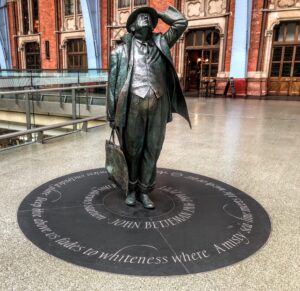
Rereading Betjeman in 2026, of course, it feels dated but that’s part of the charm. Betjeman was (is) all about nostalgia. This is the man, after all, who almost single handedly saved St Pancras station from demolition because he loved Victorian architecture and look at it now.
One of my favourite poems is “Christmas”:
The bells of waiting Advent ring,
The Tortoise stove is lit again
And lamp oil-light across the night
Has caught the streaks of winter rain
In many a stained-glass window sheen
Fron Crimson Lake to Hookers green,
The verbal economy, natural rhyme and evocation of an era and mindset is splendid. And I like the colours because they’re the names from the water colour paint boxes every child of my generation remembers. Moreover I never get through a Christmas gift opening session without thinking:
The Sweet and silly Christmas things,
Bath salts and inexpensive scent
And hideous tie so kindly meant.
It’s actually a serious poem too because he’s reflecting in awe and wonder on the truth (or lack of it) of the Christian incarnation message. His point is that if it’s true then the “sweet and silly Christmas things” are irrelevant – a thought I’ve pondered open-mindedly with many classes of 16 year olds.
And, incidentally, what was that about Betjeman not using poetic devices? There is both alliteration and assonance in those five words. Not that such things are the be all and end all of teaching poetry contrary to what my colleague seemed to think.
Betjeman was passionate about church buildings (”A great Victorian church, tall, unbroken and bright”); nature (“Feathery ash, neglected elder”); and Cornwall (“Sun shadowed valleys roll along the sea”) among other things. He loved public transport too. The poems are suffused with reference to trains and trolley buses with all their noise and ability to change lives by taking people to different places. Betjeman himself travelled all over the country and was inspired to write poems many of which have the names of locations such as “The Licorice Fields at Pontefract”, “Uffington” and “Norfolk”.
Like all good poets he used a range of forms. There are sonnets like “Chelsea 1977” and forays into pentametric blank verse. “Beside the Seaside and Indoor Games near Newbury” mixes long lines with escalating rhyming couplets. Most of his poems consist of series of neatly rhymed four, five or six line stanzas.
He was good at coy sex too. We all know what happened to the Subaltern who canoodles with the girl of the moment until the small hours only to find that “We sat in the car-park till twenty to one / And now I’m engaged to Joan Hunter Dunn.”
Betjeman, who was born in Cornwall in 1906 and died there 77 years later, was married to Penelope Chetwood with whom he had two children – a fact which always faintly surprises me. He never came across – nor does so in his poetry – as a very masculine man.
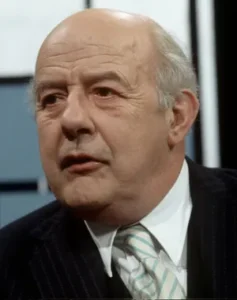
As well as poetry he wrote quite a lot of prose and fronted TV programmes on his favourite topics – all of which oevre is worth revisiting. In the days when Poet Laureateship was a lifelong appointment, Betjeman was appointed Laureate from 1972, after the death of C Day Lewis, until his own death in 1984. John Guest’s little book The Best of Betjeman (first published in 1978) has sat in the poetry section of my bookshelves for a long time. It remains my favourite collection because it includes some of the prose as well as the poetry.
Next week on Susan’s Bookshelves: Small Ceremonies by Carol Shields