Well this is a bit different but, as I often say, eclecticism in reading is all. And in this case it began as research in which one thing to another and a few jigsaw pieces fell into place.
I am familiar with Artemesia Gentileschi’s defiantly “feminist” 1610 painting Susanna and the Elders which lives at Schloss Weissenstein in Germany. I saw it at an exhibition in London a few years ago and I have read a fair bit about the artist, who was extraordinary for her time. Then, in connection with my ongoing short story project, I found myself wondering about Susanna. All I knew was this painting. Who was she and where does she sit in the Bible?
Well, she’s in The Book of Daniel – sort of. Catholic bibles include her story as Chapter 13. Most protestant bibles stick her in the Apocrypha. And no, I’d never realised that Catholic and protestant bibles are different, either. Wherever you read the story it was the calm, wise titular Daniel who disproved the adultery case against her and saved her from execution.
That drove me to wonder who Daniel was? Every school child of my generation knew the story of Daniel in the Lion’s Den and in adult life I enjoyed the famous Rubens painting (1615 – good decade for Daniel-related paintings, evidently) in Washington DC’s National Gallery of Art. Fabulous lions! But who was Daniel and what else did he do? I pulled a Bible from my bookshelves and climbed to the top shelf to retrieve my only copy of the Apocrypha and got reading.
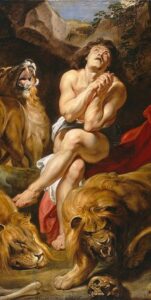
When Daniel was a young man, he and three friends, were handpicked for training Nebuchadnezzar’s court in Babylon after the destruction of Jerusalem in 587 BC. They were exiles but they weren’t badly treated at first and were given plenty of education. Daniel was a favourite because like the more famous Joseph in Egypt (Genesis 41), many centuries earlier, he could interpret dreams – or said he could – which was fine until he stopped telling Nebuchadnezzar what he wanted to hear.
All four men, in a classic case of an attempt to stamp out their Jewish culture and identity had, incidentally, been given new names. And refusal to worship a huge golden image of the king led to the other three Shadrach, Meshach and Abednego – being cast into a fiery furnace which they survived thanks to their faith in their own God: another story primary school teachers used to think every child should know. Later kings also wanted to be worshipped. It was Darius who had Daniel thrown into the Lion’s Den for refusal to comply. And, of course, as a lifelong listener to classical music I knew about Belshazzar’s Feast courtesy of Ralph Vaughan Williams but I don’t ever remember reading the original story until now.
Then there’s King Cyrus (c.600BC- c.530BC) of Persia. I had heard of him, for the first time only recently because my Iranian hairdresser, astonished I didn’t know this history, explained to be at some length what this enlightened man did for her country which is now so troubled. When he popped up in the The Book of Daniel he felt like an old friend.
The so it goes on – Daniel, intelligent and personable, having poetic visions and surviving, his Jewish faith intact against considerable odds. It’s quite a read. And, for me at least, a steep learning curve.
The discrete Susanna incident – seems to fit fairly early in Daniel’s story when be was a respected man of letters at court. She was a married woman of good character who chose (unwisely as it turned out) to bathe alone in her husband’s garden because of hot weather. Crucially, she sent her servants away. Two lascivious elders spied on her and tried to proposition her. She refused. They got their revenge by accusing her of having sex with a young lover. Naturally their word was believed over hers and she was condemned to death – until Daniel intervened and used a time-honoured police/ defence lawyer tactic to prove that the Elders were lying. (They didn’t tell us this one in primary school.)
Most scholars date The Book of Daniel to around 164-7 BC. Some think it was written four centuries earlier at the time of, or immediately after, the Babylonian exile.
Next week on Susan’s Bookshelves: Partita by Barbara Kingsolver