Mahler 6 with Marin Alsop
Philharmonia
Conductor: Marin Alsop
Violin: Esther Yoo
Royal Festival Hall, Southbank Centre
19 November 2026
For this concert the redoubtable Marin Alsop had the orchestra seated traditionally, with cellos to her right – and that’s noteworthy because it’s relatively unusual these days. I suspect she eschews gimmickry and fashion and, of course, the sound she got from the players was perfectly well balanced.
Leonard Bernstein’s Serenade after Plato’s Symposium (1954) is not performed much and it isn’t hard to see why. Bernstein was, of course, a fiendishly clever polymath and in this piece he seems to be amusing himself rather more than entertaining an audience. In four movements it references imagined conversations between seven Greeks and musically, it’s pretty patchy.
Scored for solo violin (Esther Yoo – fine sound), strings, harp and percussion, it has some pleasant spots. Here, for example, the duetting between xylophone and racing strings in Eryximachus was attractive and Yoo gave us some bravura double stopping in the cadenza-like passage which comes in Agathon. And I liked her sustained harmonic over lower strings pizzicato in the final moments of Socrates:Acibiades. Otherwise Alsop more or less carried it off, probably because of her long association with Bernstein (he was her mentor from childhood) but the result was, for me, generally unremarkable.
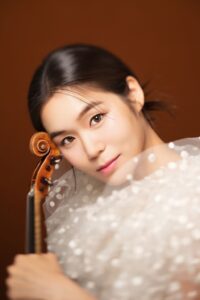
Yoo’s Bach encore was refreshing, and superbly played, but placed between Bernstein and Mahler it felt oddly disparate.
And so to what most audience members had come for: an exciting performance of Mahler’s darkest and most gruelling of symphonies. In contrast to the first five there’s not much light, in any sense, in his sixth symphony (1903) which runs for 79 minutes, most of it heavily minor.
Mahler wasn’t exactly a modest orchestrator. This work requires eight horns, two harps, celeste, eight on-stage percussionists including two sets of timps, two off-stage percussionists, batteries of brass and massive string sections.
The first movement came with plenty of colour and some especially pleasing trumpet playing. We heard some eloquently delicate work in the andante followed by lots of menace and mystery in a delightfully coherent scherzo in which the elevated clarinets were a high spot.
The finale came with all the appropriate depth and darkness including a fine tuba solo and the sinister mystery of the bells played out of sight, stage left. And the moments the cognoscenti all wait for – two resounding, deadening hammer blows came with all the visual and musical drama they need.
Alsop is a very reliable stage presence. She conducts with masses of energy but is never showy. She beats time clearly and is punctilious about signalling entries – rarely more important than in this gargantuan, complex symphony. She intrigues me, however. At 70, she can evidently see without glasses both her score and the players at all distances. Either she has state of the art varifocal contact lenses or a very skilled eye surgeon.