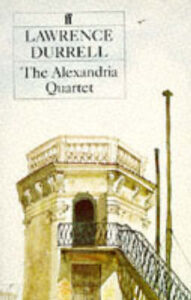
When I was sixteen a Very Nerdy Friend shared with me his enthusiasm for Lawrence Durrell’s Alexandria Quartet of which Justine (1957) is the first part. I suppose I was a bit flattered that he thought I – a keen reader but definitely not nerdy – was worthy of his recommendations. So I borrowed the complete quartet from the library and took it to Paris with me on holiday that summer. I was staying with a French friend for two weeks before going with her to their family seaside place in Brittany. The rest of the family were already at the St Malo house and my friend was working so I spent most of that fortnight alone in a very dingy flat (no bathroom!) in the 18th arrondissement feeling homesick, writing letters, and reading the Alexandria Quartet. Justine is, therefore, a book, very firmly associated in my mind with a very specific time and mindset. I’ve long wondered how, a life time later, how I would respond now. So, in the interests of literary curiosity, I’ve just reread it.
I can report that it’s stronger on language and atmosphere than it is on plot. Basically it’s a first person narrative by an Irish teacher living in Alexandria with sick (consumptive?) Melissa who is a frail nightclub dancer. He becomes friendly with a wealthy man named Nessim whose wife, Justine glitters with charisma, beauty and mysterious intelligence and their marriage seems unlikely. In time, and inevitably, the narrator starts a not particularly clandestine affair with Justine. Melissa meanwhile ails, begins a relationship with Nessim and bears a child, None of this is presented in a linear format. The novel, which begins with the narrator on a Greek island, quasi-parent to Melissa and Nessim’s child, leaps about wildly in time. The rest of the quartet (which I doubt I shall reread) explores, from various viewpoints, the same story which comes with a huge cast of other characters. The city of Alexandria – hot, dusty and alluring – is the real protagonist.
And so to the language. It’s richly poetic. His metaphors leap off the page. “the city unwrinkles like an old tortoise and peers about it” he writes of Alexandria at dusk. Or take: “The Syrians are going to bed with little cries like migrating birds” or “our blond headlights picking out the ant-hill cafes” or “the foundering plunge of saxophones crying to the night like cuckolds.” Durrell himself, who wrote poetry before he turned to novels and travel writing, described the book as a “prose poem”.
It’s also refreshing to read work which casually and uncompromisingly uses words such as “pegamoid”, “crepitating”, “refecundated”, “animadversion”, “hebetude” and “phthisic” although goodness knows what I made of it all when I’d only just done O levels. How many sixteen-year-olds today would persevere, I wonder?
I’m forcibly struck by the explicitness of the writing which would have seemed pretty far out in 1957. He writes a great deal about sex – much “lovemaking”, waking in each other’s arms and the like with a lot of subtle reference to body parts. And much of the descriptive writing is highly erotic. He is also blunt and straightforward about homosexuality – ten years before the first legislation decriminalised it for over 21s in the UK. Durrell’s earlier novel, The Black Book (1938, France) was deemed obscene and banned in Britain where it wasn’t published until 1973. Back in 1963, Nerdy Friend wanted me to buy him a copy in Paris and I can remember trying but of course, sixteen-year-old child that I was, I didn’t really know where to look so he was unlucky.
Reading Justine in 2026 I find myself uninspired by the seediness of it all. The city – although beautiful and redolent with history – is dirty. People sleep in filthy, shared beds. They drink excessively. Sexually transmitted (“venereal” – a word which has almost disappeared) disease is commonplace. And as an adult I hated the duck shooting scene with its wanton cruelty, very graphically described, but that may be a personal thing.
It’s a very intense read too which makes it hard work because there’s not much pacing or variation of mood. If you believe even a quarter of what Durrell’s irreverent youngest brother wrote about him in My Family and Other Animals (1956) you discover an earnest, intolerant man who took himself and his work very seriously. Not much of a one for laughter and smiles. And that’s what comes through in this novel.
Well my Nerdy Friend has remained a friend. I see him and his wife once a year or so. It’s still books, books, books (professionally as well as for interest) but the knowledge is now spliced it with urbanity. “Nerdy” no longer applies. I shall make sure he reads this blog and ask him what he thinks, 60 years later, about the Alexandria Quartet.
Next week on Susan’s Bookshelves: A History of the Novel in Britian by Philip Hensher