Press ESC or click the X to close this window

Lonely Angel (Susan Elkin reviews)

Lonely Angel

Brighton Philharmonic Orchestra

Violin: Ruth Rogers

Viola: Sascha Bota

Conductor/Piano: Joanna MacGregor

Brighton Dome, 22 February 2026

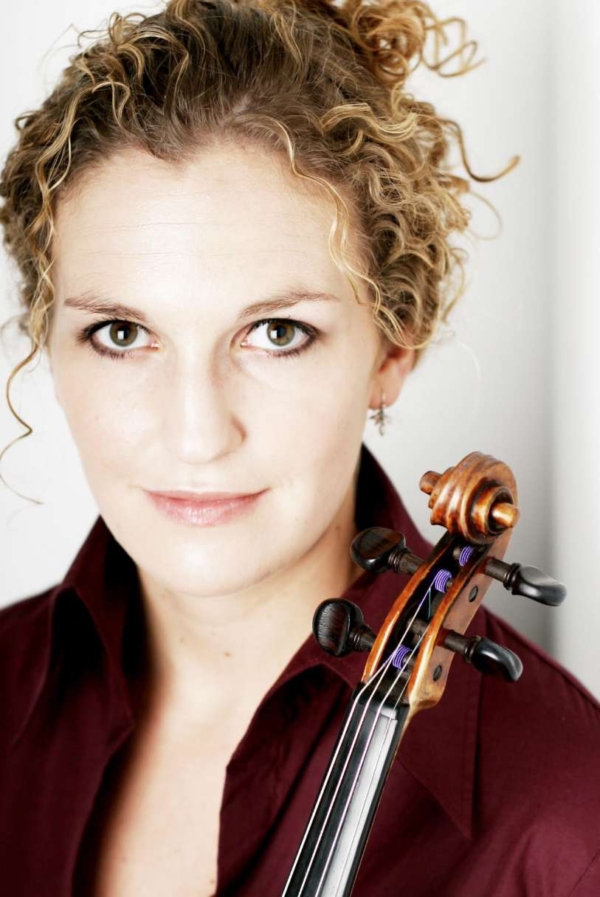
This delightful concert belonged to the charismatic, smiley, talented Ruth Rogers who played violin solo in two works and led the orchestra in another. And she shines whatever she does.

But we started, presumably while Rogers limbered up, with a short work led by the orchestra’s assistant leader Nicky Sweeney:  another richly accomplished player. The Romanian Folk Dances – a miniature six part suite – is one of Bartok’s best known works and it was played here by BPO strings (reduced numbers throughout this concert) standing, rather than sitting, which made the music feel much freer. Sweeney played the solos with plenty of Romanian verve and inspired the orchestra to do the same. It’s a work which makes a good concert opener, and it’s nice to see strings in the limelight.

Then Rogers appeared, wearing the sparkliest dress I have ever seen, with viola player Sascha Bota to play Mozart’s Sinfonia Concertante in E flat major. K364. And what a pleasure it was.  Both players played along with their respective sections until it was time for their solo passages, in the traditional manner.  They then treated us to a musical conversation leaning in to each other, smiling and exuding musical rapport. In the second movement Joanna MacGregor, now conducting but without a podium, paid careful attention to dynamics which allowed us to enjoy the mellow delicacy of Bota’s playing along with some pleasing horn work and enough warmth to toast crumpets on.  That musical camaderie continued in the Presto with lots of lightness, joy and laughter. And, for once, the happy hugs at the end felt genuine rather than perfunctory.

After the interval we were plunged  into a different sound world with Lonely Angel: Mediation for violin and string orchestra by Peteris Vasks, the 12 minute work which gave this concert its title.  It’s an evocative piece in which Rogers played the plangent legato passages with ethereal (angelic?), silvery energy –  and astonishing control. Her series of harmonics at the very top of the instrument carried impressive resonance. The sotto voce accompaniment is, I’m sure, challenging to sustain but of course MacGregor ensured that it worked.

And finally once the indefatigable Rogers had slipped back on stage in a plain black dress we were off into the Mozart’s G minor Piano concerto with MacGregor at the key board co-conducting with Rogers in the leader’s seat. The collaborative work in this concert was very striking and I was left wondering whether some of it really was down to most women being better at multi-tasking than most men along with the ability to  leave their egos at home. But that may be over-simplistic.

My mild synesthesia paints anything in G Minor slate blue and that certainly applied to this performance in which MacGregor treated us to the thunderous Beethoven cadenzas. It was a fine rendering with beautiful balance between the horn and flute in the last movement. And that chirpy wind melody which is several times echoed by the piano and always makes me beam (as well as providing an ear worm for the rest of the day) was played here with cheerful insouciance.


Conductor: Karina Canellakis

The concert opens with Pohjola’s Daughter, a Sibelius tone poem which doesn’t get out very often. Rooted in the Finnish national epic, Kalevala, it tells the story of an old man travelling home from the north and having mystic experiences on the way. The resonant, growling  cello solo (Waynne Kwon) at the opening is arresting in this performance as is the arresting string work which follows. And conductor Karina Canellakis really allows the grandiloquent brass, of which Sibelius was so fond, to sing out.

The high spot, though, comes next when Anne-Sophie Mutter, a slender column in elegant sky blue, arrives to play Tchaikovsky’s  violin concerto to rapturous, excited, applause. She has been such a huge influence on  music and music education for so long it’s a struggle to remember that she’s still only 62.  With nothing to prove, she’s an unshowy, collaborative performer frequently turning to orchestra, conductor and audience.

Mutter plays a golden, gleaming Stradivarius instrument without shoulder rest and rather, sweetly, hangs the duster she uses for part of the performance on the back of the leading desk’s music stand and keeps her mute on the corner of the conductor’s stand.

Her first movement cadenza is full of musical acrobatics and the accuracy and beauty of the sequences of harmonics breathtaking. The resolving tension in the long trill which prefaces the orchestra pick up is nicely nuanced. The muted Canzonetta movement, effectively a duet with flute (Tom Hancox) is a delight. Then comes the gravelly segue into the high-speed Finale and more spectacular harmonics from Mutter. No wonder the audience goes wild at the end.

Mutter is a communicator at every level, Once the applause subsides she takes a microphone and thanks the LPO for their fine playing and makes a few moving remarks about the power of music to unite “a troubled and divided world” before announcing her encore. Andre Previn (to whom Mutter was married from 2002-2006) wrote Tango Song and Dance in 1997 as a violin and piano piece, and later orchestrated it. Perhaps because it was written for her, she plays it with smiling panache. Her fabulous virtuosity shines through but also feels warmly modest.

Famously described by Wagner as “the apotheosis of the dance,” Beethoven’s seventh symphony certainly dances under Karina Canellakis’s baton. We get tender exuberance, sensible tempi and meticulous attention to every detail. Also a violinist, Canellakis has exceptionally expressive fingers. She beats time with her right hand, signals with her left and creates rhythmic, often geometric, shapes with her arms and body. It’s captivating to watch the LPO’s principal guest conductor weaving her spells.

Highlights in the Beethoven include oboe playing (Emanuel Abbuhl) in the opening movement and the build-up of the relentless main theme in the Allegretto, arguably one of the best movements the composer ever wrote.  Also noteworthy are the horns in the third movement and the  hard stick timp work (Marney O’Sullivan) throughout. And as for the Finale, it is played here with all the brio that Beethoven could have wanted, especially in the lively string playing and the thrill of the final bars.

Reviewed on 18 February 2026

The Reviews Hub Star Rating: 4.5

90%

90%

Mutter’s musical magic

Mrs Armitage on Wheels – Purcell Room, Southbank Centre

Picture: Dan Tsantilis

Rating: three stars ★ ★ ★ ✩ ✩

Like most shows of this sort for very young children, this one is full of charm and wit. It relies, moreover, on most of the young audience and their grown-ups being familiar with Quentin Blake’s book. Thus, it feels homely.

The titular Mrs Armitage (Gillian Kirkpatrick) is a cheerful inventor living in a shed with her dog, Breakspear (Thomas Walton). The episodic story celebrates creativity, imagination, kindness, recycling and the strength of community if everyone helps everyone else.

The songs (Jessie Maryon Davies) are jolly. “The right sort of horn will warn” is very funny and Kirkpatrick makes sure we hear every word. Her warm RP works well in the spoken dialogue too. And …

Read the rest of this review at Musical Theatre Review; https://musicaltheatrereview.com/mrs-armitage-on-wheels-purcell-room-southbank-centre-2/

Mrs Armitage on Wheels continues at the Purcell Room, Southbank Centre, London until 21 February 2026.


Book: Alexander Dinelaris

Additional Music: Chris Egan

Director: Thea Sharrock

You can’t fault it for crowd pleasing. The 1992 film has become, for many, an iconic classic and several of the songs were global, award-winning hits. Spectacular staging with Mark Henderson’s lighting and Richard Brookner’s sound plus pyrotechnics gets it off to a bang – literally.

The plot is a simplified version of the film. Rachel Marron (Sidonie Smith) is an A list star, being threatened by a toxic stalker (James Lee-Harris): cue for lots of Woman in Black-style sinister ubiquity.  So Rachel’s manager imposes a bodyguard, Frank Farmer (Adam Garcia) on her. At first she is reluctant to accept the intrusion but eventually they fall in love.  Alas, there’s no happy ending – just a final passionate parting.  Also in the mix are her young son Fletcher ( Cale Cole on press night – very good), her envious sister Nicki and the existing security man whose nose is out of joint, among others.

Smith is a fine singer and very good at catching mood which she packs with emotion. And her range is impressive, whether she is strutting her character’s professional stuff in performances and recordings or reflecting gently and privately at home. Garcia provides a good down-to-earth contrast and makes it clear why chemistry soon stirs between them.

Because this is a show, partly, about show business there is plenty of scope for big, bone-rattlingly loud set pieces in which Smith is supported by a terrific dance ensemble. Choreographed by Karen Bruce, who clearly loves geometric shapes, they are rivetingly, sinuously, show-stealingly athletic.

Henderson’s rotating spots which sweep the audience like dazzling car headlights are unpleasant. At other times there are glitzy frames for Rachel’s performances and lots of murky corners in the “real life” scenes.

The show includes a rather good scene in a karaoke bar. If you can sing perfectly in tune, as every member of this cast can, it is actually pretty difficult to sing off key. Three ensemble members do it here to comic effect followed by Garcia’s Frank, It’s effective comedy hooked into poignancy because eventually Rachel, hitherto anonymous as Frank’s date, sings.

Full marks to stage management. This is a slick show with many scene and costume changes which are impressively seamless.

What happened, however, to putting the press in good seats so that they get a clear view of what they’re reviewing? The sightlines at New Wimbledon Theatre are dreadful from Dress Circle J6.

Runs until 21 February and tours until 15 August 2026

The Reviews Hub Star Rating: 3

60%

60%

Loudness, love and leaps

Elmore Quartet

Corn Exchange, Brighton Dome, 15 February 2026

Strings Attached

It was an ambitious programme – three full string quartets, one late eighteenth century and one early nineteenth, sandwiching a dramatically different twentieth century offering

We began with Haydn Op 76, no 5 nicknamed “The Largo” because of its second movement. As in most Haydn quartets there is a virtuosic. very exposed, first violin part – I have murdered many of them myself in private so I’m very aware of the challenges. It was, therefore, a real pleasure to hear that part, in Xander Croft’s capable hands, waving its magic over the top of the texture before the melody is shared round in the opening movement. The deceptively simple largo came with rich warmth and a lot of elegance especially in Gabriel Franci-Dehgani’s cello playing. The Elmore quartet’s playing more than complemented the intricacy of the writing here.  There was more bravura, but suitably insouciant, high-speed cello playing in the trio.  And the presto finale, which sounds like a very jolly Austrian village party and builds to a dance, was fun. It came with lots of very attentive rapport between players especially in the repeated note motif which was always delivered with escalating excitement.

Then we were plunged into a completely different sound world with Bartok’s String Quartet no 3. It’s through-written in four sections and the Elmore Quartet really ran with the musical special effects that Bartok was able to play with in 1928, 132 years after the premiere of the Haydn. Among other points of interest it includes interrogative glissandi, bowing over the bridge for grating effect, left hand pizzicato, col legno passages and very incisive heavy chords. It’s educative to watch four experts adeptly running with this.

After the interval it was back to the familiarity of Beethoven’s Op 127 no 1. One his “late” quartets. It was written after the 9th Symphony when he was totally deaf.

The Elmore Quartet’s account of the first movement juxtaposed dynamic charm with passion and stressed the rich harmony of the opening big, Eroica-esque chords. The very long, almost unbearably beautiful Aadagio is actually a set of six variations, And like all slow movements, as I know from experience, it’s very diffcicult to bring off. Here it was delivered with immaculate, tender control.  The contrasting third movement found attractive lightness in the complex rhythms and they played the Finale with plenty of freshness and verve.

Each half of this concert was introduced by Inis Oirr Asano (viola_ which was largely unnecessary because most of what she said was in the free programme sheet. Nonetheless, I suppose it makes a Sunday morning concert seem friendlier and less formal,

And perhaps that is important because there were a number of children in the audience. Strings Attached is a Brighton-based charity which produces these concerts. Its mission is to promote chamber music in the city. We were informed, by their spokesperson at the beginning of the concert, that their policy of free tickets for under-25s is paying dividends. Numbers of the young attendees are rising. Hurrah.


Shadowlands

William Nicholson

Directed by Rachel Kavanaugh

Aldwych Theatre

Star rating: 4

It’s quite a treat to see a beautifully crafted, grown up play, given the number I see in the course of my work which are neither.

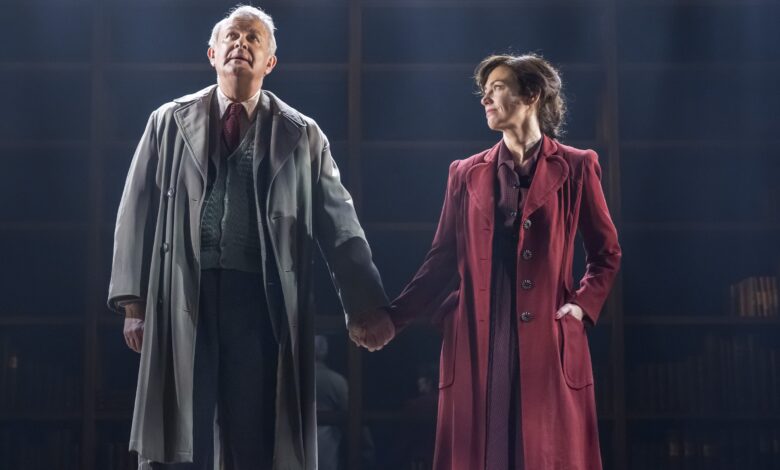
I admired Rachel Kavanaugh’s take on Shadowlands at Chichester in 2019. The production has matured since and sits very well on the much smaller stage of the Aldwych theatre. It’s an intimate piece and this restaging highlights that. Hugh Bonneville, once more, is the crowd puller.

CS “Jack” Lewis was an Oxford Academic, a deeply convinced Christian,  who wrote many books about his beliefs. With the seven Narnia books (dubbed “juvenile dementia” by a waggish colleague according to Shadowlands) he became an international household name. A mildly eccentric but friendly bachelor, he lived with his brother in Oxford. Joy Davidman was an American divorcee with two children who, against all the odds, became his friend and eventually a beloved wife. Shadowlands tells the story of that blissfully happy but shortlived relationship.

At the crux of it is The Problem of Pain (actually the title of one of CS Lewis’s books, published in 1940).  How can a Christian reconcile the suffering in the world with the concept of a loving, omnipotent God? At first glance it’s not exactly a “sexy” subject for a play but with Nicholson’s script, Kavanaugh’s imagination and some fine acting it becomes richly compelling.

As Jack,  Bonneville, as you’d expect, excels. He gives us a character who is initially an urbane, confident academic. The play opens with him delivering a lecture. Two hours later he is (literally) a howling wreck. It’s a developmentally well-paced and ultimately moving performance.  And Maggie Siff more than matches him as Joy – there’s always chemistry and humour between them even when she’s prostrate in a hospital bed and he finally accepts that he really is in love with her.

Pleasing supporting performances include Jeff Rawle as the long-suffering, vulnerable, perceptive brother Warnie and the deliciously sardonic Timothy Watson as Jack’s academic colleague Christopher Riley.

And Peter McKintosh’s lofty, booklined set which sometimes opens to reveal a Narnia fantasy creates exactly the right ambience.

It’s emotional without being mawkish and thoughtful without being didactic. Well worth catching.


Symphony No 8 in C Minor

Anton Bruckner

Philharmonia

Lawrence Renes

Royal Festival Hall, 19 February 2026


This concert was billed as “Runnicles conducts Bruckner”. The bad news was that Sir Donald was ill and unable to appear. The very good news was that Lawrence Renes had stepped in to cover. I had never seen Maltese-Dutch Renes in action before and he is remarkable. He conducted  Bruckner’s daunting, 75 minute symphony without a score. With second violins seated on his right and violas next to firsts he coaxed an exceptionally rich range of sound from this splendid orchestra. Another interesting seating idea was to position the tuba in the middle of the back row brass section rather than off to the side – and it changed the musical balance for the better.

I enjoyed the sustained energy of the upper strings in the opening movement and I liked the way Renes leant on the pulsating “peal of bells” theme in the second. The third movement, which seems to contain the whole of life and death, was played with all the requisite dramatic contrast from the triumphant cymbal clashes all the way to the poignant beauty of the violin solo (leader: Zsolt-Tihamer Visontay) at the end. And the Finale came with plenty of Brucknerian intensity highlighted by the very resolute timp work (Simon Carrington)

It seems to be a recent Philharmonia policy decision that each concert be introduced by one of its players. The problem with this is that being a fine musician does not equate to being a good speaker. At the start of this concert Scott Dickinson (principal viola), clearly nervous, spoke for too long, too fast and not always audibly despite the microphone. It would be much better simply to let the music speak for itself. After all there’s a free, information packed programme for every audience member.

Nonethess, this was a pleasing concert as well as a test of stamina which, of course, the Philharmonia passed with aplomb. Musicians often joke about heading enthusiastically for the pub/bar after concerts. They certainly deserved it on this occasion.

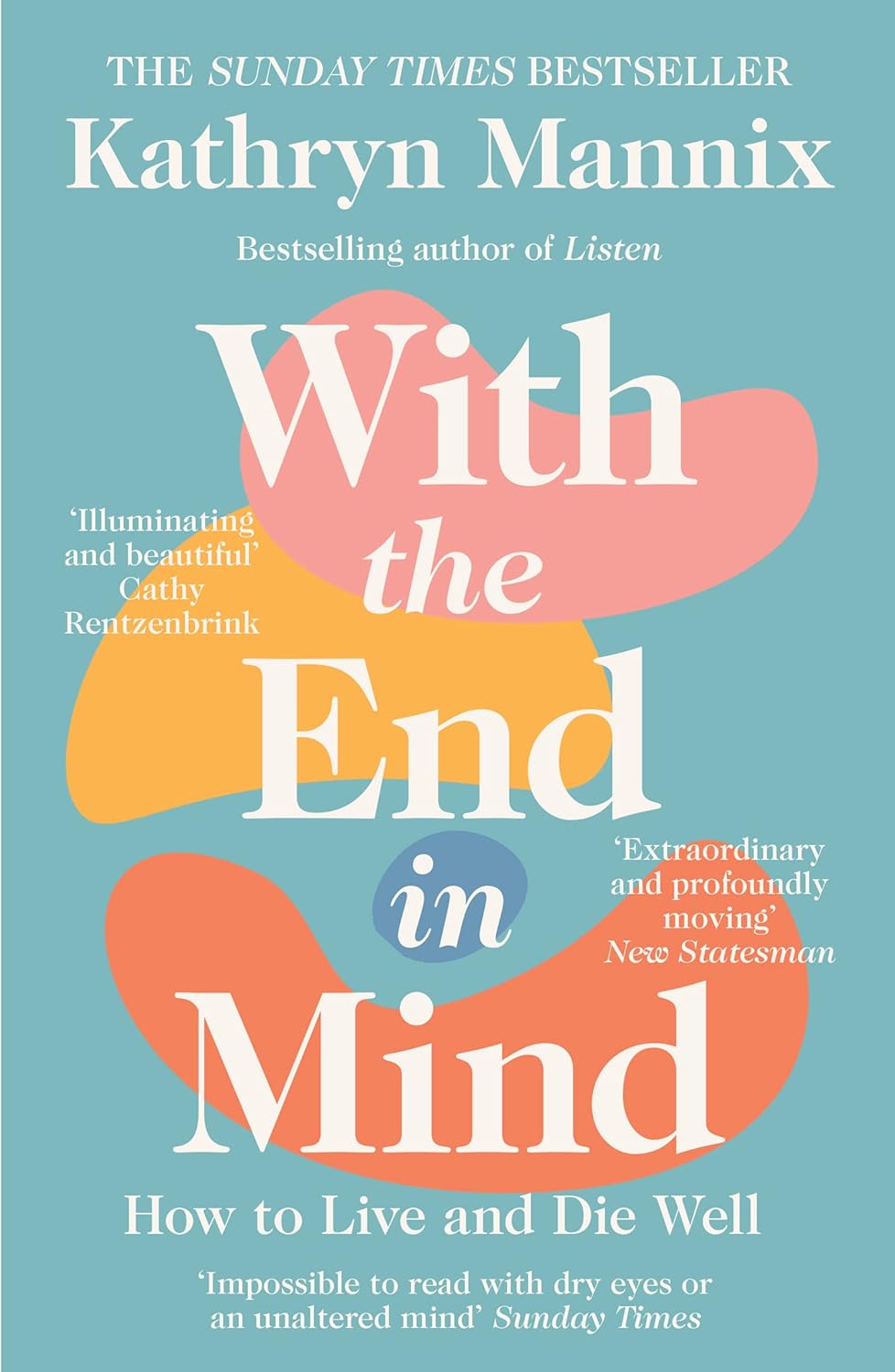
Kathryn Mannix works in a hospice as a consultant in palliative care. Her still small voice of calm experience exudes wisdom, humility and respect. At its most obvious level death is a sad subject because it involves the loss of people we love.  But I found this book  enlightening, uplifting and positive.

She observes at the outset that modern western society has turned death into a taboo subject. When people routinely died at home, everyone had experience of death and recognised it as part of life just as birth is. Now that so many deaths are hospitalised and out of sight people are frightened because, for many, it’s unknown territory. And euphemistic language – “passing away” and other coy expressions – simply compounds this. We need, Mannix argues very convincingly, to talk about death openly and honestly. It is a universal  inevitability, after all. And I was intrigued by her wry observation that there are only two days in your life which don’t have twenty-four hours.

Most of With the End in Mind consists of case studies (permission sought, names changed etc) detailing people Mannix has worked with at all stages of her career – including patients with cancer, heart disease, and degenerative conditions at all ages. There was, for instance, a devout Muslim couple who rejected pain relief for the young wife, mother of eight,  because they mistakenly thought  that a colleague of Mannix’s had sacrilegiously suggested that he knew better than God. Mannix, who always sits down, and often drinks tea, with her patients, somehow found the tact to convince them that she and her team regarded every day as a gift from God  which enabled the patient and her husband to change their minds.

Also in the mix is a sporty, youngish man, former local pin-up boy with cancer and needing help with guilt and anxiety about “deserting” his family. In the end it transpired that his sons aged 10 and 8 had worked out the truth for themselves. Or take the retired couple who both knew that the wife had cancer – and discussed it separately with Mannix – but, trying to be to be lovingly protective, hadn’t found a way of talking to each other about it. There are examples of camaraderie between afflicted families and strong friendships between patients too. Or what about the lonely man whose cat Mannix is pressurised into adopting, having taken it into the hospice each day to sit with its human? Each chapter is preceded by some general remarks which underline what Mannix learned from working with this individual and, usually, his or her family.

Death, apparently, is almost always gentle. First there’s coma. Then the breathing changes, slows and eventually stops. Now I watched exactly this process, crouched by the bedside holding his hand, when my husband died in 2019. I thought we’d been lucky that the end was so peaceful. I had no idea that this is how most lives end. It’s the norm. And that’s very reassuring. I also learned that sinking into a coma – becoming unconscious – is  crucially different from falling asleep. The latter is a consciously temporary state. The former is not.

Moreover, modern pain relief is excellent. You don’t have to suffer. Neither do you need to feel drowsy. It can restore at least some quality of life in the weeks before the final decline. And that cheered me up no end too.

Cards on the table: I am in my late seventies so I suppose I’m proabably in the last decade  of my life. I am terrified to think about what this involves. Letting go is not in my nature. So I deny it by racing about working, playing my violin and refusing to ease off as if I can outwit death by not giving in. I am, moreover, fortunate to have excellent health. There is nothing wrong with me at present and I am not on any sort of medication.  I joke to anyone who comments on it that my robustness is down to 75% vegetables and 25% luck.  But of course the suppressed, common-sensible bit of my brain murmurs that this situation cannot last for ever.

I have never openly admitted this before – especially the fear.  And it feels a bit like, I suppose, “coming out” must do. Very healthy and honest. Phew!

So Mannix’s book has dented my mindset and made me feel better about life and deeath.  I’m deeply grateful for that.

While I was reading With the End in Mind, I found myself sitting, chatting, in the kitchen of a family I know well. “How’s your dad?” I asked the father because I knew Grandpa had not been at all well. He stood up behind his son, 11, caught my eye and silently shook his head to shut me up. He was trying to protect the boy from the painful truth about a beloved grandparent. When they’d left the room I got talking to the wife. I told her about Kathryn Mannix and gently suggested that her husband needs to be honest with their son about Grandpa’s health and where, at some point, it will inevitably lead. Planning and saying goodbye are very important.  “Oh I think they’re both in denial” she said and shut the conversation down. It was (is) a classic situation.

This book was recommended to me by a community nurse I know. She, obviously, is involved in a fair amount of end of life care, I honestly don’t think she was subtly telling me that I need to confront my own mortality. She simply knows that I read a lot and thought I’d find this book interesting, which I did.

And as for facing death well, yes, I feel much more empowered about it now than before. That’s why  I think this is a book EVERYONE should read.

Next week on Susan’s Bookshelves: Uncle Tom’s Cabin by Harriet Beecher Stowe