Press ESC or click the X to close this window

Death and the Maiden (Susan Elkin reviews)

Show: Death And The Maiden

Society: Tower Theatre Company

Venue: Tower Theatre

Credits: Ariel Dorfman

Death and the Maiden

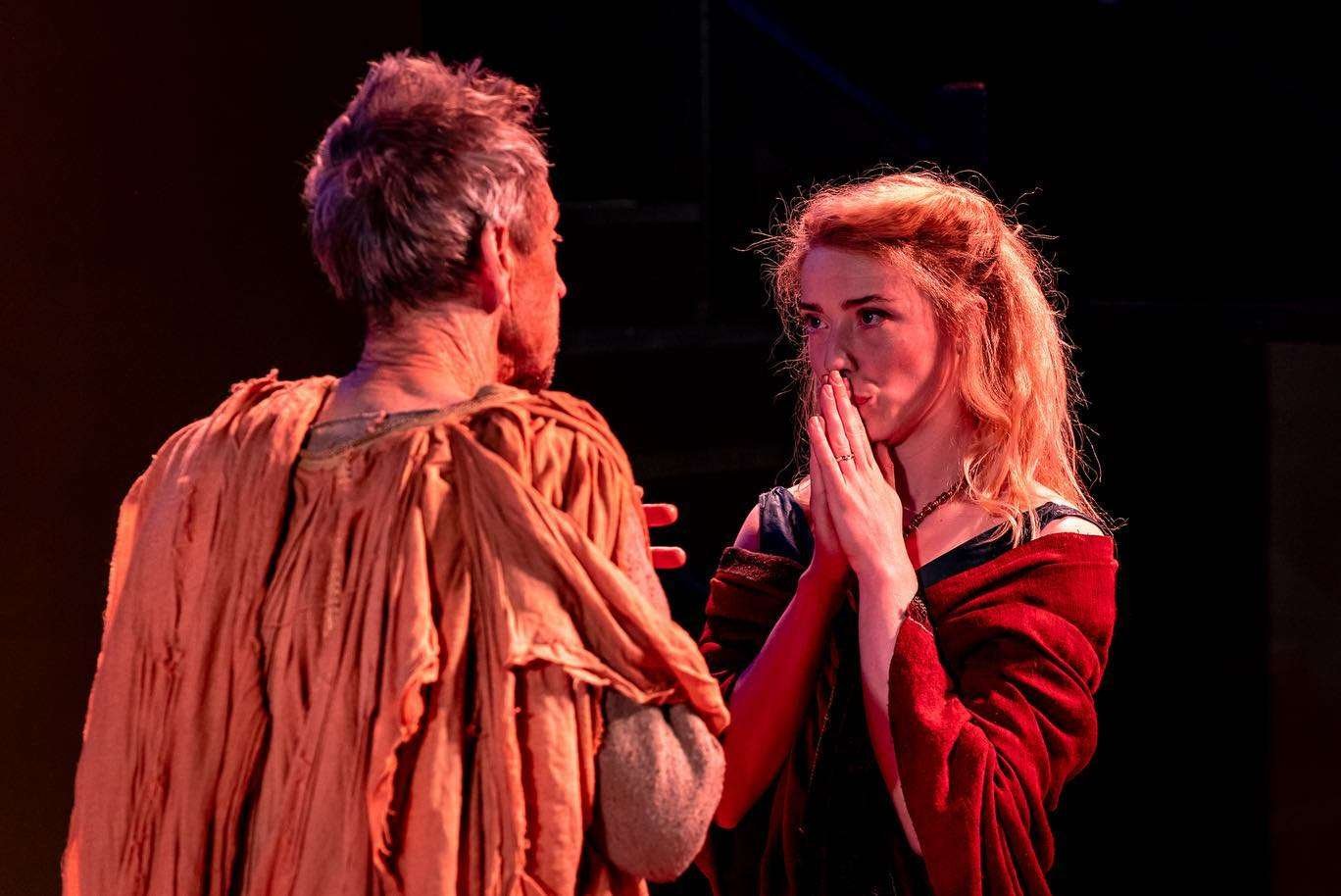
Although Ariel Dorfman’s 1991 play premiered at the Royal Court, won an Olivier in 1992 and was filmed by Roman Polanski in 1994, it was completely new to me. It is a taut, tight, powerful three-hander set in the home of a liberal lawyer in Chile (Dorfman’s adopted country) as it emerges from its long fascist dictatorship under Pinochet. In this production James McKendrick’s sensitive direction stresses every ounce of tension and ensures that the pace never flags.

The newish democratic president has offered Gerado Escobar (Matthew Vickers) the chance to lead a commission of enquiry into criminal human rights contraventions during the dictatorship. His wife Paulina (Emma Cornford) is clearly deeply traumatised from her first appearance. The chance arrival of Roberto Miranda (Martin Shaw) in their home pushes her over the brink because  it gradually transpires that this was the man, a doctor, who supervised her torture and repeatedly raped her, incongruously playing Schubert tapes as he did so. Hence the title of the play: Death and the Maiden is the name given to Schubert’s highly regarded string quartet no 14 in D minor.

These three actors play off each other with a great deal of skill, conviction, naturalism and attentive, participative listening. Cornford is thrilling as Paulina. She has a crazed glint in her eye, dangerous determination and alternating reasonableness. It’s a gift of a part and she really runs with it. Vickers delights as the ever-sensible but slightly self interested husband and there’s a potent performance from Shaw as the terrified doctor – initially affable and a crumbling, chilling mess when he eventually reveals his guilt.

The Tower’s triangular playing space is neatly organised by Angelika Michitschi’s set into a living room with front door, two internal doors and a garden space. And Laurence Tuerk’s sound design gives us Schubert and convincing sound effects.

If you do a lot of professional reviewing it’s surprising how often you see either a weak play/show which lets down competent performers or indifferent performers messing up what ought to be a good piece. This production of Death and the Maiden is neither. As an exceptionally good play brought to life by talented actors and creatives it’s quite a treat.

First published by Sardines: https://www.sardinesmagazine.co.uk/review/death-and-the-maiden-2/

Show: Abigail

Society: West End & Fringe

Venue: The Space. 269 Westferry Road, London E14 3RS

Credits: By Stephen Gillard and Laura Turner. Performed by Fury Theatre in association with Asylum Players

Abigail

3 stars

Billed as “the first showing of a piece in development” this play takes as its starting point the historical fact (although it’s disputed)  that after the 1660s Salem Witch hunts, Abigail Williams is last heard of working as a prostitute in Boston, Mass. There seems to be an assumption at the beginning that the audience knows the background. Well, yes, I’ve read the history (and visited Salem) taught Arthur Miller’s  The Crucible and seen many productions of it. But you can’t expect every audience member to be clued up and the story telling needs to be clearer especially in the first half hour.

Abigail (Laura Turner, also co-writer of the play) and Mercy (Lucy Sheree Cooper) arrive in Boston, with some money and saleable articles Abigail has stolen from her uncle so, very naively, they think they can live independently and have an adventure. Of course they’re fair game for thieves and pimps.

Because she was – arguably – responsible for sending many people to their deaths as “witches” Abigail is haunted by Solvi (Sophie Jane Corner) who represents those people. The scenes between her and Turner are very strong. Corner, who uses a very deliberate non-English accent, finds a quality of moral certainty in Solvi and is a powerful presence. And if, the change in lighting and sound whenever she appears reminded me of Elivira in Blithe Spirit I managed to suppress the thought – mostly.

Turner brings a wide range of emotions to Abigail including jealousy because, like Mercy, she fancies Jack (James Green) who oozes false gentleness but is, in fact, a violent man whose only real interest is to pimp out the pair of them.  Sophie Kamal makes the landlady/Madam, Mrs Contstance, revoltingly unpleasant. The maid Milly (Sarah Isabell) is already working as a prostitute  and the seventh cast member Nathan Haymer-Bates plays several roles including the marshal, an officer of the law, and a brothel customer. The sex scenes are look-away graphic and remind us forcibly that women are easily exploited, then and now.

It’s interesting work from a new  female-led company whose mission is to tell stories which highlight issues facing women.

A word, too, about The Space –  a venue in Westferry Road near Canary Wharf, which was new to me. A former Victorian Presbyterian chapel, it’s very pretty. There are two problems, though. First the space is so lofty that there’s an acoustic issue. Sometimes the echo blurs the sound, especially when a voice is relatively high pitched. Second, there’s a bar upstairs (so theatre goers can get drinks – good)  which also doubles as a public facility with garden beside the building. That means – because of course there’s no sound proofing – that there’s the constant, distracting sound of drinkers enjoying themselves quite loudly.

First published by Sardines: https://www.sardinesmagazine.co.uk/review/abigail/

Show: Orlando

Society: West End & Fringe

Venue: Jermyn Street Theatre. 16b Jermyn Street, St. James’s, London SW1Y 6ST

Credits: BY VIRGINIA WOOLF. ADAPTED BY SARAH RUHL.

Orlando

4 stars


Virginia Woolf’s novel Orlando (1928) was written as a quasi homage to Vita Sackville West (author, gardener, aristocrat etc)  with whom she was in a relationship. Both women had open marriages to men. Nearly a century later Sarah Ruhl’s adaptation is fresh, lively, funny  – and, of course, very topical. We meet Orlando (Taylor McClaine) several times in different personae over five centuries variously presenting as a young man or a young woman. It’s a piece about time, transformation, sexual ambiguity and “ a great variety of selves.”

Ruhl’s script shifts continually from first person to third so that we never lose the stylistic sense of a story being told by an outsider. And bringing that off requires a great deal of speaking in synch, rapid symbolic costume change and movement round Jermyn Street’s rather awkward playing space. The cast manage it in spades. The faintly jokey physicality is fun and the whole piece dances along at speed so that it never goes off the boil.

Recent graduate from Lir Academy, Dublin and richly red-headed, Taylor McClaine gives us a well nuanced Orlando with plenty of youthful sassiness spliced with wide-eyed wonder and witty grins. Rosalind Lailey, Stanton Wright and Tigger Blaize form a chorus from which all the other roles emerge. All three provide very accomplished voice work and are good at bouncing off each other. The knowing looks between Lailey and Wright when they’re servants is a good moment and Blaize (very good)  has fun as a sex-changing suitor among many other roles. Skye Hallam’s smaller role as Sasha, a Russian princess idolised by Orlando in each incarnation is less successful.

Roly Botha’s sound design and music adds a lot to this lively, energetic production too. We get appropriate music for each era that Orlando lands in.  It underlines “the spirit of the age” which almost becomes a character in its own right  in this sparkling production.

First published by Sardines: https://www.sardinesmagazine.co.uk/review/orlando/

An Evening With The Good Enough Mums Club – Pleasance Theatre and Touring

An Evening With The Good Enough Mums Club was reviewed at the Pleasance Theatre, London. The show can also be seen at the Mast Mayflower Studios, Southampton on 6 May 2022.

Star rating: three stars ★ ★ ★ ✩ ✩

Emily Beecher’s show, with songs composed by Chris Passey, has been in development for ten years. Next year, she told the audience with a gulp, it is – at last – to be fully staged.

Meanwhile here’s a taster, cabaret style, participative and more like a presentation than a show, although all five cast members (and the all female on-stage band) get the chance to showcase their considerable talent.

The thrust of The Good Enough Mums Club is that many women find motherhood pretty difficult, especially at the beginning. It can be isolating. Feelings of inadequacy are almost inevitable ….

Read the rest of this review at Musical Theatre Review: https://musicaltheatrereview.com/an-evening-with-the-good-enough-mums-club-pleasance-theatre-and-touring/

I’m a sucker for a short story and often think fondly of the ones I taught to the last couple of GCSE classes I worked with. Opening Worlds was a small anthology published by Heinemann for OCR, the examining board we were using. The good news is that it’s still available from Amazon.

The idea was to offer students literature from different cultures to conform with syllabus (“specification”) requirements. Of course that was a good thing but I was amused (and still am) that only a few years before we’d been firmly told that English Literature means just that and that writing translated from other languages would not do. Several of the stories in Opening Worlds are translations.  The arguments continued and still do. As Education Secretary (2010 to 2014) Michael Gove saw off, or tried to, time-honoured texts such as To Kill a Mockingbird and Of Mice and Men on the grounds that they are American, not English, literature.

Anyway, I’ve just reread Opening Worlds’s twelve stories – with delight. There are some famous names therein: Chinua Achabe, Amy Tan and Anita Desai for example. Alongside them are writers such as Ismith Khan and Khamsing Srinawk whose work I have never encountered in any other context.

There’s an African wedding, a bullied child with a talent for cricket in India, persecution in Maoist China and poverty in Thailand among many other heart rending, sardonic and/or ironic stories which often involve clashing cultures and misunderstandings.

My favourite story is “The Winter Oak” by Yuri Nagibin in which a young Russian school teacher berates her pupil, Savushkin for lateness. Later, she walks home with him through the forest in order to talk to his mother about his time keeping. On the way she discovers, as the child shows her all the natural wonders which routinely slow his walk to school, that he is far better educated than she is. It’s a story which used to lead to good discussions in my classrooms about the purpose of education and how you define it.

It was also a poignant joy to revisit “Leela’s Friend” by RK Narayan. The servant Sidda, adored by the young daughter of the house, is dismissed for theft by the wealthy Indians who employ him. When it transpires that he’s innocent he’s simply dubbed criminal anyway. It’s beautifully told – as Sidda, who is illiterate, entertains the child Leela with imaginative stories about the moon. The final paragraph is devastating.

Feng Ji-cai’s “The Tall Woman and Her Short Husband” punches you in the gut too. It’s effectively a case study about how people’s lives can be ruined by malicious, nosey, self-interested  gossip especially during China’s Cultural Revolution. The titular couple seem an unlikely pair but they’re happy and love each other. That is too much for some people in their collective and gradually the couple are destroyed although, in a sense,  their decency and devotion triumphs.

Please don’t be put off by the fact that this is a school anthology. Every single one of these stories is, in its way, a gem and they certainly weren’t written for children or “young adults”.  As a collection it does what is says on the tin too. I guarantee you’ll learn a lot about other cultures and issues.

Next week on Susan’s Bookshelves: Moon Tiger by Penelope Lively

Show: If. Destroyed. Still. True.

Society: West End & Fringe

Venue: Hope Theatre (Hope & Anchor Pub) 207 Upper Street, Islington, London N1 1RL

Credits: By JACK CONDON. Directed by SARAH STACEY

If. Destroyed. Still. True.

3 stars

Two friends attend the same school in a deprived Essex seaside town. One leaves for university, gradually finds a different sort of life and settles down with a young woman whose background is more privileged. The other stays and is unhappily sucked ever further into emotional and economic poverty. Tensions build over the eight year  narrative span and there’s a great deal of anger, angst and guilt. It’s hardly an original story although many people will identify with it.

This seventy-minute piece is Jack Condon’s first play (he also plays the confused, disappointed, furious John) for Jawbones, a new company he has set up with Sarah Stacey, who directs. Although it’s a generally pleasing debut some of the writing is laboured especially in the first half hour which includes far too much clunky expositionary dialogue. The “issues” stick out clumsily. It does, however improve as it proceeds.

But the acting is excellent.  Condon stomps about being outrageous and often furious as well as deeply flawed and hurt. As James, Theo Ancient finds calm, reasonableness in his character and we identify with him because John really is difficult to deal with. Yet there’s also a troubled complexity especially in the memorably powerful  final scene when Whitney Kehinde, now his pregnant wife, tries to confront him about his unhappiness  so that they can move on together. She is calm, determined and worried, all of which Kehinde conveys beautifully and the way the two actors bounce of each other at this point packs a real punch.

First published by Sardines:https://www.sardinesmagazine.co.uk/review/if-destroyed-still-true/

When I reread (and wrote about) Brave New World in January I kept thinking of his last novel, Island (1962). I’d read it only once many years ago and misremembered as an upbeat alternative future – the other side of the dystopian coin. In fact it’s a profoundly pessimistic novel with some pretty resonant 2022 topicality.

The fictional, titular island – Pala –  is in Indonesia and has, for rather contrived reasons, managed to refine all the benefits of a Western Education, culture and the English Language alongside open-minded philosophy without corrupting industrialisation. Will Farnaby is a cynical journalist who has made rather a mess of his life so far.  He gets shipwrecked (yes, plausibility is not what this novel is about) on Pala and looked after by Doctor McPhail and his family – a useful device to show us Pala from an outsider’s point of view.

The Island is free of organised religion, dogma and cant. It has an intelligent education system – child centred in the best sense of the word. Sex is regraded as a normal, natural part of life so that if a pair of youngsters fancy each other then there’s no ideological or cultural objection to their following their instincts. Death too, while sad for those who are left, is healthily regarded as a normal process not hedged about with taboos. And of course relationships are colour blind.

It is all idyllically Utopian although personally I struggle with Huxley’s evident belief that hallucinatory drugs are a sensible part of civilised life even when used in moderation and under supervision. That doesn’t sound in the least ideal to me.

This way of life, however, is under threat. There are people on the Island, represented by the Rani and her son, who envy life in the West and want to “improve” Pana with, for example, stricter education and more rules about everything. The Island, moreover, has natural resources which people on its borders are keen to “develop” or exploit which suddenly sounds all too familiar.

It’s an interesting novel although not a great one. There is far too much didacticism in the form of one character explaining things to another for that. Well worth reading and thinking about, though.

Next week on Susan’s Bookshelves: Opening Worlds – short stories from different cultures

Jina and the Stem Sisters continues at the Little Angel Theatre, London until 1 May 2022.

Star rating: four stars ★ ★ ★ ★ ✩

I first saw and reviewed this show a year ago, one of the very few I agreed to critique digitally. It’s interesting, therefore, to see it live now.

Rachel Barnett-Jones’ story gives us a little girl (pretty, earnest, feisty puppet) who wants to be a scientist. Lost in a wood she meets a series of inspiring female scientists from the past, each of whom gives her a gift – in the manner of the fairies at Sleeping Beauty’s Christening.

Thus, by the end, she is ready to embark on her career armed with curiosity, persistence, creativity, courage and open-mindedness. And we’ve enjoyed some sparky songs.

The Marie Curie song – a delightful G&S-type patter song in minor key …

Read the rest of this review at Musical Theatre Review: https://musicaltheatrereview.com/jina-and-the-stem-sisters-little-angel-theatre/