Press ESC or click the X to close this window

Made in Dagenham (Susan Elkin reviews)

Show: Made in Dagenham

Society: WWOS (West Wickham Operatic Society)

Venue: Churchill Theatre Bromley. High Street, Bromley, Kent BR1 1HA

Credits: Book by Richard Bean. Music by David Arnold. Lyrics by Richard Thomas. Based on Woolley/Karlsen/Number 9 Motion Picture.

Made in Dagenham

4 stars

“Rome wasn’t built in a day but Dagenham certainly was,” quip the family at the centre of this warm hearted David and Goliath story. Dagenham, of course, was the heart of Ford Motors in England. In 1968 it employed 5000 men and 200 hundred women. And that was the problem. The women who skilfully made the seat covers were not paid on the same grades as skilled men. In the end the “monster” (or Henry Ford, at least) is overcome, the women get their way and the feel good factor flows abundantly.

It’s a popular show for amateur societies at present because the performance rights are available and who could fail to warm to a couple of hours of 1960s-inspired music?  Moreover, it’s full of meaty character roles for talented people and West Wickham operatic society has plenty of those. Andy Moore, for example, is hilarious and very accomplished as the pipe smoking, self-interested, rather ridiculous Harold Wilson prancing round his office although I think I was the only person in the audience old enough to get the Gannex joke. Jacqui Morris is fun and beautifully observed as sweary Beryl and Victoria Watkins gives a truthful account of Connie, who has been fighting this cause all her life and now has breast cancer. Amanda Farrant’s Barbara Castle is good too – forceful, determined, passionate and, underneath it all, kind. I also liked Roxana King as the boss’s elegant, RP-speaking wife – much brighter than he is and eventually happy to support the factory women. It’s another well judged performance.

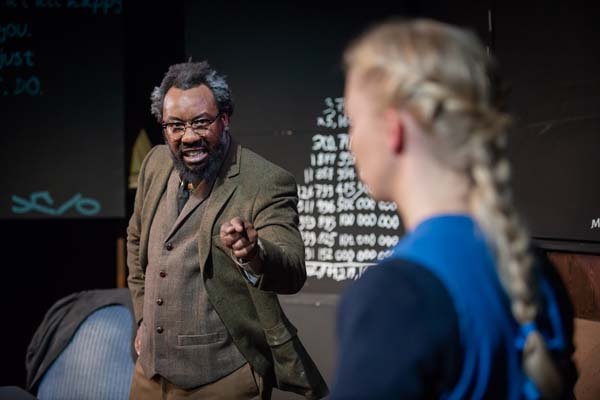
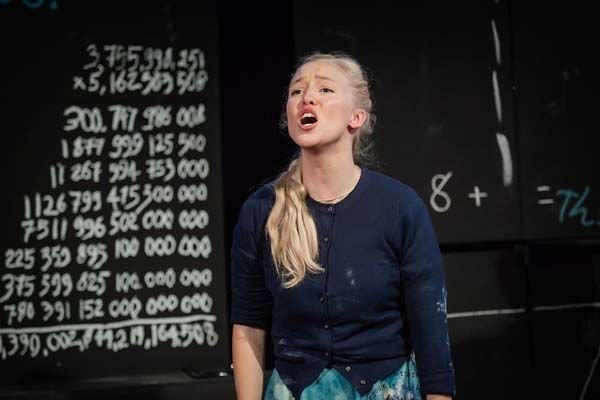
At the heart of it all, though, bravura work from Danielle Dowsett as Rita O’Grady who, somewhat reluctantly, becomes the women’s leader. Dowsett develops this character with total conviction all the way from struggling with the busy morning routine at home and getting two children off to school to a woman with the confidence to speak without notes, at the TUC Conference where she is so impassioned – segueing from speech into song that I found myself moved to tears. She sings magnificently, dances beautifully (Dowsett has a fine choreography track record) and brings naturalism and warmth to the role. She is the epitome of the “triple threat” concept.

As her husband, Eddie O’Grady, Shane King is variously blokeish, rueful, distressed and loving, It’s sensitive work and his singing in the letter scene is sublime.

This show needs two strong choruses – the men and the women in the factory along with a handful of other incarnations – and WWOS has produced them for this show. The choral sound is powerful and a great credit to musical director, Anne Greenidge whose 11-piece orchestra (tucked away out of sight behind the action) produces a lovely sound – especially the flute and trumpet.

It’s a good evening’s theatre not least because of the quality of the writing, both verbal and musical. Anyone (Richard Thomas in this case) who can rhyme “tampon” with “stamp on” gets my vote. Roll over WS Gilbert.

First published by Sardines: https://www.sardinesmagazine.co.uk/review/made-in-dagenham-7/

Show: 100 Paintings

Society: West End & Fringe

Venue: The Hope Theatre. (Above The Hope and Anchor Pub)… 207 Upper Street, Islington, London N1 1RL

Credits: Writer: JACK STACEY, director: ZACHARY HART, producer: JANE CHRISTIE/MIHNEA SAVUICA/JACK STACEY

100 Paintings 3 stars

A ruefully witty satire, Jack Stacey’s play is set in one room in a crumbling Savoy Hotel. It’s a dystopian – but faintly familiar – world. Pollution means that you can’t go put without an oxygen mask or “breather” and there are triple “stay-safe” government announcements along with unidentified sinister explosions, bangs, whistles from outside. There is no electricity and at one point someone mentions a horse-drawn Tesla.

In that squalid room The Artist (Conrad Williamson) is under commission to produce a hundred paintings at speed – variously aided, hindered or inspired by three very different women. So there’s the first issue – in a play which is laden with them – how does creativity actually work?

It’s amusing especially in the first half hour. Stacey dives headlong through the taboo which usually prevents parents and adult children from discussing the details of their sex lives. And we enjoy The Artist’s agony as The Mother (Denise Stephenson) repeatedly says outrageous things that mothers shouldn’t say to their 25 year old sons. Later we get plenty of situation comedy too as Beatriz (Jane Christie) visits and is mistaken for a sex worker. When Eva (Juliet Garricke) who actually is a sex worker turns up there’s even more confusion.

But I think this play is meant to be more than a comic romp with jokes so bawdy that under-18s aren’t admitted. It’s trying to ask big questions about life, art, free-will and the rest. But these are over-subtly submerged.

All four actors turn out good performances. Williamson does frustrated angst pretty well. Stephenson gives us a well observed outrageous mother. Christie is a gentler contrast searching for something of her own in a subplot (which doesn’t. I’m afraid, add much).  Garricke is impressive in her initial eloquent silence and then her wise, stage-commanding articulacy.

Director, Zachary Hart makes interesting use of all four of The Hope’s corners so that it feels pretty immersive and I enjoyed the threading in of Shostokovitch in lyrical mood through Jack Whitney’s atmospheric soundtrack.

First published by Sardines: https://www.sardinesmagazine.co.uk/review/100-paintings/

Show: My Fair Lady

Society: West End & Fringe

Venue: London Coliseum, St Martin’s Lane, London WC2N 4ES

Credits: By Lerner & Loewe. James L. Nederlander, Jamie Wilson, Hunter Arnold, Playful Productions and the English National Opera present the Lincoln Center Theater production

My Fair Lady

3 stars


It’s an enjoyable show which bubbles along but never quite comes to the boil. Given the huge cast and the high production values it feels oddly understated in places.

We’re all very familiar with the music. Or I thought we were. When I was a child my parents saw the original London production and bought an LP so I learned these tunes young. On the other hand I heard the twenty-something man in front of me ask his partner “What’s this show about?” as we all sat patiently for twenty-five minutes because of the delayed start on press night. So, for those who don’t know: it’s the story of a 1913 flower girl, taken in by a professor of phonetics determined to teach her to speak “properly” and treated with shameful misogyny. It’s based on Pygmalion by George Bernard Shaw.

First, the positives: Amara Okereke gives us a splendid Eliza. She has a wonderful knack with long howls and shrieks suspended on slow dipthongs – very funny and agonising for Higgins (Harry Hadden-Paton). She also sings beautifully, looks magnificent and the dignity she finds at the very end of the show is moving.

There’s a fine performance from Maureen Beattie as Higgins’s housekeeper who can communicate exasperation with her back to the audience just by moving her fingers. And it’s good to see Vanessa Redgrave at 85 still able to command the stage as Higgins’s sensible, sensitive mother.

I gradually warmed to Stephen K Amos as Doolittle, Eliza’s dustman father. Initially he seems to lack energy but he’s in fine form by the time he gets to I’m Getting Married in the Morning –  imaginatively, dramatically and colourfully choreographed (Christopher Gattelli) with gleeful bawdiness on ENO’s huge stage –  and everything Doolittle needs to be.

And that brings me to the pit beneath them where Gareth Valentine is in charge. The detail in the orchestration is adeptly picked out and I really admired  Valentine’s control of the varying tempi and dynamics, especially in I’m Getting Married in the Morning.

There’s some accomplished choral singing in this show too – especially the repeated “Poor Professor Higgins” and the work by Doolittle’s sidekicks in A Little Bit of Luck. And the Ascot scene is always a gift – delivered with aplomb here.

Michael Yeargan’s sets, and the stage management of them, almost deserve a review of their own. A revolving flat which moves backwards and forwards gives us several spaces in Higgins’s home which convincingly open into each other. It’s both ingenious and neat. When it disappears upstage we get other scenes such as Mrs Higgins’s home or Covent Garden.

On the other hand, Hadden-Paton and Malcolm Sinclair as Colonel Pickering are better actors than they are singers. Quite often there are too many characters on stage so it feels unnecessarily busy. If, like the man in front of me, you were new to this show you’d be hard put to work out who they all are. It comes across as a careful production rather than an exuberant one. It also feels drawn out in places – the running time, with interval, is over three hours.

First published by Sardines: https://www.sardinesmagazine.co.uk/review/my-fair-lady-5/


Show: Five Farces

Society: Huntingdon Drama Club

Venue: The Commemoration Hall. 39 High Street, Huntingdon 39 High St, Huntingdon PE29 3AQ

Credits: Anton Chekhov, adapted by Richard Brown

Five Farces

3 stars

This was an interesting evening because although I am very familiar with Chekhov’s full-length plays and have read a number of his short stories, his short plays were new to me. And on the whole, imaginatively adapted –  they feature many more females than Chekhov intended and the dialogue sounds right for 2022 – they are worth seeking out. Ideal choice for a drama club too because five separate plays provide lots of relatively small but meaty roles and scope for five different directors.

Some of these plays are firmly in Cherry Orchard or The Seagull territory in which landed  families visit each other and there are tensions.  Inevitably some plays are stronger than others. The inclusion of a sixth one, loosely based in Chekhov’s Smoking is Bad for You presents a stage manager (Alice Wilsmore) who links the other plays (and covers scene changes) is, I’m afraid, a slightly clunky device.

The strongest (and best known) of the plays is The Bear in which a grieving widow is refusing, like Olivia in Twelfth Night, to see visitors until, of course one forces himself on her. Another which stands out is The Night Before the Trial which Chekhov never finished. I can report that Richard Brown’s ending is very satisfying. And Richard Brown himself playing the actor in Swan Song with Madeleine Forrester as prompt is the high spot of the evening. They meet after hours in a theatre. He shows off ruefully and reminisces with a lot of deliciously absurd over acting while she acts as foil before eventually throwing in her surprise. Brown and Forrester are very well attuned to each other.

There is a problem in amateur theatre of this sort though, and to an extent in professional theatre too. Where you have a handful of really convincing, naturalistic actors who can totally inhabit a character, they tend – unintentionally of course – to highlight the ordinariness of some of the others. In this case, along with Brown and Forrester, the ones who really caught my eye were Rob Barton as the coarse, entertaining, charismatic and attractive Smirnov in The Bear; Caroline Malony as the deaf, scheming Madame Chubukov in The Proposal;  Matt Gurtler, who has  wonderfully expressive range of faces and looks in The Anniversary and Dean Laccohee who triumphs as the crafty, opportunistic criminial in The Night Before the Trial.

This was, incidentally, my first visit to Huntingdon’s delightful Commemoration Hall too, although I have reviewed in three other venues in the town: two churches and a pub. Commemoration Hall – dating from 1842 but refurbed in the 1950s – has a good sized auditorium with a neat proscenium arch performance space and a good foyer and café. Even the loos are plentiful and pretty.

 First published by Sardines: https://www.sardinesmagazine.co.uk/review/five-farces/

Show: Bare

Society: Bird College (student productions)

Venue: Bird College

Credits: Music Damon Intrabartolo. Lyrics Jon Hartmere. Book Jon Hartmere and Damon Intrabartolo

Bare

4 stars

Premiered in 2000, Bare is now a historical piece. There is, generally, much less hostility to gay love than there was, even twenty-two years ago. In that time, we’ve seen the acceptance  first of civil partnerships and then same-sex marriage in most Western countries. One feels that the relationship between Peter (Ross McHugh) and Jason (Arthur Janes) might be a little more straightforward in 2022 although the Catholic Church might not agree.

As far as I can tell this show has never had a big production in the UK although it has been staged in Liverpool and there was an outing in Brighton in 2017. So all power to Bird College for running with it – good choice, actually, because the ensemble can be as large as you like and there are thirty-six students in this group.

It was originally styled “a pop opera” and that remains a pretty fair description. It’s a sung though tragedy with chorus. Intrabartolo’s music is wide ranging and sensitive. There are hymns and anthems – because we’re in a Catholic boarding school – and, at one point a Bach-like cello continuo. All this is played well by an out-of-sight eight piece band led by MD Connor Henryk Fogel on keys.

The production (directed and choreographed by Richard J Hinds, assisted by Sam Hooper) is distinguished by the quality of its dance. There are some vibrant ensemble scenes and imaginative use of dance figures behind singers to enhance mood and atmosphere. And Marissa Sims, who plays Sister Chantelle and is reincarnated as the Virgin Mary in a dream, really is a dancer to watch.

The students are being directed by Sister Chantelle in a production of Romeo and Juliet and all the tense love themes – including an unexpected end twist – are woven into both the action and the music. Some of the songs are effectively settings of Shakespeare’s words.

At the centre of all this Janes as the anguished Jason really stands out. He is deeply attracted to/in love with Peter but tries desperately to resist it and certainly thinks any form of coming out would be madness. But he also appeals to girls and Janes gets the charisma exactly right – which eventually leads to serious trouble with Ivy (Georgia Kleopa – good). Janes sings with lots of very convincing sensitivity and makes us share his near-insoluble dilemma. Meanwhile his sister Nadia (Amy Smethurst) is in the same school. Smethurst creates a vulnerable but sassy girl, very different from her brother and yearning for some sort of relationship. When everything gets complicated she sings “Maybe being single’s not so bad” and we laugh wryly because that’s spot on.

McHugh’s performance as Peter is warm and coherent. He has no doubts. He’s known what he is since he was twelve and is very distressed by Jason’s uncertainties. His singing is pretty accurate. One of his best scenes is a phone call to his mother (Lily Gain) in which he tries to tell her the truth but she refuses to listen – but gets the message anyway and is devastated.

Well done, Bird College. You seem to be exploring, relatively unknown, musical theatre territory and doing so stylishly.

First published by Sardines: https://www.sardinesmagazine.co.uk/review/bare/

Of course I’ve read Mrs Dalloway, To the Lighthouse and The Waves (although not lately). I had, however never got round to  reading Virginia Woolf’s Orlando. Then, last month I was invited to review Sarah Ruhl’s adaptation of it at Jermyn Street Theatre – strong, feisty 4 star theatre, I deemed it. It reminded me that it was high time I read the novel too.

It’s a light hearted work about ambiguous, shifting, sexuality and it therefore as topical now as when it was written nearly a century ago. Styling it a biography –  and sending up the genre, with authorial comments, just as her Bloomsbury  friend Lytton Strachey did in Eminent Victorians ten years earlier – she presents a protagonist whose existence spans four centuries and who is sometimes a man and sometimes a woman depending on which century we’re in. Whatever Orlando is at any given time the experience of previous stages of his/her life is there to refer to and inform present actions and reactions.

“The change seemed to have been accomplished painlessly and completely in such a way that Orlando herself showed no surprise at it. Many people, taking this into account and holding that such a change of sex is against nature, have always been at pains to prove (1) that Orlando had always been a woman and (2) that Orlando is at this moment a man. Let biologists and psychologists determine. It is enough for us to state the simple fact; Orlando was a man till the age of thirty; when he became a woman and has remained so ever since” (pp 93/4)

We trace Orlando quirkily through late 16th, 17th and 18th centuries  when he is male, eventually becoming female in the nineteenth century. He/she encounters lovers of both sexes and those who change, goes on voyages and has adventures both ironically swashbuckling and amatory.  Some characters recur down the ages. It’s experimental writing which, like the music of late Schoenberg, still challenges and surprises.

In her preface Woolf acknowledges a whole string of writers, alive and dead, from whom she has drawn inspiration but mentions neither Voltaire nor Lewis Carroll (Charles Dodgson). Yet the sardonic style reminds me a lot of Candide and the surrealism of Alice’s Adventures in Wonderland.

The novel is dedicated to, and was written for, Vita Sackville-West, She and Woolf were both in “open” marriages which allowed them to enjoy extramarital relationships if they wished. The famous, long passionate love affair between these two women is clearly at the heart of Orlando – even to the account of her rejection of a traditional female manner. Years ago I taught with a man who’d been at prep school with one of Sackville-West’s sons so he spent some of his school holidays at Sissinghurst where the family lived. His overriding memory was of her marching about, shouting orders, smoking heavily and swearing.

That pretty much matches Woolf’s description of the 20th century Orlando. For instance Orlando would “change her skirt for a pair of whipcord breeches and leather jacket which she did in less than three minutes …Then she strode into the dining room.” Then “she cut herself a slice of bread and ham, clapped the two together and began to eat, striding up and down the room thus shedding her company habits without thinking, After five or six such turns, she tossed off a glass of red Spanish wine, and, filling another which she carried in her hand, strode through a dozen drawing rooms and so began a perambulation of the house, attended by such elk-hounds and spaniels as chose to follow her.” (pp 223/4)

The house – Orlando’s ancestral pile – is Knole at Sevenoaks where Sackville-West grew up and which Virginia Woolf loved although she’s wittily and relentlessly sardonic about its vast size.It’s odd though. Orlando is pretty explicit about same sex relationships and yet it was published to great acclaim, became a best seller and was soon one of Woolf’s most successful novels. Radclyffe Hall’s The Well of Loneliness deals with similar issues in a rather different way. It was published in the same year – and banned.

PS Once an English teacher … it’s a joy to read something which uses the word sex correctly. “Her sex must be her excuse” and “She had hardly given her sex a thought” and “The curious of her own sex would argue”.  Yes, leave that over-used, misused word “gender” in grammar books and discussions where it belongs.

Next week on Susan’s Bookshelves:  The Uncommon Reader by Alan Bennett


Penelope Lively, now 89, is a very unusual writer. She was a highly successful children’s novelist, winning The Carnegie Medal for The Ghost of Thomas Kempe in 1973 and the Whitbread Prize for A Stitch in Time in 1976. She is on record as agreeing with WH Auden that “There are good books which are only for adults. There are no good books which are only for children” so she turned to adult fiction. She did brilliantly at that too. In 1987 she won the Booker Prize for Moon Tiger, She then kept them coming. The Road to Lichfield was Booker shortlisted in 1977 as was According to Mark in 1984. In 2012 she became Dame Penelope Lively – and quite right too.

I read Moon Tiger when it was first published (and most of Lively’s books as they’ve appeared over the years since) and had very fond memories of it. And it doesn’t disappoint in 2022. If anything I’ve matured into it in the last 45 years so it seems even better now than it did then.

Claudia, has had a successful career as a journalist and author of history books. She now lies dying in a private room in a London hospital, reflecting on her life. She spent the war reporting from Egypt – and the country is evoked with colourful, convincing realism because Lively grew up there until she was 12.  The period detail is finely done too. The narrative slips from first to third person which is a neat technique because it means we see Claudia from a range of angles – most poignantly from the point of view of the nursing staff who have no idea what’s going on in Claudia’s head and treat her with professional, impersonal kindness, To them she’s just trying old woman, dying.

In Egypt – unbeknown to everyone else who knew/knows her –  Claudia met the love of her life but it is obvious to the reader almost from their first meeting that this is doomed because he doesn’t feature later. And this is an intricate novel full of time shifts. Instead there’s another man, still alive, who comes and goes but clearly isn’t the One, glamorous and prosperous as he is.

Feisty, argumentative Claudia had no talent for motherhood and doesn’t really know or understand her only daughter who dutifully now comes to the hospital. Also in the background is Claudia’s very close, borderline incestuous relationship with her late  brother Gordon whose insipid widow also visits her regularly. Then there’s Laszlo, the teenage Hungarian refugee she befriended in 1956 who becomes effectively part of her family although he’s resented by Lisa, her daughter.

It’s obvious from the first page of this lovely novel what has to happen on the last, although there’s an eleventh hour development which I’d forgotten.  What’s in the middle is a riveting love story and immaculate portrait of a complex woman. Reacquainting myself with Moon Tiger has left me with a thirst to reread all Lively’s other books. Reading is a never ending journey isn’t it?

Moon Tiger 2 (1)

Next week on Susan’s Bookshelves: Orlando by Virginia Woolf

Show: Barry Humphries: The Man Behind the Mask

Society: Churchill Theatre Bromley (professional)

Venue: Churchill Theatre Bromley. High Street, Bromley BR1 1HA

Credits: Written by Barry Humphries. Produced by TEG Dainty & TEG MJR

Barry Humphries: The Man Behind the Mask

3 stars

Barry Humphries is an old pro who knows exactly how to work an audience and this show is very funny indeed. Now 88, he can get a laugh simply by pausing and looking – it’s so skilled that to call it anything as banal as “comic timing” is to belittle it.

There are three elements: Humphries himself, in autobiographical mode, presenting a leisurely wander through his long life. Then there’s a projection screen on the back wall which shows illustrative archive footage and photographs. Thirdly is pianist Ben Dawson seated at grand piano and oddly underused. He occasionally plays a few bars to link anecdotes and he accompanies a valedictory song which Humphries sings, not particularly well, at the end although the rhyming of frolics with alcoholics is fun. It must feel like a pretty light evening’s work for Dawson and, I would have thought, a bit frustrating because he’s clearly very accomplished.

Humphries wears brightly coloured odd socks and a flamboyant red velvet jacket in the first half. The blue jacket he sports after the interval reflects the fact that he’s slightly less flippant and more serious in the second half, especially in the account of his recovery from alcoholism in the 1960s which involved several sojourns in expensive centres for “thirsty people”. Sober now for many years, he talks quite movingly of finding happiness as a result of that change.

Born in Melbourne where he studied law at university, Humphries started acting in student shows and we see pictures of him as Orsino in Twelfth Night where he was so embarrassed by his tights that he lurked behind the furniture on stage. “You’re naturally ridiculous” the director told him. He had difficulty learning lines too – cue for a hilarious account of corpsing in Noel Coward’s play Design For Living. So he started to invent characters and eventually Dame Edna Everage and Sir Les Patterson were born and evolved.

Humphries sits in a big armchair from which he rises often and quite adeptly although he is evidently now a slightly shaky mover. He makes a lot of jokes about age. When he walks over to the piano facing away from the audience and then turns round wearing Dame Edna glasses, the audience cheers and whoops in delight but the familiar Edna voice is not as firm as it once was.

The highlight of this show is probably the archive footage of Dame Edna grilling a very boyish looking Boris Johnson on her TV show. He cycles in and she greets him as a future prime minister as he talks dead-pan about encouraging British people to go and live in the parts of France which once belonged to England – while everyone else on the sofas look horrified, spaced out or bowled over. It shows that Johnson once had a sense of humour. There’s an interview with a young Donald Trump and his wife too. Humphries tells the audience that he was told afterwards that Trump had not understood Edna’s “complex indentity” and declared her a very nice woman. Oh my, I do so hope that’s true.

It’s certainly a very entertaining evening but it’s self indulgently long at nearly two and a half hours. Yes, we get the sense that Humphries is simply chatting although of course every word is scripted – witness the slick piano cues – apart from one or two bits of banter with front row audience members. It feels padded out in places.

First published by Sardineshttps://www.sardinesmagazine.co.uk/review/barry-humphries-the-man-behind-the-mask/