Press ESC or click the X to close this window

Susan’s Bookshelves: Charles Causley Collected Poems (1992)

I’ve always loved the poetry of Charles Causley (1917-2003). He is widely anthologised but although he received the Queen’s Gold Medal for Poetry and was appointed CBE in 1986, he wasn’t Poet Laureate, he didn’t get a knighthood and he didn’t do much broadcasting. He was never a household name as others of his generation such as John Betjeman, Ted Hughes and Seamus Heaney were. Perhaps Patrick Gale’s forthcoming novel Mother’s Boy, a fictional biography of Causley will help to change that.

Causley, who was a primary school teacher, was born in Launceston in Cornwall and lived there all his life apart from six years service in the Royal Navy in World War Two. Unsurprisingly, therefore, a lot of his poetry (but by no means all) relates to schools, Cornwall or war.  If you accept that poetry can be  “taught” – and I’m half with you if you don’t – then I have taught many Causley poems to many classes over the years. Or at least I’ve led students to it and found ways of helping them to think about layers of meaning and the applied use of poetic technique to enhance meaning.  It’s a bit like exposure to music, really.

I bought Charles Causley Collected Poems in 1992, when it was published, and that’s the volume I have reread now with fond affection and admiration. At the time Causley, who was then 75, wrote “This book contains all of my poems I wish to preserve”. There has been a revised editions since the 1992 volume.

He was as good a technician as Tennyson. When I reread “Cowboy Song” I marvelled yet again at the brilliance of anyone who can come up with this:

I come from Salem County

  Where the silver melons grow

Where the wheat is sweet as an angel’s feet

  And the zithering zephyrs blow.

I walk the blue-bone orchard

  In the apple-blossom snow,

When the teasy bees take their honeyed ease

  And the marmalade moon hangs low.

It ripples along like Mozart. And, as with  Mozart, as soon as you start to unpick it you realise just how complex it actually is and marvel  all over again at his blended use of rhyme, alliteration, consonance and assonance to create rhythmic musicality.

Causley wrote in every conceivable form. “The Ballad of Charlotte Dymond”  uses the traditional ballad form with end-rhymes ABCB to tell the story of a nineteenth century servant girl who was murdered on Bodmin Moor:

Charlotte walked with Matthew

  Through the Sunday mist

Never saw the razor

  Waiting at his wrist.

Or take “Ballad of the Bread Man” one of his many poems rooted in Bible stores and religious reflection:

 Mary stood in the kitchen

  Baking a loaf of bread

An angel flew in through the window.

  ‘We’ve a job for you’ he said.

I doubt many British students leave school without reading and thinking about Timothy Winters who comes to school /with eyes as wide as football pool  – dirty, neglected at home but unaware of his own situation as he slowly goes on growing up. It’s written in quatrains with a  marching AABB rhyme pattern. “Seasons in North Cornwall” in which  spring has set off her green fuses/Down by the Tamar today  is thoughtfully full of colour. Who could forget the white ships of winter ?

Chief Petty Officer is a blank verse account of a man  with boots and a celluloid Crippen collar,/ Buttons and cruel ambitious eyes of almond. It’s a deliciously vivid portrait:

He was probably made a Freemason in Hong Kong.

He has a son (on War Work) in the dockyard,

And an appalling daughter

In the WRNS.

But I think my favourite Causley poem of all is “Death of an Aircraft” inspired by an incident in the Cretan campaign in 1941. It’s a narrative poem which sustains a magnificent metaphor of a shot down plane as a dead whale and the sky as the sea:

One day in our village in the month of July

An aeroplane sank from the sea of the sky

  White as whale it smashed on the shore

  Bleeding oil and petrol all over the floor.

The story which follows is a chilling one of courage and daring. Look at this sardonic cynicism when three carefree young saboteurs are caught by the Germans. The latter have been made to look stupid and have a firing squad on hand:

One was sent to the county gaol

Too young for bullets if not for bail,

  But the other two were in prime condition

  To take on a load of ammunition.

Do reread some of Causley’s poems. I don’t think you’ll be disappointed. He may not be fashionable but by golly, he’s good. And if he’s new to you then you have a sumptuous treat in store.

Causley2

Next week on Susan’s Bookshelves: The Glassblowers by Daphne du Maurier

Show: Measured

Society: West End & Fringe

Venue: The Hope Theatre. The Hope Theatre is an award-winning 50-seat venue above the world-famous Hope and Anchor pub. 207 Upper Street, Islington, London N1 1RL

Credits: By Emma O’Brien. Produced by Laurel Marks.


Measured

3 stars

It is hard for someone who is fortunate enough not to have an eating disorder to get any kind of real grip on how it feels to have one. Emma O’Brien’s debut play does more to bridge that comprehension gap than any drama I’ve seen before. She has, I’m not surprised to read, come through an eating disorder herself and her three hander play certainly packs an authoritative punch.

Sophie (Juliette Burton) has been sectioned for a long time but is now being discharged from hospital. Her much younger half-sister Lucy (April Hughes) has a few problems at school and her relationship with Sophie is complicated. Tom (Aaron Phinehas Peters) is Sophie’s decent, supportive boyfriend, desperate to understand but struggling.  Other characters such as the mother of Lucy and Sophie and a friend named Lauren are developed by implication.The play is structured as a series of scenes, mostly duologues but sometimes all three are on stage and there are some strong-ish monologues. Although these three actors play off each other quite sparkily and every word feels natural and truthful the opening scene is weak. Sophie and Lucy are both on stage, each speaking to an unseen listener but not to each other. It’s effectively intercutting monologues and a clumsy, confusing way of setting up the play.

Burton’s nuanced performance makes Sophie brittle, prickly and intelligent, constantly scuppering her own position so that she finds no peace although the ending is hopeful, if not quite happy. “It isn’t about food”  she says more than once as O’Brien focuses firmly on the psychology of mental illness rather than on the physical symptoms of anorexia nervosa. In fact she overdoes this a little. Had I not read the programme first it would have been some time before I worked out the precise nature of Sophie’s illness.

April Hughes is totally believable as a conscientious but feisty and sometimes troubled fourteen year old. She is charismatic on stage and has a delicious, chirpy sense of comic timing. Peters is good as Tom too: gentle but sometimes understandably hurt or annoyed. He is forever doing practical helpful things such as cooking eggs or listening attentively.

This thoughtful – and thought-provoking –  play is part of the Measured Festival at the Hope Theatre which is working with two charities: Rethink Mental Illness and Beat Easting Disorders.

First published by Sardines: https://www.sardinesmagazine.co.uk/review/measured/

Show: The Mikado

Society: Merry Opera Company Limited, The (professional)

Venue: Opera House, Tunbridge Wells. 88 Mount Pleasant Road, Tunbridge Wells, Kent TN1 1RT

Credits: By Gilbert & Sullivan


The Mikado

3 stars

Susan Elkin | 21 Feb 2022 12:48pm

What better entertainment than an upbeat, bijoux production of, arguably, the most upbeat and tuneful operetta ever written, on a wet, windy cold  Sunday afternoon in the stunning Opera House at Tunbridge Wells? And, as ever, I’m struck by the enlightened (in this instance) approach of JD Wetherspoon, which, once a year allows its pub to revert to its original function for two performances, with a meal package if you wish.

John Ramster’s eight hander adaptation runs with the wackiness of the piece. Hands, and other things, poke through holes on the side cloths of Bridget Kimak’s set and her costumes range from Pierrot to Alice in Wonderland with a splendid, massive, shiny yellow suit and chrysanthemum-topped headdress for a scary-looking skull-masked Mikado (Matthew Quirk).

The advantage of working on G&S with a small cast – and I’ve seen it with other companies such as Illyria Theatre and Charles Court Opera – is that you can hear every note and every word because it’s all so exposed. Music director Bradley Wood, sidestage on keyboard, has wisely run mostly at fairly moderate tempos so that the clarity is crystalline – after an oddly nervous opening number at the performance I saw.

Christopher Faulkner, as a gor-blimey, insouciant Ko-Ko, for example, delivers the all-topical little list, which he wrote himself, with impeccable timing and hilarious precision. The Mikado’s song is, unfortunately, a bit muffled by the mask but I really liked the way Gareth Edmunds, a fine tenor, and Wood managed all the tempo  and mood changes in A Wandering Minstrel I. And the madrigal,  Brightly Dawns Our Wedding Day is, as sung here, a lovely example of a quartet really nailing it. I could almost feel Sir Arthur applauding.

Ashley Mercer as Pooh-Bah is magnificent. Tall, slender and sneering he literally wears a multiplicity of hats all piled one on top of another. He oozes stage presence and his bass voice is resonant and authoritive.

The larger-than-life Susan Moore is terrific as Katisha too. She has an old fashioned contralto voice like good claret and acts beautifully as the frumpy but oddly vulnerable and pretty vindictive woman nobody wants. She is also very funny, pulling faces and flirting with the audience.

Every director wants – needs, even – to put his or her own stamp on a piece as well known and much loved as this. If G&S is to work, it has to sparkle. It was, let it not be forgotten, lack of freshness which eventually alienated the Arts Council and killed the D’Oyly Carte company. The trouble is, though, that there is a fine line between imaginative artistic innovation and gratuitous gimmickry. And sometimes Ramster crosses that line. What on earth does it add to the piece to do Howdy Do in Texan accents as if we were at a rodeo? Why change the word Japan to Pajan? Why have Mathew Quirk, doubling as Pish Tush speak in a distorted accent which is a cross between West Midlands and cod-Jewish?

For various reasons I saw this touring show late in its run. It includes a lot of stage business with long bendy arms with which characters touch each other, kiss and so on. This is clearly how it was rehearsed last year when on-stage social distancing was a requirement. It would then have seemed quite witty. Now it feels a bit quaint. When this production is next revived, I’m sure this aspect of it will be dropped.

First published by Sardines: https://www.sardinesmagazine.co.uk/review/the-mikado-5/

Show: Holst: The Music in the Spheres

Society: Arrows & Traps (professional)

Venue: Jack Studio Theatre. The Brockley Jack Theatre, 410 Brockley Road, London SE4 2DH

Credits: by Ross McGregor. Produced by Christopher Tester for Arrows & Traps Theatre


Holst: The Music in the Spheres

5 stars

Susan Elkin | 21 Feb 2022 12:44pm

It isn’t often that I see a new play running for two and a half hours which holds a hundred per cent of my attention from the first moment to the last, causes me to dab my eyes several times, gasp in wonder more than once and chuckle a lot. Holst: The Music in the Spheres did all of that. And more.

Cecilia Payne, who went on to be a pioneering astrophysicist was a student of Holst’s at St Paul’s Girls School where he tried unsuccessfully to persuade her to study music instead of science. Ross McGreggor explores that relationship and finds an ongoing link between Holst’s Planets Suite and Payne’s work on stars. The play I’m reviewing here is one of a pair. This one focuses on Holst. The other – Payne: The Stars are Fire – I hope to see in April.

The play provides, with lots of time shifts, Holst’s life story from his troubled childhood, his poor health, his friendship with Ralph Vaughan Williams, his marriage and, of course, the music he was writing although for many years he also had to teach to pay the bills. Although he was born and grew up in Cheltenham his Germanic name inevitably caused problems in the second decade of the 20th century. The best scenes are the ones set in his studio at St Paul’s School where McGreggor imagines that Payne (Laurel Marks – a very intelligent performance) spends so many detention periods that these two lonely people become quasi friends rather than teacher and pupil. When his eyes are bad she morphs into his amanuensis, for example.

Toby Wynn-Davies is totally convincing as Holst – shivering with misery as a sickly, misunderstood child, diffidently courting Cornelia Baumann’s Isobel Harrison (good), weeping with joy as he conducts Jupiter or fretting about money and struggling with self confidence. It’s very nuanced acting. Even the piano playing at his desk works.

Edward Spence makes Ralph Vaughan Williams into a witty joker as well as a very supportive friend and Lucy Ioannou shows impressive versatility in switching between the prunes-and-prisms high mistress of St Pauls and Holst’s kind, down to earth aunt. Also strong is Alex Stevens as Holst’s stentorian, authoritarian father, and as Sydney Bressey a member of Holst’s orchestra at Morley College, killed in the war.

There’s a lot of music in this show and several times we get a surreal ballet ensemble sequence such as the one in the first act when Holst’s inner turmoil is evoked by projection on the back screen, Mars driving along in its relentless 5|4 rhythm on the sound track while a tableau evolves from the whole cast moving a table. I also loved the scene in which Holst conducts and the rest of the cast becomes his orchestra – miming cellos, timps, trombones and so on as they become prominent in the music. It’s excitingly ingenious movement direction by Will Pinchin.

It’s a meaty, intelligent play with some good  jokes for educated grown ups although it’s never abstruse. I loved the crack about using a clarinet for a death, for example. “No, no” says Vaughan Williams. “Death is always an oboe.” And as a former Swale resident of course I enjoyed the Sheppey joke – I had no idea, though, until now, that Holst ever lived there.

I saw the final performance of this play at the Brockley Jack because the performance I was due to see earlier in the run was cancelled. The good news is that both plays are having another run – at  New Theatre Wimbledon 11-24 April. Catch it then if you possibly can.

 First published by Sardines: https://www.sardinesmagazine.co.uk/review/holst-the-music-in-the-spheres/

Show: Handa’s Surprise

Society: Little Angel Theatre

Venue: Little Angel Studios. Sebbon Street, London N1 2EH

Credits: Based on the bestselling book by Eileen Browne


Handa’s Surprise

4 Stars

Adapted from Eileen Browne’s much loved 1995 book, this 35-minute show is effectively an opera for preschoolers. Akeyo (Rujenne Green) wants to take a gift of fruit to her friend Handa (Hannah Akhalu) but all the fruit she gathers is eaten by animals she meets on the way so it’s fortunate that a goat knocks some tangerines off a tree. Tangerines – and every child in the audience is given a segment – turn out to be Handa’s favourite and that’s the surprise.

It’s a rhythmic story in which each fruit celebrated in song, in an African language, in a repeated melody and there’s a little tune which I know as The Farmer’s in his Den. The music is very simple and, almost entirely consisting of rounds based on major chords. One child, at the performance I saw, was singing some of it back to them before we were even half way through. Green and Akhalu both have clear, sweet voices and their intonation is excellent. There is no accompaniment although both actors are on stage smiling and rocking and sweeping to steel pan tunes before the show starts.

The fruit eating animals are puppets (by Peter O’Rourke)  which either emerge from the edge of Sophia Lovell Smith’s sandy African set or are assembled from around  Green’s person. The delicate teetering monkey is attractive and we get a neat zebra from inverting a neck sling that Akhalu is wearing. The giraffe is probably the tour de force moving with spindly elegance on its bamboo legs.

The children and their parents are seated on the floor round three sides of the square playing space – as a venerable (or something) onlooker I am given a chair. All the puppets tour the audience to wave at, inspect, gently peck the children in the audience which goes down well.

It’s a show which exudes charm and it’s very engaging. All the children I saw it with were entranced.

First published by Sardines:

One of the things I have tried to do in the fourteen months that I’ve been writing these blogs is to keep the books I choose as varied as possible. Thus we go from classics from the nineteenth and twentieth centuries alongside a few recent books and taking in on the way children’s books, sci-fi, crime, historical fiction, short stories and a lot more. The only things I really can’t do are horror and fantasy which are just not my cup of tea.

But for all my careful eclecticism I’d never have thought of Dawn French. To be honest, I didn’t even know she had written novels – to my shame because there are several and this one was a Sunday Times bestseller last year. Then a friend said how much she’d enjoyed Because of You, So, always keen to widen my ambit, I read it.

Well, I don’t know what I was expecting but what I got was  a thoughtful, compelling novel with some very serious issues at its heart. It’s also very grippingly told and well written but then Dawn French is a communicator, par excellence.

Two couples are in separate rooms in a hospital delivery suite. In either case the first baby is being born.  Both couples are mixed race. Emma is the blonde wife of obnoxiously pushy self centred Julius, a politician with ambitions to be the UK’s first black PM.  Hope is the daughter of a white father and Jamaican descended mother and has grown up in Bristol. She is attended by her student partner Isaac who has come from Liberia to do his degree in London. Things go well at the hospital for Emma and Julius but not for Hope and Isaac.

What follows is a finely evoked depiction of misery, loss, grief and anguish because one baby has died and the other disappears. The reader knows from the outset where the missing baby is and we meet her again – in a completely different set of circumstances eighteen years later as issues ripple down and across the generations. Her boyfriend, Lee, is an utter delight and I wish I knew him in real life.

Of course no one can condone kidnapping but this is a book with a lot of heart in which there are no absolutes. These are – for the most part – good people. Everyone has a point of view and French leads us to see each and every one of them with thoughtful sympathy apart, perhaps, from ghastly Julius who really wants to turn his family’s misfortune into shallow political capital.

French is also – obviously – a comedian so, in amongst the thought-provoking stuff is a policeman named Detective Inspector Thripshaw who really ought to be called DI Malaprop. He never gets a sentence out without some hilarious verbal solecism. What fun French must have had inventing and developing him. But even he is tempered by his tactful, kind, wise junior colleague Debbie – the police officer we’d all like assigned to us if something awful happened.

My friend was right. It’s a jolly good read – and very different from titles such as The Silver Sword, Tenderness and The French Lieutenant’s Woman that I’ve written about recently. Isn’t variety lovely?

Next week on Susan’s Bookshelves: Charles Causley Selected Poems

Show: Rain and Zoe Save the World

Society: West End & Fringe

Venue: Jermyn Street Theatre. 16b Jermyn Street, St. James’s, London SW1Y 6ST

Credits: BY CRYSTAL SKILLMAN. ORIGINAL MUSIC BY BOBBY CRONIN.


Rain and Zoe Save the World

1 star

The best thing in this show is the motorbike. Two black-clad actors crouch with wheels while two others ride – pretty dynamically – on top. The whole thing rocks, bucks and suggests speed and danger. Congratulations to whoever thought that up, whether it was director Hersh Ellis or Jasmine Ricketts who directed the movement.

Otherwise it’s hard to find anything positive to say about this overlong, laboured tale of two American teenagers, both with family issues, who run away to join a protest and change the world. As quest stories go it’s woeful: predictable and pedestrian. Half an hour in, I was gritting my teeth at the laboured, didactic dialogue (yes, we know about climate change and its implications, thanks) and the person next to me was asleep. Of course the quest is punctuated with incidents – not very exciting in this case and, once they reach their destination nothing is as expected because that’s what happens in quest stories. Meanwhile Salma Shaw keeps floating on as the moon with an illuminated ukulele in a show which simply cannot decide whether it’s based in reality or surreality.

All this mediocrity is a great pity because there’s some real talent in the cast. Richard Holt, for instance, shows a lot of charismatic versatility from a bar owner on the make to a bossy ghost dad. His coyote howls are convincing too. And some aspects of the lighting (Pablo Fernandez Baz) and projections by Elizabeth Mak find ingenious and colourful  solutions to working in a small space. I just hope they’ll all find a better show to work on very soon.

This was, I’m afraid, one of those (quite unusual) occasions when I found myself wondering for over two hours why I had volunteered to spend my evening seeing a play when I could have been at home with a good book.

First published by Sardines: https://www.sardinesmagazine.co.uk/review/rain-and-zoe-save-the-world/

Show: Jungle Rumble

Society: West End & Fringe

Venue: Fortune Theatre, Russell Street, Covent Garden, London WC2B 5HH

Credits: Presented by Perform Productions. ‘A wild new musical for all the family.’


Jungle Rumble

2 stars

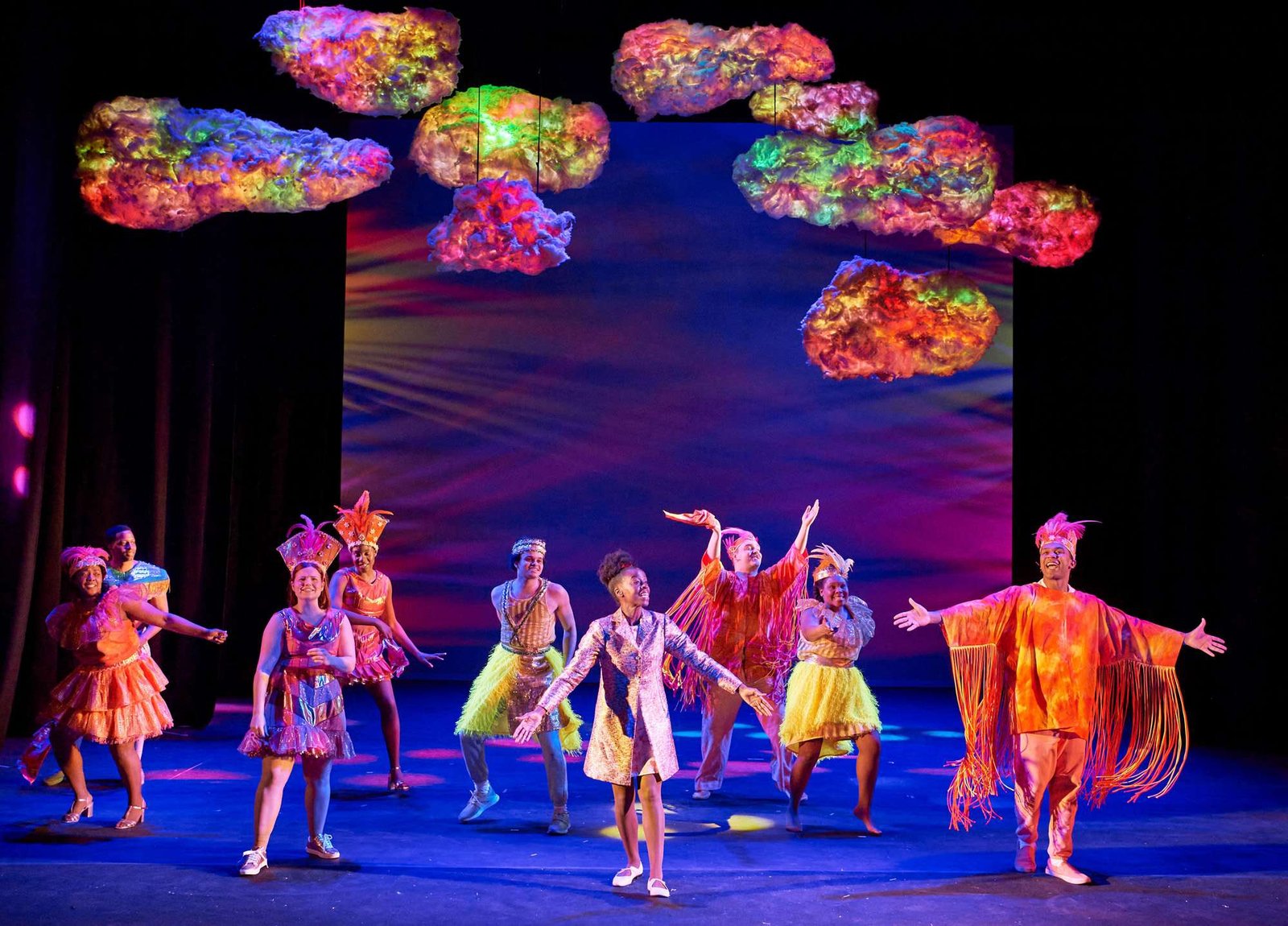
The crude political message in this 45-minute show for under-7s is shallow and overdone. Yes of course we need to save endangered animals and to conserve the jungle but absurd, outdated stereoptyping of the sort of people who once killed animals for taxidermy is hardly likely to get the message over to young children. Beware of laboured indoctrination masquerading as educative entertainment.

Moreover I wasn’t comfortable with the zoological and biological solecisms. Snow the White Lion is eventually rescued. She is the last of her species so that’s important. How she come to be pregnant is a mystery.

And Cheetahs, for goodness sake, are carnivores. “Don’t trust a cheetah with your Ryvita/With just one packet I’ll make a racket” is a witty lyric but surely this show is supposed to me making some serous points not teaching nonsense?

I winced at the rhyming of Guatamala with koala too. Sorry, folks, but koalas live in Australia.

All this is a pity because the songs are jolly and varied in style from Calyspo to Rap to ballad. These will already be known to children who attend Perform classes for 4-7s.

All seven members of the cast are strong singers and there’s some nifty movement choreographed by Frank Thompson) In particular, Darren Hart is a bit of a show stealer as the bouncy, jokey Cheetah, Rachel Lea-Grey gives us an attractive young Zebra learning to overcome self effacement and Carole Stennett’s cobra is slitheringly convincing. Ben Stock shows a lot of versatility as a ridiculed English colonial gent, leader of the monkey troop and a crocodile.

And Lotte Collett’s costume designs are inspired – just enough animal hints to make us believe in them. Sharron Ballard as Eeli the elephant, for instance, is all in grey with a trunk protruding from her chest – she creates an elephantine ambience by moving it with her hand.

An opportunity lost, therefore. We owe it to children to entertain them truthfully rather than patronising them with this sort of stuff. As it is the talents of this cast and creative team are wasted.

First published by Sardines: https://www.sardinesmagazine.co.uk/review/jungle-rumble/