Press ESC or click the X to close this window

Prom 27 July 2025 (Susan Elkin reviews)

Prom: 27 July 2025


BBC Scottish Symphony Orchestra

Ryan Wigglesworth (conductor)

Mariam Batsashvili (piano)

Royal Albert Hall


I don’t recall ever before attending a concert at which the opener was composed by the orchestra’s chief conductor. So this was rather special. Ryan Wigglesworth’s for Laura, after Bach is a tribute to Laura Samuel who led BBCSSO for 12 years until her untimely death last year at age 48. Because it’s a piece for string orchestra rooted in the Gigue from Bach’s Partita in E major for solo violin BWV 1106, there is much Brandenburg-ian busy-ness along with sections of relative lyricism. It was played carefully, as new works usually are, in a way which seemed to connote wistful, loving respect especially in the contemplative ending.

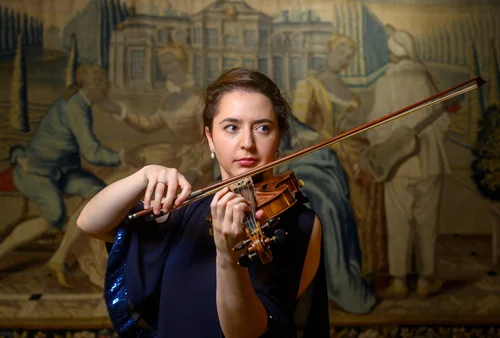
Georgian pianist Mariam Batsashvili has made quite a name for herself in a relatively short time. Dressed in a plain navy trouser suit over a simple white top, she looked less showy than any soloist I’ve seen in years. And her appearance is effectively a metaphor for her electrifying, but businesslike playing. She wanted us to listen – really listen – to the notes in Mozart’s Piano Concerto in D Minor rather than being distracted by sequins or décolletage.

This concerto, so reminiscent in places of Don Giovanni which came two years later in 1787, includes one of Mozart’s most beautiful slow movements. Batsashvili delivered it with gentle sensitivity while Wigglesworth controlled the softly pulsating string quavers beneath her melody. The finale Rondo came with commendable crispness and balance especially during the “question and answer” passages. Batsashvili has a rather appealing way of looking to her left at the instruments she’s duetting with as if she were playing chamber music so it feels intimate even in the lofty Royal Albert Hall.  It was a fine performance, nicely accompanied after momentary raggedness at the start, and it was an unusual treat to hear the grandiose, imaginative Beethoven cadenzas.

And so, after the interval, to something much larger in every sense. Bruckner’s seventh symphony, premiered almost exactly a century after the Mozart, runs for over an hour and requires, among other things, double brass, four Wagner tubas, bass tuba and enlarged string sections. It demands a deal of stamina from both players and listeners.

Wigglesworth’s committed and convincing interpretation came with many highlights amongst which were the richness of the cello sound and the flute interjections (fine work from principal flautist throughout the symphony) in the first movement followed by the Rhine Maidens moment at the end of the movement – just one of many examples of Bruckner’s admiration for Wagner.

We then got the achingly beautiful adagio complete with the dark colour of the bass tuba, all kept flowing dynamically via Wigglesworth’s calm, time-beating conducting style. I liked the incisiveness of the trumpet work in the scherzo and the way in which this performance brought out the mood change into the more tender trio. Then came the rich contrasts of the high-octane, resolute finale – all played with energy and verve.

It was good to see Royal Albert Hall full to capacity for this enjoyable concert. Classical music in general, and the Proms in particular, are evidently alive and well.


REVIEW: It’s Not All About Coffee at Brockley Jack Studio Theatre 15 – 19 July

Susan Elkin • 18 July 2025

‘Accomplished, imaginative, funny and sinister’ ★★★★


An accomplished piece of original and imaginative theatre, this production showcases the considerable talents of two women. Sophia Hail, who also directs, as Zona and Jennifer Kehl as Katherine have agreed to undertake a 60 day trial in which they train themselves to make coffee for their unseen bosses, at the end of which one or other of them will get the job but, of course, there is actually something much more serious going on. The clue is in the play’s title.

These women are actually in a “doomsday bunker” a mile underground in Hawaii because this is a dystopian two hander. It’s a witty, fast paced study of the relationship between them because they don’t initially know each other and their personalities are very different. Gradually their hang ups and vulnerabilities emerge and very slowly and, against the odds, a friendship begins to develop. There’s a lot of humour here but there’s poignancy too when, for example, Katherine explains why she applied for this trial. And towards the end there’s real terror as the situation hots up and, at last, we hear a voice (Austin Yang)  from the outside world.

Hail is very funny as the excitable, untidy, all-American Zona (her full, flamboyant name is Arizona Turquoise) who has come by sea because, of course, she has environmental objections to flying. Kehl’s contrasting character is a control freak from Dallas who just about manages to hold herself together by being ruthlessly efficient. The dialogue is finely honed and the two actors play very pleasingly off each other. The passage of days is indicated by rapid physical theatre like a speeded up film and it’s a device which is both amusing and effective.

A word of praise too for the set which neatly provides a convincing coffee bar in a room which also has camp beds and a table and chairs – everything these people need for 60 days during which food is delivered in an elevator whose ping becomes almost sinister.

Well done Little Coup Theatre Company. This is impressively thoughtful work.


It’s Not All About Coffee

Written and performed by Sophia Hail and Jennifer Kehl

Directed by Sophia Hail

Little Coup Theatre Company

Brockley Jack Studio Theatre

15 – 19 July 2025

This review was first published by London Pub Theatres Magazine:https://www.londonpubtheatres.com/review-its-not-all-about-coffee-at-brockley-jack-studio-theatre-15-19-july

Extraordinary Women

Sarah Travis & Richard Stirling from novel by Compton Mackenzie

Directed by Paul Foster

Jermyn Street Theatre


Star rating: 2.5


Originally commissioned by Guildford School of Acting and filmed during Covid, this musical take on a rather weary, satirical 1928 novel is good in parts.

We’re on the fictional island of Sirene (a not very well disguised Capri) where the sirens lure  women with “sapphic” inclinations to pursue their passions – especially in the case of Rory Freemantle (Caroline Sheen) who owns the property and the elusive, charismatic, disruptive Rosalba (Amy Ellen Richardson). The wailing sirens, clad in what appear to be plastic macs in pastel shades, have a minor key refrain which bears a close resemblance to the fairies in Iolanthe calling their titular sister out of exile. Make up your own mind whether this is homage to Arthur Sullivan or unconscious borrowing.

The story is complex, and not always clear, as six women – each excessive in her own way and said to be based on lesbian or bi-sexual women Mackenzie knew – set up trivial intrigues with each other. Cue for bitchy jealousy and over acted gesturing to ham up the satire. It’s quite amusing but, of course, a modern audience doesn’t recognise the caricatures and attitudes to same sex love have changed completely in the last 97 years.

Nonetheless all the performances are pleasing with especially fine work from Jack Butterworth, the only man in the cast of seven. His multi-roling becomes comedy in its own right as he appears repeatedly in a kilt with a Scottish accent, then as the deliciously wet, camp Daffodil with cut glass vowels and as an Italian police officer – and more. He is evidently having a lot of fun and so are we. Also outstanding is Sophie Louise Dann whose turn as the frumpy Miss Chimbley is very funny, especially as she then morphs into other soppier roles with aplomb.

As for the choreography, well, Joanna Goodwin has done her best within Jermyn Street’s limitations although there is too much  arm-writhing, especially from the sirens.

It’s a pleasure to hear good singing in a small space like Jermyn Street because it doesn’t need mics and all, therefore feels acoustically natural which is refreshing. However, the music in this piece is pretty forgettable although well enough accompanied by MD Sam Somerfield (who also did the orchestrations) on piano and James William-Patterson on guitar and double bass.

Photograph by Steve Gregson

Top Hat

Music and Lyrics by Irving Berlin
Based on RKO’s Motion Picture, adapted for stage by Matthew White & Howard Jacques
Directed and choreographed by Kathleen Marshall
Chichester Festival Theatre

Star rating: 4

A piece as daft as Top Hat works only if you warmly embrace the cheesiness and run with it. And this production does exactly that – in spades.

Dating from 1935 and effectively a vehicle to showcase the phenomenal talents of Fred Astaire and Ginger Rogers, Top Hat’s flimsy plot matters a lot less than the elaborate dance routines. And the sustained, energetic, vibrant, ensemble tap numbers are what will linger in the memory about this production, despite a false start at the beginning on press night because of an unaccountably wet floor which had to be dried off.

Jerry Travers (Phillip Attmore) is a top flight performer who comes to London from New York to work for impresario, Horace Hardwick (Clive Carter – nice foil). Practising dance moves in a hotel room, they disturb the women in the room below and soon there’s chemistry between Travers and Dale Tremont (Lucy St Louis). Cue for many jokes, misunderstandings, situation comedy and mistaken identity before the inevitable all-singing, all-dancing (literally) happy ending.

Attmore is totally on top of Jerry Travers, the Fred Astaire role. He finds masses of charismatic attractiveness in the character so that of course, women are drawn to his blend of suavity and vulnerability. He dances with riveting lightness and precision and sings with passionate warmth. And St Louis more than matches him. Her dancing has a delicate smoothness and they work well together. The rather beautiful dance which follows “Cheek to Cheek”, for example, has exactly the same function as a climactic pas-de-deux in a classical ballet – expressing the feelings of two people newly in love. And it’s a show stopper.

Among the support cast – all of them strong – there’s an outstanding performance from Sally-Ann Triplet, Hardwick’s feisty, knowing wife, Madge. She has some of the funniest lines in the show and delivers them like rapier thrusts. And James Clyde has huge fun with Hardwick’s valet, Bates, trying to be helpful by adopting disguises.

Peter McKintosh’s magnificent set is predicated on a gaudily illuminated arch and clockface beneath which a revolving flat provides a whole series of slick scene changes including a hotel bar and two different bedrooms: it’s glitzy, glamorous and fits the tenor of the show perfectly.

Then there’s a splendid unseen orchestra (MD Stephen Ridley) making all those familiar melodies sound slick, fresh and lively. Percussion work by James Gambold is especially fine.

Of course this is a comedy and, as such, invokes plenty of laughter although relentless punning feels out of place in anything other than a pantomime. Moreover, the second half is too long. But, if you take it on its own terms, it’s an enjoyable show – and probably the most flawless tap dancing you’ve seen in quite a while.

Photograph credit: Johan Persson

Time And Time Again – Seven Dials Playhouse, London

Reviewer: Susan Elkin

Director and Deviser: Ioana Pitic

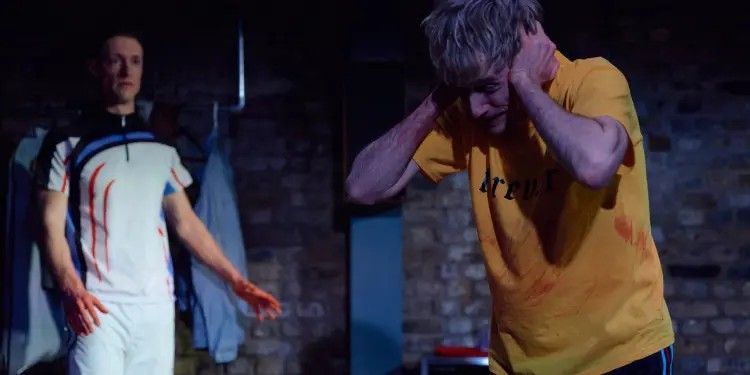
An ambitious 55-minute piece, destined for Edinburgh, Time and Time Again depicts friendship between two women, taking in issues such as migration and separation.

Becca (YY Yong) and Zoe (Stephanie Renae Law) meet at primary school in China and become friends who promise to support each other. Inevitably, as they grow up, their lives take different paths. Becca goes to university in London and settles with a successful career in the UK. Zoe stays put, and after much rather confusing shilly-shallying, marries.

Both actors are competent, although Law is marginally more convincing. Their lithe physicality is quite impressive.  And there’s a great deal of neat miming against a background of Inez Ruiz’s slick sound design, which includes the ticking of a clock to indicate the passage of time. The set comprises six upright chairs with empty backs which are imaginatively used to become an exercise bike, a bath, public lavatories, beds, screens for Zoom meetings and more.

The storytelling, however, is fuzzy. The narrative moves backwards and forwards, possibly to suggest alternative outcomes and paths. Despite the old-fashioned radio dial projected on the back wall to indicate which year we’re in, the chronology is muddled.

It’s an interesting idea for a play, but it is trying to do too much at once and therefore lacks focus. And why is it so darkly lit?

Reviewed on 20 July 2025 and then plays at Edinburgh Fringe 

The Reviews Hub Score 2.5

Watchable but weak

Pretty Witty Nell

Written and directed by Ryan JW Smith

Rogue Theatre

Barons Court Theatre


Star rating: 3.5


Modern plays written in iambic pentameter are always refreshing and Mike Bartlett does not have a monopoly. This autobiographical, one woman take on Nell Gwynne includes a lot of end rhyme too, usually on alternate lines. And it certainly flows.

Clarissa Adele is on stage, in role, bantering and flirting with the audience as they arrive.  Gwynne was, after all, one of the first generation of women to perform on British stages once the monarchy had been restored in 1660 and Puritan privations swept away. So her holding court in a theatre is an effective conceit.

We then get a 55 minute monologue telling the story of her birth in a brothel, career as an orange-selling prostitute before becoming an actress and catching the eye of the “Merry Monarch” who elevated her and the two children she bore him to wealth and respectability of sorts.

Adele is an accomplished performer and very good at saucy double-entendres and a range of voices – as she imitiates Charles II, Cromwell, Queen Katharine and others. Sometimes however her gestures become a bit samey and in places the text is a rather gabbled. The piece could afford to slow down a little. Five minutes on the length wouldn’t hurt.

This play would be a good history lesson for anyone new to the cataclysmic events of the seventeenth century although you have to make allowances for dramatic licence. For example. there were 59 signatures on Charles I’s death warrant of which Cromwell was just one. He was not solely responsible for the regicide as this play suggests. Nonetheless Gwynne’s account of the exhumation and desecration of his body is nicely depicted through Adele doing simple but ingenious things with a wig she holds in front of her. It’s powerful story telling.

Don’t Rock the Boat

By Robin Hawdon

Directed by Sally Hughes

The Mill at Sonning


Star rating: 3


One of the most harmless little plays I’ve seen in a while, Don’t Rock the Boat isn’t likely to cause many ripples on the Thames where the titular boat is moored – or anywhere else.  Nonetheless it’s quite funny, amuses its target audience and isn’t a bad way to spend a couple of hours. It is billed as a comedy and more or less does what it says on the tin.

Two parallel families meet for a mid-90s weekend on a boat which belongs to the Bullheads. Each couple has a daughter and the girls are at school together. Arthur Bullhead (Steven Pinder) is a successful speculative builder hoping to coax favours from John Combes (Harry Gostelow) who is a solicitor in what becomes an ambiguous tussle between the former’s self interest and the latter’s hypocrisy. Along the way there are revelations about the past and fury/embarassment when the girls go off and meet two local lads with whom one thing inevitably leads to another. The dialogue is fast paced and convincing.  Then it all peters out at the end as Hawdon apparently runs out of ideas.

All six actors do a reasonable job and are directed well so that they make good use of comic timing and nuance.  Pinder excels as the querulous, irritable, smarmy Arthur in a part which could have been written for Nigel Lindsay, but as far as I know wasn’t. And I liked Melanie Gutteridge’s take on his long suffering wife. The social contrasts between the two families are pointed up nicely too.

The real star of this show, though is Jackie Hutson’s set which creates a near full size barge, The Bunty, on The Mill at Sonning’s capacious playing space. It’s attractively detailed with a galley, blinds on the windows, a table which becomes bunk beds, lots of cupboards and even a bird feeder near the door. It’s surrounded by grass to represent the bank and there’s some proper water at the front.

It’s all quite fun but it’s slight.

It’s a novel I’ve always strenuously avoided for personal reasons. I am ichthyophobic in general and galeophobic in particular. (I also own a good dictionary).  In short I don’t like – really don’t like –  anything alive bigger than my thumb moving darkly in water. I have no idea where this fear came from but it means, for example, that I couldn’t go into an aquarium or on a whale watching trip. I have to be careful about TV nature programmes too. Therefore, knowing that the titular Moby Dick is a white sperm whale has aways kept me well away from Herman Melville’s 1851 novel.

Then, earlier this month, I was invited to review a dramatisation of  Moby Dick (the jury seems to be out on whether he needs a hyphen so I’m omitting it) at Tower Theatre in Stoke Newington. Surely, I reasoned, they can’t do anything to distress me in a small triangular, fairly low-tech space?  So, I took courage in both hands and went. And it was a very pleasant, educative surprise. A richly imaginative piece of physical theatre, the adaptation by Paul Graves and director Angharad Ormond taught me that Moby Dick is not “about” whales. Rather it is a study of one man’s obsession and what we would now call “mental health issues”.

I enjoyed it as theatre, wasn’t remotely freaked out and, on the bus home, ordered a copy of the novel to read. Never let it be said that reading isn’t a lifelong journey or that my reading range isn’t eclectic.

Reading Moby Dick, though, is a pretty mixed experience. “Call me Ishmael” is one of those famous opening lines which everyone knows (cf Anna Karenina, Pride and Prejudice and Nineteen Eighty Four). I wonder why the narrator says it at all. Is it not his real name?

The opening chapters are quite promising as Ishmael meets the charismatic Queequeg who becomes his close friend and they sign up as crew on a Nantucket whaling ship. It’s owned by an entertaining pair of businessmen, captained by one Ahab and managed on a daily basis by a trio of “Mates” each of them nicely characterised. The tone is quite wittily sardonic in a Dickensian kind of way and once or twice I could feel the young Mark Twain reading this and, maybe, soaking up some of its wit.

Then, sadly, the rot sets in and it becomes ever more self-indulgently prolix. Melville finds literary name dropping irresistible and far too often wanders off into verbose backwaters. We really do not need, for example, a whole waffly chapter about the taxonomy of whales or a lengthy essay about the symbolism of whiteness in religion, culture, nature. Then there’s a digression into whales in art, a separate one on whales in literature, a whole chapter about rope making and so it goes on – and on. It runs for 684 pages. One waggish friend, a former university teacher of literature, said – when I told him what I was reading –  that it’s a novel which works (a bit) only if you read alternate chapters. No wonder it achieved very little success in Melville’s lifetime.

At one third in, I was on the point of giving up but then I had a long train journey to occupy so I ploughed determinedly on because it has plugged a gap in my literary experience and, as such, is quirkily interesting.

The casually “racist” language is jarring for a 21st century reader although Melville is simply using the standard vocabulary of his day when he has Ishmael refer to the diverse crew members as, for example “negro”, “savage”, “pagan”, “cannibal” and such like. In fact Ishmael shows a lot of respect for the skills of his fellow crew members and the sentiments are pretty even handed. And that’s noteworthy considering that this book was published the year before Harriet Beech Stowe’s Uncle Tom’s Cabin (a novel I’m now minded to reread) and over a decade before Abraham Lincoln’s Proclamation of Emancipation.

Moby Dick is a colourful travelogue. Ishmael and the Pequod sail all over the world. Moreover, Melville had experience of whaling boats so the depiction of life aboard such a ship feels very authentic. And he’s good on what it would actually have been like to be lowered in a small rowing boat in hostile seas. Then, at about the half-way point, there’s an utterly revolting, and presumably accurate, description of the killing of a sperm whale which made me deeply thankful that we no longer rely on these noble beasts for lamp oil, corsets, animal food and all the rest of it.

I remain puzzled though about why Melville’s 19th century sailors speak to each other in Elizabethan English saying things like: “thou wilt hold thy peace” and “if thou hast none of thine own”. And why, in a novel, does he give us stage directions in some chapters as if he were writing a play? It creaks as much as the Pequod does when there’s a storm in the offing.

Moby Dick is a quest story in the time-honoured tradition. In the end, Captain Ahab does find the white sperm whale he blames for the loss of his leg and there’s a dramatic confrontation.

My conclusion is that, unusually, this made a far better stage play than it is a novel because the dramatisation I enjoyed was able to evoke atmosphere, tell a story and (almost literally) cut to the chase without all that digressive verbiage.

In short, it’s not a novel I would actually recommend, other than as a curiosity, although I’m quite glad I have read it.

Next week on Susan’s Bookshelves: Liza of Lambeth by W.Somerset Maugham