Press ESC or click the X to close this window

The Magic Flute (Susan Elkin reviews)

Music: Wolfgang Amadeus Mozart and Frank Moon

Director: Luca Silvestrini  

The Magic Flute has one of the most complicated plots in the entire operatic repertoire. To get it down to 70 minutes and play it with just four performers is a triumph of ingenuity. Moreover, the pared-back storytelling by Protein Dance here is as clear as it could possibly be, so all those 5+ children in the audience know exactly what is going on. And the surtitles help to drive it home even more.

In this version, it’s dance theatre rather than opera, although there’s a fair amount of spoken dialogue and singing. All of Mozart’s main musical ideas are worked into Frank Moon’s nicely played backing track, along with some newly composed atmospheric passages. These tend to sound more like Verdi, or even Puccini. That’s bound to grate a bit on grown-ups familiar with The Magic Flute, but is unlikely to bother the target audience for whom this will probably come as an introduction to one of Mozart’s best-loved operas.

Nathan Bartman as Papageno introduces the show by addressing the audience in role and explaining what he longs for – a life partner. He chases birds, leaps, twists and does apparently impossible things with his legs. He is a splendid dancer but also a charismatic all-round performer. Jacob Lang as Tamino is less flamboyant, but there’s a strong rapport between them. Donna Lennard – tall and imposing – does most of the singing and appears as The Queen of the Night, Sarastro, Papagena and, through clever puppetry, the Three Ladies. And Faith Prendergast as Pamina is a good actor as well as an attractive dancer, mostly in ballet mode.

And of course, everyone multi-roles, which means a lot of costume changes as they become the spirits, animals and more. Some of these are clumsily managed. The show doesn’t need a plot recap in the middle, for example. It’s simply a device to accommodate Papageno doing a quick change while Tamino holds the fort out front, pointing at the shadows behind him.

Generally, though, the use of upstage shadow narrative behind a big yellow sheet works pretty well, as do the swathes of gauzy material and speckled lights. Designer Dick Bird has excelled himself with costumes, too. Putting the spirits in tapered eau-de-nil tunics with big moon-like balloons is effective, for instance. And full marks for the monster at the beginning too – huge frightening head with the sinuous black body managed by two performers inside after the manner of a pantomime horse.

Runs until 24 December 2025

The Reviews Hub Star Rating: 4

Mozartian magic in miniature
This review was first published by The Reviews Hub.

Well if, at this late stage, you’re still looking for a rich, warm, affirmative book to climb into during the next few days, this could be it. I have read Sally Vickers before – the delightful Miss Garnet’s Angel at least twice, for example – but somehow this 2018 title had passed me by. And it shouldn’t have done because it’s a glorious hymn to power of reading, and especially children’s reading, to change lives. Definitely my sort of thing.

Sylvia Blackwell takes a post as children’s librarian in East Mole, a small fictional town in Wiltshire. It is the 1950s which Vickers captures perfectly. She is a year younger than me so, as I do, she vividly remembers children eating Spangles, grown ups measuring each other by their war experience and 11+ anxiety dominating everything. There are few TV sets, better off people drive Hillmans and everyone is still influenced by recent rationing. Class prejudice – in both directions – prevails.

Young, keen and passionate about books, Sylvia finds a house to rent and sets about reforming the children’s library. She makes friends locally, the children love her and there’s an ultimately educative liaison – no spoilers. At work though, her reforming zeal is disapproved of by her boss who is a rather complicated character. She buys books for the library, teams up with the primary school and is very quickly able to Make a Difference, as we would say now. But inevitably it goes wrong and suddenly she’s no longer approved of by many of the colourfully drawn inhabitants of East Mole although some of them surprise her. Meanwhile she has a troubled relationship with her own parents, especially her mother back in her native London suburb so there’s guilt there too.

But it’s Part Two which really got me. We’re whizzed forward 60 years where a grandmother – it’s a while before Vickers names her – is a globally successful children’s novelist in the manner of, perhaps, Jacqueline Wilson.  And amidst much brouhaha she’s returning to East Mole, where she grew up, to do a book event, as she does regularly all over the world. Her nicely depicted grandchildren and their parents are accompanying her to East Mole and they’re proud of her, of course, when they’re not on the internet. I was quite moved by all this once I realised who Granny must be. And there’s a wonderful ending which put me in mind of Morpurgo’s The Amazing Story of Adophus Tips or several of Victoria Hislop’s novels. And what a splendid idea to add end notes about all the titles which are mentioned in the novel. Yes, let’s hear if for reading good and loud.

Go on – read it, even if you have to sneak away. I can promise you an entertaining, uplifting respite from preparing Brussels sprouts, playing Monopoly or watching Christmas specials on TV.

Pinocchio – Shakespeare’s Globe

Stan Middleton as Puppeteer, Lee Braithwaite as Pinocchio and Nick Holder as Geppetto in Pinocchio at Shakespeare’s Globe, London. Picture: Johan Persson

Pinocchio continues at Shakespeare’s Globe, London until 4 January 2026.

Star rating: five stars ★ ★ ★ ★ ★

This sassy, poignant, funny and beautifully staged new version of Carlo Collodi’s time honoured Pinocchio – with book and lyrics by Charlie Josephine and music and lyrics by Jim Fortune – is the best children’s show I’ve seen this year.

From the moment the five-piece band (seated on the upper level), led by MD Benjamin Holder, strikes up with a gloriously folksy melody you know you’re in for a treat and sit up a bit straighter.

And we’re clearly in Italy. The text is cheerfully studded with “bellissimo”, “prego” and “ciao”. When, shortly after the opening number, the audience was addressed as “poor people like you”, one small child, at the performance I saw, shouted back “We’re not poor” and made everybody laugh.

The atmosphere is warm and inclusive as the cast …

Read the rest of this review at: https://musicaltheatrereview.com/pinocchio-shakespeares-globe/

Gaslight

Patrick Hamilton

Directed by Simon Rudkin

The Questors Theatre


Star rating 3.5


This is an interesting and brave account of Patrick Hamilton’s 1938 play – now famous for lexicographical reasons which the playwright couldn’t have anticipated.

It’s the 1880s and we’re in a comfortable sitting room – literally gaslit of course. The use of Questor Theatre’s studio space, configured with seating on three sides makes for unsettling intimacy although the way the director has blocked this play sometimes makes it difficult to hear. Alex Marker’s set includes a mysterious back wall with visible red neon gas pipes, an octagonal  – faintly arachnoid floor pattern –  and late Victorian furniture.

This is the home of Jack Manningham (Dan Dawes) and his wife Bella (Hannah Rosumund). The tension between them is palpable from the very first line. He is clearly manipulative and, when angry, addresses her abusively. Mysteriously he goes out every night and she doesn’t know where. Dawes does the range of moods rather well and creates an unpleasant character you definitely wouldn’t want to be on the wrong side of. For her part Bella – strong performance from Rosamund –  tries to comply but she’s very troubled because she’s constantly accused of things she hasn’t done. She begins to doubt her own mind not least because there is family history of insanity. And that seems to be what he wants. Seems. Shades of Shakespeare’s line in Measure for Measure: “If power change purpose, what our seemers be.”

It is possible, of course, that she’s manipulating him rather than the other way round especially after the arrival of the slightly unreal Inspector Rough (David Sellar) who feeds her whisky and a shocking story which plunges the plot into the realms of murder mystery. Who is “gaslighting” whom? The point is, I suppose, that we all lose track of the truth when persuasive people keep insisting on their own narratives – and that is as topical now as it was in 1938 or in 1944 when a film verson of this play arrived in cinemas. And, in this production, we get an alternative ending, with permission from the Partrick Hamilton estate. Some notes found in his locked desk decades after his death apparently And that sounds, in itself, like something out of a play.

There are two pretty good support performances in this show: Lucy Aley-Parker as Elizabeth, the decent senior maid and Talitha Went as the insolent younger one prepared to manipulate her employer by offering favours.

This take on Gaslight feels quite traditional – it is, after, all a drawing room drama of sorts – and the director has eschewed gimmickry. There is a very grown up flavour to it too. The audience has to think as well as be entertained because the nuances are subtle.

I was especially intrigued to see Questors Theatre’s Gaslight because Patrick Hamilton, about whom I formerly knew almost nothing, seems to have been following me about in recent years. First there was Mark Farrelly’s fine one man play The Silence of Snow which led me to a couple of Hamilton’s novels. Then, coincidentally, I was invited to a study day in Brighton on Hamilton’s Gorse trilogy and his relationship with the West Pier. I also saw and reviewed a production of Rope at Upstairs at The Gatehouse. And now this. Suddenly Hamilton is everywhere.

A Christmas Carol

Adapted from Charles Dickens by George Readshaw & Alex Wilson who also direct

Half Cut Theatre

Capitol, Horsham


Star rating: 5


Half Cut Theatre has continuously punched well above its weight since its inception in the pandemic panic of 2020. It has a knack of finding outstandingly talented actors and then directing them with remarkable imaginative flair – and this 80 minute take on A Christmas Carol is a fine example of that excellence.

It’s Christmas so audience involvement is de rigeur. What a neat idea to open this four-hander with two actors in neutral white loose shirts silently playing a game of hangman so that we create the “Scrooge and Marley” sign outside Miss Scrooge’s office. There are  several interactive games of this sort, integrated into the action, and it’s good fun.

I’d seen Eleanor de Rohan earlier in the day being brilliant as  Bunny in The Christmas Bunny and Miss Scrooge couldn’t be more different. She is icily, unpleasantly dismissive and somehow the mild updating of the story (references to Waitrose, the job centre, hip-hop and the like) make her seem more chilling and topically plausible than usual. Eventually when we reach the redemption sequence and Miss Scrooge sees the error of her ways, de Rohan’s eyes shine with happiness and glee. It’s a fine performance.

The rest of the story – told with multiple narrators – comes via Tom Briggs, Ellie Bradbury and Eddie Ahrens who play all the other roles. All have stupendous voice skills and mercurial stage presence. Ahrens (who played all the other toys in The Christmas Bunny earlier) is such a fine actor that he simply disappears into each role – from Mrs Cratchit to a delightfully louche Spirit and a lot more. He also provides a lot of atmospheric music on accordion, often along with Bradbury on violin or recorder and/or Briggs on guitar.

All four are good at audience interaction too. A random child is recruited as Tiny Tim and, at the performance I saw, a rather bemused, but clearly chuffed, young lad spoke each line fed to him with gentle confidence – to bursts of encouraging and admiring applause.

There are few props in this show but light is crucial. There’s eerie darkness where it’s appropriate, cast members use hand torches and four illuminated  rods become everything from a fireplace to a pepper grinder. Yes, there really is a lot of  atmospheric originality here.

I have seen dozens of takes on A Christmas Carol over the decades – usually at least one each season. This version is one of the best yet. Get to it if you possibly can.


The Christmas Bunny
George Readshaw & Alex Wilson
Music by Eden Treadwell
Half Cut Theatre
Capitol Theatre Horsham

Star rating: 4

This miniature show for the youngest children exudes charm and gentle humour for
every one of its 45 minutes.

The titular bunny has been delivered as a Christmas present to an unseen child
named Charlie. She meets other toys, has adventures with them and longs to be
loved enough to be “real” especially when Charlie moves on a notch and becomes
more sporty – cue for a couple of gentle tennis puns to amuse the adults in the
audience.

Eleanor de Rohan (who alternates with Ellie Bradbury) delights as Bunny, using
every muscle in her face and reaching out to the audience who are required to
practise their lapine attributes, sing songs, throw snowballs and much more. It’s a
warmly inclusive show.

The other half of the two-hander is Eddie Ahrens (alternating with Tom Briggs) who
provides a bossy wooden toy soldier, a growling dinosaur, a coy teddy bear, a
rocking horse and more. His range of voices is impressive and he too is good at
working the audience, especially when he comes out of role to recruit an audience
member to play Nanna. At the performance I saw the man who volunteered, and was
eventually invited on stage, brought his tiny boy with him and it was quite a moment.
And that’s the joy of theatre of this sort. Actors have to be reactive. You never know
what children are going to call out, suggest or do and you have work with whatever
happens. In some ways it’s more demanding than playing Hamlet. De Rohan and
Ahrens both rise to the challenge with cheerful aplomb.

Personally I would have preferred it if the script writers had used grammatical
pronouns rather than the fashionable let’s-show-we’re-woke they/them throughout. And I didn’t care for the voice over narrator but these are minor gripes about very pleasing work.

A Boy Called Christmas
Matt Haig, adapted by Philip Wilson
Music by Tom Brady
Directed by Dale Rooks

Chichester Festival Theatre

Star rating: 4.5

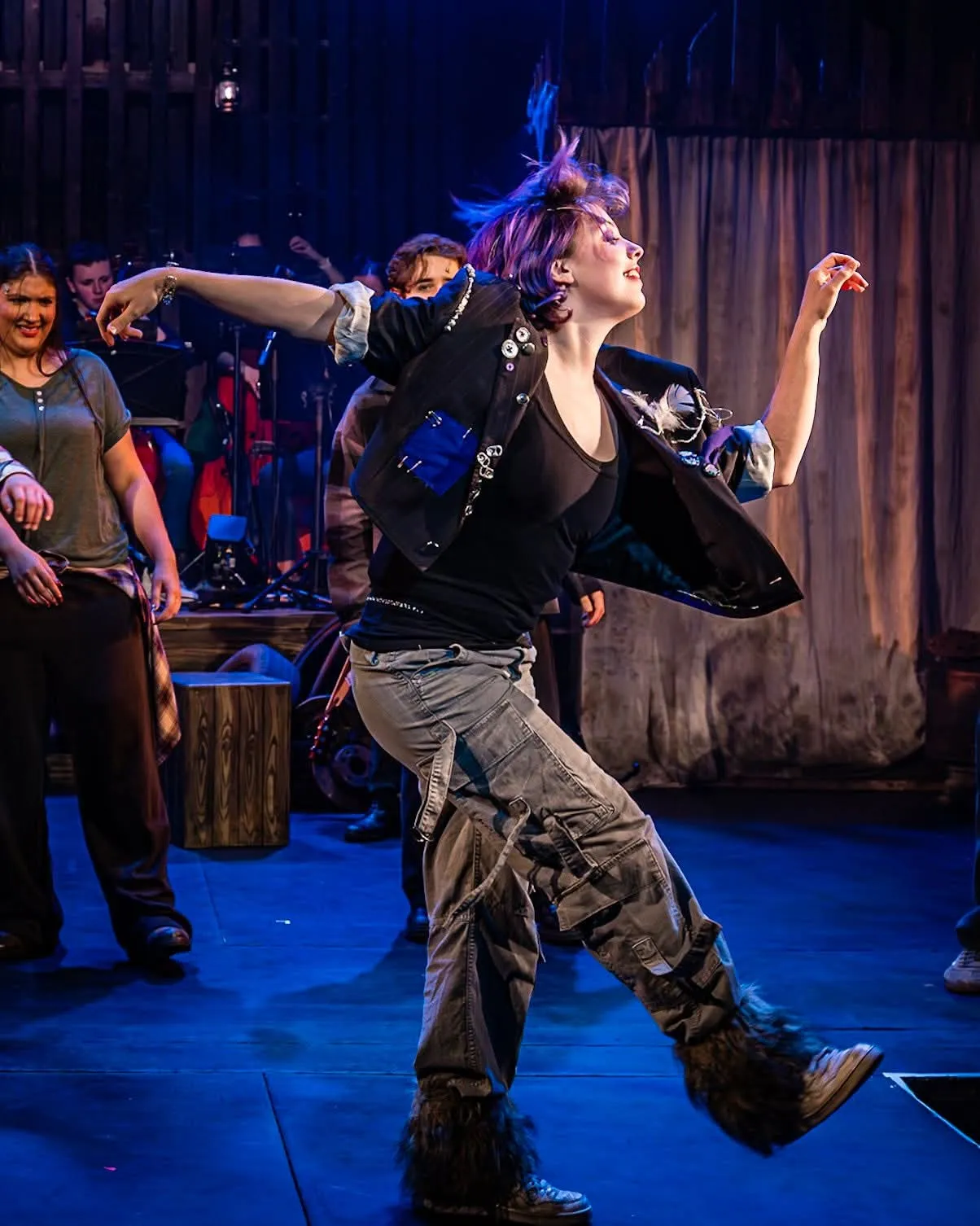
Every year since 2003 Chichester Festival Theatre has turned the main house over
to its Youth Theatre for the annual Christmas show. And the level of achievement, as
usual, is phenomenal with 71 performers aged 10-22 on stage and 25 members of
CFT’s Technical Youth Theatre working behind the scenes. I have said in the past
that CFT runs the best venue-related Youth Theatre (850 members across West
Sussex and Hampshire) in the country and I still stand by that.

This year’s show is a glorious fantasy rooted in the childhood of Father Christmas
with elves, trolls, pixies, fairies and a quest which takes young Nikolas (Devon
Sandwell on press night. – excellent) northwards through Finland towards Lapland
and a lot of danger. Matt Haig’s best-selling novel tells us that, because Nikolas was
born on 25 December, his nickname is Christmas. And Philip Wilson’s stage version
adds a framing device with a story teller which allows for a theatrically spectacular
ending.

The show is beautifully directed and draws fine performances from everyone in the
cast. Standouts include Olivia Dickens (on press night) who puppets Mikka,
Nicholas’s lively, never still mouse friend like a seasoned professional. And she
voices the witty animal with splendid confidence. Daisy Chapman turns in a terrific
turn as the Truth Fairy, singing, dancing and delivering her truths with rapier
precision – and humour. There is also some fine choral and solo singing at various
point in the show.

Ryan Dawson Laight has had huge fun with the costumes for this production. The
massive growling bear with huge teeth and long claws is terrifyingly convincing and
Blitzen the reindeer (Alexander Solly on press night – lovely movement work) is furry
and dignified. And the colours – lots of red – in the big scenes are richly dramatic
against Simon Higlett’s icy set. I don’t know whose idea the northern lights were –
depicted by coloured streamers on rods illuminated by James Whiteside’s lighting
design – but it’s a pretty special moment.

Then there’s Tom Brady’s music played by an unseen, live, six-piece band with MD
Colin Billings on keys. It’s delightful and I was frequently distracted from events on
stage by the sheer imaginative magic of Brady’s orchestrations – especially the
evocative use of cello and clarinet in an enjoyable range of styles.

CFT has again more than nailed it with this Youth Theatre show. Bravo and Merry
Christmas to you all.

Photograph: Ellie Kurttz

Margaret Atwood is sparklingly good company. She’s witty, affable, down to earth and personable. I’ve always sensed this from her novels, short stories and poetry but never more so than in this delightfully engaging memoir published last month (November 2025).

Now 86, Atwood is one of the world’s most famous novelists and she has almost single handedly put her native Canada firmly on the global literary map. I’ve long admired her work especially Cat’s Eye (which I taught to several A level Classes). Surfacing (another A level class), The Robber Bride. The Blind Assassin, Alias Grace and Old Babes in the Wood. Apart from The Handmaid’s Tale, which is an inarguable masterpiece, I am generally less taken with her speculative, dystopian, sci-fi work although that  probably says more about me than it does about her.

So why does she call her memoir a “book of lives” in the plural? Because she has done many different things at different points in her life and been many things to many people. She also contends that every writer has at least two lives: the one they adopt when they write and the everyday one who makes coffee, paints walls, bears children and lives “real” life to the full. And, in my relatively minor writerly corner, I can certainly identify with that.

Born in Ottowa to an entomologist father and a feisty, no-nonsense mother, Atwood spent all her childhood summers, often camping, in the northern wilderness in connection with her father’s insect-related projects – usually government funded. Otherwise Carl Atwood was an academic at University of Toronto. This is familiar information to readers of her novels because much of this way of life gets into them. Reading Book of Lives confirms that Atwood has always plundered her own life experience for situations, characters, issues and problems. A most notable example is the bullying and the dynamics of relationships between ten year old girls which occurs in Cat’s Eye. Yes, she is now prepared to admit because the woman in question is dead, that there really was a “Cordelia” who made the young Atwood’s life hell. I’m not surprised. Even though it’s fiction the writing in the novel is so raw and painful that you know it has to be, in some sense, rooted in reality. Truth is a slippery concept sometimes.

Writing more or less chronologically, Atwood’s richly compelling memoir takes us from assembling a self-illustrated poetry book at age 16 all the way to her state of health today and her determination to hang on in there for as long as she can – thus it spans her 70 year-long professional life as well as her childhood. Had she not been determined to make a career out of writing she would – super bright, of course – have been a biologist. She invents herself as “Peggy Nature” supervising children at a summer camp when she is still a teenager. Decades later, she uses her Peggy Nature skills to clean up a skunk’s skull for her grandson. There are boyfriends and eventually an amiable but lacklustre marriage. Then she meets novelist/bird watcher/cook/traveller, Graeme Gibson, who becomes the love of her life until his death in 2019 while they were in London on a press tour for Testaments.  He had dementia and had been ailing for some time – something else I can empathise with strongly, especially as she, as I did, had to deal with the misery of lockdown hard on the heels of her bereavement.

We meet Atwood’s elder brother and much younger sister – still very present and supportive at the time of writing. Then there are Gibson’s two sons from his first marriage, whom Atwood pretty much takes on, and their own daughter, Jess. We also meet the characters, eccentrics and one-offs who people Atwood’s world and, more often than not, wander thinly disguised into her fiction – along with the mythology, jokes and cheerful insouciance. She spares us false modesty. She is, after all, spectacularly successful. But she wears her achievement lightly

Atwood is more than just a writer. She also has a lot of artistic talent and has often, for instance, illustrated her work or designed posters for the charity work to which she and Gibson were committed. She is also the sort of person who listens to Beethoven while she scrubs the floor. She’s handy in other ways too – interested in clothes, and often makes or adapts them. She cooks as well. All of this too I had long suspected from the novels.

This is a brick of a book: 624 pages. I was, however, sad to finish it because it felt as if I’d been at a hugely entertaining party which I really didn’t want to leave.

Next week on Susan’s Bookshelves: The Librarian by Sally Vickers