Press ESC or click the X to close this window

Susan’s Bookshelves – A Piece of Work: Playing Shakespeare and Other Stories by Simon Russell Beale

Over the years I have read many books by actors describing their adventures with, and thoughts about, Shakespeare: Michael Pennington, Antony Sher, Judi Dench and Oliver Ford Davies to name but a few. The durability, topicality and humanity of Shakespeare is an endlessly fascinating subject. So naturally, having seen Simon Russell Beale on stage many times, in a wide range of roles including a lot of Shakespeare, I pounced on A Piece of Work: Playing Shakespeare and Other Stories which was published in 2024.

When I interview actors, as I often do, I generally ask as an opener “So where did all this start? At school? At home?” and that’s pretty much where Russell Beale begins in this book which is partly an autobiography. He played, we learn King Lear at school (Clifton College, Bristol) before going to Cambridge to read English but also as a choral scholar at Gonville and Caius because, as he grew up, music was always central to his life. He had been a chorister at St Pauls before Clifton College. No one in his medically inclined family was bothered about his decision not to be a doctor and his being gay was a non-issue both at home and at school. His father was an army medic so the family – he has three brothers, a sister and a sister who died when she was four – moved around a lot.

He seems to have been in work almost full time since he left Guildhall School of Music and Drama, where he started on a singing course but soon switched to drama as his family had always expected. Thereafter followed decades of work with the RSC and then National Theatre. He has enjoyed long working relationships with directors Sam Mendes and Nick Hytner and speaks very warmly of Gregory Doran. The work has led to world  tours, off-Broadway, Broadway and a Knighthood from the late Queen in 2019. He has a CBE too although he doesn’t mention either of these in this book.

He comes across as a modest man and mentions more than once that he has always been overweight and that lithe movement has never been his forte although he is very funny (and incredulous) about his ballet role as the Duchess in Alice’s Adventures in Wonderland at Royal Opera House. At the beginning of his career he tended to be cast in comic roles and Shakespeare’s “clowns” (he’s interesting on the meaning of that word, then and now) tend to speak prose so it was a long time before he was offered a full- blown verse-speaking role.

He was unlikely casting as Ariel in The Tempest,  a production  I saw in 1993, so he and Mendes and the designer, had to do something different with it. When he played Prospero in 2016 (I saw that too) it was time to think again. He regards Prospero as a manipulative failure. He probably wasn’t attending to his duties which he why he was ousted and dumped on the mysterious island.

He has also played Hamlet (having years ago done Second Grave digger), Macbeth, Lear, Leontes, Richard II, Falstaff and many more. There has been some film and TV but he is more at home on stage. His account of the closet scene in Hamlet is fascinating. Imagine what’s going on the head of a young (?) man who tells his mother she’s too old to be having sex with anyone let alone her new husband who was, until recently, her brother-in-law.

Russell Beale mentions dozens of plays and characters in the course of this book, as you’d expect. But he never makes assumptions about reader knowledge. He gives a brief run down on the plot of every play he discusses and I, for one, was glad of the information about Timon of Athens one of the few Shakespeare plays I have neither seen nor read.

He has worked in plays by other playwrights too, of course and is fascinated by Chekhov. There was a fabulous, unforgettable production of Ben Johnson’s The Alchemist at National Theatre. It is almost a farce and in this astonishingly slick production was hilariously funny. “All these fucking stairs” commented so-star Alex Jennings sotto voce during one performance, apparently, as they dashed up them with Lesley Manville. Yes. Russell Beale is happy to share a few gossipy bits. I enjoyed his account of the US tradition of any great actor who happens to be “in” for a show popping back stage afterwards to wish you well. Hence Paul Newman materialising in your dressing room or Dustin Hoffman buying you all a drink.

Then there was Candide in which Russell Beale played Voltaire and narrated the piece which is one of Bernstein’s best scores, although it has a troubled production history. It is one of the few musicals which Russell Beale has done and he doesn’t – despite his background – reckon much on his own singing even as King Arthur in Spamalot. The fact that he is a musician as well as an actor led, however, to two BBC series: one on sacred music and one on symphonies.

It’s an informative, warmly accessible book in which the reader meets an actor who manages to be self-effacing as well as at the very top of his game. I learned a lot about how an actor of this calibre works with directors and designers. The doctor siblings, now with families of their own, provide the solidarity of ordinary family life and seem to keep him rather appealingly grounded.

Next week on Susan’s Bookshelves: David Copperfield by Charles Dickens

Anna Karenina

Leo Tolstoy adapted by Philip Breen who also directs.

Chichester Festival Theatre


Star rating: 3

Photography by Marc Brenner

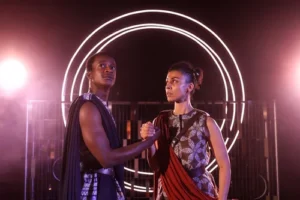
Henry James once described War and Peace as a “loose, baggy monster”. Well, Anna Karenina, published ten years later in 1877, is rather less loose and baggy but it’s still a vast narrative canvas. And what works in a 900 page novel doesn’t necessarily translate to a three hour theatre piece. That is why the first half of this show feels as if it is trying too hard – short scenes, time shifts, big stage – and the story telling is, perhaps inevitably, fudgy, although the second act is more crisply focused. Moreover, adapter Philip Breen is keen to incorporate Russianness, feminisim, imperialism, topicality and a lot more so that if feels, in places, a bit like being banged on the head with a heavy samovar.

Anna Karenina has three main, but tightly interwoven, plot strands. First there’s the troubled marriage of Dolly (Naomi Seldon – suitably volatile) and Stiva (Jonnie Broadbent – good at pragmatic contrition). And the play opens with their quarrelling because he has seduced the governess. I enjoyed Breen’s careful inclusion of Tolstoy’s famous opening statement which is here given to a rueful, angry Dolly: “All happy families are alike; every unhappy family is unhappy in its own way.”

Then there’s the infidelity of Stiva’s sister Anna (Natalie Dormer – fine performance) whose marriage to senior government official Karenin (Tomiwa Edun) is dull but who adores her son. She is entranced by, and becomes a quasi wife, to an officer named Vronksy (Seamus Dillaine). Edun and Dillaine are both fine actors but each is miscast or misdirected. Karenin should be cold and unattractive but here he’s almost cuddly. Moreover he needs to be much older than Vronsky but isn’t in this interpretation. Vronksy, moreover, is really a bit of a cad but this version of him – asides to the audience notwithstanding – is just so damned reasonable that we end up sympathising with him and wishing Anna would stop all her self-indulgent soul searching.

Finally – although there is a lot more thematic underpinning, of course – we get Levin, who has some self-confessed history as a womaniser, but who is now desperately in love with Dolly’s sister Kitty whom he eventually marries and take home to his utopian country estate where he farms, the women make jam and we get warmly lit peasant scenes.

And the point (or one of them) behind these three stories is that men are routinely forgiven for sexual profligacy but women are not. Or at least they weren’t in Imperialist Russia amongst the noble classes.

Paddy Cunneen’s music played by a fine three piece band, led by MD Kotaro Hata on piano and accordion,  adds a lot of atmosphere. There’s a mazurka when everyone’s at a ball and Akiko Ishikawa’s violin accompaniment to Kitty and Levin’s grandly staged wedding which opens the second half, is a musical delight. There is a mood music undercurrent to most scenes which works well too and I loved the grating glissandi during the death of Levin’s brother along with the whole cast, heads bowed, humming a minor key, very Russian sounding lament.

Trains are central to Anna Karenina. The 440 mile distance between Moscow and St Petersburg (think London to Edinburgh) has recently become do-able in just a few hours. They also symbolise new, changing technology and shifting social attitudes with a hint of decadence. Arguably, too, there is something phallic about trains in and out of tunnels and their climactic whistling. Breen and Cunneen have a lot of fun with this here – providing train music and whole cast rhythmic participation. And of course this story has a tragic, train-related ending but no spoilers in case you’re new to it.

There are some inexplicable oddities in this production which grate. Why, for example, in the horse riding scene do the cast start commenting in rhyme? And there are too many blackouts. On the other hand there are some brave, and pleasingly successful ideas such as the use of colloquial modern English throughout and British regional accents to connote social class and locational differences between characters.

Like almost anything Tolstoyan, this show is (very) good in parts but doesn’t always quite ground itself enough.

Itch – Opera Holland Park, London

Reviewer: Susan Elkin

Based on the novels by Simon Mayo

Librettist: Alasdair Middleton

Music: Jonathan Dove

Best headphones deals

Conductor: Josephine Korder

A revival of Opera Holland Park’s 2023 commission, this is a performance by members of the company’s Young Performers scheme. The aim of this is the provision of opportunities for singers to bridge the gap between conservatoire and professional work. Only Eric Greene (fine bass), who sings Nicholas Lofte, is a member of the main cast, and his job here is partly to support the others with on-the-job mentoring. Moreover, this Sunday matinee is a relaxed performance, so there are a lot of children in the audience.

In a story which neatly unites art (it’s an opera) with science (it’s about elements), we get a goodie/baddie plot deepened by themes such as climate change and parenting. Itch (Sebastian Hill) collects elements and enthuses knowledgeably about them. When he explains them to his mother, they are illuminated one by one on the set to form the familiar castle-like table, and it’s surprisingly moving. Then he and his sister Jack (Madeline Robinson) think they’ve discovered a new radioactive one which would be number 126 on the periodic table. If they’re right, it would have world-changing commercial implications. Enter big business, ruthless skullduggery, ethical decisions and a near tragedy.

Most of the song-through piece is dialogue set to music rather than offering much in the way of “arias”, although Eleri Gwilym, as the villain in charge of the company which wants the element at any cost, gets some pretty forceful Queen of the Night moments. Jonathan Dove’s music unfailingly supports the mood of the moment, and his orchestrations are often delightful.

City of London Sinfonia is pared down to thirteen players, one to a part, including harp and piano. There is, for instance, a sinister musical conversation between bass clarinet and horn when the children are kidnapped and frightened. A disturbing fortissimo octet is sung on the tiers of the set before we meet Itch in trouble in a disused Cornish mine over glockenspiel and celeste, and it’s an effective contrast.

As usual at Opera Holland Park, the orchestra sits at the centre of a sloped annular playing space, which means, on this occasion, that conductor Josephine Korder looks backwards over her shoulder quite often because she is, presumably, not used to this configuration. It’s an engaging directorial idea, though, meaning that access to the mine involves picking a route through the band.

Online art courses

The orchestra plays well, of course, including some nice solo work by the first violinist, but is sometimes overpoweringly loud for this inexperienced cast, talented as each one of them is.

Runs until 13 June 2025

The Reviews Hub Score

Entertainingly fuses art, science and adventure

This review was first published by The Reviews Hub: https://www.thereviewshub.com/25-itch-opera-holland-park-london-2/

Staying Alive

Kat Roberts

Tower Theatre, Stoke Newington


Star rating: 3.5


This searingly painful play about grief and loss is a brave choice and I commend director Olivia Chakraborty and her accomplished cast for running with it. It must be as emotionally draining to perform as it is to watch.

Mary (Saskia Connolly) has suffered some sort of appalling bereavement and the play, which is set around 2010, gradually reveals that her four year old son Henry has died in the sort of domestic accident which every parent dreads. But, just occasionally, these unthinkable things happen.

A professional violinist who has toured with the London Symphony Orchestra, she is a single mother supported (sort of) by her closest friends. The trouble is that they are ready to move on long before she can and they don’t know how to deal with her anyway. The play – and this cast – capture this awful awkwardness very truthfully. I remember once, in real life, walking up to a bereaved person and saying: “I have no idea what I can possibly say but I want you to know I’m here and rooting for you”. Anything rather than be one of those people who crosses the road to avoid a conversation. The trouble is that the bereaved person then ends up trying to put the sympathiser at ease and it’s that tortured issue – “the inconvenience of other people’s grief” – which Kat Roberts’s play ably confronts in most scenes. Moreover, Mary comments bitterly at one point that, whatever other people say, her grief doesn’t have a sell-by date.

There’s some fine acting in this cast of seven, especially Connolly and Jonathan Buckingham who plays her old friend, and once lover, Jack, who is now married to Jenn (Isabel Daly, good). Connolly does agony, loneliness, panic and anger very well. It’s a richly nuanced performance aided by Nick Insley’s lighting which supports Mary’s  frequent “disappearance” into a twilight world of her own even when she’s in a room full of people. Buckingham’s character, is now a successful and urbane doctor but he’s very troubled by Mary’s dreadful predicament and it, too is carefully observed acting.

Less successful are the time slips and doubling which take the audience by surprise so that we’re not always sure what’s going on although I loved the scene in which Mary remembers giving Henry his first violin lesson. The scene in which Jacky Rowland, as an administrator, questions Mary when she comes to register the death is so crassly insensitive that you really couldn’t make it up and I suspect that Kat Roberts who has worked with bereavement charities, has drawn this from someone’s actual experience. There’s also a scene in which Rowland, now a social worker, comes to question Mary relentlessly about the details of the accident. She does it well enough but you have to blink and work out who she is now because she is also the date of one of Mary’s friends at a party.  I’m not sure to what extent these abrupt shifts and switches stem from the structure of the play or are directorial decisions. Either way they don’t always quite work.

The sound track (Olivia Chakraborty and Samuel Jego) gives rather lovely – often poignantly atmospheric – ongoing classical music including Grieg’s Peer Gynt, Beethoven’s Moonlight Sonata, Barber’s Adagio and Vivaldi’s Four Seasons among other things. It fits Mary’s mood and her background imaginatively in this gruelling but courageous play.

Famous, respected and popular as he is I had never, until now, got round to reading any Robert Harris. It did occur to me, however, that I should after I’d seen the wonderful film Conclave (plot twist to die for) a few days after it started winning awards earlier this year.

Then my sister recommended Harris’s 2003 novel, Pompeii because she and I share very fond memories of visiting the site in 1966 on a road trip with our parents when it was relatively uncommercialised. So I read it  – with great pleasure.

Of course it’s one of those stories whose ending you know before you start – like Robert K Massie’s Nicholas and Alexandra (1967) Hilary Mantel’s The Mirror and the Light (2020) or even Antonia Fraser’s groundbreaking biography Mary Queen of Scots (1969). The interest is seeing how the author handles the intrigues before the blow finally falls. And in this case I loved the tiny signs in the days preceding the colossal 79 AD  eruption of Vesuvius: water in the piscina and wine in glasses shivering, rumbles underground,  and why has the aqueduct cracked – providing Harris with his core plot line as engineer Attilius sets out to repair it? It’s effectively dramatic irony because the reader/audience has foreknowledge denied to all characters.

It’s a skilfully plotted, ever-topical story about corruption. Ampliatus is a former slave who, through cruel and unscrupulous wheeling and dealing has become the richest and most powerful man in the city. Most of us have met, or know of, people like him. The real nobility regard him as a vulgar upstart but are very careful to keep on the right side of him because he’s a thoroughly nasty piece of work. As a lifelong ichthyophobe I couldn’t read the graphically described episode in which he has a slave thrown into his pool of moray eels to be eaten alive and you don’t need to be a vegetarian to be utterly nauseated by the feast he serves to mark Vulcanalia. It’s all testament, though to the power of Harris’s writing and I found myself hoping fervently almost from the start that he was going to give Ampliatus a really hideous death when Pompeii was eventually engulfed by volcanic ash.

It’s a novel full of strong characters some of whom you find yourself caring about. There’s Ampliatus’s daughter, Corelia, whom Attilius a young widower, finds attractive. She’s a pretty feisty critic of her cruel father so there’s a bit of feminism in the mix. The slave Polites is a decent sort too. And Pliny the Elder, knowledgeable, experienced and curious but obese and nearing the end of his life is nicely done too – because, of course, it was his writing that provided posterity with an eye-witness account of the (literally) devasting events in the bay of Naples in the first century.

Above all I admire Harris’s descriptive powers. He has researched volcano science pretty thoroughly and quotes from a number of reference books at the head of each chapter. The imagination he then brings to what he knows is breathtaking: the heat, the storms of pumice, the fires on the mountain side, the ash, the panic, the terror, the screams and the loss.

Another thing I liked was the way he deals with the Roman polytheism which our primary school teachers told us all Romans believed in. Well, of course, there must have been some commonsensible sceptics, especially amongst educated people. Harris has several characters who more or less reject the whole concept of the gods and that rings very true.

Of course I was curious about how he was going to end it because it’s a fact that most people died. I really liked the way Harris steps outside the confines of 79 AD and simply invites the reader to speculate and consider 2000 years of stories and myths. Under some circumstances this would be a cop out. Here it works perfectly.

Next week on Susan’s Bookshelves –  A Piece of Work: Playing Shakespeare and Other Stories by Simon Russell Beale

Miss Myrtle’s Garden

Danny James King

Bush Theatre

 Star rating: 3

Yet another (but welcome) play about dementia, this one is set in the titular garden nicely evoked by Khadija Raza’s set and Dan Balfour’s sound with soil, flowers and birdsong.

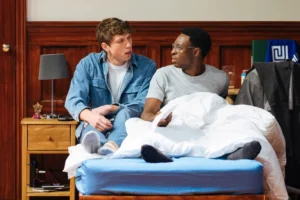
Miss Myrtle (Diveen Henry) and her husband Melrose (Mensah Bediako) are first generation Caribbean immigrants whose grandson Rudy (Michael Ahomka-Lindsay) has come to lodge in her house with his boyfriend Jason (Elander Moore). Eddie (Gary Lilburn) is a kindly Irish widowed neighbour, fond of drink.

She is now becoming confused and it isn’t long before we realise that she too is widowed but in continuous conversation with Melrose – not an original concept.  Flowers for Mrs Harris (adapted by Rachel Wagstaff from Paul Gallico for Sheffield Theatres on 2016 and Chichester Festival Theatre in 2018) uses the same device, for example. Nonetheless it’s effective and poignant especially when she mistakes Eddie for her late husband.

Henry brings a lot of sardonic humour to this piece. Her character is tactlessly forthright and capriciously unpredictable.  The well-observed dementia comes and goes, of course, like an old fashioned radio going in an out or tune as the dial is twiddled. Rudy, who speaks RP because he’s been to college and is a teacher, is worried about her and evidently very close to her.

The piece, however, effectively has two plots which are not always convincingly wound together. Jason desperately wants, full, open commitment – and honesty – from Rudy who is reluctant to come out as gay partly because it will upset his grandmother but also because he fears there will be repercussions at the Catholic school which employs him. When the coming our finally happens it’s a witty non-event. Moreover there’s a dangling secret about the premature death of Rudy’s father Rudolph which is never satisfactorily explored.

The dialogue is well written and sharp but sadly not always audible. This is, of course, a problem with theatre-in-the-round and the Bush seats its audience on four sides round a square playing space. It takes specific skill to make that work. Yes, we all know that theatre works much more inclusively without a fourth wall. On the other hand there was a reason why theatres evolved to be end-on and old fashioned drama schools taught actors never to turn their backs to the audience. I missed at least ten per cent of this play so it’s a good job I was issued with a play script in lieu of a programme – but I shouldn’t have to read it to fill in the gaps. Director Talo Lawson, please note.

Jesus Christ Superstar

Festival Players

ADC, Cambridge


Star rating: 3.5


It’s always a terrific treat to hear what is probably Andrew Lloyd Webber’s finest score.  Its angry cross rhythms, anguish and wistfulness complement Tim Rice’s lyrics perfectly. I’ve seen a number of productions over the years right back to the original London 1972 version which blew me away. And I’m happy to report that this high standard show, under Suzanne Emerson’s direction, ticks many of the boxes.

Andrew Ruddick is magnificent as Judas, one of the most complex roles in opera – and yes, I’ve always argued that Jesus Christ Superstar is every inch a rock opera rather than a “mere” musical. He agonises, argues, dances with cheeky panache at the end and has a splendid rock tenor top belt. It’s a bravura performance. And Emma Vieceli is as good a Mary as I’ve ever seen. She packs in all the warmth, sympathy, passion and anxiety the role needs and sings beautifully, especially in the show stopping number “I don’t know how to love him”. I also admired Matt Wilkinson’s suitably dead pan, gravelly take on Caiaphas and Rich Evans as Pilate, especially in his first number.

The ensemble is skilfully choreographed by Laura Saunders who has built in lots of original shapes and gestures. Moreover it accommodates cast members who aren’t professional dancers but who are slickly trained in a way which sustains the visual energy for every minute of the show. The ensemble singing (MDs Sam Kirby and Joe Griffiths) is generally strong too with only one or two ragged moments on the opening night.

There are a few problems, however. Normally I’m all in favour of gender blind casting and a female Jesus is a richly interesting idea. Moreover Vikki Jones is a highly talented performer who finds oodles of charisma in this role. Good as she is as a singer, though, the part is technically awkward for a female voice and she has to do far too much octave shifting. The text refers to Jesus throughout as “he” so we have to accept that this is a woman playing a man. Yet,  it’s a very feminine interpretation. That does, however heighten the vulnerability and makes the thirty nine lashes scene seem even more horrifying than usual.

It’s good to see, and hear, the five piece band centre stage on a platform behind the action playing the most pared down version of the score. It comes over well (one or two opening night, sound balance problems notwithstanding) although at times it could have done with an additional live melody instrument such as trumpet or trombone.

Despite those reservations, this Jesus Christ Superstar is well worth seeing. It pounds along and it works.  As ever I had to swallow a lump in my throat during that moving postlude from the band as we reflect, finally, on the horror of the crucifixion – and, on a personal note, for the record, I have always come to this show as a Christian non-believer.

The Croft

Ali Milles

Churchill Theatre Bromley and touring


Star rating  1.5


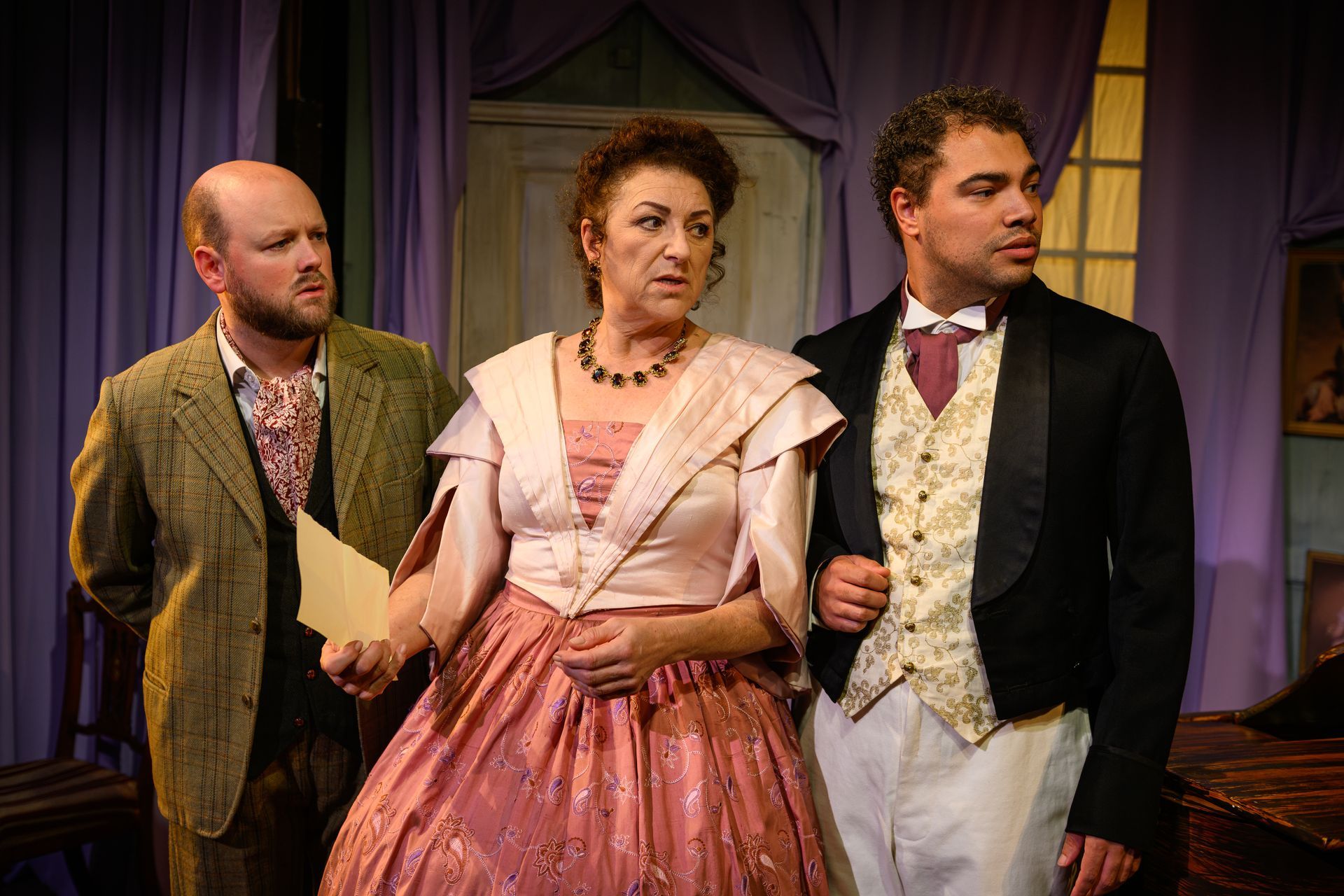
We’re in a croft in the remote village of Coillie Ghillie in the Highlands which had to be abandoned in the 19th century because of contagion. From that historical starting point Ali Milles’s play presents three pairs of women at different points in the history of the building. Or at least I think it does. The story telling is clunkily unclear.

This touring production of The Croft is a revival, now directed by Alastair Whatley. It was originally directed by Philip Franks but the tour had to be aborted in March 2020 at the beginning of the Covid 19 Pandemic.

It opens with two women arriving at the titular croft, in the present, after a long journey north from Letchworth. For the young one  (Gracie Follows) this is returning to the family holiday home for a quality time break with her older lover (Caroline Harker) whose mind is preoccupied by her two teenage sons and estranged husband. Of course there is little or no phone signal.

There are audibility problems in this production, right from the start: I struggled to catch many words even from Row G. This may be due to acoustic issues in the Churchill but either way it is not acceptable in a much hyped professional production.

It’s billed as a ghost story and chilling thriller but actually it’s simply a series of, sometimes baffling, time slip scenes with very loud clichéd “ghostly” sound effects (by Max Pappenheim) which quite often drown out the dialogue completely. The sound balance is woeful although the occasional snatches of traditional Scottish music are quite effective as a location reminder.

Attempts have been made, moreover, to ratchet up the ghostliness with devices such as pictures falling unaccountably off the wall and a rocking chair moving by itself – a trope nicked from The Woman in Black. Characters often ask, not always with convincing timing, “What was that?” and it gets wearingly predictable.

There are five actors in the cast which necessitates a lot of doubling and it’s often confusing. If you find yourself thinking “Oh it’s him again. Who’s he meant to be now?” which I did several times, then the piece is failing dramatically. Having said that, there is sense in Caroline Harker  – she is the best thing in the entire show –  playing both Laura’s older (mother figure?) lover, Suzanne, and her mother who has died from cancer and whose presence she still feels strongly. And Follows makes a reasonable job of playing Laura as an adult and as a child although the significance of her also playing a young unmarried pregnant woman in the nineteenth century scenes was lost on me.

The Croft runs for two hours including an interval but it feels much longer as you watch scene after scene, each flagging up possible story developments but failing to follow them through.

It’s always a pity to see, and report on, a show into which a great deal of hard work has evidently been invested but which ends up as a lacklustre muddle. But it’s a critic’s job to be truthful.