Press ESC or click the X to close this window

Bexhill Choral Society (Susan Elkin reviews)

St Barnabas Church, Bexhill-on-Sea
5 October 2019

A patchwork programme meant that, on this occasion Bexhill Choral Society and conductor, Kenneth Roberts, were able to feature several rather lovely short works – such as the G minor  Schubert Stabat Mater and Gounod’s O Divine Redeemer – which don’t get too many outings in standard format concerts. And I really liked the spacious, warm red brick Victorian church venue which is new for BCS so there was a festive atmosphere and a pleasingly large audience.

The most striking performance of the evening was, by chance, also the shortest. Roberts and his choir gave us, in the first half, an excellent rendering of Mozart’s famous little gem, Ave Verum Corpus. The control was palpable, the cohesion arresting and result outstanding largely, because – having presumably sung this all their lives so little need to look at the music – every singer’s eye was on the conductor.  It was a riveting couple of minutes.

Judith Buckle, a fine contralto, did her best with Gounod’s O Divine Redeemer but it’s a schmultzy piece further blurred, on this occasion by the church acoustic but a nice sound nonetheless from both soloist and prominent instrumentalists such Sally-Ann Thorkildsen on cello. All the work from the 21-strong Sussex Concert Orchestra was competent and Richard Eldridge, who played several beautiful clarinet solos, deserves a special commendation. I found their account of Mendelssohn’s overture The Hebrides pretty understated, however, apart from some dramatic crescendi. It was mostly taken well under (the usual) tempo too.

Mendelssohn’s Hear My Prayer is actually a weak piece with far too much choir and soloist echoing each other but soprano Kristy Swift did what she could with it. Her tone was harsh in the opening sections but by the time she got to the lower register O for the wings of a dove! it had warmed and softened bringing the first half of the concert to a reasonably satisfying conclusion.

The single post-interval work was Beethoven Mass in C, a delightful work which really should be performed more often. All four soloists. Buckle and Swift along with Gary Marriott (tenor) and Barnaby Beer (bass) worked unusually well together to achieve some attractively colourful effects especially in the Gloria and  Agnus Dei.

It is well known that Beethoven took no prisoners when it came to choirs and this piece is a demanding sing especially for sopranos. On the whole, as with the evening’s earlier pieces, BCS did a reasonable job here but the strain and tiredness was audibly beginning to tell as the Mass neared its conclusion. And it would be churlish to dwell too much on the occasional tuning problems, ragged moments and the failure of most choir members to look as if they were enjoying themselves. Many a conductor/ choirmaster I’ve worked with has pointed out that if you smile and look confident your intonation will probably look after itself.

First published by Lark Reviews: http://www.larkreviews.co.uk/?cat=4

The Man in the White Suit continues at Wyndham’s Theatre, London until 11 January 2020.

Star rating: one star ★ ✩ ✩ ✩ ✩


I would have left at the interval had I not been commissioned to write a review. Rarely have I been quite so disappointed in a show which had so much promise. It is quite sad to see such potential and talent so misguidedly squandered.

Based on the 1951 film of the same name, The Man in the White Suit tells the story of Sidney Stratton (Stephen Mangan) who invents an indestructible cloth which will never need cleaning, thereby threatening the entire textile industry.

Now, I usually like a bit of farce but it has to be slick, original and witty. Writer/director Sean Foley’s take on this tale is anything but …

Read the rest of this review at http://musicaltheatrereview.com/the-man-in-the-white-suit-wyndhams-theatre/

Merrily We Roll Along
Stephen Sondheim and George Furth
society/company: Artform
performance date: 13 Oct 2019
venue: Broadway Studio Theatre SE6 4RU SE6 4RU

Sondheim in general – and this show in particular – is always a good choice for an amateur company because there is essentially no such thing as an ensemble part. Played on this occasion by an accomplished cast of fourteen, Merrily We Roll Along gives them all integral roles with plenty to do and lots of solo lines and contributions.

Merrily We Roll Along, which dates from 1984, famously tells the story of musical theatre composer, Franklin Shepard (Johan Samuelsson) and his rise to success which of course includes his collaborations and personal relationships. It’s a highly accessible piece although the imaginative way the story is unfolded backwards from 1980 to 1957 in ten scenes was clearly too much for the restive, chatty quartet of men in front of me who left – to my relief – in the interval.

Rosalind Philp is very convincing and plausible as Mary, Franklin’s writer friend who secretly loves him, supports him through many dips and troughs before finally succumbing, in despair and hopelessness, to the ugliness of drink. She turns in a bravura performance with some fine singing. None of this cast, incidentally, has a radio mic but, given the vocal strength of the performers and the intimate acoustic of the studio theatre it works very well without.

Samuelsson and Brett McHarge who plays his librettist, Charley Kringas, are both new to Artform and I hope the company manages to coax them back for more. Both men sing with real passion and panache and they spark adroitly off each other whatever the mood – and there are plenty of mood changes and shifts in Merrily We Roll Along. Each is a naturalistic actor and talented singer.

Danielle Dowsett has a lot of fun as the merciless diva, Gussie Carnegie. Her Musical Husbands number is quite a showstopper. And there’s impressive work from Rosalind Killpack as Beth Spencer. Her soprano singing is of professional standard and she can be very funny especially in the slick witty Bobbie and Jackie and Jack number with Samuelsson and McHargue.

A word of praise too for Jo Robinson who plays a whole battery of minor roles. She’s a talented, professionally trained dancer but this is her first musical theatre performance in eighteen years and I hope it won’t be the last. Her performance as the interviewer with Samuelsson and McHarge in a TV studio is like a mini masterclass in acting as the situation slips out of her character’s control.

The small playing space in the studio theatre is quite limiting but choreographer Kemal Ibrahim (also new to the company) makes the very best of it with several compelling movement routines. It’s a good idea to seat the band – led by MD Paul Harrison and making an excellent sound – on a bridge too because it is acoustically effective as well as freeing playing space below.

This show is another success for director, Sheila Arden, and Artform which has continued to produce an ever higher standard work since its relaunch in 2012.

 First published by Sardines: http://www.sardinesmagazine.co.uk/reviews/review.php?REVIEW-Artform-Merrily%20We%20Roll%20Along&reviewsID=3733
The Ice Cream Boys
By Gail Louw – Part of The Memories Season
performance date: 11 Oct 2019
venue: Jermyn Street Theatre, 16b Jermyn Street,London SW1Y 6ST
 

⭐⭐⭐⭐

Gail Louw’s new play presents former South African president Jacob Zuma (Andrew Francis) and white freedom fighter Ronnie Kasrils (Jack Klaff) as old men. They are each waiting for minor treatment in a hospital cared for by Nurse Thandi (Bu Kunene who also plays other roles as the two men reflect on the past). It’s tight, edgy, powerful and very intelligent.

Francis has clearly studied Zuma carefully. He has the mannerisms and the voice perfectly along with the capricious mood changes and bombast. He wheedles, boasts, cajoles, mocks, roars and makes grandiose, outlandish claims. It’s a well judged performance.

Klaff is a splendid foil too. The two men have known each other for a very long time and have a lot of shared baggage. Klaff listens intently before delivering his barbs as the two men richochet between pretended good humoured camaderie over a game of chess and venomous disagreement.

Kunene meanwhile makes a good job of representing the new post-apartheid generation. “We have problems that we feel we carry on our own back because old men and old women in power don’t understand our problems” she says with impressive, quiet assertiveness at the end of the play. She has a nice portfolio of accents too.

The play is really a lament for the idealism and determination which drove the anti-Apartheid movement for so long. Once Mandela had gone corruption, the play alleges, set in as new less scrupulous men assumed power, and this is what Klaff condemns so roundly in man he once worked with.

“You diverted millions, billions that should have gone to improving the living conditions of the …” he tells Zuma before he is interrupted, going on to refer to Zuma’s castle “with its countless rooms, cattle kraal, its dove cote, its amphitheatre” and “arms deals for benefactors”. The history is, of course, so recent that most audience members will remember these events unfolding

This interesting, arresting piece is yet another triumph for Jermyn Street Theatre. If ever there were a small, fringe theatre which consistently punches above its weight, this is it.

 First published by Sardineshttp://www.sardinesmagazine.co.uk/reviews/review.php?REVIEW-West%20End%20&%20Fringe-The%20Ice%20Cream%20Boys&reviewsID=3730
Sing Yer Heart Out for the Lads
By Roy Williams.
society/company: Chichester Festival Theatre
performance date: 10 Oct 2019
venue: The Spiegeltent. Chichester Festival Theatre, Oaklands Park, Chichester, West Sussex PO19 6AP
 

Photo: Manuel Harlan

⭐⭐⭐⭐

Given the spacious grounds surrounding Chichester Festival Theatre, a short-season spiegeltent makes perfect sense. It is also an ideal setting for a visceral, powerful, topical revival of Roy Williams’s 2002 hard-hitting play. Joanna Scotcher has created a very plausible pub set within the tent in which a disparate group meet, ostensibly, to watch the October 7th 2000 football match in which England played West Germany and lost.

Actually, of course, this fine play isn’t about football at all. It’s about racial tension simmering just below – or sometimes discernibly above – the surface. And, although I’ve seen this play before (it has enjoyed a number of revivals in its 17-year history) I had forgotten how it ends and, thanks to a fine, well directed (Nicole Charles) cast I was swept away in horror by its truthfulness and inevitability.

Sian Reese-Williams is outstanding as Gina, the feisty publican strutting about trying to keep order and usually succeeding. She conveys decency and reasonableness and when, in the end, her personal world caves in she ensures that we really do suffer with her. There’s a splendid performance from Michael Hodgson as Alan too. Alan is a member of a fascist party who talks and talks making every ugly word sound hideously plausible. He never shouts and he’s very articulate. We’ve all met him.

Williams is a master of realistic dialogue and the rest of this 14 strong cast, some in quite small roles, bat insults and ideas at each other like a fast paced game of tennis (or I suppose, football), often coming together to chant or sing when the game hots up. Much of what they say to each other is deeply offensive but it rings horribly true which is where the real horror lies.

The crucial scenes in the gents are neatly staged through an upstage screen with overhead CCTV so that we can see clearly what’s going on.

This is pretty riveting, warmly recommended theatre. Get there if you can and expect to think very hard about how little has changed since 2002 on the way home.

Photo: Manuel Harlan

 
 First published by Sardines: http://www.sardinesmagazine.co.uk/reviews/review.php?REVIEW-Chichester%20Festival%20Theatre%20(professional)-Sing%20Yer%20Heart%20Out%20for%20the%20Lads&reviewsID=3729


images

So vocational actor training at Drama Centre has been suspended for two years pending a review. Drama Centre is (was?) part of Central St Martins which is, in turn, a collegiate section of University Arts London. Drama Centre’s own advisory council has, meanwhile, resigned in protest.

It is fairly obvious that money lies at the root of this. Drama students being trained for industry readiness need at least 30 hours a week of proper tuition and individual attention. That seems to work for independent (of universities) colleges such as RADA, LAMDA, Mountview and co as well as for independent (of mainstream education) colleges such as TheMTA and Fourth Monkey.

But as soon as a relatively small drama school merges with/is taken over by/sells out to (take your pick) a huge university there are bound to be tensions about the cost of training actors and other theatrical creatives. They’re very different from , say, mathematicians, historians or even fine artists who seem to be able to educate themselves on the basis of an occasional lecture, reading lists and a lot of “private study” time. Actors and their colleagues learn by doing. It’s like driving or making pastry.

I have often imagined the budgetary conversations with some finance whiz employed to keep university costs down. “Why can’t drama students just manage with 6 hours a week like business studies students?” “Because it’s a practical subject and this was the deal when we merged.” “But that was ten years ago and the context is different now …”. Oh yes, I could write the utterly depressing script and maybe I should. Play, anyone? Meanwhile perhaps my proposed finance whiz might look first at vice-chancellor’s salaries but that’s probably a different conversation.

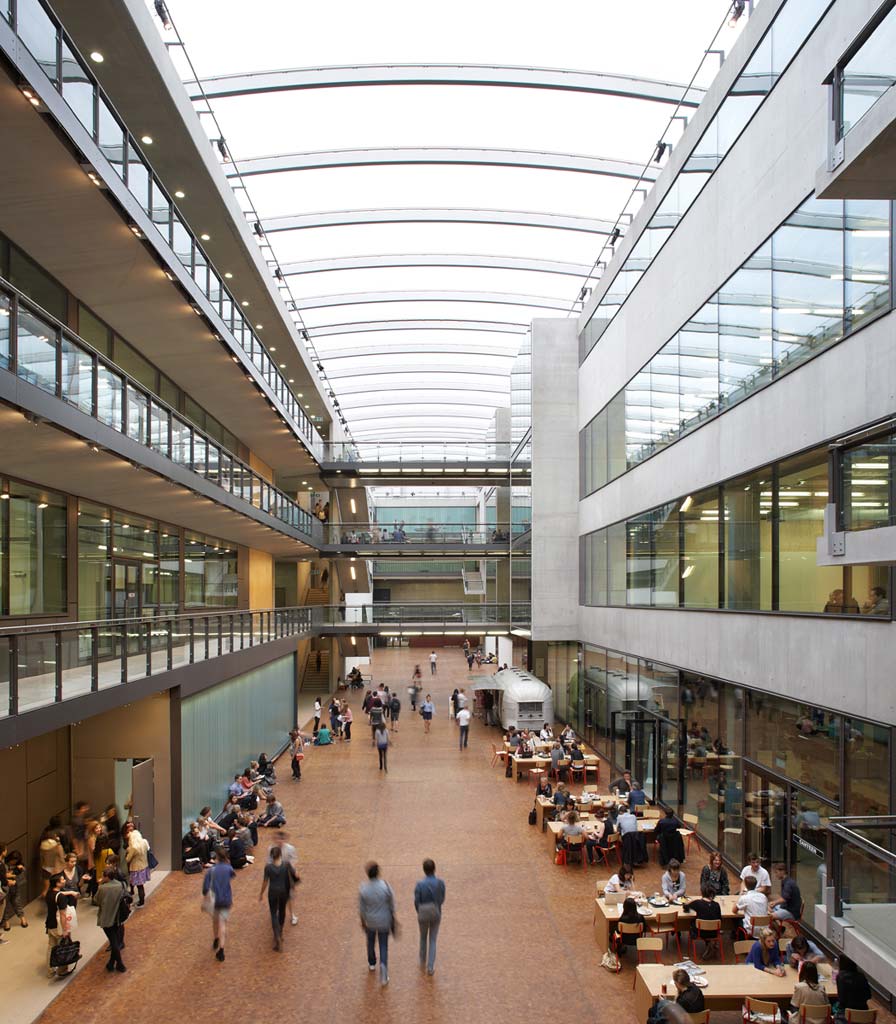
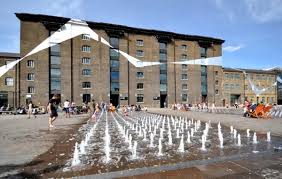
Several formerly independent drama schools have moved into universities in recent years and it isn’t hard to see why. They get access to university facilities and  presumed stability.  That often means splendid new buildings especially designed for what becomes, in effect, the drama department although the original name is usually retained. Drama Centre, for example, has (had?) a wing of Central St Martins immaculately converted, spacious Granary Building at Kings Cross complete with its own impressive drama library.

Students, moreover, get access to everything the university offers including libraries, accommodation and student union. On graduation the students have the kudos of a degree from the parent university – not that the certificate is any guarantee that the holder is employable as a stage or screen actor, of course.

The downside, obviously, is that however glitteringly good the initial deal seems, eventually it will tarnish because a drama school is expensive to run and the students pay the same fees as all the rest so they become a financial drain. The drama school can’t possibly retain much autonomy either.

I have no inside information (although I have heard a chilly, unconfirmed rumour relating to one of them) about Birmingham School of Acting, part of Birmingham City University and now merged into Royal Birmingham Conservatoire or East 15 (University of Essex). Then there’s Guildford School of Acting (University of Surrey), Royal Central School of Speech and Drama (University of London). I just hope that none of them is struggling with the same financial arguments that Drama Centre presumably was. I fear, however, that this could be the start of an avalanche.

Perhaps we shall, in the next few years, move back to a situation in which vocational training for theatre/screen creatives is completely outside mainstream higher education. That could, if handled sensibly, actually be an improvement although I struggle to see how it could be totally inclusive, unless students still had access to student loans and other support. I’m glad I won’t responsible for sorting out the funding implications either way.

NSFW-James-Warburton-and-Jules-Chan-Mark-Duffield-2019

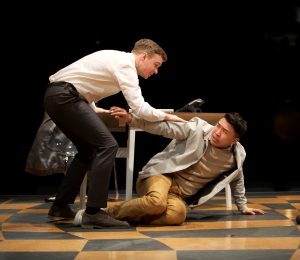
Images: Central St Martins Granary Building and Drama Centre students at work, 2019

Let’s stop smilingly pretending that tatty, cramped dives with dreadful lavatories are more artistically expressive than venues which conform to modern standards. I’m with the little boy (can we gender-fluidly cast her as a girl?) in Hans Christian Andersen’s The Emperor’s New Clothes story. It needs saying. Loudly.

Six the Musical, now running indefinitely, is one of the best shows in town. It’s edgy, sassy and original as many critics have said. But it would be just as outstanding if it were staged in the relative comfort of, say, Park Theatre or The Bernie Grant Arts Centre where the cast would have better facilities too.  Dingy, cavernous, cramped discomfort does not automatically create good theatre – although the Arts Theatre, where Six the Musical  currently “lives” has improved a lot under the management of Lizzie Scott and Louis Hartshorn. The springs in the seats no longer protrude to dig into your back and bottom. But the seating is still tighter than a sardine tin and the access is terrible.

It is, of course, a fashionable theatre-going requirement to admire, and feel empowered by, the scruffy “excitement” of improvised and other unconventional venues. I don’t. Sorry, but there it is.

I saw a very fine student graduating show (Associated Studios with Sister Act) at Vaults Theatre near Waterloo earlier this year. The walk into the theatre (I’ve been there before but had evidently blanked out the awfulness) is like some sort of Soviet Russian dungeon, the bar so dark you can’t see to read the programme, “recycled” seats horrible and the lavatory provision woefully inadequate. It’s a good job that, on this occasion, the quality of the show was so high that it almost made up for it.

Good as much of the work was, I also loathed the old Union Theatre  in its original home where I always doubted that the primitive, subterranean loos were within the law. The new premises over the road are much more civilised and pleasant and I bet the back stage facilites are better to work in too.

Many pub theatres – much as I love their feistiness and the shows they often produce or receive – struggle to be adequately provisioned too. I’m confident that The King’s Head, for example – in many ways the best pub theatre in London – won’t expect its punters to teeter down a steep flight of stone steps for a wee when it moves into its eagerly anticipated new premises on Islington Square.

There will, I hope, also be a tiny bit more room between audience members. Old fashioned I may be but I really don’t care for this haunch-glued-to-haunch business with complete strangers and it must be a lot worse if you’re larger than I am. The Old Red Lion, also in Islington, springs to mind for its dreadful ladies’ loo too although the pub/bar area at the front is lovely.

Not that a theatre has to be opulent to work. Some of the old glitzy Victorian theatres are nearly as uncomfortable (The Fortune and Ambassadors Theatres, for instance) as tiny, improvised ones. Some new theatres – New Diorama and Above the Stag, say – are quite modest but decently comfortable. It can be done on a lowish budget without resorting to the full-scale comforts and size of, say, The Bridge Theatre.

Photograph: Niall Palmer via From The Box Office Blog


Macbeth
William Shakespeare.
society/company: Chichester Festival Theatre
performance date: 27 Sep 2019
venue: Festival Theatre, Chichester Festival Theatre, Oaklands Park, Chichester, West Sussex PO19 6AP
 

Dervla Kirwan and John Simm in MACBETH at Chichester Festival Theatre. Photo: Manuel Harlan

⭐⭐⭐

Well, it’s good to see a Macbeth which starts on a blasted heath with three pretty sinister witches emerging from the rocks. I’ve seen plenty of versions of this play in which I’ve spent the first ten minutes wondering anxiously whether I’ve made a mistake and come to the wrong show. And what a heath! Simon Daw’s design gives us a huge semi-transparent glass disc with rocks and vegetation below – and it sometimes splits to create a diametric crevasse. Behind that is an upstage mirror screen behind which some of the action takes place and blurred things can happen.

Paul Miller’s directorial debut in his own home town (he runs the Orange Tree at Richmond for a day job) is a rather grown up, measured take on Macbeth. Much of the text which is often cut is restored and the show runs nearly three hours. GeneraIly I like that although the very wordy, action-light English scene could have done with a good prune.

Dervla Kirwan gives us an intelligent, plausible Lady Macbeth whose attractiveness and reasonableness makes what she is saying seem even more horrifying. And her sleep walking scene is one of the best I have ever seen – chilling and pitiful. John Simm manages Macbeth’s descent into tyranny (seems very topical) well. There’s a moment “O! Full of Scorpions is my mind, dear wife!” when Simm makes sure that you hear and see the madness and irrationality setting in and the leisurely pace at which most of the text are delivered gives you time to reflect on it.

In the support roles Luyanda Unati Lewis-Nyawo is strong as Ross and Harry Peacock gives us a pretty straightforward but quite memorable porter. Beatriz Romilly – a female actor – uses her femininity to make Malcolm seem young but poised and initially frightened although she develops the character pleasingly.

It isn’t all great though. There were some audibility problems – which didn’t bother me much because I know the text of this play almost by heart but there is a downside to a very large cast on a thrust stage playing against an almost continuous rumbling sound track (by Max Pappenheim). His video designs don’t add much either. We really don’t need blood spattered across a screen, for example, to tell us that McDuff has killed Macbeth. And why, by the way, does Michael Balogun as Macduff use a somewhat incongruous south London accent when almost everyone else is speaking RP?

And sometimes the story telling gets lost. In Lady Macbeth’s first scene she is – famously – reading a letter from her husband. No one seeing the play for the first time would understand that from this version. Flashing up the odd word on the screen behind as she speaks just feels peculiar. There are minor characters whose identity seems incomprehensible too – too much walking on and off for no apparent reason.

John Simm and Dervla Kirwan in MACBETH at Chichester Festival Theatre. Photo: Manuel Harlan

 First published by Sardines: http://www.sardinesmagazine.co.uk/reviews/review.php?REVIEW-Chichester%20Festival%20Theatre%20(professional)-Macbeth&reviewsID=3711