Press ESC or click the X to close this window

Susan’s Bookshelves: The Catcher in the Rye by JD Salinger

I read The Catcher in the Rye decades ago, when I was a teacher-training student at Bishop Otter College, Chichester. In their usual woolly way, staff were keen on getting us to read fiction and memoir which took us inside juvenile minds. I didn’t warm to it much although I’ve met many people over the years who praise it to the hilt.  Then, a few months ago, it appeared on the yes-please-for-Christmas list sent me by my 14-year old granddaughter. Naturally I bought it for her, along with several other titles on her rather encouraging list. And I made a mental note to myself, half a century after my first visit, to reread and reappraise it,

Famously it’s a first person – almost stream of consciousness in places – account of Holden Caulfield’s troubles at school (thrown out of several), sexual yearnings, sense of alienation and suicidal thoughts all worsened by a great deal of heavy drinking and smoking. He is one of those characters who has acquired a persona outside the covers of the novel so that people who’ve never read The Catcher in the Rye usually know roughly who he is. Mr Darcy, Miss Havisham and Lady Chatterley have similar status.

Holden is being expelled from his latest boarding school but his parents haven’t yet been informed. So he bunks off to New York City and tries to amuse himself, planning to turn up at home on the day term ends. Thus, in a narrative which covers just two or three days we get lots of  flashbacks. He is clearly haunted by his dead brother, Allie, and fond of his little sister Phoebe, along with an older brother who’s developing a career as a writer in Hollywood. We also hear about boys he’s known, and loathed, in various schools and a couple of girls he’s been pals with for a long time. He has, of course, almost no sexual experience and his attempt to spend a night with a prostitute is a miserable failure. His self-confidence is pretty fragile.

JD (Jerome David) Salinger was 33 in 1952  when his most famous book was published. The concept of teenager hadn’t really arrived. Young people were crudely perceived to jump from late childhood to young adulthood without any sort of acknowledged developmental period. And there was certainly no casual talk about “hormones” as an explanation for anything anyone does, says or feels between the ages of say 12 and 18. So The Catcher in the Rye broke new ground. Holden is confused, contradicts himself, does wildly silly things and uses lazy catch phrases: “I really do”, “it kills me” and “phoney”, for example. These irritate the reader as much as they probably do the adults who have to deal with him, although parents and teachers are largely absent in the narrative because he’s avoiding them. The one teacher he is fond of, when contacted, offers Holden a bed for the night but that goes wrong too. He’s moody, difficult, capricious, rebellious, unhappy and brittle but buoyed up by shallow bravado.  It’s a pretty accurate account of the sort of state of mind many teenagers find themselves in when life seems to have gone dangerously pear-shaped.

Holden also “swears” continually. His favourite adjective is “goddamned”, a profanity which many found offensive in 1952. The hundreds of authors I’ve read since who write teenage first person narratives would generally use rather stronger language but in The Catcher in the Rye the word “fuck” occurs only a few times when Holden is horrified by its use in graffiti at his sister’s school so it becomes a marker for where his boundaries lie and an acknowledgement that he has some. His self-conscious attempts to be “grown up” – getting served alcohol in bars when he’s still a minor, or staying n hotels – are well observed and I suspect many adult readers identify with that.

It’s hard to say whether Salinger, who died in 2010 aged 91, meant The Catcher in the Rye to help adults understand young people or to give teenagers something they could really recognise – or both. And surely there must be autobiographical elements in a novel as raw as this.  I also wonder, 74 years after its publication. how much this novel will mean to a modern young reader like my granddaughter. I’m waiting to hear her response. I suspect that most young 2026 readers will feel more at home with some of Jacqueline Wilsons’s more perspicacious novels (such as The Illustrated Mum) or with Sarah Crossan’s  perceptive verse novels.  But I reserve judgement.

Next week on Susan’s Bookshelves: Four Seasons in Japan by Nick Bradley

The Curious Incident of the Dog in the Night-Time

Simon Stephens, based on novel by Mark Haddon

Directed by Roger Beaumont

Questors Theatre, Ealing

Star rating: 3.5

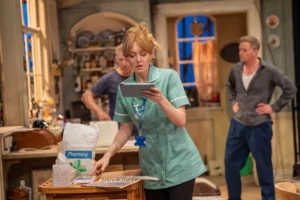
It’s good to meet Christopher Boone (Rory Hobson) again. Mark Haddon’s unforgettable 2003 best selling novel first saw the light of day as a play at the National Theatre in 2013 where I saw and loved it – and Luke Treadaway won an Olivier Award. It has toured extensively since and I saw an abridged NT production in a school at one point. It’s powerful material and Rory Hobson is terrific in this production as troubled, literalist, mathematically talented Christopher – huddling in terror, screaming if he’s touched and giving a warmly convincing account of how it feels and looks to be at this point on the autistic spectrum.

Interestingly though, Mark Haddon never saw it as a book about autism. He set out to write a book about family tensions with a Sherlock Holmes joke in the title. It is now used as a text book on autism training courses, about which Haddon apparently has mixed feelings.

The truth of course is that it’s about a lot of things including friendship, empathy, communication and even mathematics. That’s why it engages so well.  Simon Stephens’s script develops the character of Siobahn, Christopher’s special needs teacher, into a narrator who reads aloud from the book she has persuaded Christopeher to write and Claire Durrant is excellent in this role. She finds exactly the right level of assertive kindness when she’s in conversation with Christopher and she voices him perfectly.

Andrew Miller is good as Christopher’s troubled, deserted father and Holly Gillanders makes a fine job of Judy, his mother. Both are complex characters trying to do their best for Christopher but behaving badly and making mistakes because life is very difficult. Beyond that is an ensemble of six who multi-role many other characters, some stronger than others. They also do neatly directed, witty things with mime – such as becoming an ATM, a group of passengers in a tube train or a railway ticket barrier. The moments when Christopher is overwhelmed – on arrival at Paddington Station, for instance, are very effective too because we feel as if we’re inside his head.

And it’s all played on a simple geometric set (Rose Beaumont and Leon Chmabers) just as the original NT production was. Chambers’s video designs add a lot of visual interest too especially when Christopher is using maths to calm himself down.

I was expecting the lovely surprise for Christopher at the end but many of the audience I saw it with were evidently unfamiliar with this story so it was a nice moment.

When Schubert died at the tragically early age of thirty-one, he left a vast body of compositions, hundreds of which were incomplete, ranging from some that were just a few bars in length, to complete movements intended for longer works. Amongst these was what we know as his Symphony No 8 in B minor, or “The Unfinished”, even though there are at least two other symphonies which he also put to one side, unfinished, perhaps intending to work on them later.
In 1928 the Columbia Gramophone Company announced an international competition to mark the centenary of the composer’s death, the task being to complete “The Unfinished”. This proved to be very controversial, the rules being changed several times, and the eventual “winner”, the Swede Kurt Atterberg, being ridiculed for his “Symphony No 6”, which in reality, is rather good. The pianist, Frank Merrick, was the regional British finalist, and many other well-known composers also entered, Alexander Glazunov being chairman of the impressive team of judges.  BUT, all this proved was that the two movements that make up Schubert’s “Unfinished” are in reality complete in themselves, lasting, as they did in MSO’s concert, some twenty-seven minutes. Although most symphonies do have four movements, many do not: one thinks of Rubinstein’s ‘Ocean Symphony’, which has seven.
Brian Wright took a sedate view of the first movement, allowing the superbly resonant double bass section to underpin the orchestra, letting the music spread, at the same time revealing great attention to dynamics. Although, occasionally, the cellos sounded hesitant in the more exposed passages, the overall effect was of a conductor who had known this music for a lifetime. The second movement proved to be a pleasing contrast with gorgeous sounds from the woodwind section, especially the principal clarinet, Graeme Vinall, and the first violins often producing a rich timbre in the more exposed sections.
Weber’s three clarinet concertos were composed eleven years before Schubert’s 8th Symphony, in 1811 for Heinrich Baermann, having been commissioned by King Maximilian of Bavaria. And the second concerto, especially, has become very popular in recent years, together with Baermann’s “embellishments” which make it into a truly virtuosic work for a superb musician, which is what MSO’s soloist, Jonathan Leibovitz, undoubtedly is. He has the most beautiful, smooth, opulent, creamy tone when required, rather like very thick cream being slowly poured from a jug, as well as the technique to make the coloratura passages sound easy. From the almost impossible highest notes to the very lowest, he is totally at ease, clearly enjoying and savouring every moment of this underrated work.  The orchestral writing, especially for the strings, is quite challenging at times, but the MSO coped very well, as if they had been playing it all their lives.
After the interval, Wright programmed a work which many community orchestras would consider challenging: Brahms’ Fourth Symphony. It had, however,  obviously been thoroughly rehearsed and proved to be a very Germanic interpretation, in the style, perhaps, of Otto Klemperer. All that was missing was to have the excellent second violins on the conductor’s right, rather than next to the first violins, so that they balance the sound, as is still done in most orchestras in Europe, and as Brahms would have expected.
However, that is a minor criticism, given the high level of playing, the first violins coping well with the various difficulties thrown at them, for example in the final movement, and the woodwind section again making an impact, especially principal flautist Anna Binney – what a resonant, full sound she has – and Kirsten Couldwell, principal oboe. The excellent timpanist, Keith Price, also impressed with some very clean playing, as did Owain Williams with his challenging triangle part in the third movement.
This fourth concert in MSO’s 2025-2026 series was a very enjoyable foray into some ‘romantic’  music from the nineteenth century, proving, as Brian Wright says, in his introduction to the 2026-2027 season, that the orchestra is in “rude health”. Congratulations to all.

Rinaldo

George Frederic Handel

From a scenario by Aaron Hill

Conductor: David Bates

Director: Julia Burbach

Royal Academy of Music Opera

Photo credit: Craig Fuller

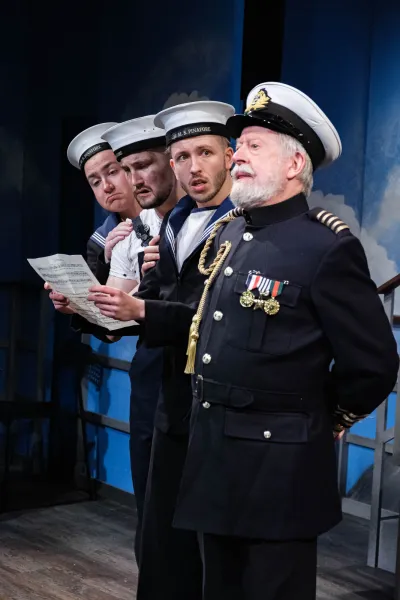
It’s probably best to ignore the tortuous plot of the thirty-one-year-old Handel’s 1711 opera. It’s always pretty obscure: The Magic Flute meets A Midsummer Night’s Dream. And in this version it becomes even more incomprehensible than usual owing to a framing device which sets it at a 21st century book launch (I think!) and then has six performers acting it out against a steeply raked white box. I was no wiser at the end than at the beginning.  But musically it’s exquisite and this production runs with that in spades.

All six of the cast (two casts – two performances each) that I saw were strong with exceptional work from counter tenor Agustin Pennino as the anguished, titular Rinaldo. Every note and every word was placed with precision. Caroline Blair, soprano, found sauciness and pain in Almirena, especially in the well known Lascia ch’io pianga which she sang with sad warmth building nicely through the repeats.

Pavel Basov comes from Russia and has a wonderfully deep bass voice. He’ll make a fine Boris Goodanov one day. His take on Cupid (pink jumper, wings and socks) was great fun and he’s a stage commanding actor. There was, however, some blurring of clarity at the bottom of his register.

Best of all, perhaps, was the work in the pit where conductor David Bates smiled, mouthed, encouraged, and looked after his singers with benign authority. And the playing from Royal Academy Sinfonia was terrific with especially lovely work from Felix Hesse on bassoon. You can’t beat a baroque trumpet and Reuben Anelay, Sasha Canter, Iris Rushbrooke and Luella Shaw really brought this lovely music to life.

At the end, Bates took the entire orchestra on stage for an enthusiastic curtain call with the cast which was a delightful touch and richly deserved.


Au Printemps Duruflé Requiem

Bach Choir

Conductor: David Hill, Organ: Philip Scriven. Mezzo soprano: Katherine Gregory

Holy Trinity, Sloane Square, 19 March 2026


Katharine, Duchess of Kent famously sang with the Bach Choir for nearly 25 years and she taught music for 13 years in a Hull primary school. She became passionate about music education and co-founded  Future Talent, a charity to support talented young musicians from low-income families. She died last year. Attended by the Duke and other family members, this concert was a memorial to her.

The almost entirely programme French programme was thematically rooted in Gregorian Chant. We began with a series of musical hors-d’oeuvres  of which Fauré’s Cantique de Jean Racine was the best known.  The sound of the Bach Choir in the rich, lofty acoustic of Holy Trinty, is stunning. Hill’s trademark baton-less conducting style coaxed soaring power from the singers especially in Poulenc’s Litanies a la Vierge Noire sung by all female voices with lovely work from the chamber groups within the soprano and alto sections. Organist Philp Scriven played Pamela Decker’s reflective Jesu, dulcis memoria, influenced by Messiaen, so that it resounded evocatively round the glorious Arts and Crafts building especially in the engaging fugue.  The first half ended with Poulenc’s Quatre Motets pour un temps du penitence – chosen, perhaps, because the Duchess of Kent converted to Catholicism in mid-life. It was movingly and hauntingly sung especially the Verdi-influenced, operatic Tristis est anima mea. I was struck by how challenging it must be to sing those relatively unfamiliar Latin words (“crucifixissent” “amaritudinem”) but of course this fine choir delivered every syllable with dynamic precision and elegant diction.

The post-interval main course comprised Duruflé’s Requiem (1947) in the version for organ and choir. And it came with a great deal of the requisite shimmering mystery, angst and beauty. Hill ensured that the glorious climaxes erupted, especially in the Kyrie, Katherine Gregory made a fine job of Pie Jesu, her voice burgundy rich on her bottom notes and demonstrating phenomenal control in the moving ending as it died away. The muscularity of Libera Me made a striking contrast and the final In Paradisium came with the tender top notes gently echoing round the building.

It was a memorable concert which managed to splice joy and celebration with reverence and remembrance, I hope they collected  plenty of generous donations to Future Talent.

National Symphony Orchestra of Ukraine Conductor: Volodymyr Sirenko Piano: Mariia Pukhlianko Cadogan Hall,  17 March 2026 I first saw National Symphony Orchestra of Ukraine at Fairfield Halls, Croydon in 2023. I admired their distinctive style then and, if anything, it’s even more striking now as they enter formally and sit with second violins to the conductor’s right and cellos next to firsts with basses behind. And Volodymyr  Sirenko is the only conductor I have seen – anywhere, ever – who takes his final bow centre stage holding up the leader’s hand on his right and the principal second violin on his left to form a symmetrical triumphal arch. It rather wonderfully confers on second violins exactly the equal status they deserve. It is also a joy to be able to see and hear second violin work so clearly throughout an enjoyable concert which launched with a pleasant surprise. Maksym Sozontovych Berezovsky – of whom, in common I suspect with most Brits in the audience, I had never heard – was a Ukrainian contemporary of Haydn. His “symphony” in C major (1770-72) is really a three-part miniature, very charming, tuneful and ideal as a concert opener. And it was played with here with affection and verve. Then we got one of the finest accounts of Beethoven’s “Emperor” concerto I have heard yet. Resplendent in voluminous sparkly scarlet, Mariia Pukhlianko took it slightly more slowly than some soloists choose to do, working though all those mood changes in the first movement with sensitivity. It’s odd that she looks mostly at the keyboard and rarely directly at Sirenko but the chemistry clearly works in other ways because the balance with the orchestra was close to perfection.  She gave us stunning right hand work at the end of the first movement and her trills in the adagio came close to perfection. I always judge this concerto by the handling of the transition passage between the adagio and the rondo – one of the most enchanting moments in the whole of the classical/early romantic repertoire. Here it was done with exactly the right delicacy and tension. And incidentally, partly because of Cadogan Hall’s excellent acoustic and partly because of Sirenko’s attention to detail, I heard a timpani entry (crisp with hard sticks) just before the final crescendo in the rondo which usually passes unnoticed. The climactic post-interval work was Beethoven’s “Eroica” symphony,  every note like an old friend but here sounding as fresh and revolutionary as Beethoven could have wished. Highlights of a moving performance (you have to remember where this orchestra comes from) included the wonderful horn climaxes and incisive chords in the first movement and a lively scherzo which avoided the temptation to run at break-neck speed. Too many conductors see it as a look-how-fast-we-can-play-it challenge at the expense of the finer points. There was some excellent horn playing in the trio. Even in the finale Sirenko packed it with passion and energy, without rushing. and allowed the wind chorale moment to work its glorious magic. Most impressive of all, however, was the funeral march. It’s a very long movement requiring a great deal of sustaining and control. Here we felt the  passion in every bar. And the grandiloquent horn playing (quite an evening for horns, really) was tenderly powerful. Overall, a memorable concert of (mostly) old favourites played with a commendable blend of respect and vibrancy.      

Writing a piece the other day about the history of the Carnegie Medals, I realised that I had missed last year’s winner for writing. Time then to put that right. And I can now attest that it’s an emotional rollercoaster.

Finlay and Banjo have both grown up in care. Neither has ever really known family life although Banjo’s current, saintly, foster parents are doing their damnedest.  Their circumstances are different. Banjo is back at school (sometimes) and Finlay is now training to be a nurse although self-funding is causing him worrying problems. The novel has a split time frame between “now” and three years ago.

Both boys are damaged, vulnerable, unhappy and angry although it manifests in different ways. Neither really knows how to form any sort of friendship or relationship. Anyway, who wants to? Anything which seems good is bound to be snatched from you so you might as well bust it up now – with violence, anti-social behaviour, silence, withdrawal or lies. Margaret McDonald has a real knack of getting inside their heads so that we understand – really understand – their thinking and flawed reasoning. In that sense Glasgow Boys reminds me a little of Melvyn Burgess’s Junk which also won the Carnegie Medal (2021) and remains the only thing I’ve ever read which helped me to understand heroin addiction.

Banjo and Finlay meet in a facility three years earlier in St Andrews and are room mates. Very gradually they form the nearest thing to a friendship either of them has ever known. Although Finlay is gay and Banjo is not, this is simply friendship. There is however, nothing simple about it. There are issues of trust born of a lifetime of being unable to rely on anyone and eventually there is a shattering rift, the exact details of which McDonald drip feeds with great skill though the memories of these boys now in their upper teens.

There are some wonderful characters in this novel. Paula, Banjo’s foster mother is the epitome of kindness understanding and reasonableness, Anger, or even irritation, is foreign to her. Akash the medical student, Finlay is falling in love with is a delight and he has a stable family home so Finlay begins to understand the dynamic. Meanwhile Banjo works  part-time in a café where he makes friends with Elena and slowly morphs into her boyfriend. She too has a very stable, welcoming family. When Elena is hospitalised with Crohn’s Disease ( interesting quasi “subplot”) her father, Carlos, welcomes Banjo into her hospital room as “part of the team” and that’s quite a moment.

Of course none of this happens straightforwardly. Both “Glasgow boys” suffer repeated setbacks which they recognise as being their own fault but neither is super human enough to get systematically on top of the issues. They need help but they’re conditioned not to discuss their feelings.

So will Finlay and Banjo meet and repair their friendship? I’ll spare you the spoilers. Suffice it to say that this warm hearted, intensely perceived, moving novel ends hopefully.

Glasgow Boys was published by Faber & Faber as young adult fiction. It wouldn’t have qualified for the Carnegie Medal for Writing, otherwise And Margaret McDonald, incidentally, is at 27 the youngest ever winner. I have read many hundreds of novels written for children and young adults over the years and I used to say that the writing is subtly curtailed so that you can sense immediately which genre you’re in.

Bernard Ashley is a retired South London headmaster, author of many prize-winning books who came, at my invitation, several times to schools I taught in.  And I once heard him talking to a teachers’ conference about gang warfare in the East End which featured in one of his books. Of course, he said, these people would have been swearing in every sentence but you can’t do that in a children’s book so you have to find other ways of conveying the mood.

That would have been about 1985. Forty years later expectations are completely different. Glasgow Boys is authentically gritty. Finlay and Banjo speak exactly as they would in real life. And as I read, apart from the main characters being young adults, I had no feeling at all that this was a book targeted at teenagers. The distinction has disappeared and, on balance, I think that’s welcome.

Next week on Susan’s Bookshelves: The Catcher in the Rye by JD Salinger

Regency Quartet

Brighton Dome, Corn exchange

25 March 2026

The concert opened with a pleasing account of Mozart’s K465 quartet. It’s a good choice with which to warm up both performers and audience because it offers equal prominence to all four players especially in the Hadynesque (it was dedicated to Haydn in 1785) adagio opening section. The andante cantabile came with loving tenderness and lots of eye control and the clarity of the semi-quavers in the final allegro was notable. And, as always, I was struck by the way the lofty Corn Exchange acoustic, which looks so unlikely with its huge space behind the players, actually allows us to hear every note.

Jesse Montgomery’s Strum (reworked for string quartet in 2012) provided a complete contrast. The seven minute piece is inspired by folk songs, protest songs and dance music and includes a great dela of the titular “strum”. Jamie Howe began with his viola in guitar position and all four players demonstrated rhythmic pizzicato with chords across the strings in both directions – all rather fascinating and enjoyable, especially when  violin harmonics topped the texture.

After the interval came Webern’s 1905 more familiar Langsamer Satz, written when he was only 22, still a student, and long before he started experimenting with atonality. The Regency Quartet delivered it with lots of wistful lyricism, lovely playing from Olwen Miles (Violin 2) when she introduces the melody and delicately muted piano sections. It’s a piece which requires a great deal of imaginative control which it certainly got in this performance.

Shostakovich’s String Quartet no 3 is an extraordinary work. Written in 1946 under the Stalinist regime, it presumably tested the composer’s fragile relationship with the establishment. It was rarely performed in public after its premiere and Shostakovich soon withdrew his potentially provocative headings for the five movements,

In this performance there was a string sense of virtuosic  wonder. In the opening movement Mabelle Young-Eun introduced the typically Shostokovich-ian melody with verve and, at the point when it goes fugal, the other three nailed the anxious, chromatic insouciance rather well. Then they found all the right disquieting menacing (sinister?) tone for the second movement with its strange percussive pianissimo.

The war-like (surely that’s what the composer intended?)  third movement needs, and found, huge reserves of energy and the contrasting funereal adagio followed with some beautiful lachrymose violin playing in the instrument’s highest register and some solemn near-unison statements. I especially admired Ellen Baimring’s cello work here along with Howe’s poignant viola solo

It’s a pleasure to see and hear four young players performing such challenging work with such vibrant passion and intensity.