Press ESC or click the X to close this window

Providers (Susan Elkin reviews)

Providers

Ambreen Razia

Directed by Esther Baker

Synergy Theatre Project

Brixton House Studio 2


Star rating: 4


This strongly cast, perceptively written play is moving, entertaining – and as relevant to our troubled times as it could possibly be.

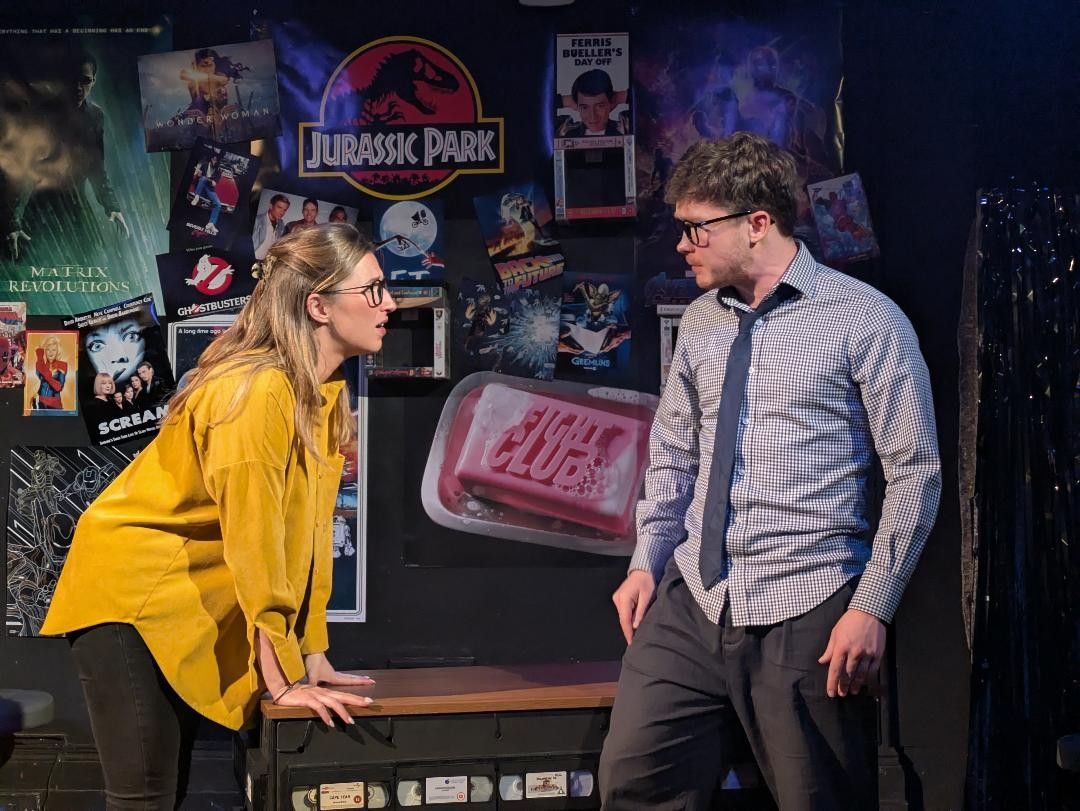
Two pairs of south London siblings are each grappling with problems of money (the cost of living crisis) and the absence of parents. Who is responsible for whom and for what under these circumstances?  We see Christa and Mia at home, having not told anyone in authority that their mother has died. In parallel are Yusuf and Saleem whose parents have gone “home” to Pakistan and left Yusuf in charge. Christa has serious mental health problems and Mia, still at school, struggles to cope. Saleem is the same age as Mia and they are drawn to each other. Meanwhile Yusuf is not simply a vape shop owner. The 60 minute piece is shot through with issues, decision points and foreseeable disaster borne of the need for money – although it ends on a hopeful note.

Sunjay Midda is outstanding as Yusuf, variously angry, wheedling, violent, caring, unscrupulous but trying, in his own way, to hang on to family values. His is a very complex character who somehow needs to keep his brother and send money to his parents so the vape shop isn’t enough.  Midda also doubles – good voice work – as a teacher.

There is a fine performance from Aamira Challenger as Christa, a character which develops and eventually finds some strength. She too doubles, rather effectively, as a teacher. Adil Hassan is pleasing as Saleem, finding all the right boyishness and enthusiasm replaced by fear when he gets out of his depth. And Daniella Henry is interesting as Mia. She is very good at puzzled determination and anxiety.

Synergy Theatre Project uses theatre to transform lives and works across the criminal justice system: with prisoners, ex-prisoners, young offenders and at-risk young people. Providers has toured to schools, prisons and institutions as well as performing to school parties at Brixton House.

The cast for Providers comprises three professional actors and one who has worked with the director, Esther Baker, on projects while in prison. As she told the audience in the Q/A which followed the performance, Danielle Henry was released from prison just six weeks ago after serving four and a half years. She then came straight into this paid job – her first professional role. This is very inspiring and one hopes fervently that she gets more work soon and that every young audience member takes away the vital message that, challenging as life is, there are always choices and people who will try to help.

I discovered Daphne du Maurier when I first read Rebecca in my mid teens. I gobbled the whole of her backlist from the library and, for the next ten years or so, pounced eagerly on each new novel as it was published. Rule Britannia, which arrived in 1972, turned out to be her last. She died in 1989.

I agree with du Maurier’s biographer, Margaret Forster, that this is probably her weakest novel. Nonetheless, although until now I had read it only once, over fifty years ago, its premise is something I have often thought about. It posits an invasion of Britain by the Americans, invited by a bankrupt British government to form USUK. I need not spell out why it has sprung to mind forcibly now and why I have just reread it in horrified fascination.

Cornish residents – strong characters, all of them – are the focus. Britain has just withdrawn from the Common Market which has led to devastating economic problems. Yes, with astonishing perception, du Maurier anticipated Brexit. She was writing  a few months before January 1973 when  Britain joined the group which later became European Economic Union and finally the EU. America, of course, sees Britain as a strategic toehold in Europe. So marines arrive on the beaches of Cornwall and there’s a warship in the bay.

Mad is a feisty, determined retired actress who has brought up her granddaughter Emma, 20, from whose point of view the story is largely presented. She has also adopted six boys, unrelated to each other, and each with his own clearly drawn personality – and issues. Shades of JM Barrie’s “lost boys” and I’ve now learned that the Llewellyn boys were cousins to Daphne du Maurier. The characterisation is the strongest part of this novel whose plot is pretty creaky as the Cornish people rebel. It is worth noting, that du Maurier, set eight of her novels in Cornwall and became a Cornish nationalist.

Also in the mix is an American marine who takes a shine to Emma – because initially everyone tries to keep relations cordial. The local doctor, also a family friend, gradually comes on side and he’s very plausible. On the other hand Joe, the eldest boy who does the gardening is surprisingly articulate for someone who’s not meant to be able to read and write. And Mr Willis, the Welsh beachcomber squatting in a hut on the cliffs, is underdeveloped. He seems mysteriously helpful but Emma finds him sinister so reader desperately wants to know his back story but never gets it.

There are deaths, explosions, cover-ups, curfews and it all gets pretty implausible,  although it seems a lot closer to reality in 2025 than it did 1972 when Rule Britannia was written.  This situation with modern communications would be a thousand times worse. As it is, the Americans simply block the radio waves and cut off the phones when the locals start being troublesome. I suppose the novel is, in a sense, parody although I enjoyed the idea of building an impenetrable, pungent wall of manure to scupper Thanksgiving celebrations.

It may not be in the Rebecca league but do read, or reread, Rule Britannia for its Orwellian prescience.

Next week on Susan’s Bookshelves: It All Ends With Us by Colleen Hoover

Shakespeare in Love – Tower Theatre, London

Reviewer: Susan Elkin

Adaptor: Lee Hall based on the screenplay by Marc Norman and Tom Stoppard

Director: David Taylor

The writing in Shakespeare in Love is so witty and literate that it glitters. This is Tom Stoppard, much of whose work for the 1998 film Lee Hall has ably translated to the stage, at his sparkling best. As in Travesties (1974), arguably Stoppard’s best play, the script is threaded through with quotes and references thus becoming an affectionate send-up of theatre itself.

“Give me to drink, mandagora,” says Shakespeare casually in the inn. “Anon, anon,” says Viola to her nurse. “I’ll be revenged on the whole pack of you” declares The Lord Chamberlain. Add to this effortless ingenuity Paddy Cunneen’s elegant period music, played live in this production, and you’re on to a winner almost before you start rehearsals.

Tower Theatre is very good indeed at attracting fine new talent and three leading actors in this show are appearing there for the first time. Christopher Edge excels as Will Shakespeare, variously nervous, passionate, exasperated and determined. This is an accomplished actor on top of his game giving a totally convincing performance.

Kizzy Parvin is warm, soft and delicate – but feisty – as Viola, who wants to be an actor but can’t be by law, which, of course, she defies. She gives a well-judged contrast between the “real” Viola and her character’s ability as an actor, combining sweetness and gutsiness. Then there’s James Collins, who commands the stage as Ned Alleyn, who is directing Shakespeare’s new play with forceful panache – another outstanding performance.

Also in this rich mix is Vahan Salorian who leads the music from a stage-right alcove. He is a multi-instrumentalist who really makes violin, pipe, trumpet, and guitar sound convincingly Elizabethan. As with previous shows at The Tower, there are occasional cohesion and intonation issues with the incidental ensemble choral numbers (all settings of Shakespeare songs), possibly because Salorian is not visible to most of them thanks to the fan shape of the playing area. James Collins, though, stands out again as a talented actor-muso with a very pleasing tenor voice.

This production needs, and uses a big cast, ably directed by David Taylor to make the best possible use of space and to allow every delicious line. Christopher Lloyd-Jones, for example, gives us a nervous Henslowe, Nvaron R Anderson a Christopher Marlowe who lords it over Shakespeare and Victoria Flint a suitably haughty Queen Elizabeth. Also rather delightful are the dances choreographed by Rachel Berg.

Runs until 29 March 2025

The Reviews Hub Score 4.5 stars

Warmly entertaining

This review first published by The Reviews Hub https://www.thereviewshub.com/shakespeare-in-love-tower-theatre-london/

Maidstone Symphony Orchestra 22 March 2025

Mote Hall, Maidstone

The third overture (of four)  which Beethoven wrote for Fidelio, his only opera – Leonora No 3 – is a pleasingly colourful concert opener because it tells the story so clearly. In this performance the trombones set the scene nicely in the opening dungeon scene, the off-stage trumpet nailed the triumphant drama and I admired the accuracy of the high speed string work which precedes the joyful ending.

Then came the centrepiece of the evening: Tchaikovsky’s flamboyant violin concerto and soloist Callum Smart whose modest demeanour belies his phenomenal technique. His first entry was breathtakingly mellifluous as he delivered every note with all the compelling warmth the piece demands. Wright meanwhile balanced the orchestra so that we heard a coherent conversation, including very incisive pizzicato, between soloist and players. Smart looks at the orchestra and listens attentively when he’s not playing himself and that’s very telling. The show-stopping cadenza was stunning too. How on earth does Smart find all those climactic harmonics and make then resonate so tunefully?

The tender shift into G minor for the Canzonetta movement was, as ever, a beautiful contrast: silky playing from Smart, some delightful flute work and plenty of tension in the link passage into the Finale. Smart and Wright emphasised the dynamic and rhythmic contrasts in the latter and packed the duet between soloist and orchestra with excitement. And if it wasn’t always quite together then it didn’t detract from the infectious joie-de-vivre. Smart’s impressive encore was his own arrangement of Amazing Grace – a mini masterclass in double stopping, split chords and imaginative harmonies.

Dvorak’s Symphony No 7 is always a melodic delight and MSO, now fully warmed up, more than did it justice on this occasion from the bravura brass work in the opening movement to the grandiloquence of the final page. Wright ensured there was gentle beauty in the string playing in the Poco adagio especially when  we reached the sublime cello melody and I have rarely heard this movement brought to such a sensitive conclusion. Also noteworthy was the elegantly negotiated counterpoint in the Scherzo which included strongly supportive timp work and delightful flute playing in the “trio” passage. Wright chose, rather refreshingly, to exaggerate the tempo changes in the Finale more than some conductors do and built plenty of mystery into that wonderful section which I always think sounds like theme music for a faux sinister comedy drama. Good old Dvorak.

Thanks, MSO, for yet another enjoyable concert.

Photograph credit: Patrick Allen & Roscoe Rutter 

Haydn Symphony 104

Barbara Hannigan

Academy Chamber Orchestra

Duke’s Hall, Royal Academy of Music

Transitioning from internationally renowned soprano to respected orchestral conductor is an unusual musical journey. Barbara Hannigan is on record as saying that as a singer she is also an actor. And, standing in for indisposed Rachel Podger, she certainly found plenty of drama in Haydn’s final London symphony at this performance which must have been a roller coaster experience for the participating students.

Second violins on the outside and cellos next to the firsts meant that we heard plenty of colourful detail directed with flamboyant fluidity. Hannigan  conducts by making expressive shape pictures with her beautiful hands rather than using a baton or doing anything as conventional as beating time, other than very occasionally. Her facial expressions are so eloquent that she is effectively acting the narrative of the music. This resulted in, for example, an exceptionally exciting development passage in the first movement. Hannigan loves Haydn and it came through in every bar.

There was plenty of tender insouciance in the adagio with a beautiful bassoon solo along with those alternating heavy statements. The decorated variation was lovely too because we really heard the second violins weaving round the texture and that can easily get lost.

The minuet and trio movement was enjoyably lively and Hannigan took the finale at a pretty nippy tempo. Her emphasis on the colourful swoops and quasi glissandi wouldn’t be to everyone’s taste but for a Friday lunchtime concert it felt pleasantly fresh. And the flute decoration was outstanding.


The Washing Line – Chickenshed, London

Reviewer: Susan Elkin

Devisers and creators: Michael Bossisse, Dave Carey and Bethany Hamlin

This powerful and disturbing show tells the horrifying story of the mass suicide of over 900 people in a 1970s religious cult, based in Guyana. And as cast members agree, talking over real-life footage at the end, it is extraordinary to be able to take events as grim as these and create art from them – but Michael Bossisse, Dave Carey and Bethany Hamlin and their huge, richly inclusive, young cast carry it off with thoughtful professionalism and enormous energy.

The Rayne Theatre, configured with a huge traverse playing area for this production, is strewn with dozens of dead bodies as the audience finds seats and music plays softly. Then the appalled first responders, handkerchiefs to their noses, arrive in temperatures of over 80 degrees F. Flies buzz on the soundtrack. Thereafter, with the aid of large screens the story is unfolded in a series of clear flashbacks and flashforwards as we gradually learn how the Jonestown cult began, the history of Rev Jimmy Jones, the members who spotted danger and fled, the assassination of US Congressman Leo Ryan who tried to investigate, and the response in the years since the events, now categorised as mass murder.

The main narrative medium is dance drama with compelling choreography (also by Bossisse and Hamlin) while MD Dave Carey provides evocative, pulsating music in late 1970s style. Cast members speak with their lithe bodies, engage in leaps and lifts and there’s one very beautiful sequence with a circus-style wheel.

And it’s all seamlessly hooked together with dialogue and song including a big choral number at the beginning of the second act. It is clearly heading towards mass death – bodies like washing on a line – from the moment the lights go down and yet this cast also conveys that there was peace, happiness and fulfilment at Jonestown which is why most of them stayed including young people, couples with families and mothers with new babies.

The cast is Chickenshed’s usual, gloriously diverse mix of young members (teenagers rather than children in this case) and adult staffers, most of whom have a long history with the organisation. Jonny Morton is charismatically sinister as Jimmy Jones and makes it perfectly plausible that so many people trust him unquestioningly. We also see him, in youth, killing a cat because it would be “happier dead than alive” and the number of women he keeps close as well as his wife (Sarah Driver – good) sets alarm bells ringing. Ashley Driver is strong as the detective in charge of the initial investigation and Alex Brennan is good as the commonsensible young man who wants to get out.

The Washing Line began life in 2017 as a Chickenshed Foundation Degree final year production entitled What’s Wrong With Jim? It was then developed into a full-blown show and staged in spring 2022. It has been adapted, deepened and expanded for this revival.

This is one of those rare shows at the end of which the audience is so shocked and moved that applause somehow seems trivial. There is no curtain call and it’s unusually quiet as people file out.

Runs until 5 April 2025

Star rating: 4.5

This review was first published by The Reviews Hub: https://www.thereviewshub.com/the-washing-line-chickenshed-london/


Zauberflöte

Wolfgang Amadeus Mozart

Royal Academy Opera

Susie Sainsbury Theatre, Royal Academy of Music

 Faced with such an incomprehensible narrative as Zauberflöte every director has to find a way of making some sort of sense of it. Jamie Morton and his design team set it in a hospital and why not? The whole thing is conceived as Tamino’s drugged dreams and nightmares as he lies in intensive care, ventilated and sedated. Thus, the three ladies become sinister nurses, Papageno and Papagena are cleaners, Pamina is his anxious bedside girlfriend and Sarastro a benign authoritarian consultant. It isn’t quite clear where The Queen of the Night and Monostatos fit into this conceit but never mind. Lots of ensemble tableaux (Royal Academy Opera Chorus), with drip stands, wheelchairs, crutches and the like, help to nail the ambience. I’m not sure that Mozart or his librettist,  Emmanuel Schikaneder, would have recognised it but  hey, this is 2025 so that’s fine.

All the principals role-share across the four performances. On 18th March, which was Press Night, I saw a strong cast amongst whom Conrad Chatterton is outstanding as Papageno – rueful, pragmatic and with a gift for making those familiar numbers sound as if you’ve never heard them before. He uses his physicality well too as he towers above almost everyone else on stage. Monostatos is probably the hardest role to bring off because it’s difficult to fathom who or what he’s actually meant to be. Clad in Wizard-like robes, an intriguing headdress and doing a lot of writhing, Owen Lucas makes him feel enjoyably sinister. Grace Hope-Gill finds all the puzzled wistfulness Pamina needs and as her mother, Binny Supin Yang, dressed in shiny PVC,  hits all those show-stopping top notes with menacing enthusiasm.

My biggest issue with this production is lighting, designed by Charlie Morgan-Jones. Of course, it’s meant to be hazy – we’re inside one man’s hallucinations but 2 hours and 35 minutes is a long time to watch something so relentlessly dark, with more stage smoke than I’ve seen in ages, that one was soon longing for a scene or two in which one could actually see what was going on. Second, the main lighting/stage design device is a quasi canopy of glowing tubes to connote institutional strip lights. These pointlessly change colour, re-angle and rise up and down continuously until it becomes a distracting irritant.

That’s a minor gripe, though. It’s a treat to see emerging singers delivering a generally pleasing production. I admire the decision to play this in the original German which must have been a challenge for some cast members but they rise to it with aplomb. Moreover, as always, Royal Academy Sinfonia, conducted this time by Olivia Clarke, are well balanced and supportive. Clarke is adept at allowing the audience to hear the musical detail – especially in the magical moment with flute (Sofia Patterson-Gutierrz) and timp (Anna Fyi).

I bought this book on autopilot because I’m an enthusiastic Elly Griffiths fan. I love her nonchalant present tense style, her wit and her engaging characters including cats. And I have fond memories of interviewing her in a Brighton café for Ink Pellet a few years ago. However, apart from noticing that this new book was the first in a new crime series, I had no idea what it was about.

And it was a shock. This is crime fiction spliced with sci-fi and hey, I don’t “do” fantasy of any sort so at 5% in (I was reading it on Kindle) I considered throwing it crossly aside. I didn’t want to read about time travel, thanks very much. But, because this is TGEG (The Great Elly Griffiths) and because I’d paid for it, I read on –  sceptically. And thank goodness I did. I should have trusted her. She can make anything compelling and by the time I’d got to 15% I was completely hooked.

Ali Dawson is a police officer in her fifties with a long history of failed marriages and an adult son, Finn, whom she adores. She now works for a special unit engaged on cold cases – very cold because the current one dates back to 1850. Think His Dark Materials, Alice in Wonderland, Narnia and even Enid Blyton’s The Magic Faraway Tree because Ali actually visits the period and place in question. And the reason it works fictionally is that she and her colleagues daren’t tell anyone what they’re doing because the reaction, obviously, would be cynical disbelief and suspicion of laughable irrationality. And a feet-on-the-ground reader like me identifies very much with that. Moreover Griffiths is very hot on the day-to-day details – food, clothing, sanitation and so on – at both ends which make it convincing. And there’s wry humour in that Ali has her 2023 brain and experience with her even in 1850 so there are some delicious anachronisms and characters she meets find her speech mode very strange. She explains by saying she comes from Hastings.

Finn is a special adviser to a Tory cabinet minister and the intricate, quasi gothic plot links his boss with the events in 1850 as we, like Dawson and Griffiths ponder metaphysical questions about how the past affects the present and vice-versa. If you move back in time can you change events? And could Ali have been murdered, or painted in 1850? Could someone from 1850 have come “through the gate” (an experience which causes terrible vertigo, by the way) to commit crimes in 2023?

When all is said and done, this novel is a whodunit. And I didn’t see the answer coming – yet another Griffiths strength. She’s very adept at keeping you guessing and springing surprises.

The Frozen People is great fun and very entertaining – as Griffiths always is. I’m now very intrigued to see where she takes this next because it is very clearly presented as the start of a series. I don’t think she’s likely to convert me to fantasy in general but she has certainly taught me a lesson about managing my prejudices and preferences.

Next week on Susan’s Bookshelves: Rule Britannia by Daphne du Maurier