Press ESC or click the X to close this window

Susan’s Bookshelves: Trelawny’s Cornwall by Petroc Trelawny

Petroc Trelawny is a much loved Radio 3 presenter: urbane, warm, witty, knowledgeable and never patronising. And with a name like his, the Cornish roots are obvious.

Now, I have a dear friend who, like Trelawny has deep ancestral ties with Cornwall. She now lives in Penryn where I have stayed with her several times. When I boarded the big GWR train from Paddington to Truro in September, I took newly published Trelawny’s Cornwall  to her as a thank-you-for-having-me gift. Like me, she is life-long music maker and Radio 3 buff so it seemed a perfect fit. Of course I couldn’t resist reading the opening pages before I gave it to her which meant – inevitably – that I had to buy another copy for myself because he drew me in hook, line and sinker, as a Cornish fisherman might say.

It’s not an easy book to categorise because it seamlessly blends travelogue, memoir, history, geography, economics and a lot more. And I learned a huge amount as I walked and drove through England’s most southerly and westerly county with this man, youngest of five brothers, who went to school in Helston after his father retired from the Army and moved the family “home” to Cornwall.

He leads us through Helston with its attractive buildings, tells us about the Flora Dance and the silly (but very catchy!)  song which made it famous, He’s a bit of a railway nerd so he tells us about the Cornish stations and lines closed as the result of the 1963 report by Richard Beeching, acknowledging ruefully that although the cuts were heartbreaking for local communities they did enable the rest of the pretty extensive national network to thrive and develop. He visits some of these stations or their sites. Today, if they haven’t been demolished and built over, some are cafes or community centres thus still serving local people. And, of course, we marvel at Brunel’s railway bridge across the Tamar, which incidentally Trelawney tracks to its source a few miles south of Bude.

I had no idea that Cornwall was once the country’s, if not the world’s, communication centre when cables were laid on sea beds in the late 19th century so that people could send messages to America, India and Australia in just a few minutes. Much later came satellite dishes named after characters in Arthurian legend although most of the Cornish ones are no longer operational. We stand with Trelawny on the wind-swept cliffs and marvel.

Mining, formerly Cornwall’s industrial mainstay, is another dominant strand and he’s very good on how and when the industry developed, what brought about its demise and the situation today. There is lithium in Cornwall and it’s essential for car and other batteries. At present it has to be imported.  Can one of the start-up entrepreneurs Trelawny talks to (he’s every inch a journalist and interviews many people in this book) find an economic way of extracting it in Cornwall?

He introduces us to personalities such as John Betjeman, whose father had a holiday home in Cornwall so his son wrote about it, later bought a house of his own and died in the county. I was glad to see Charles Causley in the mix too. He was a wonderful poet but oddly underrated. I used, incidentally, to teach Betjeman and Causley together as required by the O level syllabus we were using in the 1980s. Perhaps Trelawny studied the same set of poets when he did his O levels at Helston. He was in one of the last cohorts to take O levels before the introduction of GCSE. He then chose not to go to university but to develop his ambition to be a broadcaster by taking a job and learning the ropes as he went.

Whether you know Cornwall or not, this book is richly compelling. And once you’ve read it you will – I guarantee – want to hop on God’s Wonderful Railway, or into the car headed for A30, and get down there. Happily, I’m booked to visit my friend again in March for another Cornwall fix.

Susan’s Bookshelves was originally a 2021 lockdown project, suggested by my daughter-out-law who thought that as I read widely, compulsively and a lot, it would make sense to write about the books which grab me – for whatever reason and in whatever circumstances. So that’s what I did. Nearly four years later I have written over 200 of these blogs, ranging across fiction, non-fiction, biography, several centuries and many countries. The only theme is that whatever it is, it took my fancy or drew me back for a re-read. And I’m open to anything except fantasy. Spare me dragons, witches, elves, and unicorns, please. From time to time I wonder whether the idea has run its course but whenever I mention that my regular readers tell me to carry on, so I do. This is the last for 2024 (during which I have gobbled 130 books, although only 52 found their way here) so Happy New Year to you all and, of course, happy reading. See you on 01 January 2025.

Next week on Susan’s Bookshelves:Caledonian Road by Andrew O’Hagan

Cinderella

Philip Wilson

Directed by John Pashley

Chichester Festival Youth Theatre


Star rating: 5


The Cinderella story is over 2000 years old and, in some form, it occurs as a folk tale in many cultures all over the world. It was retold by both Charles Perrault in the seventeenth centry and the brothers Grimm in the nineteenth. Today we are very accustomed to the 1950 Disney version which (loosely) informs most Cinderella pantomimes

It is, therefore, a refreshing change – and a real joy – to see Philip Wilson’s take which modernises the story and takes elements from both Perrault, Grimm and other sources. The result, along with Jason Carr’s music of which more shortly, is a show which packs food for thought and oodles of charm but never descends to cheesiness.

Cinderella (Annalise Bradley on press night – excellent) grows up on a farm with little illuminated hen houses and gorgeous puppeted hens. Overhead are soaring white doves. Then, alas, her beloved mother dies and her bereft father (Dilshad Yilmaz- good) makes a disastrous second marriage and she aquires two nasty stepsisters. In a strong, well directed cast, Tilly Groves, who alternates the role with Charlotte Stubbs, is outstanding as the cold, calculating, authoritarian step mother.

Stephen Tiplady has made a wonderful job of directing the puppetry in this show. Cinderella is advised by a Council of Birds, including a pushy parakeet and a gor-blimey, grab-your-food seagull (very funny indeed). They perch in a hazel tree which sprouts overnight and are her chief supporters when the going gets rough. Genius!

Simon Higlett’s,  castellated back wall set is grey stone with an upper floor walkway and a balcony, all rather magically lit up in the second act. for the King’s three day ball at which his reluctant son, the prince, is supposed to choose a bride. A combination of stunning red black and silver costumes (by Abigail Caywood) and simple but impressively slick movement with fans (choreography by Julia Cave) makes the opening of act 2 feel as dynamic as the Ascot scene in My Fair Lady.

And so to the music. Many of the melodic lines are repetitive which makes them easy for a young cast to nail and carry off with panache although there are one or two nice moments when the principals sing in harmony. It’s Jason Carr’s orchestrations which really enhance it though. The score, beautifully played by a six-piece band under Audra Cramer’s musical direction from keyboard, is full of lovely contrapuntal and decorative effects especially from viola and trombone.

It’s a show with a lot of heart. Of course a 21st century audience sympathises with the Prince. He’s very young. Why on earth should be be forced into marriage? And Cinderella’s father thinks, like many a widowed father to this day, that he’s doing the right thing by remarrying only to have it all go wrong. Yes, there are funny moments and even some black humour, but there’s plenty of serious stuff here too.

It would be a fine achievement for any company anywhere to have staged this high quality, near-faultless show. To do it with a youth theatre, all under 25 and, by definition only able to rehearse part-time, is truly remarkable.

I am on record as saying in the past that I think Chichester Festival Youth Theatre is one of the finest organisations of its type in the country. Cinderella more than confirms my view.

My attention was drawn to this 2005 novel by a friend whose book club has it scheduled for discussion and she wondered what I thought. The first thing to note, is the date of publication. It was published seventeen years before Ukraine’s current war. Be aware too that it’s fiction – as I wasn’t – until, very curious, I read the first page and realised that the title is ruefully ironic. This is a novel about a family of Ukrainian descent living in Peterborough, or at least that’s where the family home is.

Nadezsha (Nadia) who narrates, is a happily married sociology lecturer at Anglia Polytechnic University in Cambridge. She is worried about her 84 year old widowed father. He is a highly educated engineer who, eventually escaped the horrors of World War Two, Stalin and camps and came to England with his wife Ludmilla. She too had lived through terrible experiences in her homeland, alongside her elder daughter Vera.

Pappa is writing a history of tractors, whose title provides the title of the novel. It is also, incidentally, a history of the Soviet Union, including, of course, Ukraine. He regards tractors as the basis of all political outcomes as he patiently explains at length and many time to Nadia’s rather wonderful husband Mike while Nadia tries to sort out the mess her father has allowed his life to get into.

The mess is called Valentina. She is a blousy, not very law-abiding Ukranian women with huge breasts (Nadia discovers a bill for their enlargement) and no money.  Fifty years younger than Pappa, she is on the make, wants to stay in Britain and targets the old man who is lonely and very susceptible. Well Reader, he marries her and the situation gets ever more complicated. But Lewycka is too good a novelist just to make Valentina into a scheming pantomime villain preceded by her grossly enlarged assets.  Yes, she isn’t very nice and you want Pappa to get shot of her (although he’s capriciously ambivalent) but she’s also a quite hardworking woman trying to maximise opportunities for her teenage son in a culture she doesn’t fully understand. So we, and Nadia, do feel some sympathy.

The characterisation in this novel is splendid. There is a long-standing feud between Nadia and her sister although they do have to co-operate now because of Pappa. Gradually we learn the roots of the conflict. Vera is ten years older and remembers the camps. She is a tough divorcee and despises Nadia, born in Britain, for her liberal views but there is slow burn reconciliation which is rather uplifting – and an intelligent exploration of how misunderstandings and simply not knowing the truth can fester in a family. Also beautifully drawn is Valentina’s ex-husband, an academic working in Ukraine – calm, measured, determined and likeable.

I learned a lot from this novel about the history of Ukraine and how the experiences they have lived through must have shaped people like Pappa and Valentina. I also chuckled – often. Lewycka has, consciously, or not, borrowed a technique from Dickens which worked comically for him every time as it does for her. When she gets on the warpath Nadia dubs herself “Mrs Flog-‘em-and-send-‘em-home” and sustains the joke at her own expense for hundreds of pages. Pappa is forced to buy Valentina, who has never passed a driving test, a car (well three, actually) one of which is dismissed by her as “crap car” because it won’t go. Her English is short on conjunctions, articles and verbs but contains strings of angry nouns.  Nadia refers to it as “crap car” for the rest of the novel. There is a lot of tragic-comedy in Lewyck’s writing and it makes this novel as appealing as it is revealing.

Next week on Susan’s Bookshelves: Trelawny’s Cornwall by Petroc Trelawny


A Christmas Carol

Abridged from Charles Dickens and directed by Richard Williams

Narrator: Alistair McGowan

Conductor/piano: Joanna MacGregor

Brighton Philharmonic Brass Quintet

St George’s Kemptown, Brighton

14 December 2024


Star rating: 4


This atmospheric take on Dickens’s timeless tale is an exquisite bijoux version, lasting less than an hour. Opening with Joanna MacGregor beating a drum to alert the audience and to give the BPO Brass Quintet a lead in, it combines fine story telling with carols and feels rather magical in the semi darkness of St George’s, Kemptown.

Alexander McGowan, dressed in Victorian wing collar with cravat,  sits in a big chair with book across his knees and is warmly compelling. He is, of course, famed for vocal versatility, accents and mimicry and here he gets the various characters – Scrooge, Marley’s ghost, the three spirits, the boy in the street, Bob Cratchit and many more – with total conviction. It is a fine performance.

The brass quintet breaks up the narrative with some lovely playing. I particularly admired the arrangement by Roger Harvey of Es ist ein Ros entsprungen (a tune I know as the hymn “O Great and Mighty wonder”) in which all five instruments – two trumpets, horn, trombone and tuba – weave contrapuntally around each other. I’m, always pleased, moreover, to hear the tuba (John Elliott) being given its magnificent head.  Eight carols and Christmas hymns joyfully punctuate the story.

There are sound effects too, to support the drama, sometimes from MacGregor on piano or percussion instruments and sometimes from the quintet players. And that works well too.

Once MacGowan has exited down the main aisle we get a Carol Fantasy arranged by John Iveson. It’s reasonable to listen to but hopeless, because of the tempi, to sing along to which is what we were invited to do. This adds nothing much and it would be better to end this show at MacGowan’s exit.

A Christmas Carol, which I have seen there once before (three years ago, I think) seems to have become a regular  BPO Christmas event in Brighton, using different actors. It’s an attractive idea and clearly very popular: the early evening performance I attended was sold out. Booking for next year warmly recommended.

Two Turtle Doves

Dillie Keane and Barb Jungr with Sarah Travis

Crazy Coqs, London and touring

Star rating: 5

A feel-good show which exudes humour, talent and effortless musicality, this 75 minute Christmas cabaret concert is delightful.

Actually, of course, that musicality isn’t effortless at all. Dillie Keane and Barb Jungr are both first and foremost highly accomplished musicians who’ve been honing their considerable skills (composing, playing, singing, arranging and more) for decades. In this show I was particulay struck by how good Jungr is on the harmonium in a Bob Dylan number, for example.

Their Christmas Show ranges from the very funny to the seasonally poignant. Keane is especially good when she adopts the native accent of her Irish parents in, for example, the Twelve Days of Christmas told as a series of ever more distressed thank you letters from the recipient. I’ve heard this before (on radio) and it’s even more hilarious when done live with Keane’s masterful comic timing. Another wonderful number is her account of Grant Baynham’s Wine Song which sends up people who are pretentious about wine and unashamedly praises its capacity to get you drunk.

Jungr meanwhile gives us a lovely account of Santa, Teach Me To Drive with Keane harmonising and their Egg Nog song and Grandma Got Run Over By a Reindeer, both of which are dueted are great fun. They work seamlessly together in a show which is meant to feel relaxed and spontaneous.

Arguably, perhaps (and Keane and Jungr do say it) the real star of this show is Tony award-winning pianist Sarah Travis, the perfect accompanist who catches every pause and sings occasional harmonic lines at the same time. A player of her talent would enhance any performance, anywhere.

We hear a lot these days about ageism and marginalisation of older women in the performing arts industries. So it adds an additional level of pleasure to spend an hour or so with two septuagenarian women both so gleefully at the top of their game.

I have to say, though, hugely enjoyable as this show is, I don’t like Crazy Coqs as a venue. The seating is  cramped. You have to put up with waiting staff taking orders and, disturbingly, bringing them to tables during the performance. They messed up my bill and charged me for everyone at my table. And the lavatories are totally inadequate for the numbers.

The Chimes

Adapted from Charles Dickens by David Willis

Music by Conor Linehan

Directed by Rob Ellis

Tower Theatre, Stoke Newington

Star rating: 2

In his “goblin story”, The Chimes (1844) Dickens was trying to repeat what he had done so successfully the year before with A Christmas Carol. The result is a very sentimental tale, with supernatural elements, laden with moralising. Even in its original novella form, it’s a weak effort after the richness of Ebenezer Scrooge and co.

David Willis’s brave and ambitious attempt to adapt it as a musical  gives us a big cast, a Greek-style chorus driving the narrative, a busy ensemble and lots of walking about. The story, much less familiar to most audience members than A Christmas Carol, tells of Trotty Veck (Dom Ward) a very poor, widowed errand man, living near a church whose chimes dominate his thoughts. He is reluctant to let his daughter Meg (Imogen Front) marry her sweetheart. Then he climbs the church tower, has some scary/warning visions driven by goblins, and wakes up on new year’s day to see sense.

Ward is excellent in this role – sensitive, warm, passionate, distraught and very good at reactive listening of which he has do a great deal in the second act. And Front brings a whole range of emotions to Meg who really does – in the alternative futures scenes – have a pretty rough time. She delights in her love for Richard (Nvaron Anderson – good especially in the second half), and is one of the few people on stage who sings convincingly and in tune.

Sadly some of the chorus singing was neither together nor in tune and many of the solos were weak although Rachel Berg is a highly entertaining show stealer as Mrs Feeder. Some of composer Conor Linehan’s songs are WS Gilbert-style rapid patter and these fail if you can’t hear every word. Part of the problem seems to be that MD, Jonathan Norris – an admirably competent pianist – is seated stage right on the very edge of the Tower’s triangular space where the cast can’t see him. And he isn’t doing much obvious directing anyway. He simply plays the piano accompaniments, often too loudly so that singing is drowned.


The moralising gets wearisome in this quite lengthy show too. Much of it comes straight from Dickens but Ellis has worked on the timelessness of the piece: heartless treatment of the poor in society, injustice, shockingly patronising attitudes and so on. At times it all feels a bit obvious, particularly when, amidst all this Victorian stuff, we suddenly and incongruously get Santa Baby played quietly under the dialogue at the Blarney Hall party.

There are offsetting strengths though, of course. The moment at the end of Act 1 when Veck climbs the tower by going right up a ladder into the quasi-flies is enjoyably dramatic. The costumes (by Emma Efkeman) are lovely. The set of tubular bells, stage left, which represent the titular chimes both visually and aurally works perfectly. And the central movable platform is an effective and very versatile set device.

Obviously, I can only review what I see and I saw this show at its opening performance. It has time to bed down and mature before it closes on 21 December and I’m sure it will get better. In general Tower Theatre Company knows what it’s doing.

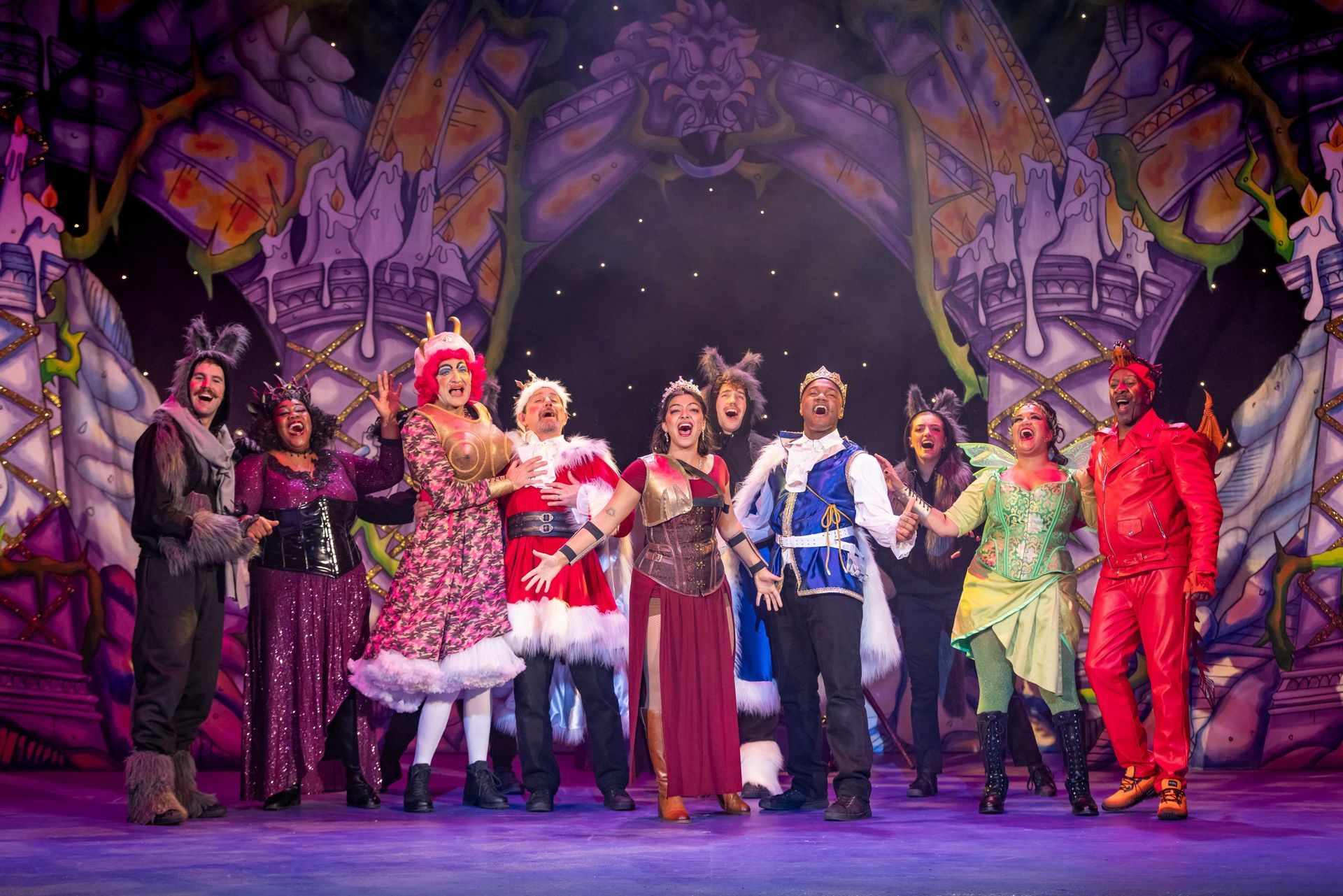
REVIEW: SLEEPING BEAUTY at Broadway Theatre, Catford 4 – 31 December

Susan Elkin • 9 December 2024

‘Good in parts’ ★★★

It’s a show with strengths and weaknesses. Susie McKenna (who also directs) provides a sparky, original script which is, in places, genuinely funny – a witty summary of the progress from spinning wheels to Amazon, for example. And if a bird dropping lands on your head and you choose to ignore it you are, of course, undeterred. (Think about it).

Moreover, you don’t go to panto expecting plot twists but there a couple of interesting ones in this show. Why shouldn’t the Prince (Surone Stokes – good) meet monsters in the forest he has to hack down? And of course, in 2024 it makes no sense that the princess (Roshani Abbey – of whom more shortly) will come out of her coma to find a man she’s never seen before and instantly agree to marry him. McKenna’s is cheer-worthy feminist reworking. 

On the other hand, the script is absolutely larded with overtly leftish political digs. I am a Lewisham resident and know that our council is 100% Labour. There is no opposition in this borough, so the panto is playing to local allegiances. Nonetheless, all this preaching/pandering to the converted gets tiresomely wearing.

The show’s strengths include Justin Brett as Dame Nanny Norah which he lays for laughs, obviously, but is never grotesque and there isn’t a single joke about bodily functions which is a welcome change. He has moreover strikingly beautiful diction, isn’t afraid to use RP and good at giving jokes time to settle.

Lisa Davina Phillip has glittering purple stage presence as Carabosse and sings commandingly. The decision for her to speak in a very broad Jamaican accent, however, again might do down well locally but at times it blurs the clarity and audibility. Natasha Lewis is dependable as Willowsnap, the good fairy who eventually has to facilitate the downfall of Carabosse – although here, it’s

about redemption rather than destruction.

Roshani Abbey, though, is the real star of this show. She packs Princess Thalia with feisty confidence and grace and her singing voice is outstanding. I was not surprised to learn afterwards that she trained at Royal Academy of Music.

The five piece band in the pit, directed by Ben Goddard-Young does a fine job too and I don’t think I’ve ever heard a harp (Morwenna Brown) worked into a panto score before. Its effect is delightful.

So it’s generally a pleasing show despite some weak links in the casting.

SLEEPING BEAUTY at Broadway Theatre, Catford 4 – 31 December

Box Office https://www.broadwaytheatre.org.uk/events/sleeping-beauty/

This review was first published by London Pub Theatres Magazine: https://www.londonpubtheatres.com/review-sleeping-beauty-at-broadway-theatre-catford-4-31-december

White Christmas – The Mill at Sonning

Reviewer: Susan Elkin

Music and Lyrics: Irving Berlin

Based on  Paramount Pictures Film written for screen by Norman Krasna, Norman Panama and Melvin Frank

Director: Jonathan O’Boyle

3.5 stars

 White Christmas is an unashamedly sentimental, and potentially dated, show, so it has to be taken on its own terms, which is exactly what Jonathan O’Boyle does in this production featuring 14 pretty talented performers.

It tells the story, of course, of two American servicemen who discover, around Christmas 1944, that they can sing and entertain others. Fast forward 10 years, and they’re a well-established duo featuring on the Ed Sullivan Show. The flimsy and gentle plot which follows takes them to a failing hotel in Vermont, which, by coincidence, is owned by their old General. The idea is to stage a show in his barn, which eventually they do, having meanwhile taken up with a pair of sisters with whom the path of true love wavers a bit, but, obviously, there’s a “happily ever after” ending because that’s part of the cheesiness. There is nothing remotely hard-hitting about White Christmas.

Online movie streaming services

Nonetheless, it’s an energetic production full of impressive tap dancing (impressive choreography by Gary Lloyd) and smiling ensemble numbers danced by supple folk who can repeatedly shoot a leg almost to 180 degrees in their pretty, coordinating costumes designed by Natalie Titchener.

Because this is a show about staging a show, there’s plenty of scope for set pieces. I Love The Piano, developed and orchestrated for this production by MD Jae Alexander, which opens Act 2, is a good example of how this helps to drive the piece – and it’s fun. Another instance, in a different mood, is Gabriella Williams as Betty singing (very well indeed) in a nightclub.

The seven-piece band, which is out of sight in another room, purrs along (exceptionally good bass playing by Matt Hollick) sounding, at times, so vibrant that it could be an orchestra of 20 players, and this is largely down to Jae Alexander’s skilled arrangements.

This mildly soporific show is an ideal Christmas choice for the Mill at Sonning.

Runs until 25 January 2025