Press ESC or click the X to close this window

Idle Women (Susan Elkin reviews)

REVIEW: Idle Women at Bridge House Theatre 15 – 19 October 2024

Susan Elkin • Oct 18, 2024

´Charming songs but too long` ★★★

This show is like an almond fondant in an old-fashioned box of chocolates. It’s very sweet but there’s crisp kernel at the centre of it.

During World War Two, women were hired and trained to take barges, laden with coal or other products through the canals of England because the regular bargemen were conscripted. We hear a lot about land girls but much less about these “barge girls” and it’s a story which deserves to be told.

´Idle Women` is a collaborative venture by members of Busy Lizzies Theatre Company who wrote, composed, directed, produced, designed and choregraphed it. It’s effectively, therefore, a devised piece in which four women are on a coal barge. Edna (Emma Barnes) is in charge assisted by Ginny (Elizabeth Kroon). They are joined by two raw recruits, Meg (Maple Preston-Ellis) and Ruth (Catriona Judt) who, it fairly soon emerges, are a gay couple.

Most of the first half is spent exploring the dynamic between the four of them with some delightful folksy songs accompanied by two guitarists, who also play other instruments, along with a rather charming, muted trumpet which connotes nostalgia. Judt singing a lilting 3|4 quasi-music hall song “We Stroll Through the City” and then bursting into a gravelly jazz number is theatrically effective, for example.

In the second half trumpeter Aaron Coomer (good) morphs into a German soldier, the sole survivor of a shot down aircraft. Injured, he takes refuge on the barge and suddenly the plot feels like Robert Westall’s `The Machine Gunners`. Predictably, all four women are initially terrified but eventually the five of them become friends with clear but supressed “feelings” developing between Alfred and Edna, although she has to hand him over to the authorities as soon as she can.

We are dealing, obviously, with serious issues here. Gay relationships between women are not illegal (they never were) but definitely taboo in the 1940s. Alfred is “the enemy” but they learn that they have more in common with him than they would ever have expected to. Edna has a very “well bred” husband and three evacuated sons but, beneath her patrician (matrician?) authoritative manner is a yearning, vulnerable, lonely, unfulfilled woman valiantly doing her duty. So, we’re made to think about split loyalties, and understandable fears especially as Ruth is Jewish. Thus we crunch on the almond at the heart of the piece.

It’s all quite enjoyable and nicely done but there are issues with this show. Some of the dialogue is spoken too fast and not audible, even in a tiny space such as Bridge House Theatre. And the singing is dramatic (clever, neat words) but not always particularly musical although Barnes is an excellent singer. The harmony is pleasing, however, and as an ensemble they often sound a bit like the folk group, The Watersons.

However, `Idle Women` is far too long at 150 minutes including a short interval. It feels like a show which wants to be a single act piece at 60-80 minutes, and I suspect that’s what it has been at some stage in its development. The second act seems very drawn out. There is no need, for instance, to revisit the status of the gay relationship or read out everybody’s letters from home in song after the despatch of Alfred. It feels like a clumsy bolt on and destroys the narrative shape.

This review was first published by London Pub Theatres Magazine  https://www.londonpubtheatres.com/review-idle-women-at-bridge-house-theatre-15-19-october-2024

Susan’s Bookshelves: Orbital by Samantha Harvey

 Early in 2020 (good timing as it turned out) my son Felix and I went to Texas on holiday, where among other delights, we spent a wonderful day at the NASA centre in Houston. Learning about the unfathomable wonders of space, and human achievement within it, is profoundly moving and there were many lumps in our throats that day. Last month I visited the Science Museum in London with my younger two grandchildren where again, on a smaller scale, I was several times overcome with awe.

And now  here’s Samantha Harvey’s 2023 novel which is shortlisted for this year’s Booker prize and is totally unlike any fiction I’ve ever read before. The setting is the International Space Station which, manned by six people, orbits the earth sixteen times a day. That means (and this had never occurred to me but it’s obvious) a continuously unfolding display of sunrises and sunsets on the earth, which is 250 miles below. If fiction is putting yourself into someone else’s place and imagining what they’re seeing and feeling then this novel is a truly extraordinary example of it.

Aboard the ISS are two Russians, one American, one Brit and one Japanese and one Italian, each on a nine month placement. It’s never clear what language they’re speaking but it’s presumably English as a lingua franca as they go about their tasks – maintaining the vehicle from within and without, servicing the lab mice and the plants, carrying out a strict exercise routine to prevent muscle loss, receiving instructions from the ground crew and receiving and sending emails to and from home where each of them has left a life. They “swim” round the capsule, hooking themselves into hanging sleeping bags at night like bats.

And all the time the profound beauty and wonder of earth is rotating beneath them. In some ways, the novel is a heartfelt hymn of praise to the glory and wonder of our richly coloured planet and a timely reminder that national boundaries and all the hostility they cause are an irrelevance. We just need to take care of our magnificent environment because who knows how long we shall have it for. Harvey’s characters marvel at the countries and continents they pass over – it’s a novel full of geography – and see, but not ruefully, how much of it is illuminated by man-made development.

At the same time,  from earth is launched a new, manned Moon probe which is sending four people to land on the Moon as in 1969. “The lunar astronauts are catapulted  past them in a five-billion-dollar blaze of suited-booted glory”. Each of the characters reflects on childhood memories, families and the strange ambivalence between homesickness and a wish never to be anywhere but in that weightless, quasi-religious isolation.

It’s succinct, poetic, philosophical and breath-taking at every level and has certainly given me an insight into the realities of everyday life on the ISS, where boundaries don’t matter except that, oddly, the Russians have to sleep in a separate compartment. Orbital is a veritable Everest (which you can see from the ISS, apparently)  of imaginative writing since, of course, Samantha Harvey, who lives and works in the UK, has never been an astronaut. It’s an outstanding, probably at present unique, example of just how far good research, and the hotline between a novelist’s mind and a reader’s, can take you. Literally.

Next week on Susan’s Bookshelves: About Uncle by Rebecca Gisler

Piano Concert, The Four B’s, with Robert Taub

Saturday evening 12 th October 2024 at the Levinsky Hall, Plymouth University

A Musica Viva concert

As always Robert Taub began with a lively and informative talk, demonstrating each
point by playing short sections from each work about the choice of programme. The
four Bs of the concert’s title being, in the order of performance, Bach, Bartok,
Beethoven and, after the interval, Brahms. The principal link between the disparate
genius  of these four is the experimental nature of each of the chosen works.
Taub is a charming host and a natural teacher. As a pianist I have always admired
the aura of absolute concentration he builds round himself – that communicates its
intensity to the audience too. And he needed that – all four of these works are
ferociously difficult.

Johann Sebastian Bach’s Chromatic Fantasy and Fugue

Playing Bach, Taub makes each of the separate voices of the piece sing. I have
always admired his left-hand work especially: it is balanced and clear, especially
important with this composer as the hands appear to compete at first but then weave
a harmonious melody. There were dramatic changes of tempo in this fantasy. It is the
nature of fantasies to be playful with pace, balance and structure. The pace was
often very fast indeed and then leavened by contrasting moments of seemingly
thoughtful hesitation. The last moment of this fantasy stays in the memory, ending
with a lovely slow resolved chord held for a long moment before breaking into the
fugue section.

Of course Bach was a master of the fugue form. The balance of the two hands,
which are separate voices, is imperative and was beautifully and evenly executed.
The whole keyboard is used, lending the piece at times a haunting distance as both
hands work at different ends of the keyboard. This is a three-voice fugue, lending
extra richness to the effect. It ends in a memorable run up to the final triumphant
chord.

Bela Bartok, Sonata [1926]

Bartok follows the classical three movement sonata form, with a slow movement
sandwiched between two variations of allegro, the final movement being set at a
cracking pace.

Seemingly Bartok’s work contrasts the preceding Bach, but there is a lot in common
between the two masters. The differences lie in the strongly emphatic discords and
modernist phrasing but this piece is as playful as Bach’s and as daringly
experimental. As in the previous piece Taub’s hands moved around the whole
keyboard. Individual notes were suddenly emphasised and repeated and the whole piece was driven by extraordinary energy. It my not be as easy to listen to as the more familiar classical modes, but the drive of it compels and the sudden melodious phrases charm.

Individual repeated notes appear again in the contrasting slow movement, leading
into slow darker-toned chords. Adding to its thoughtful, sombre mood is the new
minor key in contrast to the first and last movements. There is a simplicity to the end
of phrases, which often end in single next-door notes, taken slowly and dwelt on, as
if an idea is being tentatively worked out. Which it is, as the piece asserts with loud
outbursts that lead into the final movement.

Here the energy of the first movement is recaptured and repeated in staccato notes.
The hands fly apart along the keyboard and back together again, each time with witty
variations as the music turns into a folk melody and Taub’s hands mimic the
stamping of the dancers.

Ludwig van Beethoven, Sonata in A-flat major, Op.110

Composed towards the end of his life, this piece shows the composer pushing the
form of the sonata in experimental ways. Once again, the entire
keyboard is used, delighting in the range and variety of which this instrument is
capable. It is in total contrast to Bartok, or so it seems, with its clear melodies and its
more familiar intervals and yet it isn’t. This movement is full of little threads of
melody, followed by runs up and down, snippets of chromatics, thoughtful pauses, as
if the composer is testing himself, seeking to break out of the mould.

The first movement resolves beautifully before moving straight into the slow
movement, full of repeated and sometimes long-sustained notes that feed into
melodious, often single-note phrases. From here we move seamlessly into the final
fugue, with its separated hands suggesting question-and-answer, its
swooping between bass and treble and its steady pace so that we can savour the
precision of each hand’s individuality. Some of the themes of the first movement are
echoed and the movement becomes meditative, using single separated notes and
chords that grow louder and fade away to turn back into fugue mode, with more
variations. These work up to a fast crescendo, full of echoes of past motifs from the
rest of the work.

Johannes Brahms, Variations on a Theme by Paganini, Op.35, Books I and 2

The piece begins with the well-known Paganini tune, embellished by extra flourishes,
which moves quickly into a series of variations. These begin by playing recognisably
with that opening theme but quickly spin away into more and more fantastical
versions of the melody, until each new tune becomes a playful re-invention of the
starting-point.

It is extraordinary how many inventions Brahms could find. There are melodic ones,
tricksy jokey ones, some very short, some fast, some slow, all leading to a repeat of
the main Paganini tune. This ends the first Book, but in the second which follows on
immediately, Brahms discovers even more variations he can play with. In this second
set lovely melodies abound. There are more jokey ones and some where the time
signatures of the right and left hand are different. One has both hands in unison,
another has them in contrary motion. They get more and more delightfully
outrageous! Some variations deconstruct the previous one but in the end, with a
mighty flourish, the triumphant end arrives.

How the audience – quite rightly – cheered and gave Robert Taub a standing ovation,
in response  to which he finished with a pretty Scriabin Nocturne as an encore.
Congratulations to Taub for a challenging and thought-provoking programme. These
composers may seem far apart in style and content but these particular pieces share
particular motifs: chromatics, fugues, drama, playfulness, use of the entire range of
the piano and above all a daring experimentation.

Maidstone Symphony Orchestra

Mote Hall, Maidstone Leisure Centre

Conductor: Brian Wright

Pianist: Ariel Lanyi

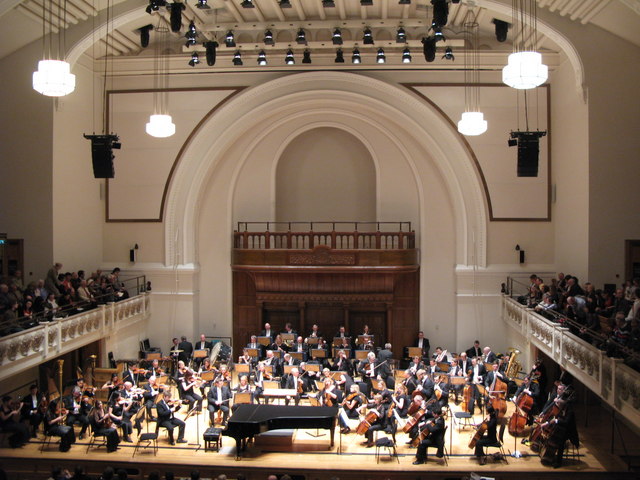
This concert was a neat chronological programme starting with Brahms (1880) and ending with Prokofief (1944) taking in Rachmaninov (1927) on the way. Much of the work was dauntingly challenging so it made an impressive opening to the 2024/5 season.

It took a few bars for Academic Festival Overture to cohere properly but thereafter it was a pleasing performance. The big brass melody was very slow but the off-beat passages surged along. And all those frantic string scale passages down the final page were delivered with commendable clarity as the brass belted out Gaudeamus Igitur.

There are, of course, some beautiful passages in Rachmaninov’s fourth piano concerto, played here with stunning sensitivity by Ariel Lanyi but in general it lacks the easy appeal of the composer’s other three. For me – I am mildly synaesthetic – anything in G Minor is slate blue and the piano and horn duet work in the first movement was definitely just that, with Lanyi catching every mood. He gave us a schmultzy solo introduction to the Largo and Wright ensured that the muted, legato string work picked that up. And then it was seamlessly but dramatically (nice cymbal work) into the Allegro. Lanyi is certainly an electrifying player to watch: there are thousands of notes in many rhythms and moods in the last movent but he nailed them with panache.

Telling the audience that he thought it was time for something calmer, Lanyi then played Chopin’s Nocturne in C sharp minor for his encore and it was delivered with great delicacy. You could see and feel (but not hear, thank goodness) him breathing the music so it flowed with elegant warmth.

There is certainly plenty for everyone to do in Prokofief’s fifth symphony, the scoring for which includes five percussionists plus timps, double brass, piano and harp. It’s not the most familiar of Prokofeif’s symphonies and it was clearly a new challenge for many of the players. I could sense careful counting amongst the furrowed brows. But it came off resoundingly well. Highlights included  fine underpinning from trombone and bass drum in the heavy statements in the first movement and the lightness achieved by the whole orchestra in the Allegro marcato. I also admired the compelling rhythms sustained by piano and tuba and the dynamic contrasts in the Adagio and the lovely playing of the clarinet melody in the final movement.  And excellent work from all those accomplished percussionists made the whole work feel pretty exciting.

Miss Julie

August Strindberg

Directed by Jon Fentiman

East London Theatre Company

Courtyard Theatre


Star rating: 4


Directors, adapters and translators are inclined to pull Strindberg’s 1888 play in all directions in order to make it “topical” and I’ve seem all sorts of whacky versions. This account of it places it firmly in late nineteenth century Sweden and allows the play to declare its timelessness without gimmickry. It is, after all, a visceral presentation of the power struggle between a man and two women, which is as relevant now as it was 140 years ago.

There’s an authentic in-period, big house kitchen in the Courtyard’s quite spacious in-the-round (seating on all four sides) space in which we first see Kristin (Lia Goresh) working diligently until Jean (Chris Agha) her charismatic, plausible, ambitious, pragmatic fellow servant – and paramour –  bursts in at the beginning of the play. Then Miss Julie, the daughter of the house (Maria Naterstad) arrives, apparently shallow, ruthlessly flirtatious, manipulative but vulnerable.

These three actors are skilfully directed to work intelligently together. Naterstad finds exactly the right level of confusion as she ricochets from being a troubled young women who wants a man to take charge of her life, and give her a purpose, to an imperious daughter of the landed gentry who expects servants to do as they’re told. She does playfulness, anguish, horror (especially at that awful, richly symbolic, moment in act two when Jean decides that she doesn’t need her tame finch), distress and sexual longing with real conviction. Why wasn’t I surprised to learn that she’s an East 15 graduate?

And Agha’s performance is splendid as he prowls round the space, saying anything to get what (he thinks) he wants from these two women. His voice, incidentally is richly edgy too – he sounds like a moderately educated, but bright servant who definitely comes from a different background from Miss Julie. Call it “estuary”, perhaps. It’s a perfect choice for this role. His heartbreak at the end of the play is devastatingly effective.

Lia Goresh’s role is smaller but she presents, as she must, an excellent contrast to Miss Julie. She makes Kristen into a moral compass at the heart of the play, sensible, firm but also desperately hurt as she sees her future slipping away.

Miss Julie was banned (good old Lord Chamberlain) in Britain for 50 years because it breaks through class barriers, and “worse”, presents graphic sex between Miss Julie and Jean – although the encounter is off stage. This version makes that coition as clear as possible by having a dishevelled Miss Julie come back on stage clutching her blood stained linen which she eventually puts in a receptacle where Kristen later finds it. It’s neatly done and succeeds it making the encounter feel sordidly transactional.

This is a worthy and thoughtful production of a fine play: well worth catching.  And, incidentally, this was my first visit to Courtyard Theatre. Now that I know where it is, I’ll be back.


Princess and the Hustler

Chinonyerem Odimba

Directed by Sara Amanda & Lande Belo

Tower Theatre

Star rating: 3

Chinonyerem Odimba’s 2019 play sets a family story of tentative reconciliation at the time of the 1963 Bus Boycott in Bristol. The Bristol Bus Company’s refusal to employ “coloureds” triggered a four month boycott which led to a climbdown and the first black bus conductor on a Bristol Bus. It influenced the  first race relations legislation which came  two years later.

Mavis (Ebony Skerritt), a first generation immigrant from Jamaica, has raised two children on her own having been abandoned by her husband, Wendell (Steven Burrell) who now reappears with another daughter, Lorna (Lakeisha Louise)

The first half of the play focuses on the complexity of these relationships. Mavis’s ten year old daughter, Phyllis or “Princess” (Hannah Morgan-Johnson) is delighted to have a sister. Her almost grown up son “Junior” (Aaron Mante) resents the intrusion and soon gets involved in demonstrations in the city, to his mother’s horror.

Meanwhile there’s Margot (Lucy Moss) Mavis’s friend upstairs, the only white character in the play, who represents the face of quietly pernicious, casual racism which all the others have to deal with continually.

The second half of the play is tighter although the ending is clumsily drawn out with, among other things a dramatically superfluous recitation of the names of black women who have triumphed against prejudice.

Skerritt and Burrell are both fine actors who play off each other well but they are working far too hard with their accents. Of course these people would have had strong Jamaican accents, in a way that their children born in Britain wouldn’t and that is well observed. On the other hand, this is a drama and if clarity gets lost in the voice work then it falls at the first hurdle. I missed at least a third of what Skerrit and Burrell said, especially in the first half.

Moss – whose character is tarty and forthright but vulnerable and lonely – adopts a forced, rather unconvincing Bristolian accent. She too is overworking it  and sounds, I’m afraid, irritatingly like Pam Ayres when she’s hamming it up. It is, however, clearly enough delivered and Moss makes this rather sad woman pretty convincing. The warmth and love is amongst the other characters. It’s Margot, ultimately, who’s the outsider.

Morgan Johnson finds plenty of childlike glee, temper and distress in Princess who is having to deal with prejudice at school but whose dream is to become a beauty princess. Louise creates a different sort of child in Lorna, distressed, torn and trying to make the best of things.

And there’s a fine performance from Mante who presents, initially, a school boy disobeying his angry mother and then develops his character into a brooding, troubled young man, passionate about the bus boycott and longing for the status quo to be restored at home. He gazes meaningfully into the distance, reacts tellingly to what others are saying and speaks with rich conviction.

The 1960s clothes (costume design by Laura Coulton) are delightful. Mavis appears in several very pretty, flattering outfits and I wore a dress almost exactly like Margot’s pink one, short length with flared sleeves, to my 21st birthday party. The ambience is spot on.

Conductor: Edward Gardner

Thoughtful programming by the London Philharmonic Orchestra brings together three works written in different countries within 32 years of each other in the first half of the 20th century. Moreover, to an extent they were all the product of political tension, anxiety and anguish.

Benjamin Britten’s Sinfonia da Requiem (1940) reflects his pacifism and disquiet about the escalating war. Commissioned by the Japanese government and then rejected, it was first performed in New York in 1941. In this performance, conductor Edward Gardner brings out the grief of the first movement and ensures that muted trumpets and xylophone sound as sinister as they should in the second. And the way he lets the 3|4 rhythms just die away at the end is very moving.


Patricia Kopatchinskaja arrives on stage barefoot, wearing a strange cover-all lacy dress, eccentrically holding her  violin and music aloft as she walks through the orchestra to play the very challenging Shostakovich A minor concerto (1948). Music on stand and eyes glued to it, she starts the rather subdued, brooding opening Nocturne, which expresses, one assumes, some of the composer’s worries about working in Stalinist Russia. As the piece continues, she becomes more and more animated, almost animalistic, hunched fiercely over her instrument, leaping up and down and, at one point, almost colliding with Gardner on the podium.

She is intensely dramatic to watch. It’s very unusual to see a performer actually out of breath as she is at the end of the second movement and she is evidently exhausted at the end. Her sound, though, is terrific, with impressive dynamic range and a pretty spectacular cadenza, during which Gardner neatly turns the page of her music.

And so, after the interval, to the glories of Sibelius’s 5th symphony (1915), probably the best known and loved of his seven. The orchestra has now reduced forces: we don’t need all that percussion or harps, tuba and keyboard players for this work. Familiar as the piece is, Gardner takes the first movement at a speed which makes it sound fresh and never allows it to become maudlin or sentimental.

High spots include the brass fanfares, bassoon solo and the strings’ incisive “knitting” in the first movement. The Andante gives us nicely nuanced dynamic and tempo changes. And Gardner more than catches the grandiosity of the final movement in which the main motif is rising thirds, played and developed across the texture. And excitement builds clearly as we head through the rich mellifluous melody towards the six climactic chords at the end.

Reviewed on 4 October 2024

This review was first published by The Reviews Hub:https://www.thereviewshub.com/patricia-kopatchinskaja-plays-shostakovich-southbank-centre-london/

I recently a few happy days staying with a friend in Cornwall. A former teaching colleague, she is a drama specialist who, like me, became a professional writer when she left teaching. She has written many hugely successful resources for schools and is a published novelist. As you can imagine, she and I never stop talking from the moment we get up until the minute we say goodnight. I probably have more in common with her than with anyone else I know. We know the same plays, read the same books and listen to the same music.

Anyway, knowing she’d be intrigued, I told her about the 5* (in my opinion) production of Our Country’s Good which I had just reviewed at Lyric Hammersmith and took her the programme because I knew she’d be as familiar with the play as I am with my back garden. That led to her asking if I’d read Kate Grenville’s The Secret River (2005) because it is about the penal colony in Sydney, the birth of “westernised” Australia, and the repression of native Australians so there’s some overlap. I hadn’t. So she gave me her copy.

It’s beautifully researched, raw and heartbreaking. William Thornhill is a lighterman on the Thames. He comes from a very poor family but gets a break as an apprentice and marries the boss’s daughter which is a strong love match. Then a mistake leads to arrest for theft and a death sentence which is, at the last minute, commuted to deportation. Sal goes with him and their second child is born at sea. Because she is a free woman, Will is assigned to her as her servant once they reach Sydney so they can live in relative, if impoverished, freedom and start an inn business in their makeshift hut.

Sal is counting the days, months and years before they can return to London but Will yearns for something of his own – and land is nearby and available cheaply. Except that it isn’t because it is already occupied by people who’ve been there for millennia living quietly and competently in communities, catching the occasional kangaroo by enticing it into new plant growth and then expertly spearing it.

The main focus in this novel is the clash between the two groups and it’s utterly heart-breaking. It’s presented from the point of view of the white settlers, with their understandable but – to us in the 21st century – unjustified sense of entitlement. They are terrified of the “blacks”, their spears, shameless nakedness and what looks to them like insolence. Grenville, however, makes sure that we can also see exactly what these native Australians are seeing and thinking and makes the reader long for someone to start breaking down the cultural barriers and finding ways for the two groups to communicate. There’s a wonderful moment when Dick, one of the Thornhill children, is spotted in the river playing naked with the black children. But of course, his mother calls him in. Neither of the Thornhills are bad people. They just want the best for their children and there’s a huge gulf caused, by language, culture, custom and, of course, the obvious point that invaders are never going to be welcome anywhere. And that’s what these emancipists were. On the other hand, it’s a huge country and there was probably room for both communities to live peacefully side by side but it would have needed empathy and a recognition that of course  black people have rights too but here we are 200 years later still having to say it.

Some of the brutality in The Secret River is so appalling that it made the soles of my feet go clammy – my personal physical reaction to anything really shocking. And of course, we all know that the invaders got their way in the end and Australia developed as a British Colony. Whether it remains in the British Commonwealth or not, it is always going to be a “Westernised” country in which, tragically, the indigenous Australians are marginalised. You can compensate and offer sanctuaries and repatriation schemes but you can’t rewrite history.

Read this telling novel and reflect.

Next week on Susan’s Bookshelves: Orbital by Samantha Harvey