Press ESC or click the X to close this window

Prom concert – September 11 2025 (Susan Elkin reviews)

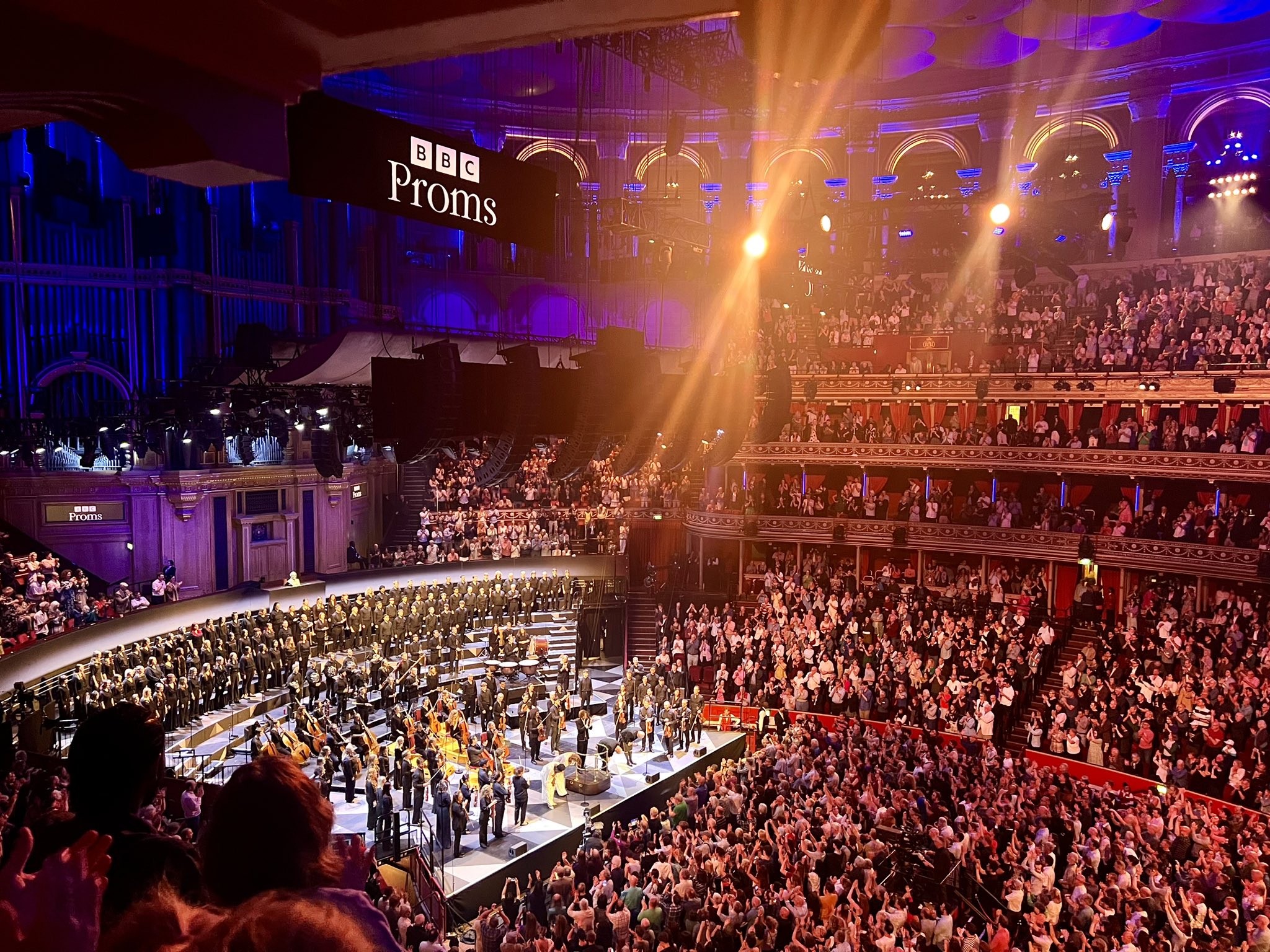
National Youth Choir

BBC Scottish Symphony Orchestra

Conductor: Ilan Volkov

Soloists: Jess Dandy and Ashley Riches

Royal Albert Hall


It was worth my nightmarish journey across London, gridlocked by the tube strike, to hear the National Youth Choir in Stravinsky’s Requiem Canticles. The quality and musical nuance of their sound (chorus-master Nicholas Chalmers) had me on the edge of my seat from the first note of “Exaudi”. It, like the rhythmic speaking in “Dies irae” (a Stravinsk-ian homage to Verdi), resonated electrically in the Albert Hall’s rich acoustic.

Then in the same work came Jess Dandy singing Lacrimosa. We are so used, these days to hearing mezzos, that it’s a real treat to hear a “proper” contralto, her voice so cavernous that it sounds almost like a man at times. The female equivalent of a counter-tenor, perhaps? The sound is very attractive and Dandy’s Lacrimosa was profoundly moving.

It must have been a pleasure for Volkov to conduct these young people. He’s one of those unassuming but effective conductors who smiles a lot as he works. It is also, incidentally, very encouraging to see much more diversity across the group than one normally sees in adult choirs.

Each half of this unusually programmed concert opened with a short piece by Gabrieli reworked by Bruno Maderna in the 1960s and 70s. In excelsiis and Canzone a tre cori are both choral pieces arranged here for full orchestra including two harps and tubular bells. Happily, though, Maderna was no Baroque-murdering Leopold Stokowski and I admired the retention of the early 17th century ambience in the delicate orchestration. And Volkov is very good at balancing the wind, particularly the brass, with the strings.

And so to the familiar sunny uplands of Brahms Symphony No 2 in D Major in which Volkov brought out delightful detail I’ve hardly noticed before – and I have played this symphony.  There was delicacy which showcased the work of lower strings in the first movement with admirable precision in the off-beat pizzicato at its end. I admired the balance and enjoyed the bassoon line in the Adagio and the highlighted contast between the “busyness” and lyricism of the Allegretto. Then Volkov gave us lots of the requisite “spirito” in the final movement. Moreover, he achieved phenomenal speed at the end – bravo trumpets! – without ever losing crispness.

At the end of the concert, after the applause, Volkov, unexpectedly, used the podium to make a resolute statement condemning the war his native Israel is waging on Gaza. Of course, there was some mild hostility both to the substance of what he said and to what some regarded as “abuse” of position. For myself, I support him in principle. You cannot divorce music from politics. Both are existential.

Patience

WS Gilbert and Arthur Sullivan

Directed by John Savournin

Charles Court Opera Company

Wilton’s Music Hall

Star rating: 5

I grew up with big scale G&S featuring big choruses and full orchestras. I still sometimes see these operas done that way courtesy of say, ENO or one of the few amateur companies still devoted to this wonderful material. But every time I see Charles Court Opera Company in action I realise that I have actually come to prefer chamber versions, I love the clarity of sound that a good cast of nine can produce under David Eaton’s musical direction from stage left piano. And director John Savournin knows exactly how to use every inch of the stepped stage at Wiltons to maximum comic and visual effect.

Arguably Patience has worn less well than Gilbert’s other satires because few 21st century audience members are au fait with absurdity of the late nineteenth century aesthetic movement . So the challenge is to bring out its innate funniness which this production does – in spades. It reinevents milkmaid Patience as a barmaid and the setting is a pub. The original “twenty lovesick maidens” become “melancholic maidens” which scans seamlessly (and alliteratively!) into the music and makes sense because they are now a well-sozzled, frustrated  trio, not a crowd.

Catrine Kirkman is woefully, wistfully hilarious as the elderly Lady Jane (“Silvered is the Raven Hair” beautifully sung). Meriel Cunningham as Lady Angela oozes stage presence and Jennie Jacobs in turquoise tights with matching plait tips adds gleeful gloom.

Matthew Kellett always delivers. His Bunthorne hops about in silly attitudes, curly hair flopping about and pale face ridiculously serious. And Matthew Silviter, who has a much bigger build, provides a rich contrast as rival poet Grosvenor.

Patience herself has to be a striking contrast to all this posturing and Catriona Hewitson nails it perfectly – all common sense and plimsolls with her warm Scottish accent. And like everyone else in this accomplished cast she sings with passion, accuracy and verve,

High spots in this delightful production include the big double chorus in Act 1 when the women are counterpointed against the men, a device Sullivan claimed to have invented. Whether he did or not, it’s unfailingly effective here. And the anthem in Act 2 (another Sullivan trademark) is impeccably sung as a sextet with characters carefully positioned to sing without stage business – which is exactly how it should be done.

This show is a revival of a production which I’ve seen before but it was a pleasure to revisit it because it simply goes on giving. And if, at the performance I saw, there was a moment of raggedness in the final chorus, most people won’t have noticed it.


How to Date

Stephanie McNeil

Directed by Isabel Steuble-Johnson

Jack Studio, part of SEFest 2025


Star rating: 3.5


It’s good to see this rather uplifting play revived after its three performances at Collective Theatre earlier this year.

It tells the story of two rather different young women in their early twenties trying to pick their way through work and social life in London. It’s about friendship, relationships, insecurity, ambition – and danger. The darkly lit opening scene presents Helin Ekin’s distraught character, Clarissa, being given the all clear after a chlamydia test but told that she’s in the early stages of pregnancy. She is horrified and immediately demands an abortion, thus setting the scene for a piece which is often funny while making it clear that this isn’t all about laughter. Structurally it flashes back to Clarissa’s early friendship with Emily (Stephanie McNeil, who also wrote the play) and then moves towards the unwanted pregnancy at about the half way point.

I really liked the naturalistic dialogue as Emily, who’s done a drama degree and dreams of starring on Netflix, works in a coffee shop and jauntily serves pretend drinks to front row audience members. Clarissa, meanwhile, a trained accountant, loses her internship by being too sassy at work and turns to drink, one-night stands and casual jobs – her self esteem at rock bottom.

Both women are strong actors but an especial word of praise to Danny Jeffs and Seyi Ogunniyi, who between them, play all the men who pass through the women’s lives at work or in clubs and pubs. Jeffs has a richly versatile range of voices and attitudes whether he’s the chauvinist of whom Clarissa falls foul at work or the fellow barista who chums up with Emily. Ogunniyi gives us Emily’s wettish but decent boyfriend and then morphs into Clarrissa’s anything-but-decent Rushane,  somehow creating an illusion of being twice the size with mere body language. Bravo for character acting! Both men adeptly play a whole string of other roles too.

Isabel Steuble-Johnson’s direction makes good use of the Jack’s limited playing space with Clarissa’s messy room, evoked by a bench, a throw or two and a lot of mess at stage right. The set (designed by Isabella Sarmiento Abadia) also uses a 1970’s tea trolley positioned stage left which variously, and rather neatly, connotes the coffee shop, club bars and drinks at home.

At its heart this is an entertaining, compelling, play about young women finding the confidence to live the independent lives they want to without being unhealthily dependent on relationships with men for self-validation. It’s a worthwhile message.


I devour detective fiction for characterisation and geography. Who could not fall for Richard Osman’s Thursday Murder Club quartet? On the page they’re utterly compelling although it’s a pity about the film. Then there’s Simon Mason’s wonderful DI Ryan whose small boy is the most engaging child I’ve met in fiction for a long time. Elly Griffith hits every chord with forensic archeologist Ruth Galloway with the joys of the mysterious Norfolk marshes thrown in. I read Will Dean’s “Tuva” novels for icy North Sweden, Alexandra McClean for glorious Dorset (many childhood memories for me), William Shaw for the familiarity of Kent and Peter James for Brighton, where I have family and  know the city well. And there are many other examples. Only Martin Walker disappoints. I love the Dordogne setting but vegetarian me is nauseated by the graphic hunting/shooting.fishing/cooking digressions.

Detective fiction plots are always implausible. That’s part of the deal. We suspend disbelief – very willingly in my case. It’s places and people that win the day

I was thinking about all this the other day when I heard Ann Cleeves talking to Michael Berkley on Radio 3’s Private Passions. I had read one or two of her Vera books but otherwise didn’t know her work. She explained in the interview how she’d discovered Shetland and met her late husband there on an ecology project. Then, having written with modest success for a long time, she thought of setting a detective story in Shetland. Raven Black was published in 2003. “It changed my life” she told Berkley. Since then there have been seven more books and a hugely successful BBC TV series starring, Douglas Henshall, which I’ve not watched –  but might now. Series 10 airs this year.

It sounded just the ticket after sixteen days with Joseph Stalin (https://susanelkin.co.uk/articles/susans-bookshelves-stalin-the-court-of-the-red-tsar-by-simon-sebag-montefiore/)  and I was entranced by the idea of the Shetland background. So I ordered Raven Black and met the gently charismatic but troubled Detective Inspector Jimmy Perez who comes from Fair Isle. He is regarded as an outsider by the inhabitants of fictional Ravenswick, a small island where everyone knows everyone else’s business. Families are intermarried and there are connections everywhere. Then a sassy, bright teenager named Catherine with an uneasy home life, is found murdered. Everyone connects it with the disappearance of a child, Catriona, who disappeared eight years earlier. Most people  suspect an elderly man named Magnus Tait who has mental health problems and mild learning difficulties. It’s too obvious though and the reader can see from the start that this can’t be the solution no matter how suspicious it seems. I really liked the way Cleeves sets up a whole range of interesting characters, each with issues and flaws and then finally comes up with something which I certainly didn’t see coming.

Also in the mix are the beaches, the icy winter weather, the empty roads, the big skies and the traditions.  Mendelssohn’s atmospheric Hebrides overture (inspired by a different archipelago away to the south west but not geographically dissimilar) kept rattling round my head all the time I was reading. Yes, I shall continue with this series. I want more Jimmy Perez. He deserves to find a more settled personal life and if that means the unlikely prospect of many murders in small communities then so be it.

Next week on Susan’s Bookshelves: Nye by Tim Price


Writer: Elena Mazzon

Director: Colin Watkeys

A quirky, imaginative solo show lasting just 60 minutes, Popess takes us to 13th-century Milan to explore a bit of not-very-well-known church history. And it does it, wearing the learning lightly, with witty 21st-century linguistic anachronisms, and some quite searching audience involvement.

Guglielma of Bohemia came to be an object of worship for people from all walks of life who believed her to be the incarnation of the Holy Spirit. She appointed Maifreda as “Popess” to continue her work after her death, distributing the eucharist and saying mass. It was, in effect, a feminist revolt against the patriarchy of the church until, inevitably, the Inquisition suppressed it.

Elena Mazzon’s main narrative role is as Maifreda, who arrives at the beginning singing a blessing and making the sign of the cross at audience members. She’s good at voice work and also gives us a convincing account of her teenage friend, and nuns and priests who put her down in childhood.

Audience members are required to reveal what causes they’d die for, among other serious questions. Later, they have to learn an anthem and sing it at a service, as well as becoming victims of the Inquisition.

Mazzon is a pleasing actor with eyes that she uses eloquently, and her beatific smile feels very appropriate. Her performance is understated but strong. Clad in a robe she grabs from the wall tied over a belly which a member of the audience is asked to help her with, she becomes a deceptively avuncular inquisitor who finally decides to burn a couple of people as an example. How dare people question the authority of the church or imagine that women can ever be the equals of men?

On the other hand, there are some nice jokes. It doesn’t take much imagination to see the brick-lined, damp-smelling basement performance space of The Glitch as a torture chamber. The inquisitor informs his heretics that all the toilets are gender-neutral – just a bucket at the back.  And Maifreda’s friend describes a boy she fancies as “fit”.

Runs until 8 September 2025

The Reviews Hub Star Rating: 3.5

70%

70%

Gently subversive

This review was first published by The Reviews Hub

It Never Rains

Wendy Fisher

Directed by Ralph Bogard

SE Fest 2025, Bridge House Theatre, Penge


Star rating 3.5


Wendy Fisher’s taut new play presents three generation of women within a pretty dysfunctional family. Each has more issues than you can shake a stick at. They struggle to communicate with each other or even to be honest with themselves.

Sarah (Jill Stanford) is just home from a holiday in Spain where her husband  has died in the unprecedented heat. Climate change is a theme in this play, which is set firmly in the present, but it isn’t properly developed. Her daughter Anne (Cathy Conneff) arrives to announce that her husband has met someone else and thrown her out penniless. She needs, therefore to stay with her mother for a while although there have clearly always been tension between them. Then Anne’s daughter Mags (Rosa French) who is already married with twin boys turns up and seems, for a while, to be the voice of commonsense until her life too becomes disrupted. They are, as Sarah comments ruefully, “three fuck-ups”.

The situation doesn’t however quite make sense. Anne says she is in her forties and yet she has been married for 30 years. So how old is Mags? Are we too assume that all three of these women were teenage brides? They don’t quite seem the type. It’s not clear.

The tight dialogue which often has ironic undertones pounds along as the three women fall out, become temporarily reconciled, play one off against the other and, gradually uncover or reveal long guarded secrets. There is laughter, angst and anger, the rhythms of which are quite nicely paced.

Stanford seems wooden at the beginning but gradually warms into the role with passion and venom. Her character is a pretty difficult woman. Conneff’s Anne is an inadequate non-coper and she gets the vulnerability combined with an irritating sense of entitlement convincingly. French is strong as the youngest of the three presenting a breezy, no-nonsense young wife and mother, impatient with the irrational behaviour of her mother and grandmother, But it doesn’t last. She is of her generation and wants better than she’s got which leads to weeping, tears and determination to “take her chance.”

I rather liked Farah Ishaq’s video effects which include a window though which, eventually, we experience a thunder storm. The significance of the bathroom and the showers at the end was, however, lost on me.

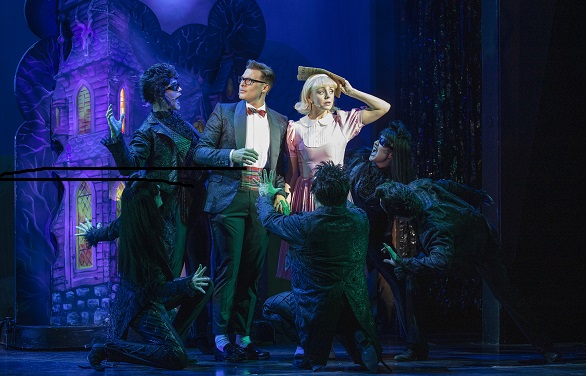
Rocky Horror Show

Richard O’Brien

Directed by Christopher Luscombe

Fairfield Halls, Croydon 


Star rating: 3.5


It’s a strange feeling to be at a Cult Musical when you are not, definitely not, part of the cult. Although this show began to gestate in 1973 (at the Royal Court) I had never seen it before. Today it seems to attract hordes of adoring fans in extravagant 1970s/80s costumes who know the entire show, words and music, by heart. And they’re not quiet about it.

An elaborate spoof on 1970s horror and sci-fi movies, the piece is framed by a pink-clad usherette (Laura Bird – cheerfully flirtatious) to create a cinematic ambience. Thereafter we’re in a “film” in which newly engaged Janet (Haley Flahertry) and Brad (James Bisp) end up at a gothic castle full of weirdos because their car has broken down. Lots of very slick choreography (Nathan M Wright)  and loud music (MD Adam Smith) drives the fast-paced piece through its Frankenstein-like plot, complete with sexual discovery, to a theatrically spectacular finale with flashing lights and masses of smoke.

A fine performance from Stephen Webb as Frank N Furter sits at the heart of the production. As the dastardly, manipulative inventor he purrs, cajoles, seduces, sings well and commands the stage. And he’s supported by exceptionally energetic ensemble work especially Ryan Carter-Wilson as Riff Raff and Daisy Steere as Columbia. And Morgan Jackson is athletically muscled and convincing as Rocky, the created “man”.

It seems to be a Rocky Horror tradition that well versed fans chip in throughout the show. It’s more like pantomime than anything else I’m familiar with although the humour is outrageously “adult”.  At the performance I saw two men in drag, who moved to the front row in the second half, had a well practised, clearly audible comment for almost everything said on stage. And Nathan Caton, as narrator is very good at running with the spontaneous comedy. It’s brash, often ribald and sometimes funny as the show pounds on. Caton makes eye contact and times his gestures and ripostes with consummate ease.

Behind the noise and Cultish ambience of this production there’s a five piece band doing a fine job with a demanding score. Bravo to them all.

Seeing this show was a bit like going sailing or sampling crème de menthe. I’m glad I did it – once – but shall not be repeating the experience. Each to her own.

Act 4, Scene 1 of Julius Caesar is one of the most nonchalantly shocking interchanges Shakespeare ever wrote. It presents victorious Mark Antony casually organising a purge which includes his nephew and Lepidus’s brother. I thought about that scene many times as I read, in horror, this scrupulously detailed account of Stalin’s life. The parallels are chilling.  Yet Julius Caesar pre-dates Stalin’s birth by over three hundred years. The timeless truth, of course, is that absolute power corrupts absolutely, as Lord Acton observed in 1887. Stalin consciously modelled himself on Ivan the Terrible.

Sebag Montefiore’s book was first published in 2003, a time when relations with Russia were relatively relaxed. British people casually visited Moscow and Petersburg to see museums and enjoy Russian culture. It meant Montefiore could interview the descendants of the huge cast of characters he writes about and  crucially, he was granted access to archives which had never been open before. It is not clear whether he is fluent in Russian or whether he travels with an interpreter. Writing such a biography would, obviously, be impossible now, given the present situation.  It’s fascinating, however to notice the ways in which history has repeated itself in the last 22 years.

Ioseb Besarionis dze Jughashvili, who came from humble Georgian stock, adopted the name Stalin when he became Lenin’s successor. He wanted a name which sounded similar. A heartless murdering, heartless monster soon emerged. Sebag Montefiore never leaves us in any doubt about that.

Nonetheless Stalin was a more complex, rounded character than popular history sometimes suggests, For example, he was an avid reader, had a huge library and loved writers such as Dickens. He had perfect pitch and sang so well that his friends thought he could have become a professional musician. As Sebag Montefiore comments wryly, it might have changed the course of 20th century European if Stalin had gone down that route. Moreover, capricious and unpredictable as he was, Stalin was often kind to people, He would send gifts to people whose plight caught his attention and he inspired love in his children, especially his daughter Svetlana.

Most people, however, were terrified of him – with good reason. During the purges of the late 1930s he organised quotas of “traitors” who were to be arrested and shot in the regions. These were people facing, mostly trumped up, charges of treason, and torture procedures which ensured that anyone would confess to anything. One of Stalin’s thugs casually boasted to a frightened father: “So your son wrote Eugene Onegin!”. So “popular” were the purges that the regions became competitive and requested larger quotas.

Sebag Montefiore reckons that about 20 million people were killed during Stalin’s “entire monstrous career” while 28 million were deported. Of this latter group around 18 million slaved in the gulags. There was no regard whatever for the sanctity of human life (although Stalin never stopped grieving for his wife Nadya who took her own life in 1932).  In 1950 when Stalin was cosying up to the Chinese he wrote to Zhou Enlai: “The Northern Koreans could keep on fighting indefinitely because they lose nothing, except for their men.” Sebag Montefiori italicises the last four words. I’ve emboldened them as well.

Arguably Stalin’s Russian forces won the war for the allies and the scenes in which Churchill and Roosevelt meet him are not pretty. These are very famous conferences especially Teheran and Yalta but Sebag Montefiore, who has evidently studied the papers very closely, tells the story freshly. But these appalling facts were new to me:  Two million German women were raped by Russian soldiers as Russian forces penetrated Germany. They even raped women who were newly liberated from Nazi camps. Stalin’s almost unbelievable comment was: “And what is so awful about his [a Soldier] having fun with a woman after such horrors?”

This is the man who also ordered the destruction of the families of Russian men who were taken captive by Germany in the early years of the war. If they allowed themselves to be captured they had surrendered to the enemy and were therefore traitors. Meanwhile, shades of Mark Antony “pricking” (marking) names on his list, Stalin had ordered the arrest of his own daughter-in-law whose three old daughter didn’t then see her mother for two years.

Sebag Montefiore is good on the luxurious lifestyle (food, drink and palaces) of Stalin and his entourage, whose fortunes went up and down like yo-yos. Beria and Molotov, for example were both in hugely powerful positions for a long time but very lucky to hang in there for as long as they did because trust was non-existent. Beria was finally “liquidated” (hideous euphemism) during the jockeying for power after Stalin’s death in 1953.

That death is interesting too. Stalin, aged 74, had not been in good health for a while but still wielded the power fiercely. Then he had a stroke, His minions failed to call a doctor for 12 hours which has long been regarded as a deliberate ploy to hasten his death. Sebag Montefiore points out, however. that Russia’s  best doctors had all been arrested and were, at that point, being interrogated under torture. Stalin loathed doctors and those around him probably feared for their lives because had the sick man recovered and realised doctors had been summoned, murderous fury would have been vented. In the end he died on 05 March, 1953. Sebag Montefiore must have seen medical papers because he has an enormous amount of detail even down to Stalin’s loss of bladder control.

I am a naturally fast reader. Normally I consume two or three books a week. Stalin: the Court of the Red Tsar has 750 pages and took me 16 days partly because I would often be so incredulously horror-struck at the end of a paragraph that I had to go back and read it again so make sure that I hadn’t misunderstood. This is not to say that it isn’t accessibly written because it is. And in places the prose shines. Kirov’s funeral is, for instance, described as “an extravaganza of Bolshevik sentimental kitsch.”

It’s not a comfortable read and “enjoy” certainly isn’t the right word. I am however, very glad indeed to have read this book and recommend it warmly.  I have learned a huge amount. Apart from anything else it helps to explain some of the background to the present war between Russia and Ukraine.

Next week on Susan’s Bookshelves: Raven Black by Ann Cleeves